
Storage unit abandonment is a legal status reached only after a tenant defaults on rent and a facility completes a state-mandated lien enforcement process, not simply when a payment is missed. Most people picture a padlock being cut and belongings auctioned off the moment rent goes unpaid. The reality is far more structured, legally protected, and time-consuming. Platforms like StorageTreasures host thousands of storage auctions annually, yet every single one of those sales follows a strict chain of legal steps required by state law. Understanding how storage units get abandoned matters whether you are a tenant trying to protect your belongings, a landlord managing delinquencies, or a real estate professional evaluating self-storage assets.
How storage units get abandoned: the legal process explained
Abandonment is a legal status triggered by documented default and formal lien enforcement, not by casual nonpayment. A tenant missing one payment does not abandon a unit. What follows is the actual sequence that leads to a unit being legally declared abandoned and sold.
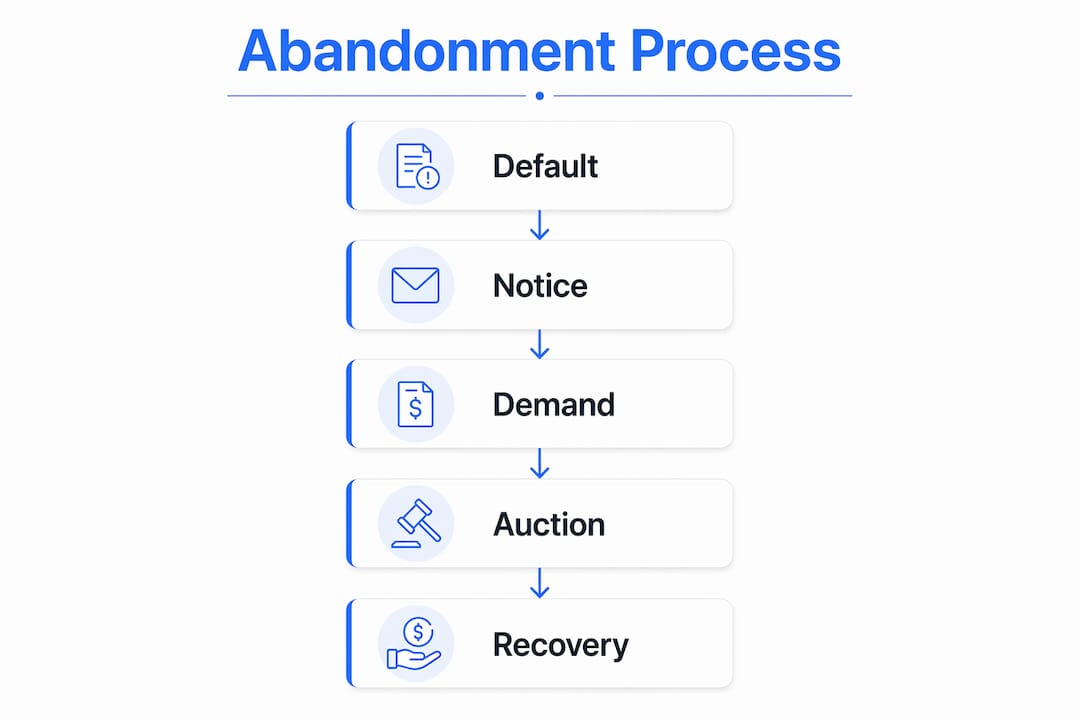
The standard lien enforcement sequence:
-
Missed payment and late fees. The tenant fails to pay rent by the due date. The facility applies late fees per the rental agreement and sends informal reminders by phone, email, or text.
-
Lockout. After a defined grace period, typically 5 to 14 days depending on state law and the rental agreement, the facility overlocks the unit, preventing tenant access.
-
Pre-lien notice. Around 21 to 30 days after default, the facility sends a pre-lien notice by certified mail or email where permitted. This formally warns the tenant that lien enforcement has begun.
-
Formal lien notice. A second, more detailed notice is sent specifying the amount owed, the auction date, and the tenant’s right to pay and reclaim the unit.
-
Public auction advertising. The facility publishes auction notice in a local newspaper or on an approved online platform. State law dictates how many days this notice must run before the sale can proceed.
-
Auction. The unit contents are sold to the highest bidder to recover unpaid rent and fees.
State timelines vary significantly. Florida’s lien laws require a minimum 14-day payment demand after the formal notice is sent, plus a 15-day waiting period after auction notice publication before any sale can occur. Georgia’s process is even longer: the full enforcement timeline runs a minimum of 60 days from default to the earliest possible sale date, accounting for continuous default, payment demand, publication, and mandatory waiting periods.
| State | Minimum timeline from default to auction | Key requirement |
|---|---|---|
| Florida | Approximately 30 to 45 days | 14-day payment demand plus 15-day publication wait |
| Georgia | Minimum 60 days | Continuous default, payment demand, and publication periods |
| Most states | 30 to 90 days | Certified mail notice plus public auction advertising |
One critical nuance: partial payments or accepted payment plans can legally reset the lien clock, forcing the facility to restart the entire notice sequence. This means a tenant who pays even a portion of the balance mid-process may delay auction eligibility by weeks or months. Operators must review both their rental agreement and state statute before accepting any partial payment during active lien enforcement.
Pro Tip: If you are a facility operator, document every step of the lien process with timestamps, certified mail receipts, and email confirmations. A single procedural error can invalidate the entire auction and expose you to a lawsuit.
Why do tenants abandon storage units?
Abandonment is rarely intentional. The most common reasons behind storage unit abandonment are rooted in sudden life disruptions rather than deliberate forfeiture. Understanding these reasons helps both operators and real estate professionals approach delinquency with more effective strategies.
The most frequently cited social and economic reasons include:
-
Divorce or separation. One party may lose track of a jointly rented unit, or neither party wants to claim responsibility for the contents or the bill.
-
Financial hardship. Job loss, medical debt, or sudden income disruption makes rent on a storage unit one of the first expenses cut.
-
Death of the account holder. Heirs may not know the unit exists, or the estate process delays payment long enough to trigger lien enforcement.
-
Sudden relocation. A job transfer, eviction from a primary residence, or family emergency can leave a tenant unable to retrieve belongings or maintain payments.
-
Downsizing and estate sales. Older tenants or families managing a deceased relative’s estate sometimes abandon units containing items they cannot sell, donate, or transport quickly enough.
“Storage unit abandonment often reflects a moment of crisis in someone’s life. The unit becomes the last thing on their mind when everything else is falling apart.” — Self-storage industry observer, CBS12 I-Team investigation
Beyond financial stress, some abandonments involve complications that go far beyond unpaid rent. Abandoned units sometimes contain prohibited or illegal items, requiring facilities to coordinate with law enforcement before proceeding with any auction or cleanout. This adds operational complexity and potential liability that most operators are not prepared for when they first discover the contents.
Communication breakdown is another underappreciated factor. Tenants who move without updating their contact information become unreachable during the notice process. Facilities that rely solely on a single phone number or outdated mailing address may send legally required notices to the wrong location, which both delays enforcement and creates compliance risk.

Pro Tip: Collect multiple contact methods at lease signing, including a secondary emergency contact. This single step reduces the number of tenants who become unreachable during lien enforcement.
How do storage auctions work after abandonment?
Storage auctions sell entire unit contents as-is to the highest bidder, with no item-by-item sales permitted. Buyers typically view the unit from the doorway only, bidding based on what they can see without entering or touching anything. This is the standard practice on platforms like StorageTreasures and at in-person facility auctions.
Key rules governing the auction process:
-
Winning bidders must pay in full immediately, usually by cash or approved payment method.
-
Buyers are required to clear the entire unit within a set period, often 24 to 72 hours after winning.
-
Facilities are legally required to handle any excess proceeds (money beyond the unpaid balance) by holding them for the former tenant for a state-specified period.
-
Personal documents, photographs, and certain items may need to be returned to the former tenant or disposed of according to state law.
| Perspective | What the auction means |
|---|---|
| Facility operator | Cost recovery tool, not a profit center; legal compliance is the primary goal |
| Former tenant | Final opportunity to reclaim belongings is lost once the gavel falls |
| Auction buyer | Buys unknown contents at risk; value is speculative |
| Real estate professional | Auction history signals delinquency rates and operational health of a facility |
Operators view auctions as a last resort, not a revenue strategy. Legal compliance costs, advertising fees, staff time, and unit cleanup expenses frequently exceed the auction proceeds. A unit that sells for $200 at auction may have accumulated $800 in unpaid rent, leaving the facility with a net loss. The auction exists to satisfy legal obligation and clear the unit for a paying tenant, not to generate income.
Auctions must also be conducted in a commercially reasonable manner. Selling to a friend or accepting a suspiciously low bid from a known associate exposes operators to legal and financial risk. Every bid must be legitimate, and the process must be documented thoroughly.
How can tenants, landlords, and real estate professionals prevent abandonment?
Prevention is more cost-effective than enforcement for every party involved. The steps below apply across the full rental lifecycle, from lease signing to delinquency resolution.
-
Collect complete tenant information at move-in. Full name, two phone numbers, a valid email address, and a secondary emergency contact. Update this information annually or at lease renewal.
-
Send automated payment reminders. Property management software like Storable or Yardi Breeze can trigger SMS and email reminders three to five days before rent is due, reducing unintentional late payments significantly.
-
Understand your state’s lien law before you need it. Incorrect notice procedures can invalidate auctions and trigger costly legal disputes. Operators should review their state statute annually and consult a self-storage attorney when procedures are unclear.
-
Offer payment plans early in the delinquency cycle. A tenant who owes two months of rent is far more likely to pay if offered a structured plan before lien enforcement begins. Once the formal process starts, many tenants disengage entirely.
-
Document everything. Every notice, every phone call, every payment received during a delinquency must be logged with dates and delivery confirmation. This documentation is your legal defense if a former tenant disputes the auction.
-
For tenants: read every notice you receive from your storage facility. A certified mail letter from your facility is not junk mail. It is likely a legally required notice with a hard deadline attached. Missing that deadline can mean losing everything in your unit.
Pro Tip: Real estate professionals evaluating self-storage acquisitions should request delinquency reports and auction histories for the past 24 months. High abandonment rates signal poor tenant screening, weak communication systems, or a facility operating in an economically distressed area.
Key takeaways
Storage unit abandonment is a legal outcome of formal lien enforcement, not a consequence of missed rent alone, and every party in the process faces distinct risks, timelines, and responsibilities.
| Point | Details |
|---|---|
| Abandonment requires legal process | A unit is not abandoned until the facility completes state-mandated lien notices and auction steps. |
| State timelines vary widely | Florida requires roughly 30 to 45 days minimum; Georgia requires at least 60 days from default to sale. |
| Life disruptions drive most abandonments | Divorce, financial hardship, death, and sudden relocation are the leading causes behind tenant default. |
| Auctions recover costs, not profits | Facilities use auctions to clear delinquent units and satisfy legal obligation, rarely breaking even. |
| Prevention beats enforcement | Automated reminders, complete tenant records, and early payment plans reduce abandonment rates measurably. |
The part most people get completely wrong about storage abandonment
I have seen the same misconception repeated by tenants, landlords, and even some real estate investors: they believe a storage facility can simply seize and sell a unit the moment rent goes unpaid. That belief is wrong, and it creates problems for everyone involved.
Facilities that rush the process, skip a notice step, or use the wrong delivery method for a legal notice do not just face a delay. They face a lawsuit. I have reviewed situations where an operator accepted a partial payment mid-enforcement without understanding that it reset the entire lien clock. The result was months of additional carrying costs on a delinquent unit and a tenant who had no incentive to pay in full.
The human side of this process also gets ignored in most discussions. Most tenants who end up in lien enforcement are not bad actors. They are people dealing with a divorce, a job loss, or a family member’s death. Operators who treat every delinquency as a confrontation rather than a communication problem tend to have higher abandonment rates and worse auction outcomes. The facilities with the lowest abandonment rates I have observed are the ones that pick up the phone early, offer options, and treat tenants like adults facing a temporary problem.
For real estate professionals, abandonment rates are a facility health metric that deserves the same attention as occupancy and revenue per square foot. A facility with a clean delinquency record and documented lien procedures is a far safer acquisition than one with a history of contested auctions.
— Mike
How Corvane Systems helps storage operators stay ahead of delinquencies

Self-storage operators who understand the legal and human complexity behind unit abandonment still need one more thing: visibility. When potential tenants search for storage facilities online or ask an AI assistant for recommendations, your facility needs to appear in those results. Corvane Systems builds that visibility specifically for storage operators, combining traditional SEO with AI search optimization so your facility surfaces on Google, ChatGPT, Perplexity, and Claude. Beyond search rankings, the AI-optimized content Corvane Systems publishes monthly positions your facility as the authoritative local option, which matters when occupancy depends on being found first. Explore what Corvane Systems can do for your facility’s online presence and long-term occupancy rates.
FAQ
What triggers the legal abandonment of a storage unit?
A storage unit enters the legal abandonment process when a tenant defaults on rent and the facility initiates state-mandated lien enforcement, including formal notices and auction advertising. Missing one payment alone does not constitute abandonment.
How long does the storage unit abandonment process take?
The timeline varies by state but typically ranges from 30 to 90 days. Florida requires a minimum of roughly 30 to 45 days; Georgia requires at least 60 days from the date of default to the earliest possible auction date.
Can a tenant reclaim a storage unit before it is auctioned?
Yes. A tenant can stop the lien process at any point before the auction by paying the full amount owed, including late fees and lien enforcement costs. Once the unit sells at auction, the contents belong to the buyer and cannot be reclaimed.
What happens to money left over after a storage auction?
If auction proceeds exceed the amount owed in unpaid rent and fees, the facility is legally required to hold the excess funds for the former tenant for a period defined by state law. The tenant can claim those funds by contacting the facility.
Why do storage facilities prefer not to auction units?
Auctions are a last resort for operators because legal compliance costs, advertising fees, and cleanup expenses frequently exceed the sale proceeds. Facilities prefer paying tenants in occupied units over the time and cost of lien enforcement.