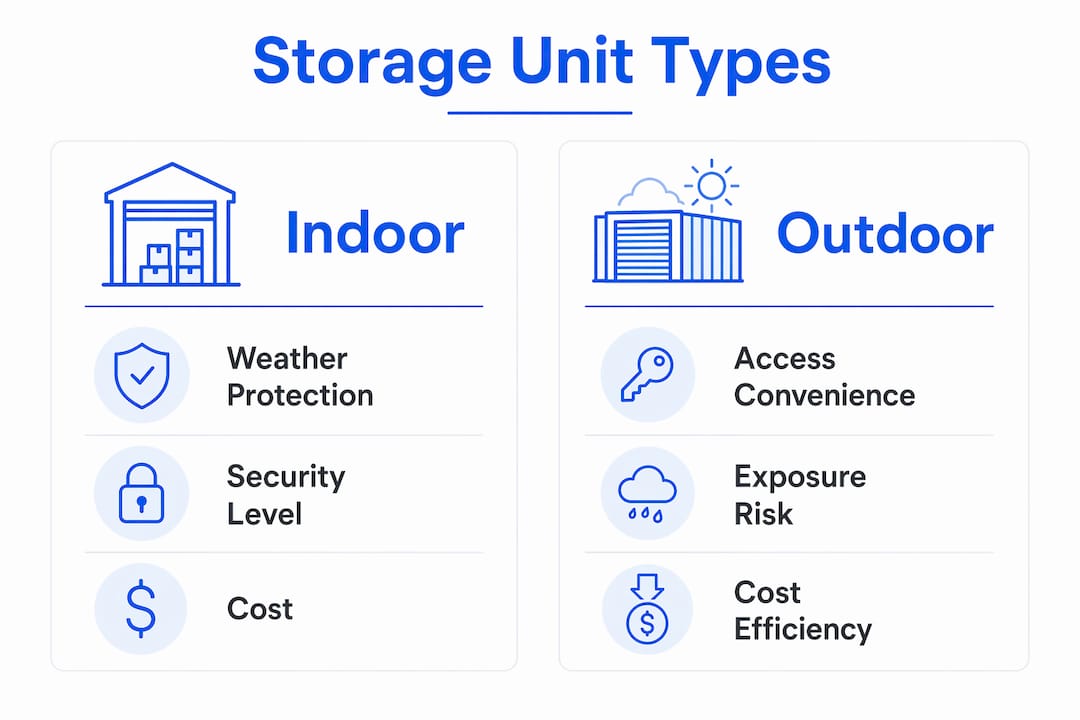
Choosing between indoor and outdoor storage units is a decision defined by three variables: what you're storing, how often you need access, and what you're willing to spend. Indoor self-storage units sit inside climate-managed buildings, offering protection from weather, temperature swings, and humidity. Outdoor units, often called drive-up units in the industry, are accessed directly from outside and typically cost less. When you compare indoor outdoor storage units side by side, the right choice becomes clear once you understand what each type actually protects against and where each one falls short.
What are the main differences between indoor and outdoor storage units?
The physical structure of each unit type drives every other difference. Indoor units are located inside a building, accessed through interior hallways, and typically share walls with other units. Outdoor units open directly to the outside, usually via a roll-up door facing a parking lot or driveway.
Outdoor storage is not a single category. It includes uncovered lots, covered canopy spaces, enclosed exterior-access units, and drive-up units. Each carries a different level of weather exposure, and the term "outdoor storage" can mean something very different from one facility to the next. Always ask the facility to specify exactly what type of outdoor unit you are renting before signing anything.
Environmental protection is where the gap between the two types is widest. Outdoor units face direct exposure to temperature extremes, humidity fluctuations, dust, and pests. Indoor units are recommended for delicate items and long-term storage where environmental swings matter. That recommendation exists because even a non-climate-controlled indoor unit benefits from the building's insulation and reduced airflow compared to an exterior unit.
One distinction worth understanding is the difference between climate-controlled and temperature-controlled indoor storage. True climate-controlled storage regulates both temperature (55 to 85°F) and humidity (30 to 50%). Temperature-controlled units regulate only temperature. That difference matters enormously for wood furniture, electronics, artwork, and paper documents, all of which are damaged by humidity as much as by heat.
| Feature | Indoor storage | Outdoor / drive-up storage |
|---|---|---|
| Weather protection | High (building envelope) | Low to moderate (varies by type) |
| Climate control availability | Yes, often available | Rarely available |
| Security features | Electronic access, cameras, staff proximity | Gate access, cameras, but fewer barriers |
| Drive-up convenience | No | Yes |
| Typical cost | Higher | 20 to 30% lower |
| Best for | Sensitive items, long-term storage | Vehicles, tools, frequent access |
Pro Tip: Ask any facility whether their "outdoor" units are fully enclosed or simply covered by a canopy. A covered canopy reduces sun exposure but does almost nothing to control humidity or prevent blowing rain.
How to assess your storage items to choose between indoor and outdoor units
The single most reliable way to choose a storage type is to categorize your items by their sensitivity to moisture and temperature change. Items that fall into the high-sensitivity category belong in a climate-controlled indoor unit. Everything else can be evaluated based on access needs and budget.
High-sensitivity items include:
- Electronics: Computers, televisions, audio equipment, and cameras are damaged by humidity above 50% and temperatures above 90°F.
- Wood furniture: Warps, cracks, and develops mold when exposed to humidity fluctuations over time.
- Paper documents and photographs: Absorb moisture, yellow, and become brittle without stable humidity control.
- Fabrics and clothing: Attract mold and mildew in damp conditions, especially when stored long-term.
- Musical instruments: Particularly sensitive to both temperature and humidity changes.
Items that generally tolerate outdoor storage include vehicles, motorcycles, boats, landscaping equipment, construction tools, and metal shelving. These items are built for environmental exposure and benefit more from drive-up convenience than from climate protection.
Storage duration changes the calculation significantly. A piece of furniture stored outdoors for two weeks carries minimal risk. The same piece stored for 12 months in a humid climate will likely show damage. Gradual moisture damage is typically excluded from renters and homeowners insurance policies, which means you bear the full cost of any slow deterioration caused by a poor unit choice. That insurance gap makes the unit selection decision more consequential than most renters realize.
Pro Tip: Before packing, photograph high-value items and keep a written inventory. If you ever need to file an insurance claim, documentation of pre-storage condition is the difference between a paid claim and a denied one.
What cost factors should influence your choice between indoor and outdoor storage?
Price is the most visible difference between the two storage types, but the sticker price rarely tells the full story. Outdoor storage costs are typically 20 to 30% less than comparable indoor units. That gap is real and meaningful for budget-conscious renters, but it narrows when you account for the full cost of outdoor storage.
| Cost factor | Indoor storage | Outdoor storage |
|---|---|---|
| Monthly rental rate | Higher baseline | 20 to 30% lower |
| Packing materials | Standard boxes and bins | Moisture barriers, silica gel, heavy-duty bins |
| Insurance premium | Standard | Potentially higher for weather exposure |
| Item replacement risk | Lower | Higher for sensitive items |
| Long-term value | Better for sensitive items | Better for durable items |
Additional packing materials for outdoor storage add up. Heavy-duty plastic bins with locking lids, moisture-absorbing silica gel packets, and waterproof tarps are not optional for anything stored outdoors long-term. These costs can add $50 to $150 upfront per unit, partially offsetting the monthly rental savings.
Insurance is another factor that shifts the math. Some insurance providers charge higher premiums for contents stored in exterior-access units, particularly in regions with extreme weather. Check your policy before assuming your belongings are covered at the same rate regardless of storage type.
Long-term storage in an outdoor unit for climate-sensitive items carries a hidden cost: item replacement. A $200 annual savings on rent means nothing if a $1,500 piece of furniture warps beyond repair. Run the numbers against the replacement value of what you are storing, not just the monthly rate.
How to evaluate access, convenience, and security for indoor vs outdoor units
Access patterns are a stronger driver of unit choice than most renters acknowledge upfront. If you need to load or unload items weekly, drive-up outdoor access is genuinely more practical. You pull your vehicle directly to the unit door, load or unload without navigating hallways or elevators, and leave. That convenience has real value for contractors, small business owners managing inventory, or anyone moving large or heavy items regularly.
Indoor units trade that convenience for protection. Most indoor facilities require you to park in a lot, enter through a main door, and navigate to your unit using hallways, stairs, or elevators. Many facilities provide carts, but the process takes longer. Indoor facilities also sometimes have more restricted access hours than outdoor facilities, though this varies by location.
Security differences between the two types are meaningful:
- Indoor units typically feature electronic gate access, keypad entry to the building, security cameras in hallways, and staff proximity during business hours.
- Indoor storage security includes enhanced barriers and monitoring compared to outdoor units.
- Outdoor units rely primarily on perimeter gate access and cameras, with fewer physical barriers between your unit and the outside world.
- Drive-up units are more visible from public areas, which can increase theft risk at lower-security facilities.
Frequent access to outdoor storage increases cumulative item exposure to weather during loading and unloading. Every time you open an outdoor unit in rain, high humidity, or extreme heat, you introduce those conditions directly to your stored items. Factor that cumulative exposure into your risk assessment, especially for anything stored longer than three months.
How to prepare and pack your items effectively for either storage type
Packing correctly reduces risk in both storage types, but the stakes are higher for outdoor units. Follow these steps regardless of which unit type you choose, then add the outdoor-specific steps if applicable.
- Clean everything before packing. Dirt, food residue, and organic material attract pests and accelerate mold growth. Wipe down furniture, appliances, and tools before they go into storage.
- Use sturdy, uniform boxes. Uniform sizing allows stable stacking, which reduces the risk of collapse and maximizes space. Plastic bins with locking lids outperform cardboard for anything stored longer than 60 days.
- Leave air gaps between items and walls. Airflow reduces moisture buildup. Pushing items flush against the unit walls, especially in outdoor units, traps humidity and accelerates deterioration.
- Avoid shrink-wrapping furniture directly. Shrink wrap traps moisture against surfaces, causing damage that builds unnoticed over weeks or months. Use moving blankets or breathable fabric covers instead.
- Add moisture control for outdoor units. Place silica gel packets inside boxes and bins, use moisture-absorbing products on the unit floor, and raise items off the ground on pallets or shelving to prevent floor moisture absorption.
- Create a written inventory. List every item, its condition, and its approximate value. Store a copy digitally and one physically outside the unit. This practice supports insurance claims and helps you track what you have without making unnecessary trips.
Pro Tip: For outdoor units in humid climates, place a small hygrometer inside the unit and check it periodically. If humidity consistently exceeds 60%, add more moisture-absorbing products or reconsider whether the items belong in an indoor unit instead.
For businesses storing inventory or equipment at drive-up facilities, proper organization and labeling also reduces time spent searching for specific items, which matters when access efficiency affects daily operations.
Key takeaways
The best storage unit choice is determined by item sensitivity, storage duration, access frequency, and total cost including packing materials and insurance, not by monthly rental rate alone.
| Point | Details |
|---|---|
| Item sensitivity drives the decision | Electronics, wood, fabric, and paper require climate-controlled indoor storage to prevent moisture damage. |
| Outdoor costs less upfront, not always overall | Outdoor units cost 20 to 30% less monthly, but packing materials and insurance can close that gap. |
| Climate control means both temperature and humidity | True climate control regulates humidity (30 to 50%) alongside temperature; temperature-only units do not fully protect sensitive items. |
| Insurance gaps favor careful unit selection | Gradual moisture and mold damage is typically excluded from renters insurance, making the right unit choice a financial decision. |
| Access frequency affects cumulative risk | Frequent visits to outdoor units increase total weather exposure; weigh convenience against long-term item protection. |
What I've learned from watching people get this decision wrong
Most people who regret their storage choice made the same mistake: they optimized for the monthly rate and ignored the duration. A $40 monthly savings sounds reasonable until you open a unit 18 months later to find warped furniture, rusted tools, or mildewed clothing. I've seen this pattern repeatedly, and it almost always involves someone who underestimated how long they would actually need the unit.
The second most common mistake is treating "outdoor storage" as a single category. A fully enclosed exterior-access unit in a dry climate is a very different product from an uncovered lot space in a coastal city. The label is the same; the protection is not. Always ask the facility to describe the unit's construction, not just its access type.
My honest recommendation for anyone storing items for more than six months: split your load if you can. Put climate-sensitive items in an indoor unit and durable items in a cheaper outdoor unit. The combined cost is often lower than putting everything in a premium indoor unit, and the protection is better matched to what each item actually needs.
Climate control's value also depends heavily on where you live. In Phoenix or Houston, the temperature and humidity swings between seasons are severe enough that climate control is worth paying for on almost anything. In San Diego or Seattle, the calculus is different. Regional weather patterns should be part of your decision, not an afterthought.
— Mike
How Corvane Systems helps storage facilities get found by renters like you
If you operate a self-storage facility, the renters reading this article are exactly the customers you need to reach. They are actively comparing options, ready to make a decision, and searching online and through AI tools to find the right facility.
Corvane Systems builds search and AI visibility specifically for self-storage operators. When someone asks ChatGPT, Perplexity, or Google's AI Overview which storage facility to use in your city, Corvane's work is what puts your facility in that answer. The service covers technical SEO, local search positioning, and AI-optimized content published monthly, all at a flat monthly rate with no contracts. If your facility is not showing up where renters are searching, Corvane Systems is built to fix that.
FAQ
What is the main difference between indoor and outdoor storage units?
Indoor storage units are located inside a building and offer better weather protection, security, and access to climate control. Outdoor units, also called drive-up units, are accessed directly from outside and cost 20 to 30% less but expose items to greater environmental risk.
Is climate-controlled storage worth the extra cost?
Climate-controlled storage is worth the cost for electronics, wood furniture, paper documents, fabrics, and anything stored longer than six months. True climate control regulates both temperature and humidity, which prevents the moisture damage that standard temperature-only units do not address.
Does renters insurance cover items damaged in outdoor storage?
Renters and homeowners insurance typically covers sudden events like fire or theft but excludes gradual moisture or mold damage. This exclusion applies regardless of storage type, making correct unit selection and proper packing critical for protecting stored items.
How do I know if an outdoor storage unit is safe for my items?
Ask the facility whether the unit is fully enclosed, covered by a canopy, or an open lot. Fully enclosed exterior-access units offer significantly more protection than canopy or open-lot spaces. For any outdoor unit, use plastic bins with lids, silica gel packets, and raised flooring to reduce moisture exposure.
Can I use both indoor and outdoor storage at the same time?
Yes, and splitting items between both types is often the most cost-efficient approach. Store climate-sensitive items in an indoor unit and durable items like vehicles or tools in a less expensive outdoor unit. The combined cost frequently comes in below renting a single large premium indoor unit.