
Self storage operators who ignore AI-powered search platforms are losing up to 40% of potential search traffic. That is not a projection for some distant future. It is happening right now, as renters skip Google and go straight to ChatGPT, Perplexity AI, and Google AI Overviews to ask where they should store their belongings. If your facility does not appear in those answers, there is no page two to fall back on.
AI search optimization, also called Generative Engine Optimization (GEO), is the practice of structuring your facility's digital presence so that AI-powered platforms can understand, trust, and recommend your business. It goes beyond ranking for keywords. The goal is to become the source AI engines cite when someone asks a conversational question like "What size storage unit do I need for a two-bedroom apartment?" or "Is there climate-controlled storage near downtown Austin?"
What this requires in practice:
- Answer-first content that directly addresses real customer questions
- Schema markup (LocalBusiness, FAQPage) that helps AI parse your pages
- Consistent Name, Address, Phone (NAP) data across every directory and platform
- A fully complete and regularly updated Google Business Profile (GBP)
- Steady, detailed reviews across Google, Yelp, and industry platforms
- Structured summaries and bullet points that language models can extract and quote.
Operators who act now hold a real advantage. AI systems build trust over time, and facilities that get cited early tend to stay cited. The window is still open, but it will not stay that way.
How AI search optimization shapes your storage business's visibility
Search behavior has shifted faster than most storage operators realize. Google AI Overviews appear on roughly 16% of queries, and platforms like ChatGPT, Perplexity AI, and Gemini are now genuine traffic sources. Any SEO program that does not account for the AI layer is working with an incomplete strategy.
Traditional SEO focused on ranking links. GEO is about becoming the answer. When a renter asks an AI assistant for storage options near them, the platform does not return a list of blue links. It synthesizes information from sources it trusts and delivers a short recommendation with a reason. Generic marketing copy ("clean, safe, affordable storage") gets ignored. Concrete, structured, factual content gets cited.

The practical difference for your facility is significant. Self-storage operators who publish specific, well-structured content are getting cited in Google AI Overviews for competitive local search terms, often within days of publishing, compared to weeks or months for traditional organic rankings. That speed advantage compounds: AI systems that have cited your content before are more likely to cite it again.
Building a content strategy that AI engines actually cite
The most common content mistake storage operators make is writing for themselves instead of their renters. A page titled "Why Choose Us?" answers nothing a renter is actually asking. A page that answers "Do you prorate rent if I move out early?" or "What fits in a 10x10 unit?" tells AI platforms that your site is a reliable source.
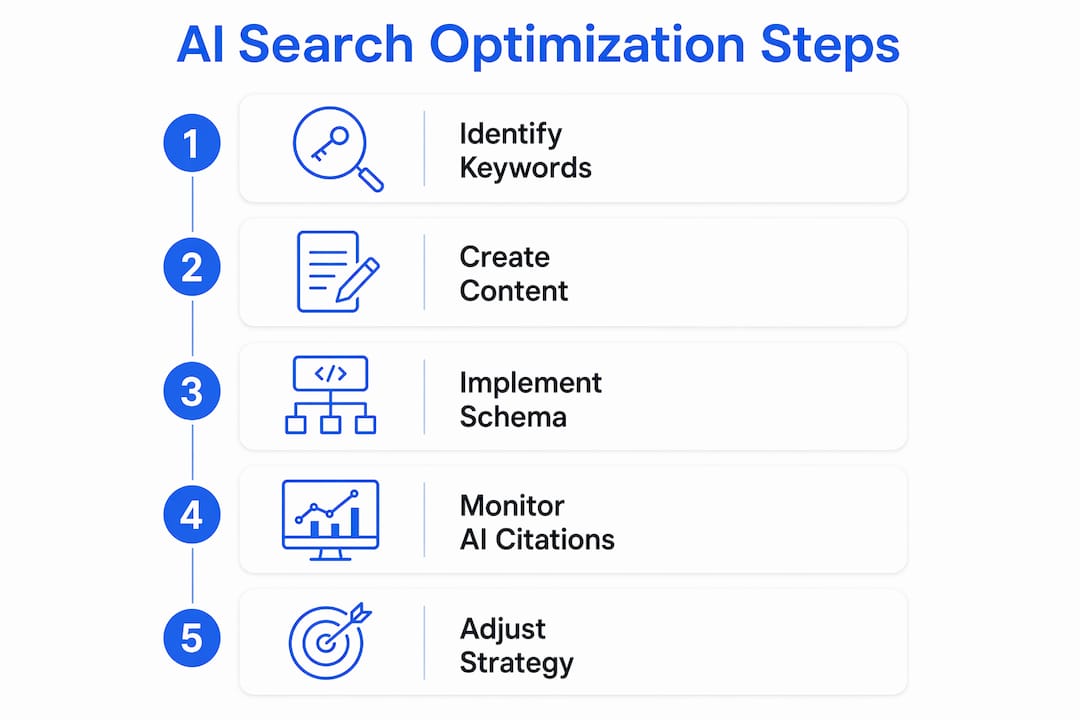
Start by listing the questions your staff fields every single day. Those are your content priorities. Each question deserves its own clear answer, written in plain language, with the response in the first paragraph. Depth matters, but so does directness. An AI engine scanning your FAQ page is looking for a clean question-and-answer structure it can extract and quote.
Key content priorities for storage sites targeting AI visibility:
- Build a dedicated FAQ page using real customer questions, not marketing prompts
- Apply FAQPage schema markup so AI engines can extract structured answers
- Write city-specific pages that include nearby landmarks, neighborhoods, and local context
- Publish at least one useful, original page per week rather than batches of thin posts
- Add a short three-bullet executive summary at the top of each article or guide
- Include pricing information, unit size guides, and access policy details in plain text
Pro Tip: Avoid vague questions like "Why is storage important?" on your FAQ page. Instead, answer "What happens if I miss a payment?" or "Can I access my unit after hours?" Those are the questions renters type into ChatGPT before they call you.
Publishing localized, original content with structured formatting increases citations across AI platforms within weeks. That timeline is far shorter than traditional SEO, which is why content quality and structure matter so much right now.
What technical SEO looks like for a storage site in the AI era
Your website's technical foundation determines whether AI engines can read, trust, and recommend your facility. The most common technical failure is inconsistent NAP data. If your business name appears as "ABC Storage" on your website, "ABC Self Storage LLC" on Google Business Profile, and "ABC Storage & Moving" on Yelp, AI systems flag that inconsistency as a trust problem and may exclude you from recommendations entirely.

Beyond NAP consistency, page speed and mobile usability directly affect both user experience and search rankings. A site that loads slowly on a phone loses customers and rankings in equal measure. Google's own guidance confirms that crawlability, indexing, and usability are foundational to appearing in search results at all.
| Technical element | Why it matters for AI and GEO |
|---|---|
| Consistent NAP data | AI engines cross-reference your name, address, and phone across sources; mismatches reduce trust |
| LocalBusiness schema | Identifies your facility as a physical business with verifiable location data |
| FAQPage schema | Signals structured Q&A content that AI can extract and cite directly |
| Page speed (under 3 seconds) | Affects rankings and user behavior signals that AI engines weigh |
| Mobile optimization | Most storage searches happen on phones; poor mobile UX suppresses visibility |
| XML sitemap and Search Console | Ensures Google and Bing can discover and index all your key pages |
| HTTPS and clean URL structure | Basic trust signals that AI platforms expect from credible sources |
Technical must-dos for AI and GEO compliance:
- Audit your NAP data across your site footer, GBP, and the top storage directories
- Implement LocalBusiness and FAQPage schema on relevant pages using schema.org standards
- Validate your markup with the Schema Markup Validator to catch errors before they affect rankings
- Compress images and remove unused plugins to hit sub-3-second load times
- Verify your site in Google Search Console and submit an updated sitemap
How backlinks, pricing transparency, and competitor gaps strengthen your rankings
Backlinks from relevant local and industry sources act as endorsements that improve both traditional search rankings and AI-generated recommendations. A link from your local chamber of commerce, a regional moving blog, or a self-storage industry publication carries real weight. Bulk link purchases or links from unrelated directories do the opposite.
Pricing transparency is an underused SEO signal in the storage industry. When your site clearly lists unit sizes, monthly rates, and any fees, AI engines can surface that information in direct answers to pricing questions. Renters asking "How much does a 10x10 storage unit cost in Phoenix?" are more likely to find and trust a facility that answers that question on its own website than one that says "call for pricing."
Competitor analysis does not require naming your competitors. Look at which content gaps exist in your market. Which questions are renters asking that no local facility answers well? Which unit sizes or access policies are poorly explained across your area? Those gaps are your content opportunities.
- Audit your backlink profile using Google Search Console or a tool like Ahrefs to identify and disavow spammy links
- Pursue links from local business associations, moving companies, real estate agents, and storage industry publications
- List your facility on authoritative directories: Google, Yelp, the Better Business Bureau, and storage-specific platforms
- Publish transparent pricing pages with unit dimensions, monthly costs, and any promotional rates
- Identify content gaps in your local market and fill them with specific, well-structured pages
Pro Tip: One high-quality backlink from a local news site or real estate blog is worth more than fifty links from generic directories. Focus on relevance and authority, not volume.
Which AI platforms to target and which tools help you track them
The AI platforms that matter most for storage operators right now are ChatGPT, Perplexity AI, Google AI Overviews, and Bing Copilot. Each behaves differently. Google AI Overviews pulls heavily from your GBP and structured on-site content. Perplexity often leans on Yelp and third-party review sources. ChatGPT draws from a broader web of citations, including forums, directories, and published articles.
AI engines use sentiment and recent, detailed reviews from multiple platforms as signals to include businesses in conversational search results. A facility with a steady flow of specific, recent reviews across Google and Yelp is more likely to surface in AI answers than one with a large but stale review count.
| AI platform | Primary trust signals | Key optimization action |
|---|---|---|
| Google AI Overviews | GBP completeness, on-site schema, local content | Keep GBP current; add FAQPage schema |
| ChatGPT | Web citations, directories, published articles | Build backlinks; publish citable content |
| Perplexity AI | Yelp, third-party reviews, structured web content | Maintain active Yelp profile; earn detailed reviews |
| Bing Copilot | Bing Places, on-site content, local citations | Claim and complete your Bing Places listing |
Top AI platforms to monitor and optimize for:
- Google AI Overviews: appears on a growing share of local queries and pulls directly from GBP
- ChatGPT: used by renters for direct recommendations; rewards citable, structured content
- Perplexity AI: heavy reliance on third-party review platforms and authoritative web sources
- Bing Copilot: powered by Bing's index; requires a complete Bing Places listing alongside GBP
Pro Tip: Run a monthly AI presence audit by typing your target queries into ChatGPT, Perplexity AI, and Google AI Overviews. Note which facilities appear and what content those platforms cite. That tells you exactly where your gaps are.
Tools like Birdeye Search AI let you track citations, monitor sentiment, and audit how your facility appears across major AI engines at scale. For operators managing a single location, Google Search Console combined with manual AI prompt testing covers the basics without added cost. Platforms built for AI-optimized content can also help structure your pages so language models recognize and extract your answers more reliably.
How to keep your Google Business Profile working for AI local search
A fully complete Google Business Profile is the single highest-return free action a storage operator can take for local AI visibility. AI platforms treat your GBP as a primary source for your business information. An incomplete profile, one missing hours, photos, or recent activity, signals to AI systems that the business may not be reliable or currently operating.
Local SEO improvements through GBP begin showing results within a few weeks, making it the fastest-returning action in your entire digital strategy. Full SEO and GEO programs take 3–6 months to reach full impact, but your GBP is where you start.
GBP checklist for AI local search:
- Verify your business and confirm your NAP data matches your website footer exactly
- Add current hours, including holiday hours, and update them whenever they change
- Upload at least 10 recent, high-quality photos of your facility, units, and access points
- Write a complete business description that includes your unit types, access hours, and location context
- Add all relevant categories (Self-Storage Facility, Moving and Storage Service, etc.)
- Post updates at least twice per month to signal an active, current business
- Respond to every review, positive and negative, within 48 hours
Encouraging reviews requires a system, not a one-time ask. A short text message sent after a renter moves in or out, asking for honest feedback, generates a steady review flow. Review velocity matters to AI platforms. A facility with 10 new reviews in the past month outperforms one with 200 reviews and nothing recent.
A complete, regularly updated Google Business Profile is one of the clearest trust signals available to AI search engines, and it costs nothing. If you only do one thing to improve your AI discoverability, update your GBP.
Why combining traditional SEO and GEO builds a durable competitive position
Traditional SEO and GEO are not competing approaches. They reinforce each other. Traditional SEO builds the technical foundation: crawlable pages, indexed content, keyword-relevant metadata, and backlinks. GEO layers on top of that foundation by structuring content so AI engines can parse, cite, and recommend your facility in conversational answers.
The shift from SEO to GEO is a shift in goal. Traditional SEO aims to rank a page. GEO aims to become a cited authoritative source. That distinction changes how you write content, how you structure pages, and how you build your reputation across the web. A facility that ranks well on Google but has no structured content, no schema, and no external mentions will not appear in AI-generated answers.
Key practices to align traditional SEO and GEO:
- Maintain keyword-optimized metadata and title tags for traditional search while adding structured summaries for AI
- Use schema.org markup to bridge human-readable content and machine-readable signals
- Build social proof through reviews, forum mentions, and community engagement, not just on-site content
- Publish original, locally specific data that other sites and AI engines can cite
- Track both traditional keyword rankings and AI citation frequency as separate but related metrics
Corvanesystems works exclusively with self-storage operators, combining technical SEO, local search positioning, and GEO content strategy into a single program. The 2026 operator guide covers how facilities are applying these methods to capture AI-driven traffic in competitive local markets.
How to monitor AI search as it keeps changing
AI search is not a static target. Google updates AI Overviews frequently. ChatGPT and Perplexity add new data sources and change how they weight reviews, citations, and content structure. A strategy that works in January may need adjustment by April.
Monthly monitoring is the minimum. Run your key customer queries through ChatGPT, Perplexity AI, Google AI Overviews, and Bing Copilot each month. Record which facilities appear, what content those platforms cite, and whether your facility is included. That data tells you where to focus next.
Track these metrics alongside traditional SEO reporting:
- AI citation frequency: how often your facility appears in AI-generated answers for target queries
- Review velocity: new reviews per month across Google, Yelp, and storage-specific platforms
- GBP engagement: profile views, direction requests, and call clicks from your GBP listing
- Organic traffic from AI referrals: sessions arriving from AI platforms, tracked in Google Analytics 4
- Keyword rankings: traditional rank tracking for your core local and unit-type queries
Treat GEO like an ongoing experiment. When a content format or schema addition drives better AI visibility, apply it across all your key pages. When a competitor appears in AI answers for a query you should own, analyze what they have that you do not and close that gap.
How AI-driven behavior analysis improves your storage website's UX
User experience signals feed directly into both traditional search rankings and AI platform trust. Google's ranking systems weigh usability as a core factor, and AI engines increasingly reflect the same behavior patterns. A storage website that loads slowly, buries pricing behind a contact form, or makes it hard to find unit availability on a phone is losing renters before they ever call.
AI-driven behavior analysis tools like Google Analytics 4 and Google Search Console surface exactly where renters drop off. High exit rates on a unit-size page suggest the content is not answering the question. Low click-through rates on a city page suggest the title or meta description is not matching what renters are searching for. These signals are fixable once you can see them.
Prioritize these UX improvements for storage sites:
- Place unit sizes, pricing, and availability information above the fold on every relevant page
- Make your phone number and online reservation button visible on every page, especially on mobile
- Reduce page load time by compressing images and eliminating unnecessary scripts
- Structure your navigation so renters can find unit types, pricing, and location details in two clicks or fewer
- Add a clear, specific page title and meta description to every page so AI engines and renters know what to expect
The storage website guide from Corvanesystems covers how to structure a storage site specifically for AI search discoverability, including page architecture, content hierarchy, and technical requirements.
How voice search changes the way renters find your facility
Voice search queries are longer and more conversational than typed searches. A renter typing into Google might search "climate storage Austin TX." The same renter using Siri or Google Assistant asks "Where can I find climate-controlled storage near downtown Austin?" Your content needs to answer both.
The practical fix is writing content that mirrors natural speech. FAQ pages are particularly effective here because they already follow a question-and-answer format. A question like "Do you offer drive-up access units?" written in plain language on your FAQ page matches the exact phrasing a renter might speak into their phone.
Voice search optimization priorities for storage operators:
- Write FAQ answers in complete sentences that directly answer the question as spoken
- Include conversational phrases like "near me," "close to," and neighborhood names in your location pages
- Target long-tail queries that match how renters actually speak, not just how they type
- Ensure your GBP hours and address are current, since voice assistants pull directly from GBP for "near me" queries
- Add a "How to get here" section on your location pages with landmarks and cross-streets
Advanced local SEO tactics that put nearby renters in front of your facility
Local SEO for storage operators has moved well beyond claiming a GBP listing. AI-powered local search now factors in review sentiment, citation consistency, content relevance, and how recently your digital presence has been updated. Facilities that treat local SEO as a one-time setup are losing ground to operators who treat it as an ongoing program.
City-based keyword targeting is one of the highest-return local tactics available. A dedicated page for each city or neighborhood you serve, written with specific local context, performs far better than a single generic "locations" page. Include nearby landmarks, major employers, apartment complexes, and moving routes. That local specificity is exactly what AI engines look for when deciding which facility to recommend to a renter in that area.
Advanced local SEO actions for storage operators:
- Build individual city and neighborhood pages with locally specific content, not duplicated templates
- List your facility on storage-specific directories and keep those listings current and consistent
- Seed answers on local forums and community platforms like Nextdoor and Reddit where renters ask for storage recommendations
- Use Google Posts to publish timely updates, promotions, and facility news directly on your GBP
- Monitor and respond to questions in the GBP Q&A section, since AI engines read those answers as content
- Earn citations from local news outlets, real estate agents, and relocation services that serve your market
Ready to get your facility into AI search results?
Corvanesystems is built specifically for self-storage operators who want to compete in both traditional and AI-powered search. The program covers technical SEO, local search positioning, GEO content, AI visibility audits, and performance tracking, all at a flat monthly rate with no contracts and no minimums.
If your facility is not appearing in ChatGPT, Perplexity AI, or Google AI Overviews when renters search for storage in your market, that is a solvable problem. See how Corvanesystems works and get a clear picture of where your facility stands today.
Key Takeaways
Self storage operators who combine traditional SEO with GEO and keep their Google Business Profile current are best positioned to capture AI-driven search traffic in 2026.
| Point | Details |
|---|---|
| AI traffic loss is real | Ignoring AI platforms costs storage operators up to 40% of potential search traffic. |
| GBP is your fastest win | Local SEO improvements through Google Business Profile begin showing results within 4–8 weeks. |
| Schema markup is required | FAQPage and LocalBusiness schema help AI engines extract and cite your content directly. |
| NAP consistency builds AI trust | Mismatched name, address, or phone data across directories causes AI systems to exclude your facility. |
| GEO and SEO reinforce each other | Structured, answer-first content earns both traditional rankings and AI citations simultaneously. |