
AI visibility for self storage means your facility appears as a direct recommendation inside AI-generated answers, not just as a blue link in traditional search results. Platforms like ChatGPT, Google Gemini, and Perplexity now answer tenant questions with specific facility names, hours, and pricing pulled from structured web content. Operators who build their digital presence around this reality are pulling far ahead. Facilities using AI-first content strategies achieve around 41.1% AI visibility, nearly triple the next competitor. That gap is the opportunity every independent operator needs to act on now.
How AI-driven platforms change search and discovery for self-storage facilities
Traditional SEO puts your facility on a list. Generative Engine Optimization, or GEO, puts your facility in the answer. That distinction changes everything about how tenants find you.
When someone types "storage near me" into Google, they get ten links. When they ask ChatGPT or Perplexity the same question, they get one or two named facilities with specific details. The AI pulls from structured, plain-text content it can read and trust. Facilities that have not structured their content for AI crawlers simply do not appear.

The shift in search behavior is real and accelerating. Traditional search volumes are declining as AI-generated summaries replace the need to click through multiple links. GEO redefines online visibility by measuring inclusion in AI answers rather than ranking positions. A facility ranked fifth on Google may be the first name an AI recommends if its content is structured correctly.
Here is what separates facilities that show up in AI answers from those that do not:
- Structured plain-text content. AI crawlers read text, not images or JavaScript widgets. Unit sizes, prices, and gate hours must appear as readable text on the page.
- Consistent NAP citations. Name, address, and phone number must match exactly across Google Business Profile, Yelp, and every directory listing.
- Specific, detailed reviews. AI engines weight reviews that mention staff names, unit types, and facility features far more than generic five-star ratings.
- FAQPage and LocalBusiness schema. These markup types tell AI systems exactly what your facility is and what questions it answers.
- Hyperlocal content. References to nearby landmarks, neighborhoods, and local tenant needs signal relevance to AI systems serving local queries.
How to optimize your facility's online presence for AI recommendations
Winning AI visibility is not a one-time fix. It requires building a content foundation that AI systems can read, trust, and cite confidently.
1. Publish plain-text unit details. List every unit size, price, and feature as readable text on your website. AI crawlers cannot read content hidden inside JavaScript widgets or images. A tenant asking an AI about 10x10 climate-controlled units in your city will only find your facility if that information exists as readable text.
2. Build a tenant FAQ section. About 12 common tenant questions drive most inbound interest, covering topics like gate hours, climate control, and prorated rent. Answer each one directly in plain language on your site. Write answers the way a tenant would ask the question out loud.
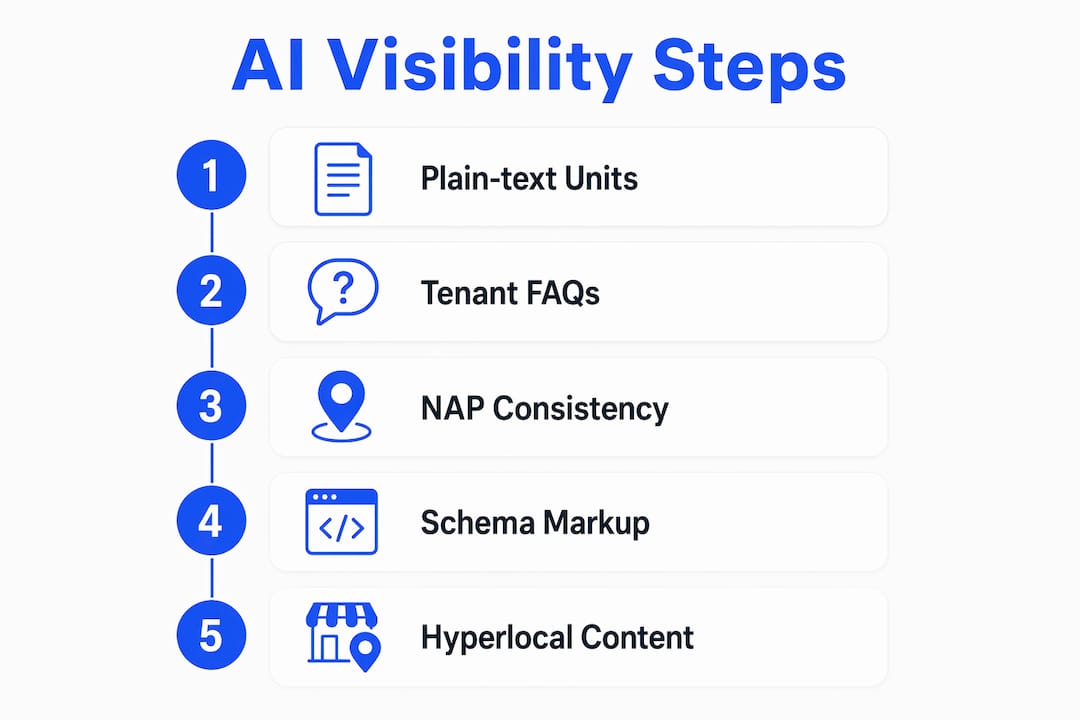
3. Lock down your NAP consistency. Your facility name, address, and phone number must be identical on every platform. GEO demands structured data and citation consistency to appear in AI-generated summaries. One mismatched address across directories creates doubt in AI systems and drops your recommendation rate.
4. Add schema markup. Implement LocalBusiness and FAQPage schema on your website. This tells AI systems your facility type, location, and the questions your content answers. Schema is the clearest signal you can send to an AI crawler.
5. Create hyperlocal content. Write about storage needs specific to your city, neighborhood, and nearby landmarks. Independent operators beat national REITs in AI search because local knowledge and rapid content updates outperform templated corporate pages. A page titled "Storage near Downtown Austin for Small Business Owners" will outrank a generic national template every time.
Pro Tip: Disable JavaScript in your browser and load your own website. Everything you can still read is what AI crawlers see. If your unit prices and sizes disappear, they are invisible to AI.
| Optimization tactic | AI visibility impact |
|---|---|
| Plain-text unit details | High: directly feeds AI answer content |
| NAP citation consistency | High: builds AI trust in facility identity |
| FAQPage schema markup | High: signals answerable content to AI |
| Hyperlocal page content | Medium: improves local query relevance |
| Specific review responses | Medium: reinforces facility credibility |
How operational AI tools improve management and tenant conversion
Getting found by AI is only half the job. Converting that traffic into signed leases requires your website and operations to match the experience tenants expect after an AI interaction.
Traffic from AI platforms converts at about 50% higher rate than traditional search traffic. AI users arrive having already researched their options. They are ready to decide, not browse. A slow website, a missing phone number, or a form-only contact page will lose that tenant immediately.
AI chatbots on your website close that gap. AI-powered chatbots nearly double lead conversion rates when they can take reservations directly, compared to simple message-taking forms. A tenant who just asked Perplexity about your facility and lands on your site expects an instant, conversational response. A chatbot that answers questions and books units in real time matches that expectation.
Beyond customer-facing tools, AI also improves how operators run their facilities day to day:
- Dynamic pricing. AI tools analyze local market data and support pricing adjustments at hourly to monthly intervals based on demand patterns. This keeps your rates competitive without manual monitoring.
- Workflow automation. AI acts as a productivity multiplier by interpreting data and patterns, while automation handles the repetitive tasks. Together they reduce staff workload without reducing service quality.
- Inquiry analysis. AI tools can identify which questions tenants ask most often, letting you update your FAQ content before competitors do.
Pro Tip: A website chatbot that mirrors the conversational style of AI search tools keeps tenants engaged longer and reduces drop-off before booking. Match the tone tenants already experienced when they asked an AI for help.
How do you measure and sustain AI visibility over time?
AI visibility is not a set-and-forget metric. It requires active monitoring and regular content updates to maintain your position as AI systems learn and update their recommendations.
A 90-day AI adoption cycle gives operators a structured path to integrate AI without disrupting daily operations. The first 30 days focus on learning by doing. The second 30 days document the workflows that work. The final 30 days add guardrails and human review processes. This cycle builds repeatable habits rather than one-time fixes.
Tracking your AI presence requires testing across multiple platforms. Search your facility name and key tenant questions in ChatGPT, Perplexity, and Google's AI Overviews regularly. Note which facilities appear and what content those answers pull from. That tells you exactly where your content gaps are.
Key actions to sustain your AI visibility advantage:
- Update FAQs within 48 hours of receiving a new tenant question your site does not answer.
- Audit citation consistency monthly across Google Business Profile, Yelp, and major storage directories.
- Monitor review specificity. Generic reviews carry less AI weight than reviews mentioning unit types, staff names, or specific features. Encourage detailed feedback from satisfied tenants. The best practices for online reviews matter more in AI search than most operators realize.
- Avoid hiding data. Pricing tables inside image carousels, hours buried in PDFs, and unit details locked behind login walls are all invisible to AI crawlers.
- Track keyword rankings and AI mentions together. Traditional rankings and AI mentions do not always move in the same direction. You need both data points to understand your full search presence.
The facilities that sustain AI visibility treat it as an ongoing editorial process, not a technical project with a finish line.
Key Takeaways
AI visibility for self storage requires structured plain-text content, consistent citations, and direct answers to tenant questions so AI platforms can find, trust, and recommend your facility.
| Point | Details |
|---|---|
| GEO beats traditional SEO | AI platforms recommend facilities by name; structured content determines who gets cited. |
| Plain-text content is non-negotiable | Unit details hidden in widgets or images are invisible to AI crawlers and cost you recommendations. |
| NAP consistency builds AI trust | Mismatched name, address, or phone across directories reduces AI confidence in your facility. |
| AI traffic converts higher | Visitors from AI platforms arrive ready to book, making conversion optimization critical. |
| Sustain with 90-day cycles | Regular content updates, FAQ refreshes, and citation audits maintain AI visibility over time. |
What most operators get wrong about AI visibility
The biggest mistake I see operators make is treating AI visibility as a one-time SEO project. They clean up their Google Business Profile, add a few FAQs, and expect the results to hold. AI systems update their recommendations constantly. A facility that ranked well in an AI answer in january may not appear in march if a competitor published better content in between.
The second mistake is underestimating the advantage independent operators already have. Large national storage companies use templated content that AI systems recognize as generic. A single-location operator who writes specifically about their neighborhood, their tenant types, and their actual unit inventory will outperform that template in local AI queries. That is a real, durable edge. The AI recommendations landscape for operators in 2026 confirms this pattern repeatedly.
The third mistake is ignoring the operational side. Getting found by AI means nothing if your website cannot convert the tenant who arrives. A chatbot that books units, a pricing page that loads in plain text, and a FAQ section that answers real questions are all part of the same system. Visibility and conversion have to work together.
The operators who win in AI search are the ones who treat their website as a living document, not a digital brochure. They update it the way a good manager updates a bulletin board: frequently, specifically, and with the tenant's actual questions in mind.
— Mike
How Corvanesystems helps storage operators win AI-driven bookings
Corvanesystems is built specifically for self-storage operators who want their facility to appear where tenants are actually searching in 2026.
Corvanesystems combines traditional SEO with GEO to structure your facility's digital presence so AI platforms like ChatGPT, Perplexity, and Google AI Overviews recognize and recommend you. The service includes AI visibility audits, 30 keyword-optimized articles published monthly, local search positioning, and plain-text content structured for AI crawlers. Pricing is a single flat monthly rate with no contracts and no minimums. If your facility needs a stronger digital foundation, Corvanesystems also builds custom storage websites designed to convert AI-driven traffic into signed leases. Visit Corvanesystems to see how your facility currently scores across AI platforms.
FAQ
What is AI visibility for self storage?
AI visibility for self storage means your facility appears as a named recommendation inside AI-generated answers on platforms like ChatGPT, Perplexity, and Google AI Overviews, rather than just in traditional search link lists.
How does GEO differ from traditional SEO?
GEO, or Generative Engine Optimization, focuses on getting your facility included in AI-generated answers rather than ranked in a list of links. It requires structured plain-text content, schema markup, and consistent citations across directories.
Why does NAP consistency matter for AI search?
AI systems cross-reference your facility's name, address, and phone number across multiple platforms to verify credibility. Inconsistent NAP data creates doubt in AI systems and reduces the likelihood of a recommendation.
How often should I update my FAQ content?
Update your FAQ within 48 hours of receiving a tenant question your site does not already answer. AI systems reward fresh, specific content and penalize sites that go months without updates.
Do AI chatbots really improve booking rates?
Yes. AI-powered chatbots that can take reservations directly nearly double lead conversion rates compared to simple contact forms, because AI-driven visitors arrive ready to book and expect an immediate, conversational response.