
A storage website built for AI search is a facility website structured with machine-readable data and hybrid search capabilities so that AI engines can find, verify, and present your facility as a trusted answer. Most self-storage sites today are built for human visitors, not for the AI tools that increasingly drive booking decisions. ChatGPT, Perplexity, Claude, and Google's AI Overviews pull answers from structured, indexable content. If your site lacks that foundation, you are invisible to the platforms your future customers are already using. Generative Engine Optimization, or GEO, is the recognized industry term for this practice, and it sits alongside traditional SEO as a non-negotiable part of your digital presence in 2026.
1. Why a storage website built for AI search starts with structured data
AI search engines do not read your website the way a human does. They ingest structured fields, parse metadata, and match queries against indexed documents. Azure AI Search indexers convert metadata and documents into searchable JSON fields, which means your facility's unit sizes, pricing, and access hours must exist as explicit, machine-readable data points, not buried inside a paragraph of marketing copy.

Facility websites must have indexable, JSON-formatted content with explicit mappings of unit pricing, features, and locations to ensure AI search engines retrieve grounded, accurate answers. Grounded means the AI cites your actual data rather than guessing. Without that structure, the AI either skips your site or, worse, fabricates details about your facility.
The practical fix is straightforward. Add JSON-LD schema markup to every key page. Tag your unit types, climate control options, access hours, and pricing tiers as structured fields. Think of it as labeling every shelf in your facility so a new employee can find anything instantly.
- Unit size schema: label each unit (5x5, 10x10, 10x20) with square footage and price
- Feature tags: climate control, drive-up access, 24-hour access, security cameras
- Location data: full address, GPS coordinates, service area radius
- Availability status: current occupancy or unit count, updated regularly
Pro Tip: Use Google's Rich Results Test to verify your JSON-LD markup is valid before publishing. A single syntax error can prevent the entire schema block from being read.
2. How hybrid search improves your facility's discoverability
AI search platforms do not rely on keyword matching alone. Hybrid search combining vector embeddings with keyword matching improves recall for both natural language queries and exact term searches. This matters because your customers search in two very different ways.
One customer types "10x10 storage unit near downtown Austin." Another asks an AI assistant, "Where can I store furniture while I'm between apartments?" The first query is keyword-driven. The second is intent-driven. A site optimized only for keywords misses the second customer entirely.
Vector embeddings capture the meaning behind a query, not just the words. Keyword matching catches exact terms like unit sizes and facility names. Together, they cover the full range of how real customers search.
| Search type | How it works | What it catches |
|---|---|---|
| Keyword matching | Exact term lookup in indexed fields | "10x10 unit," "climate controlled storage" |
| Vector/semantic search | Meaning-based similarity scoring | "Place to store furniture," "safe unit near me" |
| Hybrid search | Both methods combined and ranked | All of the above, with better accuracy |
Pro Tip: Write at least one FAQ page that answers common conversational questions like "What size unit do I need for a two-bedroom apartment?" This content trains AI systems to associate your facility with intent-based queries.
3. Automating data sync to keep AI results accurate
Static pages cause a specific and costly problem. AI search does not automatically reflect real-time occupancy without automated periodic ingestion, and outdated data leads to hallucinations or wrong answers. If an AI tells a customer you have a 10x10 unit available and you do not, that is a lost booking and a damaged reputation.
The solution is automated data ingestion tied directly to your facility management software. AI-driven search relies on structured data ingestion via website crawlers, API JSON documents, or database connectors, with sync times ranging from 1 to 24 hours depending on your update frequency settings.
Three ingestion methods work for self-storage operators:
- API connectors: Your facility management software pushes updated pricing and availability directly to your website's data layer on a set schedule. This is the most reliable method for accuracy.
- Crawler-based sync: A search platform crawls your site on a defined schedule and re-indexes updated pages. Works well if your site already has clean structured markup.
- Database connectors: A direct link between your backend database and your search index. Best for operators running custom-built platforms with dedicated IT support.
Daily sync is the minimum standard for pricing and availability data. If your occupancy changes frequently, hourly API pushes are worth the setup cost. The goal is simple: every time an AI pulls data about your facility, it gets the right answer.
4. Website architecture that AI engines can actually crawl
A fast, clean site structure is not just good for human visitors. A headless website architecture separating textual data from heavy images and scripts improves AI crawling speed and indexing relevance. Heavy design assets slow down the crawl and push your site lower in AI-generated results.
Most storage facility websites carry unnecessary weight: large unoptimized photos, third-party scripts, video embeds, and pop-up overlays. Each of these adds latency to the crawl. AI indexers work on tight time budgets, and a slow site gets less attention than a fast one.
The architecture changes that make the biggest difference:
- Separate your content layer from your design layer using a headless CMS or a clean static site generator
- Serve a dedicated XML sitemap and a JSON-LD data feed that AI crawlers can access without rendering JavaScript
- Compress all images to under 100KB and use next-gen formats like WebP
- Remove or defer third-party scripts that block page rendering
- Create a dedicated "facility data" page with all unit types, pricing, and features in plain, structured text
Facility data structured into machine-readable JSON-LD or XML is properly ingested by AI crawlers rather than relying on HTML layouts alone. Your HTML layout is for customers. Your JSON-LD feed is for AI.
5. Choosing cost-efficient AI search infrastructure
The cost of running AI search infrastructure has dropped significantly. Vector storage on object storage platforms reduces traditional database costs by up to 95% while maintaining sub-10ms p50 latency. That figure comes from platforms built specifically to replace memory-first vector databases with object storage alternatives.
For self-storage operators, this matters because the underlying infrastructure of your website's AI search capability determines both cost and speed. Traditional in-memory vector databases are expensive to run at scale. Object storage-based alternatives deliver the same performance at a fraction of the cost.
Serverless vector and full-text AI search platforms built on object storage power leading AI applications, including tools used by Cursor, Notion AI, and Linear. These platforms offer auto-scaling, meaning your site handles traffic spikes during peak moving seasons without manual intervention.
| Infrastructure type | Cost profile | Latency | Best for |
|---|---|---|---|
| In-memory vector database | High fixed cost | Under 5ms | High-traffic enterprise sites |
| Object storage vector search | Up to 95% lower cost | Under 10ms | Small to mid-size operators |
| Hybrid object and keyword index | Moderate cost | Under 10ms | Most self-storage websites |
The practical takeaway: you do not need enterprise-grade infrastructure to compete in AI search. Object storage-based vector search gives you the same discoverability at a price that fits a single-facility operation.
Key takeaways
A storage website built for AI search requires structured JSON data, hybrid search support, and automated sync to stay accurate and visible across AI-driven platforms.
| Point | Details |
|---|---|
| Structured data is non-negotiable | JSON-LD schema for unit sizes, pricing, and access hours must be explicit and machine-readable. |
| Hybrid search covers all query types | Combining vector embeddings with keyword matching captures both intent-based and exact-term searches. |
| Automate your data sync | Daily or hourly API sync prevents outdated availability from causing wrong AI answers. |
| Architecture affects crawl speed | Separating content from heavy design assets reduces indexing latency and improves AI prioritization. |
| Object storage cuts infrastructure costs | Vector search on object storage delivers sub-10ms performance at up to 95% lower cost than traditional databases. |
What I've learned building AI-visible storage sites
The biggest misconception I see from facility owners is that AI is replacing their website. It is not. AI is acting as a mediator that ingests your website's structured data to generate answers. If your site has clean data, AI becomes your best salesperson. If it does not, AI ignores you entirely.
The second mistake is treating this as a one-time setup. The key to AI search visibility is shifting from traditional page ranking to providing comprehensive semantic coverage for the questions your customers actually ask. That means publishing content regularly, updating your schema when pricing changes, and answering the long-tail questions that show up in AI queries, like "Is there storage near me with 24-hour access and no long-term contract?"
I have also seen operators spend heavily on design and almost nothing on data structure. A beautiful website with no JSON-LD schema is invisible to AI. A plain site with clean structured data and daily sync will outperform it every time in AI-generated results. The self-storage industry in 2026 is competitive enough that this gap will cost you real bookings.
Balance matters. Technical setup gets you indexed. Customer-focused content gets you recommended. You need both.
— Mike
How Corvanesystems helps storage operators get found by AI
Corvanesystems is built specifically for self-storage facility owners who want their sites to appear in AI-generated answers, not just Google's blue links. The agency maps your facility data into structured, AI-readable formats, syncs it with your existing management software, and publishes 30 keyword-optimized articles monthly to build the semantic coverage AI engines need to recommend your facility.
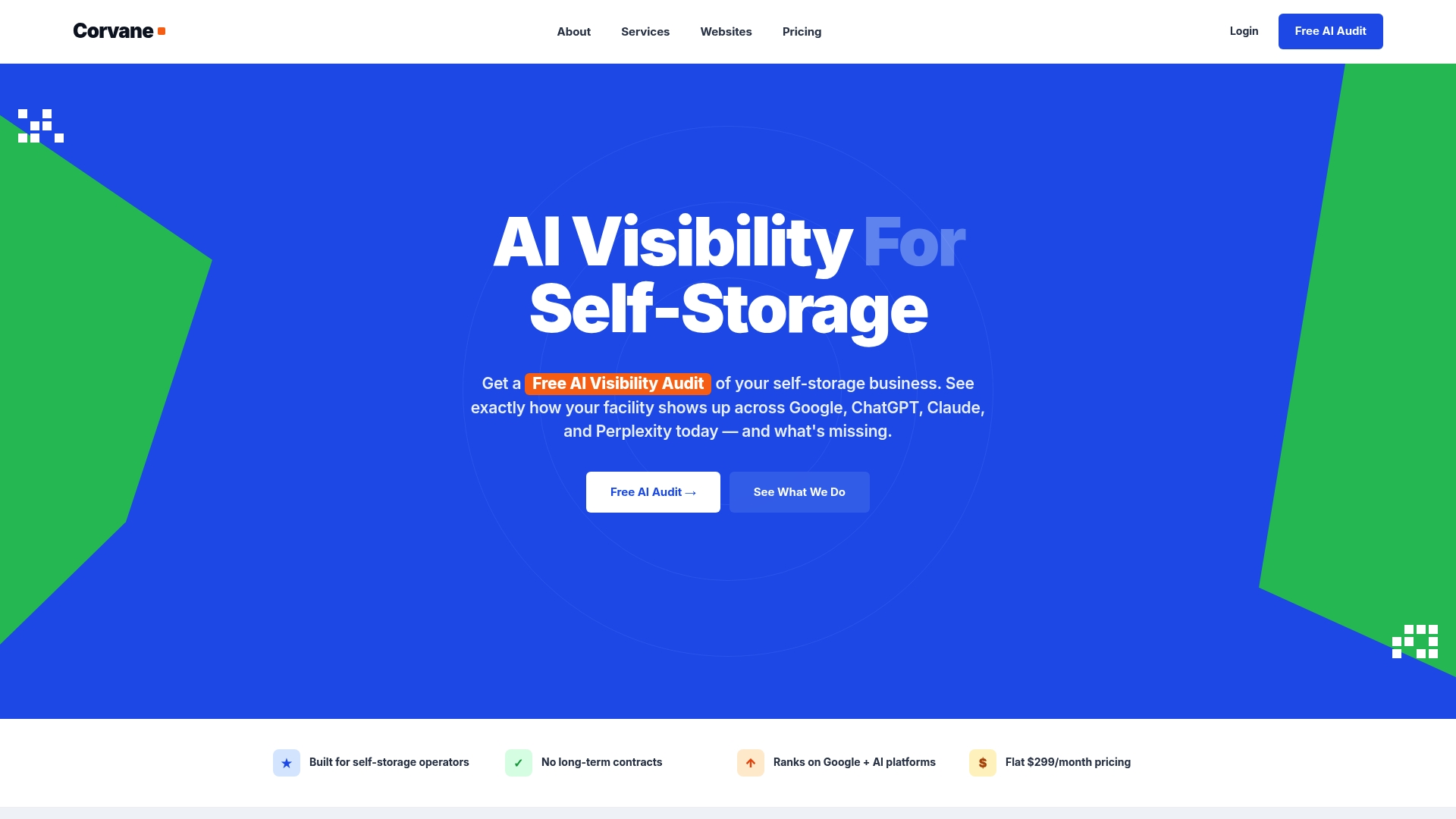
Corvanesystems also runs AI visibility audits that score how your facility currently appears across ChatGPT, Claude, Perplexity, and Google AI, then delivers a clear roadmap to improve it. Pricing is one flat monthly rate with no contracts and no minimums. If your site needs a stronger foundation, Corvanesystems also builds custom storage websites designed from the ground up for AI search visibility and booking conversion.
FAQ
What is a storage website built for AI search?
A storage website built for AI search is a facility site structured with JSON-LD schema, machine-readable data fields, and hybrid search support so that AI tools like ChatGPT and Perplexity can accurately index and recommend it.
How often should I update my facility's data for AI accuracy?
Daily sync is the minimum standard for pricing and availability. Facilities with high occupancy turnover benefit from hourly API updates to prevent AI tools from surfacing outdated information.
Does my storage site need a complete rebuild for AI optimization?
Not necessarily. Adding JSON-LD schema markup, compressing assets, and connecting an API sync to your facility management software can significantly improve AI indexing without a full rebuild.
What is the difference between GEO and traditional SEO for storage sites?
Traditional SEO targets Google's ranking algorithm through keywords and backlinks. GEO, or Generative Engine Optimization, structures your content and data so AI engines can pull accurate, grounded answers about your facility directly into their responses.
Why do AI tools sometimes show wrong information about my facility?
AI tools surface wrong data when your site lacks automated sync. Static pages without periodic ingestion cause AI systems to rely on cached or outdated content, leading to incorrect pricing or availability in AI-generated answers.