
To get recommended by Perplexity, self-storage operators need three things working together: a real base of detailed customer reviews, byte-for-byte consistent business data across every listing, and website content that answers the exact questions renters ask. Perplexity runs live retrieval on every query and shows clickable citations rather than static rankings, which means it re-checks your facility's credibility every time someone asks about storage in your area. Roughly 780 million queries flow through the platform monthly, and each one is a fresh chance to be cited or skipped.
Here's where to start, today:
- Audit your Google Business Profile for name, address, and phone number mismatches against your website and directory listings.
- Request detailed reviews from your last 20 move-ins, specifically asking them to mention features like climate control or gate hours.
- Add LocalBusiness schema markup to your homepage and location pages.
- Publish or update one FAQ block answering "does this facility have 24/7 access" or similar prompt-style questions.
- Confirm your site is indexed and verified in Google Search Console.
These aren't random tasks. Perplexity verifies businesses by cross-referencing independent sources, so ambiguous or conflicting data is often the single reason a facility gets skipped entirely.
Key Takeaways
Getting recommended by Perplexity comes down to fixing entity consistency, building a real review base with specific detail, and publishing content that answers exact customer prompts.
| Point | Details |
|---|---|
| Fix NAP first | Match your name, address, and phone number exactly across your site, GBP, and directories. |
| Chase review depth, not just count | Aim toward the roughly 300-review benchmark seen in highly recommended businesses, with detail-rich text. |
| Add LocalBusiness schema | Include address, hours, service area, and review snippets so engines can verify you fast. |
| Write for real prompts | Structure FAQs and unit-spec content around exact questions renters and AI systems ask. |
| Consider Corvane Systems | A flat-rate audit maps your current AI visibility gaps and prioritizes fixes for you. |
Table of Contents
- How Do You Get Recommended Perplexity Storage Placement Fast?
- How Many Reviews Do You Need to Get Recommended?
- What Content Should You Publish for AI Assistants?
- Why Does NAP Consistency Matter So Much?
- Is Your Site Technically Ready for AI Retrieval?
- What Metrics Show You're Getting Recommended?
- How Long Does This Actually Take?
- What I've Seen Work for Storage Operators
- Get Professional Help Getting Recommended by Perplexity
- Sources
How Do You Get Recommended Perplexity Storage Placement Fast?
Speed here comes from sequencing, not from doing everything at once. A small operator with one location and a part-time office manager can realistically knock out the highest-leverage fixes in 30 days, then spend the next 60 building the depth that keeps you cited consistently.
The 30-day tasks fix the errors that actively block recommendations. The 90-day tasks build the depth and corroboration that push you from "occasionally mentioned" to "reliably cited."
- Week 1: Pull your NAP data from your website, GBP, and top three directories side by side. Any difference, even "Suite" versus "Ste," counts as a mismatch.
- Week 2: Send review requests via text or email within 48 hours of move-in, when satisfaction is highest.
- Week 3: Rewrite your homepage's opening paragraph to state your city, unit sizes, and standout features in plain language.
- Week 4: Check Search Console for indexing errors and submit an updated sitemap.
Pro Tip: Don't wait for a "big" review campaign. Ask every satisfied tenant during checkout or renewal, then respond publicly to each one. Perplexity's retrieval process favors sources with recent, ongoing activity over stale profiles that haven't changed in a year.
How Many Reviews Do You Need to Get Recommended?
Review volume is the single strongest lever you have. Businesses in the "highly recommended" tier average about 304 reviews, compared to roughly 117 for businesses in the lowest tier. That's not a small gap, and it tells you something practical: sporadic review collection won't get you there. You need a system.
Star ratings matter less than the words inside the reviews. Perplexity and similar assistants pull specific language, so a review that says "the drive-up units made moving my furniture so much easier" carries more weight than a five-star rating with no text. The same goes for phrases like "climate control kept my documents dry" or "loved the 24/7 access when I needed to grab tools late at night." Those details are exactly what a generative engine extracts and quotes back to a searcher.
A few practical templates that consistently produce useful review text:
- "Would you mind mentioning which feature mattered most, like climate control, access hours, or unit size?"
- "If our staff helped with your move-in, feel free to name them and describe what they did."
- "What made you choose us over other storage options nearby?"
Prioritize Google Reviews first since it's the most heavily cited source, then branch into industry-specific directories and local news mentions where relevant. Avoid incentivizing reviews with discounts tied to a specific star rating. It's not just a policy violation on most platforms, it also produces generic, low-detail text that doesn't help you get cited.
What Content Should You Publish for AI Assistants?
Start by figuring out what your customers are actually asking, both you and AI systems. Mine your existing reviews for repeated phrases, check the Q&A section on your Google Business Profile, and pull common questions from your front-desk call logs. If five different renters have asked about vehicle storage, that's a content gap you can close in one afternoon.
Perplexity and other generative engines favor a handful of specific formats over generic marketing copy:
- Short, stat-rich answer blocks that open with the direct answer (unit sizes, price ranges, hours) before any elaboration.
- FAQ sections structured like a cookbook: one clear question, one clear answer, no fluff in between.
- Named-feature bullets listing exactly what's on-site (drive-up access, climate control, 24-hour gate, moving carts).
- Real customer examples describing specific use cases, like storing a boat over winter or holding inventory for a small business.
If a prospective renter might type "storage units with climate control near [city]" into an AI assistant, your page should have a heading and paragraph that answers that almost verbatim. Structured content like this, paired with schema, has shown uplifts of around 44% in citation likelihood in GEO case studies.
Pro Tip: Add a short unit-spec table (size, price, features) directly on your location page. It's one of the easiest ways to give AI systems a clean, extractable answer instead of forcing them to guess from paragraph text.

Photos with descriptive captions, a 30-second video walkthrough of your facility, and a simple table comparing unit sizes all add unique signals that generic template text can't replicate. Building a site with these elements from the ground up is covered in more depth in Corvanesystems's guide to AI-ready storage websites.
Why Does NAP Consistency Matter So Much?
Because Perplexity corroborates facts across independent sources before it trusts them enough to cite. If your name, address, and phone number differ even slightly between your website, Google Business Profile, and a directory listing, that's often read as a sign of an unverified or unreliable entity, and the model moves on to a competitor with cleaner data.
Your Google Business Profile deserves particular attention since it's one of the primary sources feeding local recommendations. Audit these fields specifically: business name (exact match to your signage and website), primary and secondary categories, hours (including holiday hours), a full list of services, and at least 10 recent photos showing your units, gate, and office.
Beyond Google, claim and verify listings on directories relevant to storage and moving, since niche directories often outperform general business listings when it comes to Perplexity's citation preferences. A guide to which sources actually move the needle for storage facilities specifically is available in Corvanesystems's breakdown of backlink sources.
On the technical side, LocalBusiness schema should include your address, geo-coordinates, opening hours, accepted payment types, service area, and aggregate rating with a few review snippets pulled in. This isn't decorative markup. It's the machine-readable version of your business card, and it's what lets an AI system confirm your identity without ambiguity.
Is Your Site Technically Ready for AI Retrieval?
A page can have perfect content and still never get cited if it's technically invisible. Generative engines rely on the same indexing infrastructure as traditional search, so Google's own technical requirements for AI features apply directly here.
- Verify your domain in Google Search Console and confirm there are no coverage errors on your key pages.
- Publish an updated XML sitemap and submit it through Search Console.
- Check your robots.txt file to confirm you're not accidentally blocking crawlers like PerplexityBot, OAI-SearchBot, or standard search bots.
- Test that your pages render clean HTML content, not just a shell that depends entirely on JavaScript to display text.
- Review canonical tags for consistency, especially if you have multiple location pages that could confuse indexing.
Common red flags include blocked crawlers in robots.txt (an easy oversight when a developer sets up staging protections and forgets to remove them), inconsistent canonical tags across similar pages, and heavy client-side rendering with no server-side fallback for crawlers that don't execute JavaScript well.
- Run a quick site: search on Google to confirm your key pages are indexed.
- Use Search Console's URL Inspection tool to check individual page eligibility.
- Fetch your page with a text-only browser or crawler simulator to see what a bot actually sees.
Fixes to indexing issues often show up in Perplexity's citations within days, since it performs live retrieval rather than relying on a stored index. Other platforms may take weeks to reflect the same change. For a deeper technical walkthrough specific to storage sites, see Corvanesystems's local SEO guide.
What Metrics Show You're Getting Recommended?
Track a handful of numbers weekly rather than trying to monitor everything. The most useful GEO metrics are Share of Voice (how often you appear versus competitors across a set of test prompts), Mention Rate, Citation Rate, review volume and sentiment trends, and referral clicks originating from AI citation links.
| Metric | What It Tells You | How Often to Check |
|---|---|---|
| Share of Voice | Your presence relative to competitors in AI answers | Monthly |
| Citation Rate | How often your page is directly linked in a response | Monthly |
| Review Volume Growth | Progress toward the review benchmarks that drive recommendations | Weekly |
| AI Referral Clicks | Traffic arriving from Perplexity's clickable citations | Weekly |
| Local Pack Presence | Whether you show up in traditional local search results | Monthly |
Because Perplexity displays clickable citations rather than a static answer, you can tag your key landing pages with UTM parameters and watch for referral traffic that lists Perplexity as the source. Expect referral numbers to be modest at first, often single digits weekly for a smaller market, but consistent growth over 8 to 12 weeks is a real signal.
A genuine recommendation event looks like your facility being named with specifics (address, a feature, a price range) in response to a query like "storage near [city] with climate control." A mere mention, by contrast, might just be your name appearing in a list with no elaboration. Both matter, but only the first reliably drives clicks. Tools built specifically for this kind of tracking are outlined in Corvanesystems's operator guide to AI visibility.
How Long Does This Actually Take?
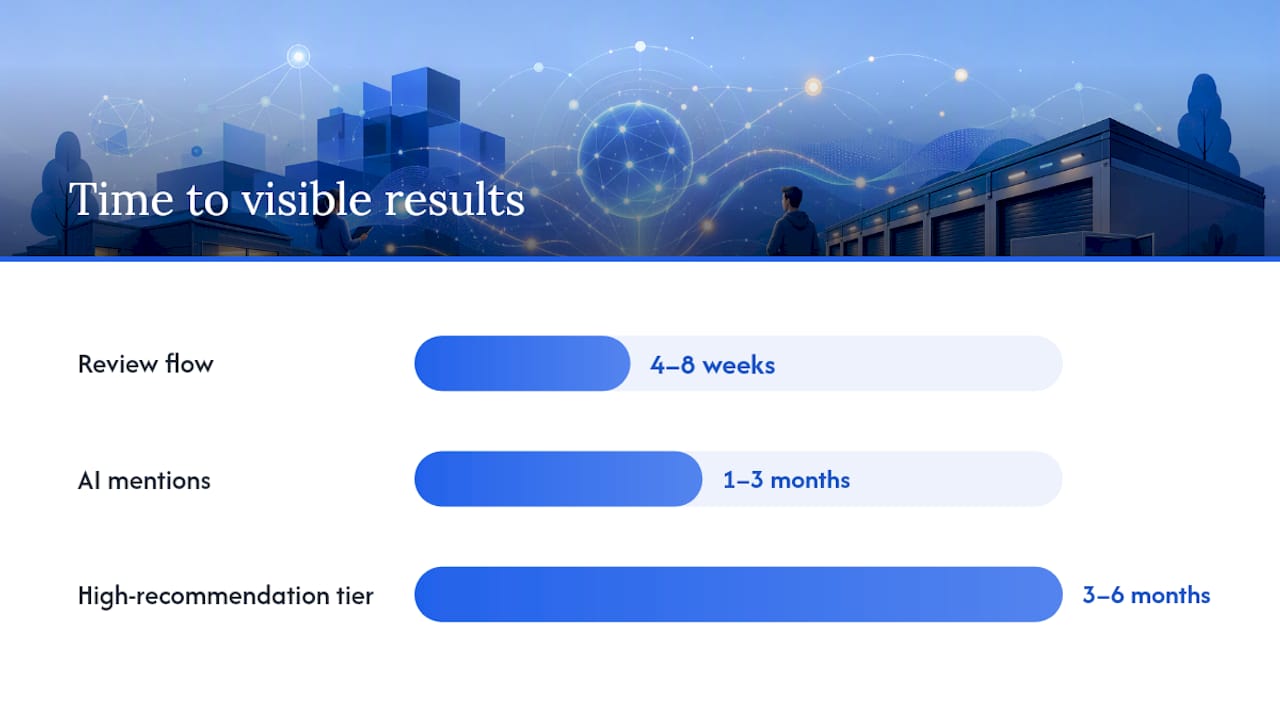
GBP fixes and NAP corrections can show measurable change within days, since Perplexity's live retrieval reflects updates almost immediately. Review flow takes longer to build real depth, typically 4 to 8 weeks of steady requests before you see a meaningful jump in count. Visible changes in how often AI assistants mention you tend to show up in the 1 to 3 month range, and reaching a genuinely high-recommendation tier, the kind with 300-plus reviews and full directory coverage, usually takes 3 to 6 months of consistent work.
Effort estimates vary by task. In-house NAP audits and GBP cleanup might run 5 to 10 hours total for a single location. A basic paid review campaign (text/email automation plus incentive-free prompts) can run a few hundred dollars a month depending on the tool. Full directory cleanup across 10 to 15 listings often takes another 5 to 8 hours if done manually.
- You have no in-house marketing capacity and listings have drifted out of sync across a dozen sites.
- You're chasing a seasonal occupancy target and can't afford months of trial and error.
- Your reviews have stalled below 100 despite steady move-ins.
- You've made technical fixes but still see no citation activity after 90 days.
A solid GEO audit and remediation retainer should include a full NAP consistency check, a review strategy with templates, schema implementation, a content gap analysis against real customer prompts, and monthly reporting on the metrics above; not a one-time PDF that never gets revisited.
What I've Seen Work for Storage Operators
Storage is a strange category for AI visibility because the buying decision is almost entirely local and urgent. Nobody asks Perplexity to recommend a storage facility three states away. That narrows the competition to a handful of real rivals in your zip code, which means the operators who get the basics right, consistent data, real reviews, answer-ready pages, tend to pull ahead fast because so few facilities bother to fix all three at once.
The biggest misconception I run into is operators assuming this is a content problem when it's usually a verification problem first. You can write the best FAQ page in your market, but if your phone number on Yelp doesn't match your website, a retrieval engine treats you as an unresolved entity and moves to the next listing. Fix the boring data issues before investing heavily in content. Two client patterns show up consistently: facilities that focus review requests on specific features (not just "leave us a review") see faster gains in citation-worthy text, and facilities that publish even one well-structured location page with schema tend to outperform sites with ten generic pages and none.
Corvane Systems runs flat-rate audits specifically built around this sequence, and the fastest wins almost always come from the unglamorous work: fixing a phone number, asking a tenant one more follow-up question, adding one schema block that was missing the whole time.
Get Professional Help Getting Recommended by Perplexity
There are other paths here. You can handle NAP audits, review requests, and schema markup yourself with a spreadsheet and a few weekend afternoons, or hand pieces of it to a generalist marketing freelancer who dabbles in local SEO. Both work, to a point, but neither is built specifically for how self-storage facilities get evaluated by AI assistants like Perplexity, ChatGPT, and Claude.
Corvane Systems is the alternative to piecing this together yourself or hiring a generalist agency: a flat monthly rate covering technical SEO, review and listing consistency work, 30 AI-optimized articles a month, and a standing AI visibility audit that scores exactly how your facility shows up across Perplexity, ChatGPT, Claude, and Google's AI Overviews. There are no tiers and no contracts, so you're not locked into a package sized for a facility twice your size. The audit itself typically takes about a week to compile and hands back a clear roadmap instead of a wall of jargon. If you want to see where your facility currently stands, start with a visibility audit and get a straight answer on what's holding you back.
Sources
A handful of sources are worth returning to whenever you run your own visibility check or brief a team member on this work.
- Perplexity real-time retrieval characteristics (FAQ)
- Perplexity statistics and benchmarks (Backlinko)
- Generative Engine Optimization (GEO) for local businesses (Uberall)
Use these to double-check any claim before you act on it, especially the review benchmarks, since those numbers shift as more data comes in year over year.