
A storage facility missing from AI results is not a ranking problem. It is an entity clarity problem. AI engines like ChatGPT, Claude, Perplexity, and Google AI Overviews need clean, factual, structured data to confidently recommend a business. When that data is absent, incomplete, or buried inside JavaScript widgets, the AI skips your facility entirely. The cost is real: relocation-related prompts are the highest-intent queries driving storage demand through AI search, and missing from those results means losing customers who are ready to book.
Why is your storage facility missing from AI results?
AI engines do not browse your website the way a human does. They extract structured facts: your facility name, address, service area, unit sizes, access hours, and pricing. When those facts are not written in plain text, the AI cannot build a confident picture of your business. Entity data clarity is the single most important factor in whether an AI recommends your facility or ignores it.

The impact of missing or inconsistent data is immediate. An AI model that cannot confirm your address, service area, or hours will simply recommend a competitor whose data is clear. This is not a penalty. The AI is not punishing you. It is defaulting to the facility it understands best.
AI results also shift based on user context. A person asking "where should I store my furniture while I move to Austin?" gets a different result than someone typing "storage units near me." Facilities that answer move-specific tenant questions in plain, conversational language show up in both types of queries. Facilities that rely on generic marketing copy show up in neither.
- Entity completeness: Your facility name, address, phone number, and service area must appear in plain text on every key page.
- Factual specificity: Unit sizes, prices, gate hours, and lease terms must be readable by AI crawlers, not locked inside booking widgets.
- Conversational coverage: Pages that answer questions like "Do you have climate-controlled units in [city]?" signal relevance to AI intent matching.
- Consistency across platforms: Your data on your website must match your Google Business Profile, Yelp, and local directories exactly.
Pro Tip: Test your own AI visibility right now. Open ChatGPT or Perplexity and type: "What are the best storage facilities near [your city] for someone moving this month?" If your facility does not appear, you have an entity clarity gap to fix.
Common reasons storage facilities fail to appear in AI-driven search
The most common cause of missing storage locations in AI is not a technical failure. It is a content failure. Owners write marketing copy when AI needs factual answers. Here are the specific patterns that cause facilities to go invisible.
-
Vague, marketing-heavy copy. Phrases like "your trusted storage solution" tell an AI nothing. The AI needs facts: "We offer 5x5, 10x10, and 10x20 climate-controlled units at our facility on Main Street in [city]."
-
No dedicated page per facility. Multi-location operators who list all their properties on a single page create an entity identity problem. Each location needs its own URL with its own address, hours, and unit details written in plain text.
-
Operational facts locked in inaccessible formats. Pricing and availability data buried inside JavaScript booking widgets or PDFs is invisible to AI crawlers. If the AI cannot read it, it does not exist.
-
Inconsistent NAP data across directories. Your name, address, and phone number must match exactly across Google Business Profile, Yelp, Bing Places, and every local citation. A single variation creates doubt in the AI's confidence score.
-
Keyword stuffing instead of semantic answers. Keyword density is irrelevant to AI. What matters is whether your content clearly answers the questions tenants actually ask.
Pro Tip: Pull up your facility's website and search for your own gate hours, unit prices, and lease terms. If you cannot find them in plain text within 10 seconds, an AI crawler cannot find them either.
How to optimize your storage facility for AI search
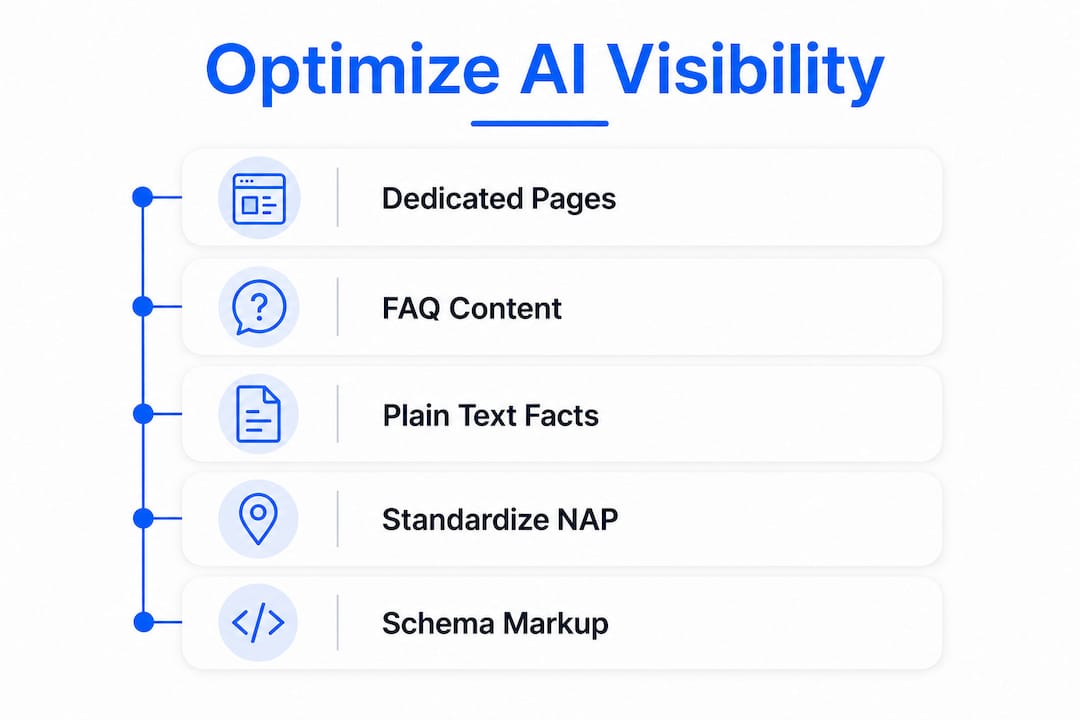
Fixing AI storage facility issues requires a structured approach. The goal is to make your facility's data so clear and complete that any AI model can confidently recommend you without hesitation.
Build a dedicated page for each location
Every facility location needs its own page with a unique URL. That page must include the full address in plain text, the phone number, gate hours, office hours, available unit sizes, pricing, and any special features like climate control or drive-up access. Well-structured FAQs and clear metadata on these pages produce measurably higher AI discoverability.
Write conversational FAQ content
Create a FAQ section that answers the questions your tenants actually ask out loud. "Do you have month-to-month leases?" "What is the smallest unit you offer?" "Is your facility gated?" These questions mirror the conversational prompts people type into AI assistants. Conversational FAQ pages with concise answers improve AI matching across different buyer personas, including the high-value relocation segment.
Expose all operational facts in plain text
This is the fix most owners overlook. Your unit sizes, prices, access hours, and policies must live in plain HTML text on your pages. Not in a PDF. Not inside a JavaScript booking widget. Not in an image. Plain-text operational content including unit sizes, prices, gate hours, and policies is the baseline requirement for AI crawlability.
Standardize your NAP data everywhere
Run a citation audit across Google Business Profile, Apple Maps, Bing Places, Yelp, SpareFoot, and any local chamber of commerce listings. Your facility name, address, and phone number must be identical on every platform. Consistent NAP data across all touchpoints is often more impactful for AI recommendations than your website content alone.
Add schema markup where possible
Schema markup is structured data code that labels your content for search engines and AI crawlers. Adding LocalBusiness schema to your facility pages tells AI systems exactly what type of business you are, where you are located, and what hours you keep. You do not need a developer to add basic schema. Many website platforms support it through plugins or built-in settings.
| Optimization action | Impact on AI visibility |
|---|---|
| Dedicated page per location | High: creates unique entity identity for each facility |
| Plain-text pricing and hours | High: makes operational facts readable by AI crawlers |
| Conversational FAQ content | High: matches move-related and intent-specific queries |
| Consistent NAP across directories | High: builds AI confidence in your entity data |
| Schema markup | Medium: reinforces entity type and location signals |
| Third-party reviews and citations | Medium: adds external trust signals AI models weigh heavily |
How to sustain your facility's AI visibility over time
AI visibility is not a one-time fix. Tracking move-related AI prompts and updating your FAQs quarterly produces better long-term citation rates than any single content update. The AI models that recommend businesses are constantly retraining on new data. Your content needs to stay current to stay visible.
AI results also vary by user. The same query typed by two different people can return different facility recommendations based on their location history and past searches. AI customizes outputs based on chat history and user preferences, which means no single content update guarantees permanent visibility. Consistent, ongoing updates are the only reliable strategy.
External trust signals matter as much as your own website. Reviews on Google, mentions in local news, and listings in authoritative directories all feed into the signals AI models use to evaluate credibility. AI models weigh local reviews and directory citations alongside website content, so a facility with strong external signals consistently outperforms one that relies on website content alone.
A practical maintenance schedule looks like this:
- Monthly: Check that your Google Business Profile hours, photos, and services are current.
- Quarterly: Test five to ten move-related AI prompts and note whether your facility appears.
- Quarterly: Refresh your FAQ pages with new questions based on actual tenant inquiries.
- Annually: Run a full NAP audit across all directories and correct any inconsistencies.
"The facilities that win AI recommendations are not the ones with the best websites. They are the ones with the clearest, most consistent, and most frequently updated factual data across every platform an AI can read."
For a deeper look at boosting occupancy through AI visibility, the connection between search presence and booked units is direct and measurable.
Key Takeaways
A storage facility missing from AI results is almost always caused by unclear entity data, inaccessible operational facts, and inconsistent citations across platforms.
| Point | Details |
|---|---|
| Entity clarity is the foundation | Your name, address, hours, and unit details must appear in plain text on every key page. |
| Plain text beats widgets | Pricing and availability locked in JavaScript or PDFs is invisible to AI crawlers. |
| Conversational FAQs drive citations | Pages that answer move-specific questions directly match the highest-intent AI queries. |
| NAP consistency builds AI confidence | Identical name, address, and phone data across all directories reduces AI uncertainty. |
| Visibility requires ongoing maintenance | Quarterly FAQ updates and prompt testing are required to sustain AI recommendations over time. |
The pattern I keep seeing from storage operators
The most common mistake I see from storage operators is treating AI visibility as a one-time SEO project. They fix their Google Business Profile, publish a few pages, and then wait. Six months later, they are still invisible on ChatGPT and Perplexity, and they cannot figure out why.
The real issue is that AI models are not static. They update constantly. A facility that was well-represented in an AI's training data six months ago may have slipped if competitors published fresher, more detailed content. The operators who win long-term are the ones who treat content updates as a recurring operational task, not a marketing campaign.
The opportunity most owners are missing is the relocation segment. Someone moving to a new city and asking an AI assistant for storage recommendations is one of the highest-value prospects in the industry. They are not price shopping. They are looking for a facility they can trust quickly. If your content answers their specific questions, including neighborhood, access hours, and unit availability, you are the obvious recommendation. Most facilities are not even trying to capture this traffic. That is a significant gap worth closing now, before your local competitors figure it out.
The self-storage AI recommendations landscape in 2026 rewards operators who think like publishers, not just property managers.
— Mike
Corvanesystems can put your facility on the AI map
Your facility deserves to show up when a potential tenant asks an AI assistant for storage options in your city.
Corvanesystems is built specifically for self-storage operators who want to be found on ChatGPT, Claude, Perplexity, and Google AI Overviews. The service includes AI visibility audits that score exactly where you stand across every major AI platform, plus monthly content that answers the conversational queries driving real bookings. NAP consistency, schema setup, and Google Business Profile optimization are all included. There are no tiers, no contracts, and no minimums. If you are ready to turn AI search into a reliable source of new tenants, see how Corvanesystems works and get started today.
FAQ
Why is my storage facility not showing up in AI search?
Your facility is likely missing from AI results because your entity data, including your address, hours, and unit details, is not written in plain text that AI crawlers can read. Operational facts buried in JavaScript widgets or PDFs are invisible to AI systems.
What is GEO and how does it differ from SEO?
GEO stands for Generative Engine Optimization. It focuses on structuring your content so AI models like ChatGPT and Perplexity can confidently recommend your facility, rather than just ranking your pages in traditional search results.
How often should I update my content for AI visibility?
Quarterly updates to your FAQ pages and regular testing of move-related AI prompts are the minimum required to maintain consistent AI citations. AI models retrain on new data continuously, so stale content loses ground over time.
Does having more Google reviews help with AI recommendations?
Yes. AI models weigh external trust signals heavily, including Google reviews, local directory listings, and mentions in local publications. Strong external signals often carry more weight than website content alone.
What is the fastest fix for a storage facility not indexed by AI?
The fastest fix is to publish plain-text pages for each facility location that include the full address, phone number, gate hours, unit sizes, and pricing. This gives AI crawlers the factual entity data they need to identify and recommend your business.