
Self storage Claude AI visibility is the practice of structuring your facility's data and content so AI platforms like Claude include you in their synthesized answers rather than just ranking you in a list of links. This shift from traditional SEO to Generative Engine Optimization (GEO) is not a future trend. It is happening now, and most storage operators are unprepared for it. AI engines intercept queries before users ever reach a website, synthesizing direct answers from trusted, well-structured sources. Facilities that fail to meet those standards are simply absent from the conversation. Corvanesystems was built specifically to close that gap for self-storage operators competing in crowded local markets.
What sets self storage Claude AI visibility apart from traditional SEO
Traditional SEO earns you a ranked link. AI visibility earns you a spoken recommendation. Those are fundamentally different outcomes, and they require fundamentally different strategies.
When a potential renter types "storage units near me" into Google, they see a list of links and choose one to click. When they ask Claude the same question, Claude synthesizes a direct answer, names specific facilities, and explains why. Your website ranking means nothing if Claude does not recognize your facility as a credible, well-structured source.

GEO replaces traditional SEO as the dominant visibility framework for AI-driven search. The core difference is inclusion versus ranking. GEO focuses on whether your facility appears inside the AI's synthesized answer at all. Traditional SEO focuses on where your link appears in a list. These require entirely separate optimization approaches.
The market has already shifted. One operator group's AI-first strategy produced 41.1% average AI visibility, nearly triple the nearest competitor's 15%, by optimizing 24 out of 26 high-impact keywords. That gap between operators who have adapted and those who have not will only widen.
Here is what the transition from SEO to GEO requires in practice:
- Shift your success metric. Stop measuring only keyword rankings. Start measuring how often your facility appears in AI-generated answers for buyer intent queries.
- Restructure your content for synthesis. AI platforms pull from content that answers questions directly. Reformat key pages to lead with answers, not background context.
- Treat every data source as an AI signal. Your Google Business Profile, directory listings, and website all feed AI models. Inconsistency across any of them weakens your inclusion odds.
- Audit your current AI presence. Search Claude, Perplexity, and Google's AI Overviews for your facility by name and by category. If you do not appear, you have a visibility gap that no amount of traditional SEO will fix.
Pro Tip: Treat AI visibility as an operational priority on par with occupancy tracking. Assign someone on your team to run monthly AI prompt audits, not just check Google rankings.
How to build consistent data and entity signals for Claude recognition
AI models like Claude build their understanding of your facility from signals scattered across dozens of platforms. When those signals conflict, the AI loses confidence in your data and excludes you from recommendations.
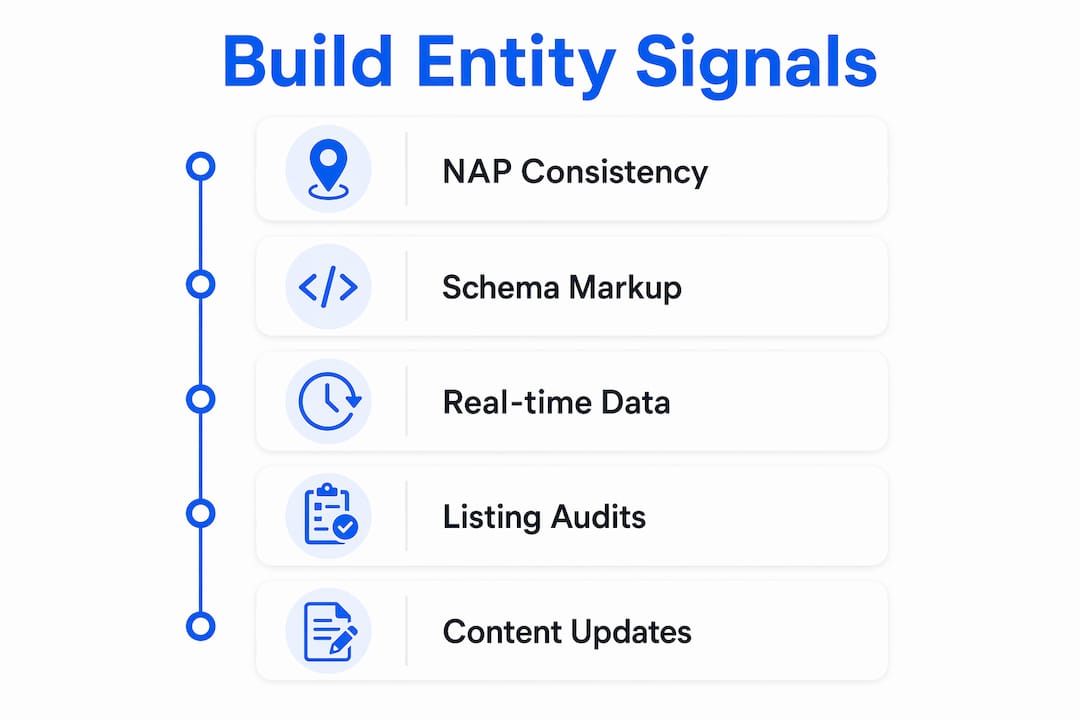
The foundation is NAP consistency: your facility's name, address, and phone number must be identical across every directory, listing, and platform where you appear. Inconsistent NAP data confuses AI models and reduces your local search visibility. A single mismatched suite number or a phone number formatted differently on two platforms is enough to create doubt in an AI's retrieval process.
Schema markup is the next layer. LocalBusiness and FAQPage schema tell AI crawlers exactly what your facility is, where it is, and what questions it answers. Facilities without structured schema markup lose critical visibility even when their content is well written. Schema is not optional for AI visibility. It is the translation layer between your website and the AI's understanding of it.
Real-time data integration matters more than most operators realize. Claude and similar platforms favor sources that reflect current conditions. Stale pricing, outdated unit availability, or an old phone number signals an unreliable source. Connecting your facility management software to your website so pricing and availability update automatically gives AI models a reason to trust your data over a competitor's.
Your review ecosystem is also an entity signal. Authentic, detailed reviews that mention specific unit sizes, access hours, and staff names give AI models richer data to work with than a generic five-star rating. Entity signal consistency across platforms compounds over time, building the kind of trust that gets your facility named in AI answers.
Key data hygiene practices that directly affect AI recognition:
- Audit all directory listings quarterly for NAP accuracy, including Yelp, Apple Maps, Bing Places, and niche storage directories.
- Implement LocalBusiness schema on your homepage and FAQPage schema on any page that answers common renter questions.
- Connect live pricing and availability feeds from your facility management system to your website.
- Respond to every review, positive or negative, with specific language that reinforces your facility's location, features, and service quality.
- Flag and correct duplicate listings immediately. Two listings for the same facility split your entity signals and confuse AI retrieval.
Pro Tip: Use a tool like Yext or Moz Local to monitor listing consistency across directories automatically. Manual audits miss changes that third-party aggregators push without your knowledge.
Crafting AI-friendly content that builds local relevance
AI platforms favor content that answers questions directly and demonstrates genuine local knowledge. Generic storage content that could apply to any facility in any city performs poorly in AI-driven search.
Answer-first content structure is the single most effective change most operators can make. Lead every page and blog post with a direct answer to the question it addresses. If the page is about climate-controlled units, the first sentence should state what climate control means for your specific facility and why it matters in your local climate. AI models pull from the top of content. Burying your answer in paragraph four means Claude may never surface it.
Hyper-local content and authentic, detail-rich reviews give independent operators a real advantage over national brands. A national brand cannot write credibly about the flooding risk in your specific neighborhood or the fact that your facility is two blocks from the local university's move-out zone. You can. That local specificity is exactly what AI models use to match your facility to geographically specific queries.
| Content type | Traditional approach | AI-optimized approach |
|---|---|---|
| Unit size guide | Lists dimensions and cubic footage | Answers "What size unit do I need for a two-bedroom apartment?" directly |
| Pricing page | Displays rate table | Explains current rates, move-in specials, and what drives price differences |
| Location page | Lists address and hours | References nearby landmarks, neighborhoods served, and local access details |
| FAQ section | Generic questions about storage | Mirrors exact conversational queries renters ask AI assistants |
| Customer reviews | Displays star ratings | Features detailed testimonials with specific unit types, staff names, and use cases |
Content update frequency also signals trustworthiness to AI platforms. A blog that published one post in 2023 and nothing since tells Claude your facility may not be actively managed. Publishing consistent, quality content monthly maintains your relevance signal. Quality matters more than volume. One well-structured, locally specific article per month outperforms ten thin posts that say nothing new.
How do you monitor AI visibility on Claude and other platforms?
AI visibility is not a static metric. Claude indexes and retrieves brand information dynamically, which means your visibility can shift without any change on your end. A competitor improves their schema markup, and suddenly they appear in answers where you used to. Monitoring is not optional. It is how you catch those shifts before they cost you leads.
The most direct monitoring method is prompt testing. Run a set of buyer intent queries through Claude, Perplexity, and Google's AI Overviews weekly. Queries like "best storage units near [your city]," "climate-controlled storage in [your neighborhood]," and "affordable 10x10 storage unit near [local landmark]" tell you exactly where you appear and where you do not. Document the results in a simple spreadsheet so you can track changes over time.
AI visibility requires continuous monitoring because static rank expectations fail in dynamic AI retrieval environments. Operators who check their Google ranking once a month and assume AI visibility follows the same pattern will miss significant drops in consideration before they show up in occupancy numbers.
A practical AI visibility monitoring program follows these steps:
- Define your prompt set. Build a list of 15–20 buyer intent queries that reflect how real renters search for storage in your market.
- Run weekly prompt audits. Test each query across Claude, Perplexity, and Google AI Overviews. Note whether your facility is named, described, or absent.
- Track your competitors' presence. If a competitor appears in answers where you do not, analyze what their content or data structure does differently.
- Update content in response to gaps. If you are absent from answers about a specific unit type or neighborhood, create or update content that directly addresses that query.
- Review schema and listing data monthly. AI retrieval depends on current, accurate data. A listing that goes stale or a schema error that goes unnoticed can drop your visibility within weeks.
Integrating AI visibility into your operational infrastructure
The operators who win at AI visibility treat it as infrastructure, not a marketing campaign. AI embedded deeply in operations drives superior leasing, pricing, and maintenance outcomes. That same operational discipline is what feeds AI models the consistent, accurate data they need to recommend your facility.
Pricing data is a clear example. If your facility management software holds your current rates but your website shows outdated pricing, Claude may pull the wrong number and either exclude you as unreliable or misrepresent your offer to a potential renter. Connecting your pricing engine directly to your website and Google Business Profile eliminates that gap. The AI sees accurate data, trusts your source, and includes you in relevant answers.
Occupancy data works the same way. A facility that shows real-time unit availability gives AI platforms a live, trustworthy signal. A facility with a static "call for availability" message gives AI nothing to work with. AI-powered operational tools improve cash flow visibility, tenant confidence, and decision-making across the business. The visibility benefits are a direct result of the operational discipline required to run those tools well.
Centralized data platforms that unify your facility management system, website, listings, and review responses give you a single source of truth. That consistency is what AI models reward. Exception-based oversight, where your team is alerted only when data falls out of sync, keeps the system accurate without requiring constant manual attention. You can learn more about treating AI as infrastructure and what that means for day-to-day operations.
Pro Tip: Align your AI visibility review with your monthly leasing and pricing meetings. When you adjust rates or run a promotion, update your website, Google Business Profile, and schema markup at the same time. AI models reward real-time accuracy.
Key Takeaways
Self-storage operators who treat AI visibility as operational infrastructure rather than a marketing add-on will consistently outperform those who rely on traditional SEO alone.
| Point | Details |
|---|---|
| GEO replaces traditional SEO | AI platforms synthesize answers, so inclusion in those answers requires GEO, not just keyword ranking. |
| NAP and schema are non-negotiable | Consistent name, address, and phone data plus LocalBusiness schema are the minimum entry points for AI recognition. |
| Local content wins | Hyper-local, answer-first content outperforms generic storage copy in AI-driven search results. |
| Monitoring must be active | AI visibility shifts dynamically; weekly prompt audits across Claude and Perplexity catch drops before they affect occupancy. |
| Operations drive visibility | Connecting live pricing and availability data to your website gives AI models accurate, trustworthy signals to recommend your facility. |
What I've learned about AI visibility that most operators get wrong
Most operators I talk to think AI visibility is a content problem. Write more blog posts, get more reviews, and the AI will find you. That framing is wrong, and it leads to wasted effort.
AI visibility is a data trust problem. Claude does not recommend your facility because you published a good article. It recommends you because every signal it can find about your facility, from your Google Business Profile to your schema markup to your directory listings, tells a consistent, accurate, and current story. One stale listing or a mismatched phone number can undermine months of good content work.
The second mistake I see is treating AI visibility as a one-time fix. Operators spend a week cleaning up their listings, add schema markup, and then move on. Six months later, a third-party aggregator has pushed an outdated address to four directories, and their AI visibility has quietly collapsed. This is not a project. It is an ongoing operational discipline.
The facilities that will dominate AI-driven search in the next three years are the ones that build visibility into their operational rhythm today. They update pricing in real time, respond to every review within 24 hours, and run monthly prompt audits the same way they run monthly occupancy reports. AI visibility compounds. The operators who start now will be very difficult to displace later. The ones who wait will find the gap has grown too wide to close quickly.
— Mike
Corvanesystems: built for AI visibility in self storage
Corvanesystems is an SEO and AI search visibility agency built exclusively for self-storage operators. The work described in this article, from schema markup and NAP audits to monthly AI-optimized content and prompt monitoring, is exactly what Corvanesystems delivers as a flat-rate monthly service.
Corvanesystems combines traditional SEO with GEO to structure your facility's digital presence so Claude, Perplexity, ChatGPT, and Google's AI Overviews recognize and recommend you. The service includes AI visibility audits that score your current presence across all major AI platforms and deliver a clear roadmap to improve it. If your facility is not appearing in AI-generated answers, Corvanesystems can fix that. No tiers, no contracts, no minimums.
FAQ
What is self storage Claude AI visibility?
Self storage Claude AI visibility is the practice of structuring your facility's data and content so AI platforms like Claude include your business in synthesized answers. It differs from traditional SEO because the goal is inclusion in an AI-generated recommendation, not a ranked link.
How does Claude decide which storage facilities to recommend?
Claude pulls from sources with consistent entity signals, structured schema markup, and accurate, current data. Facilities without LocalBusiness schema and NAP consistency are frequently excluded from AI-generated answers regardless of their website quality.
How often does AI visibility change?
AI visibility is dynamic and can shift week to week as AI models update their retrieval logic and competitors improve their data. Continuous monitoring of buyer intent prompts is the only reliable way to catch and respond to those changes.
Can a small independent storage facility compete with national brands in AI search?
Yes. Hyper-local content and detailed customer reviews give independent operators a genuine advantage over national brands that cannot match local specificity. AI models reward relevance to the specific query, and local operators own that ground.
What is the fastest way to improve my facility's AI visibility?
Fix your NAP consistency across all directories, implement LocalBusiness and FAQPage schema on your website, and run a prompt audit to identify where you are currently absent. These three steps address the most common reasons facilities are excluded from AI-generated answers.