
AI recommendations for self-storage operators are most effective when built on your facility's own operational data, not generic prompts or disconnected software. The industry term for this approach is AI infrastructure integration, and it is the standard that separates tools that drive occupancy from tools that just add noise. Platforms like Storable and publications like Inside Self Storage have documented how integrated AI systems reduce manual reporting, automate tenant communication, and sharpen pricing decisions. For operators competing in crowded local markets, self storage AI recommendations grounded in real facility data deliver measurable gains in revenue and tenant retention.
1. What makes self storage AI recommendations actually work
The single factor that separates useful AI from expensive noise is data integration. AI trained on your facility's data improves decision-making in ways that generic prompts never can. That means your tenant activity, lease history, payment patterns, and communication logs all feed the system continuously.
Operators who evaluate AI tools on integration depth rather than product labels get better outcomes. The question to ask any vendor is simple: does this tool connect directly to my facility management software, or does it require manual data entry to function?

Pro Tip: Before signing any AI contract, ask the vendor to demonstrate a live connection to your existing management system. If they cannot show it, the tool will add workload rather than remove it.
2. Key features of effective self-storage AI tools
The most valuable AI capabilities in self-storage fall into four categories: tenant communication automation, revenue management, operational workflow automation, and portfolio analytics.
- Tenant communication: AI-assisted messaging tools summarize conversations, flag sentiment trends, and reduce response times without requiring staff to monitor every thread.
- Revenue management: AI adjusts rental rates based on vacancy data, competitor signals, and seasonal demand patterns rather than manual spreadsheet reviews.
- Workflow automation: Delinquency notifications, lease renewal reminders, and maintenance scheduling run on triggers rather than staff memory.
- Portfolio analytics: Multi-location operators gain a consolidated view of performance across all sites, making it easier to spot underperforming units or markets.
Disconnected AI tools often fail to deliver ROI because they cannot pull reliable data from across your operation. Data fragmentation is the biggest barrier to AI effectiveness in self-storage. A tool that cannot see your full tenant activity and communication history will produce recommendations that are incomplete at best and misleading at worst.
Pro Tip: Prioritize AI tools that layer directly over your existing management system. Adding a standalone app creates a second data silo and reduces staff adoption.
3. How AI integration improves tenant engagement and lead conversion
AI-assisted chat and messaging tools cut response times from hours to minutes. Faster responses convert more leads. A prospective tenant who asks about unit availability at 9:00 PM and gets an answer within seconds is far more likely to book than one who waits until the next morning.
Sentiment trend analysis adds a second layer of value. When AI flags that a cluster of tenants is expressing frustration about gate access or billing, you can address the issue before it becomes a wave of negative reviews. This is especially useful for operators managing online review performance across multiple locations.
Key benefits operators report from AI-driven tenant engagement include:
- Faster lead qualification through automated follow-up sequences
- Reduced staff time spent on repetitive inquiry responses
- Earlier detection of tenant dissatisfaction before move-outs occur
- Higher conversion rates on web and phone inquiries
AI adoption delivers measurable benefits including additional rentals and better tenant retention that cover subscription costs. The math is straightforward: one additional rental per month at average market rates typically exceeds the monthly cost of most AI tools.
4. Optimizing pricing and revenue management with AI
AI pricing tools work best when they pull from your actual occupancy data, not from generic market feeds. A tool that sees your real vacancy rate by unit size, your historical lease-up patterns, and your current delinquency rate will recommend rates that reflect your specific situation. A tool that relies on broad market averages will recommend rates that fit no one in particular.
The practical steps for AI-driven pricing are straightforward:
- Connect your AI tool directly to your facility management software so it reads live occupancy data.
- Assign one person on your team as the pricing decision owner. Clear ownership of pricing decisions consolidates data consistency and improves AI learning over time.
- Set automated rate adjustment triggers for units that cross vacancy thresholds, such as 85% or 95% full.
- Review AI pricing recommendations weekly at first, then monthly once you trust the system's outputs.
For a deeper look at how pricing strategy works in practice, the 2026 pricing strategy guide covers the mechanics of rate setting in detail.
Pro Tip: Do not let AI pricing run fully unsupervised in the first 90 days. Review its recommendations against your gut read on local demand. The goal is to build trust in the system before handing it full autonomy.
5. Practical steps to implement AI in self-storage operations
Operational readiness matters more than the AI tool you choose. Operators who rush to deploy AI without consolidating their data sources end up with a system that produces unreliable outputs and frustrated staff.
- Consolidate your data first. Pull tenant records, payment history, and communication logs into one system before adding AI on top. Fragmented inputs produce fragmented recommendations.
- Start with low-risk, high-impact tasks. Automating delinquency notifications and leasing follow-ups builds team confidence and typically shows wins within 60 days.
- Embed AI within existing workflows. Staff should not need to open a separate app to use AI features. If the tool does not live inside your management software, adoption will stall.
- Test before full deployment. Run the AI tool on one location or one task category for 30 days before expanding. Measure response times, conversion rates, and staff hours saved.
"Operators who view AI as an operations initiative first, rather than a technology project, see better outcomes. When AI integrates into operational decisions, it becomes part of the infrastructure rather than a feature no one uses."
Standalone AI tools add workload and reduce adoption rates. The tools that stick are the ones staff never have to think about because they run inside the systems already open on their screens.
6. Comparing AI features by operation size and need
Not every operator needs the same AI capabilities. A single-site operator with 200 units has different priorities than a regional portfolio with 15 locations. The table below maps generic AI feature categories to operator benefits by scale.
| AI feature category | Entry-level operator benefit | Enterprise operator benefit |
|---|---|---|
| Automated tenant messaging | Handles after-hours inquiries without staff | Manages high inquiry volume across all sites |
| Sentiment analysis | Flags unhappy tenants before move-out | Identifies service issues by location |
| Dynamic pricing | Adjusts rates on slow-moving unit sizes | Coordinates pricing strategy across the portfolio |
| Delinquency automation | Sends notices without manual tracking | Reduces delinquency rate at scale |
| Portfolio analytics | Not typically needed at single-site level | Surfaces underperforming locations quickly |
Simple messaging automation is enough for most single-site operators starting out. The ROI is immediate and the implementation risk is low. Full portfolio analytics become worth the cost when you are managing more than three locations and need a consolidated performance view.
AI tools help teams handle volume so staff can focus on value-added tenant experience and local market knowledge. That division of labor is where the real productivity gain lives.
Key takeaways
AI recommendations for self-storage operators deliver the most value when the tools are integrated with real facility data, embedded in existing workflows, and deployed starting with low-risk automation tasks.
| Point | Details |
|---|---|
| Integration is the priority | AI trained on your own facility data outperforms any generic tool. |
| Start with low-risk automation | Delinquency notices and follow-ups show results within 60 days. |
| Assign pricing ownership | One decision owner improves data consistency and AI accuracy. |
| Avoid standalone tools | AI that lives outside your management software reduces staff adoption. |
| Scale features to operation size | Single-site operators need messaging automation; multi-site needs portfolio analytics. |
The uncomfortable truth about AI hype in self-storage
Most operators I talk to have tried at least one AI tool that did not deliver. The pattern is almost always the same: the tool was purchased as a technology project, not an operations decision. Someone saw a demo, liked the interface, and signed up without asking how it connected to their existing data. Six months later, staff had stopped using it.
The operators who get real results treat AI the way they treat their management software. They ask hard questions about data connections before they buy. They assign someone to own the outputs. They start small, measure the results, and expand only when the numbers justify it.
The part that most articles miss is this: AI does not replace judgment. It amplifies whatever data discipline you already have. If your tenant records are messy, your AI recommendations will be messy. If your pricing decisions have no clear owner, AI will just automate the confusion. The technology is only as good as the operational foundation underneath it.
Operators who build that foundation now will have a real advantage in 24 months. The ones who wait for AI to become simpler will find that their competitors have already locked in the occupancy gains.
— Mike
How Corvanesystems helps operators get found by AI
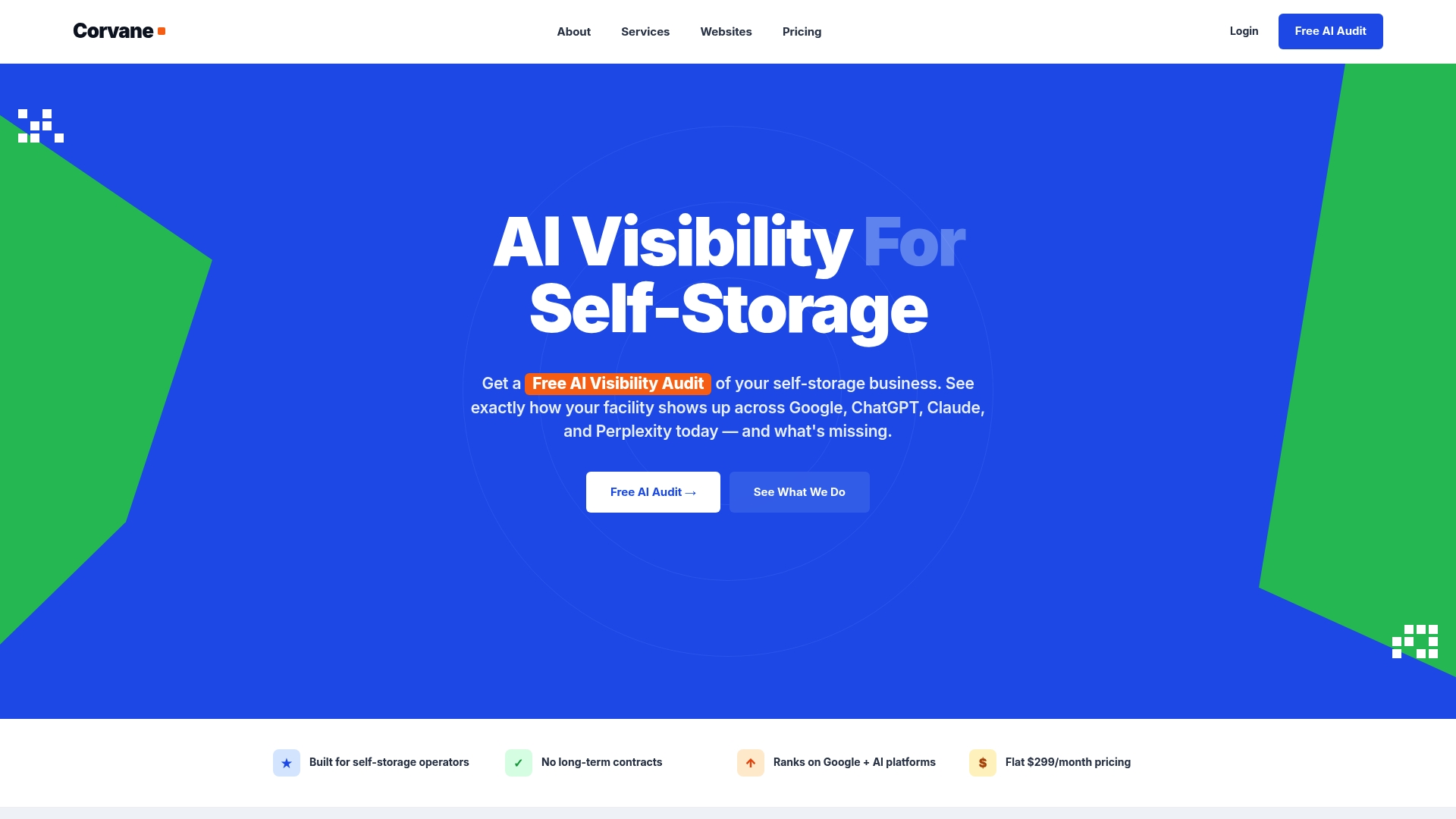
Corvanesystems is built specifically for self-storage operators who want their facility to appear when potential tenants search on Google or ask an AI assistant where to rent a unit. Most facilities are invisible to ChatGPT, Perplexity, and Google AI Overviews because their digital presence is not structured for how those systems read and recommend businesses. Corvanesystems closes that gap with AI-optimized content, local search positioning, and AI visibility audits that show exactly where your facility stands and what to fix. If you are ready to turn online discovery into booked units, Corvanesystems offers a flat monthly rate with no contracts and no minimums.
FAQ
What are self storage AI recommendations?
Self storage AI recommendations are data-driven suggestions generated by AI tools trained on your facility's operational data, covering pricing, tenant communication, and workflow automation. The most effective recommendations come from systems integrated directly with your facility management software.
How does AI improve self-storage occupancy rates?
AI improves occupancy by speeding up lead response times, automating follow-up sequences, and adjusting rental rates based on live vacancy data. Faster responses and accurate pricing convert more inquiries into signed leases.
What is the best first AI task for a self-storage operator?
Automating delinquency notifications and leasing follow-ups is the best starting point. These tasks are low-risk, high-volume, and typically show measurable results within 60 days of implementation.
Why do standalone AI tools fail in self-storage?
Standalone AI tools fail because they require manual data entry to function, which adds workload and reduces staff adoption. AI that integrates directly with existing management software runs without friction and produces more reliable outputs.
How do I evaluate an AI tool for my storage facility?
Evaluate AI tools on three criteria: direct integration with your management software, use of your real facility data rather than generic market data, and a clear track record of measurable outcomes such as additional rentals or reduced delinquency rates.