
Why your storage facility isn't appearing in ChatGPT results
Your storage facility isn't showing up in ChatGPT because the AI doesn't browse the web the way Google does. It pulls from a specific set of pre-indexed sources, and if your business isn't accurately represented there, you simply don't exist to it.
Here's what's actually driving the omission:
- ChatGPT doesn't run a live web crawl for every query. Many queries are answered from cached training data, meaning new or recently updated facilities may not appear at all.
- The primary data sources include Bing's web index, Yelp, and Foursquare, not Google Business Profile. Your Google ranking is largely irrelevant here.
- NAP consistency is non-negotiable. When ChatGPT finds conflicting Name, Address, or Phone number data across Foursquare, Yelp, and Bing, it loses confidence in the listing and omits it.
- Incomplete or missing listings on those key platforms mean the AI has nothing to work with, regardless of how strong your website is.
- Review volume and recency across multiple platforms influence which businesses get surfaced. A thin review profile signals low credibility to the AI.
- Structured data on your website matters. Without LocalBusiness JSON-LD markup, AI tools struggle to parse your business details accurately.
- Knowledge cutoffs and update lag can exclude facilities that opened recently or changed their information within the past several months.
Table of Contents
- How ChatGPT actually gathers local business information
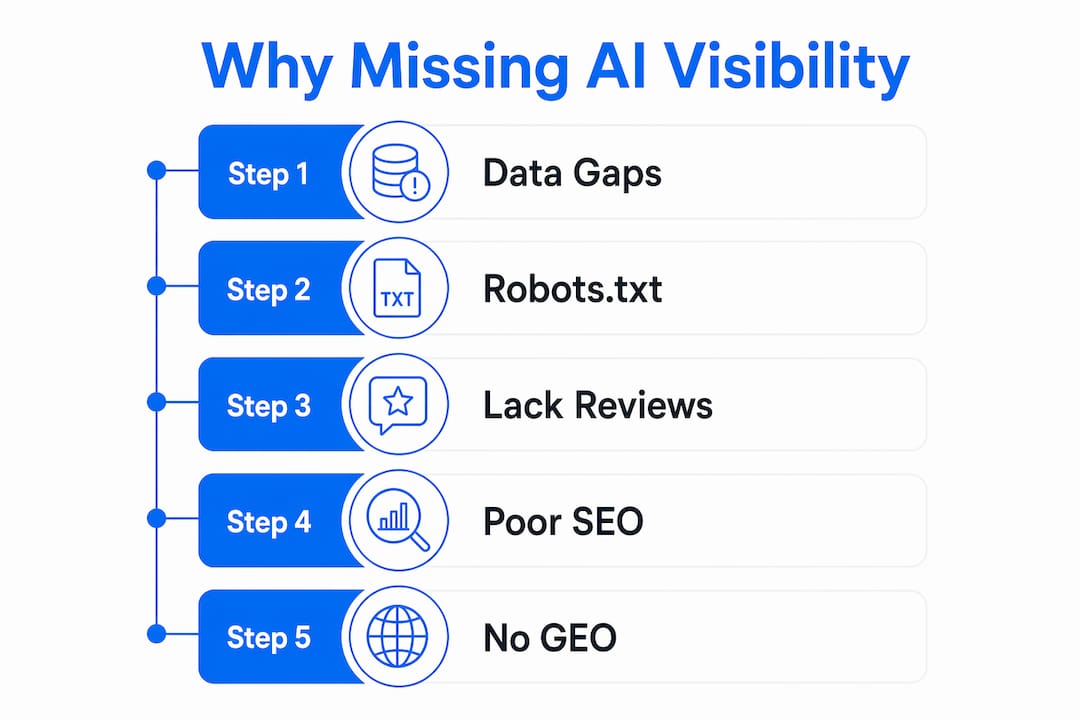
- Common reasons your storage facility is missing from AI results
- Steps to improve your storage facility's AI visibility
- How professional SEO and AI visibility services close the gap
- Key Takeaways
How ChatGPT actually gathers local business information
ChatGPT doesn't work like a search engine. It decides per prompt whether to run a web search at all, and when it does, it queries Microsoft Bing alongside APIs from Yelp and Foursquare. Google Business Profile data reaches ChatGPT only indirectly, if Bing's crawler happened to index it.

That distinction matters for storage operators. You can have a perfectly optimized Google Business Profile and still be completely invisible to ChatGPT if your Bing Places listing is unclaimed or inaccurate.
The AI then synthesizes data from those multiple sources using its own logic, not search engine rankings. A small portion of URLs cited by ChatGPT rank in Google's top 10. Ranking well on Google doesn't translate to AI visibility. The AI prioritizes data accuracy and cross-platform consistency over domain authority.
Review content also feeds into this process. ChatGPT analyzes sentiment and detail across platforms to determine which businesses are worth recommending. A business with many detailed, positive reviews sends a stronger signal than one with few reviews. Volume, recency, and detail all factor in.
Common reasons your storage facility is missing from AI results
Most storage operators who can't find their facility in ChatGPT share a handful of fixable problems. Here's where to look first:
- Missing or unclaimed listings on Bing Places, Yelp, and Foursquare. Foursquare provides about 70% of ChatGPT's local results, and Yelp data appears in one-third of responses. If you're not there, you're not in the conversation.
- Inconsistent NAP data across directories. A different phone number on Yelp than on your website, or an old address still live on Foursquare, is enough for the AI to drop your listing entirely.
- No LocalBusiness JSON-LD schema on your website. Without it, AI tools can't reliably confirm your business name, hours, services, or location.
- Thin or outdated review profiles. Few reviews, or reviews clustered on just one platform, don't give the AI enough signal to recommend you confidently.
- OAI-SearchBot blocked in your robots.txt. If your site disallows OpenAI's crawler, ChatGPT can't fetch your website data directly.
- New or recently rebranded facility. Update lag and knowledge cutoffs mean it can take months for changes to surface in AI results.
- Generic, thin website content. Pages with no service details, no FAQs, and no geographic specificity give the AI nothing to cite. Sections structured with detailed content earn significantly more AI citations than sparse pages.
- Relying on Google SEO alone. Traditional local SEO and AI visibility are different games. A strong Google ranking doesn't carry over to ChatGPT's recommendation logic.
Pro Tip: Check your robots.txt file right now. Search for "OAI-SearchBot" and confirm it's not listed under Disallow. This single fix can open direct access to your site for ChatGPT's crawler.
Steps to improve your storage facility's AI visibility
Getting your facility in front of ChatGPT users isn't complicated, but it does require working the right levers, not just the Google ones. Here's what actually moves the needle:
- Claim and verify your listings on Foursquare, Yelp, and Bing Places. These are the platforms ChatGPT draws from most heavily. Treat them with the same attention you give Google Business Profile.
- Audit your NAP data across every directory. Your name, address, and phone number must match exactly, character for character, across all platforms. Use a tool like Moz Local or BrightLocal to catch discrepancies.
- Add complete LocalBusiness JSON-LD markup to your website. Include your business name, address, phone, hours, service types, and geographic area served. This gives AI tools machine-readable confirmation of who you are.
- Build a steady flow of fresh reviews across multiple platforms, not just Google. Ask satisfied customers to leave reviews on Yelp and other platforms. Recency and variety matter more than chasing a perfect star rating.
- Expand your website content with detailed service pages, FAQs, and pricing. Thin pages don't get cited. Detailed, well-organized content that answers real customer questions does. A solid local lead generation strategy starts with content that AI can actually parse and trust.
- Allow OAI-SearchBot in your robots.txt. Add a specific allow rule so OpenAI's crawler can access your site.
- Keep your business hours, descriptions, categories, and photos synchronized across all platforms. Stale or conflicting information erodes AI confidence over time.
- Run an AI visibility audit to see exactly where your facility stands across ChatGPT, Claude, Perplexity, and Google AI. You can't fix what you haven't measured.
Pro Tip: Don't wait for reviews to come in organically. Build a simple post-move-in follow-up sequence, a text or email three days after a customer rents a unit, asking for a review on Yelp or Bing. Consistent volume beats occasional five-star spikes.
How professional SEO and AI visibility services close the gap
Traditional SEO gets you found on Google. It doesn't get you recommended by ChatGPT. Those are two different problems requiring two different approaches, and most storage operators are only solving one of them.
Generative Engine Optimization (GEO) is the practice of structuring your digital presence so AI systems can correctly understand, index, and recommend your business. It covers multi-platform directory consistency, schema markup, AI-specific content formatting, and crawler access, none of which standard SEO campaigns typically address.
Corvanesystems is built specifically for this gap. The agency combines traditional SEO with GEO, running AI visibility audits that score how your facility appears across ChatGPT, Claude, Perplexity, and Google AI, then delivers a concrete roadmap to fix what's broken. Managing schema errors, directory claims, and review strategies across platforms is time-consuming work. Having a team that does it specifically for storage operators, and tracks the results monthly, removes the guesswork entirely.
For operators who need a stronger foundation, Corvanesystems also builds custom websites designed for AI discoverability, with proper structured data and semantic content built in from the start. Pricing is a flat monthly rate with no contracts or minimums, which makes it accessible whether you run one facility or ten.
If your facility isn't showing up where customers are now making decisions, get your AI visibility assessed and find out exactly what's holding you back.
Key Takeaways
Your storage facility's absence from ChatGPT almost always traces back to missing or inconsistent data on the specific platforms AI tools actually use: Foursquare, Yelp, and Bing Places.
| Point | Details |
|---|---|
| ChatGPT's data sources | Bing, Yelp, and Foursquare drive results; Google Business Profile has no direct influence. |
| NAP consistency is critical | Conflicting name, address, or phone data across directories causes AI to omit your listing. |
| Foursquare provides about 70% of ChatGPT's local results; claiming and optimizing your Foursquare listing is one of the highest-impact actions you can take. | |
| OAI-SearchBot access matters | Blocking OpenAI's crawler in robots.txt cuts off direct site indexing by ChatGPT. |
| GEO differs from traditional SEO | Only 12% of URLs ChatGPT cites rank in Google's top 10; AI visibility requires its own strategy. |