
Getting your storage facility found online is defined as building a digital presence strong enough that local renters discover, evaluate, and book your units without ever calling first. Search behavior has shifted sharply toward online discovery. Customers now expect to compare prices, check real-time availability, and reserve a unit in minutes. Storage marketplaces aggregate over 100–300 facilities per metro area, with prices starting as low as $6 per month. That level of transparency sets the bar every operator must clear. Corvanesystems works specifically with storage operators to close the gap between being listed and being chosen.
How to get your storage facility found online: start with the right platforms
The fastest path to visibility is not your own website. Marketplace listings deliver better immediate discovery than relying solely on an individual facility site, because marketplaces consolidate the pricing and availability data renters demand before making a decision. A renter searching "storage near me" on a Tuesday evening is not browsing one facility's site. They are scanning a results page that shows dozens of options side by side.
Large self-storage marketplaces serve as the primary discovery hubs for most local searches. They pull real-time pricing and availability from hundreds of facilities, giving renters the comparison experience they expect. Facilities that feed accurate, current data into these platforms appear more often and rank higher within marketplace search results.
The aggregation benefit is real. When a marketplace lists your 10x10 climate-controlled unit at $89 per month next to your competitor's at $95, you win that click without spending a dollar on ads. The key is that your listing must be complete, accurate, and updated.
- List on major self-storage marketplaces and keep pricing current. Stale rates cost you clicks.
- Include every unit type you offer, from small lockers to large drive-up units, so the platform can match your facility to a wider range of searches.
- Add high-quality photos for each unit category. Renters filter by photos before they read descriptions.
- Verify your facility address and hours match exactly across every platform. Inconsistencies confuse both renters and search algorithms.
Pro Tip: Set a calendar reminder to audit your marketplace listings every 30 days. Pricing changes, seasonal promotions, and new unit types should update within 48 hours of going live at your facility.
What role do AI tools play in helping customers find storage?
AI-powered tools are now a standard part of the online storage search experience, and they directly affect which facilities get recommended. AI size estimators analyze photos submitted by renters and recommend the right unit size in real time. That kind of personalized guidance reduces hesitation and captures leads earlier in the decision process, before a renter has committed to any facility.

The implication for operators is clear. If your facility's unit descriptions are thin or generic, AI tools cannot match your inventory to a renter's specific need. Structured, detailed unit information is what allows AI-assisted search engines to recommend your facility over a competitor's. This applies to Google's AI Overviews, ChatGPT, Perplexity, and any other AI tool a renter might use to ask "what size storage unit do I need?"
The table below shows the difference between a listing that AI tools can work with and one they cannot.
| Listing element | Weak version | Strong version |
|---|---|---|
| Unit description | "10x10 storage unit" | "10x10 drive-up unit, climate controlled, fits 2-bedroom apartment contents" |
| Amenities | "Climate control available" | "Individual climate control per unit, 24/7 keypad access, gated perimeter, video surveillance" |
| Pricing | "$89/month" | "$89/month, first month free, no credit card required to reserve" |
| Unit photos | None | Interior and exterior photos for each unit size |
- Write unit descriptions in plain language that mirrors how renters search. "Fits a 2-bedroom apartment" outperforms "200 square feet" every time.
- List every amenity explicitly. Transparency on climate control, 24/7 access, and gated security converts search traffic into reservations.
- Use structured data markup on your website so search engines can read your unit types, sizes, and prices as machine-readable data.
Pro Tip: Treat your unit descriptions like product pages, not classified ads. The more specific the language, the better AI tools can match your inventory to what a renter actually needs.
How does online booking reduce friction and increase reservations?
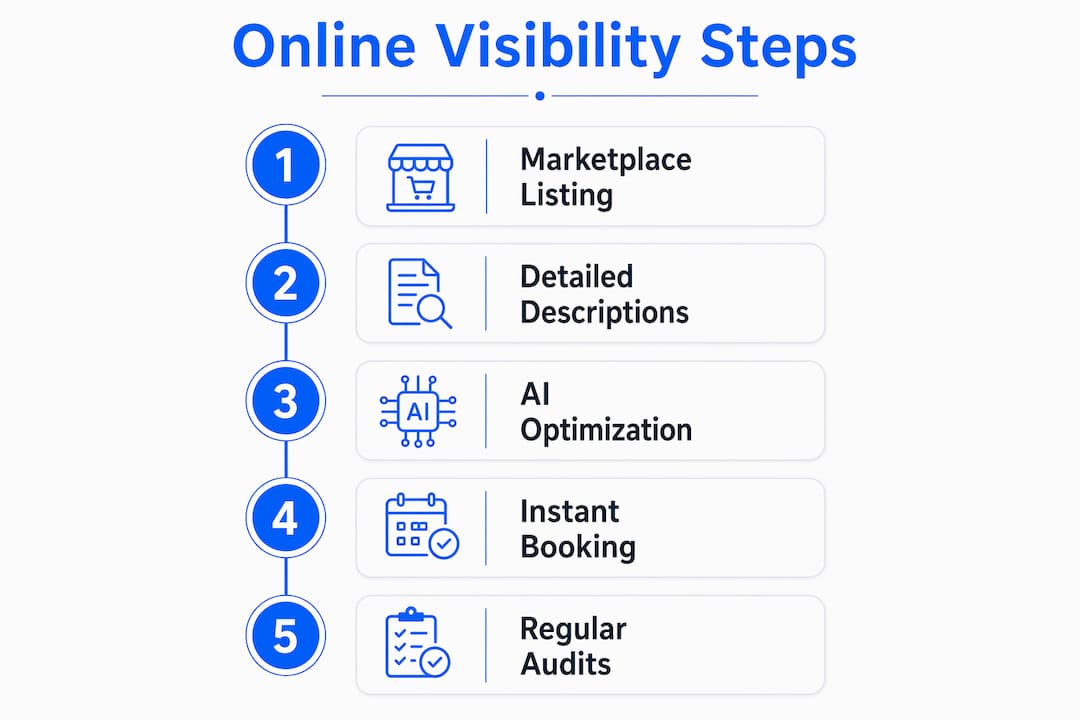
Frictionless booking is a direct ranking signal on major marketplaces. Platforms prioritize listings with instant reserve availability, which means facilities that require a phone call to complete a reservation appear lower in results than those with one-click booking. The renter who hits a wall at checkout does not call. They click the next listing.
The "reserve online with no credit card required" model has become the standard for high-converting storage listings. No credit card booking attracts high-intent traffic because it removes the single biggest friction point in the reservation process. A renter who commits to a reservation without entering payment details is still a qualified lead. You can collect payment at move-in.
Here is the booking setup that produces the best results:
- Enable one-click reservations directly from your marketplace listing and your own website. Renters should never need to leave the page to complete a hold.
- Send instant confirmation by email and text. Confirmation builds trust and reduces no-shows. A renter who receives a confirmation within 60 seconds feels committed.
- Offer month-to-month rental terms on your listing. Month-to-month options increase conversions when renters are comparison shopping, because flexibility lowers the perceived risk of choosing your facility.
- Sync your facility management software with every marketplace and your own site. Real-time availability data prevents double bookings and keeps your listings accurate around the clock.
- Test your booking flow monthly. Walk through the reservation process as a renter would. Broken forms and outdated availability are invisible to operators but obvious to customers.
How do you localize your online presence to attract nearby renters?
Local search visibility is the engine behind "search for storage near me" queries, and it runs on three inputs: accurate location data, consistent reviews, and location-specific content. A facility with a fully optimized Google Business Profile appears in the local map pack, which sits above organic results on most mobile searches. That placement alone drives a measurable share of inbound calls and reservations.
- Claim and fully complete your Google Business Profile. Add your address, hours, phone number, website, photos, and a description that includes your city and neighborhood name.
- Use location-specific keywords on your website and listings. "Climate-controlled storage in [City Name]" outperforms generic phrases like "storage units available."
- Collect and respond to reviews. Online reviews directly influence local search rankings. A facility with 50 recent reviews ranks above one with 10 old reviews, even if the older reviews are higher rated.
- Add location signals to your website. Your city, zip code, and nearby landmarks should appear in your page titles, meta descriptions, and body content.
- Build local citations. List your facility on Yelp, Apple Maps, Bing Places, and local business directories. Consistent name, address, and phone number data across all platforms strengthens your local search authority.
What mistakes hurt a storage facility's online visibility?
The most common visibility problem is not a missing tactic. It is inaccurate or outdated information sitting on live listings. A facility that raised prices in march but did not update its marketplace listings will show the wrong rate to every renter who finds it. That mismatch destroys trust before the renter ever contacts you.
- Outdated pricing on marketplace listings creates a bait-and-switch experience. Update rates within 24 hours of any change.
- Broken software integrations cause availability to fall out of sync. Real-time syncing is required for marketplace visibility. Check your integration status weekly.
- Poor mobile experience costs reservations. Mobile-optimized pages rank higher and convert better. If your site takes more than three seconds to load on a phone, you are losing renters before they see your rates.
- Missing or low-quality photos reduce click-through rates on every platform. Renters skip listings without images.
- No response to negative reviews signals neglect. Respond to every review, positive or negative, within 48 hours.
Pro Tip: Run your facility's website through Google's PageSpeed Insights once a month. A score below 70 on mobile is costing you bookings. Fix image sizes and server response time first.
Key Takeaways
Getting a storage facility found online requires accurate listings, structured unit information, frictionless booking, and consistent local signals working together across every platform where renters search.
| Point | Details |
|---|---|
| Marketplace listings first | List on major aggregator platforms before investing in standalone SEO to capture immediate search traffic. |
| Structured unit descriptions | Write detailed, plain-language unit descriptions so AI tools can match your inventory to renter searches. |
| Frictionless booking | Enable no-credit-card reservations and instant confirmation to reduce drop-off at checkout. |
| Local SEO signals | Optimize your Google Business Profile and collect recent reviews to rank in local map results. |
| Accurate, synced data | Keep pricing and availability current across all platforms to maintain marketplace visibility and renter trust. |
Why most storage operators are invisible online and what actually fixes it
The operators I see struggling most are not the ones ignoring digital marketing. They are the ones who set up a marketplace listing two years ago and assumed the work was done. Search is not a one-time setup. It is a living system that rewards facilities that stay current and punishes those that go quiet.
The shift toward AI-assisted search has made this more urgent. When a renter asks ChatGPT or Google's AI Overview "where can I find storage near me," the answer comes from structured, well-maintained data. Facilities with thin descriptions and stale pricing simply do not surface. The AI has nothing useful to say about them.
What actually works is the combination of complete marketplace listings, detailed unit content, real-time booking, and local review management. None of these tactics is complicated on its own. The challenge is doing all of them consistently. Most operators have the time for one or two but let the others slip. That inconsistency is what creates the visibility gap.
The facilities I have seen grow occupancy fastest are the ones that treat their online presence like a product. They update it, test it, and improve it on a schedule. They do not wait for a slow month to ask why no one is calling.
— Mike
How Corvanesystems helps storage facilities get found and booked
Storage operators who want consistent online visibility need more than a checklist. They need a system that keeps listings accurate, content structured, and local signals strong month after month.
Corvanesystems is built specifically for self-storage operators. The service covers technical SEO, Google Business Profile optimization, AI-optimized content published monthly, and visibility audits across ChatGPT, Claude, Perplexity, and Google AI. When a renter searches "storage near me" or asks an AI assistant for a recommendation, your facility needs to be the answer. Corvanesystems structures your digital presence for storage so that outcome happens reliably. One flat monthly rate, no contracts, no minimums. Built for storage operators who want to lease more units without chasing leads manually.
FAQ
What is the fastest way to get a storage facility found online?
List your facility on major self-storage marketplaces with complete, accurate unit descriptions and real-time pricing. Marketplace listings deliver faster visibility than a standalone website for most local searches.
How do AI tools affect storage facility search rankings?
AI search tools recommend facilities with structured, detailed unit information. Thin or generic descriptions make it harder for AI systems to match your inventory to a renter's specific search query.
Why does "no credit card required" booking matter for online visibility?
Platforms prioritize listings with instant reserve availability, and no-credit-card booking reduces the friction that causes renters to abandon the reservation process before completing it.
How do customer reviews help a storage facility rank locally?
Recent, high-volume reviews are a direct local search ranking signal. A facility with consistent new reviews outranks one with older reviews, even when the older ratings are higher.
What is the most common mistake that hurts storage facility visibility?
Outdated pricing and availability data on marketplace listings is the most damaging error. Inaccurate information reduces platform ranking and breaks renter trust before the first contact.