
Most self-storage facilities are invisible to AI search tools right now, and their owners have no idea. Whether your facility shows up when someone asks ChatGPT, Claude, Perplexity, or Google AI Overviews for "storage near me" depends on a handful of technical factors you can check and fix today.
Here is the short answer: your storage business's AI visibility comes down to three things.
- Crawler access. Your robots.txt file either allows or blocks AI crawlers like GPTBot and ClaudeBot. If it blocks them, AI platforms cannot read your site, regardless of your Google ranking.
- Content structure. AI systems favor plain-text details, schema markup, and FAQ pages over generic marketing copy. Facilities with LocalBusiness and FAQPage schema markup tend to appear in Google AI Overviews within days of publishing well-structured content.
- Trust signals. A complete Google Business Profile, third-party reviews, and directory listings all tell AI platforms your facility is real and worth recommending.
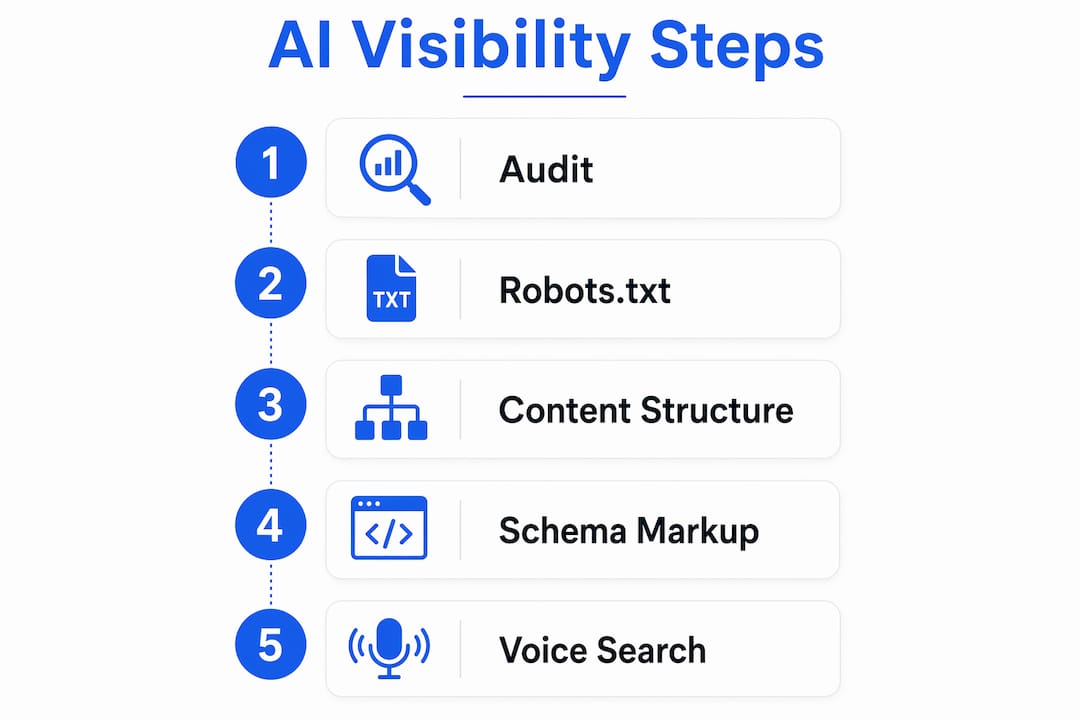
The fastest way to get a baseline reading is isvisible.ai, a free tool that audits your site against 13 AI crawlers including GPTBot, ClaudeBot, and Google-Extended. It checks your robots.txt and llms.txt files and returns a 0–100 score: crawler access counts for 80 points, while publishing an llms.txt file adds the remaining 20. If your score is below 50, most AI platforms cannot see your content at all.
How AI search differs from traditional search and what it means for your facility
Traditional Google search hands users a list of ten blue links and lets them decide. AI search skips that entirely. When someone asks ChatGPT or Perplexity which storage facility to use in their city, the AI returns two or three specific recommendations with reasons attached. There is no page two. If your facility is not in that short list, the tenant never sees you.

The mechanics behind that recommendation are worth understanding. AI platforms do not rank pages by keyword density. They analyze structured, authoritative content and look for business profiles and reviews that confirm a facility is legitimate. Generic phrases like "clean, safe, and affordable storage" get ignored. Concrete answers to specific questions, like what fits in a 10x10 unit or whether you prorate rent, get cited.
A few practical contrasts between the two systems:
- Traditional search rewards keyword placement, backlink volume, and page authority built over months.
- AI search rewards factual specificity, schema markup, and trust signals that can be verified by a machine in seconds.
- Traditional search shows users a list they must evaluate themselves.
- AI search delivers a single recommendation the user already trusts before clicking.
- Traditional search takes weeks or months to reflect new content.
- AI search can surface a well-structured facility page within days of publication.
The shift matters because tenants are already using AI to make storage decisions. Operators who understand this early have a window of advantage that will close as the rest of the industry catches up.
What technical factors determine whether AI can find your storage website
Crawlability is the foundation. Before any AI platform can recommend your facility, its crawler needs permission to read your site. Your robots.txt file, located at yourdomain.com/robots.txt, controls that access. A single disallow rule aimed at "all bots" can block GPTBot, ClaudeBot, and Perplexity's crawler simultaneously, making your site invisible to every major AI platform even if you rank on the first page of Google.

Beyond access, the structure of your content determines whether AI can actually use what it finds.
| Technical factor | What AI needs | Common mistake |
|---|---|---|
| robots.txt | Allow rules for GPTBot, ClaudeBot, Google-Extended | Blanket "Disallow: /" blocking all crawlers |
| llms.txt | A plain-text summary of your site at /llms.txt | File missing entirely |
| Schema markup | LocalBusiness and FAQPage structured data | No schema on facility pages |
| Page content | Plain-text address, hours, unit sizes, prices | Key details buried in images or widgets |
| Site speed | Fast load times on mobile | Heavy image carousels slowing render |
Schema markup deserves special attention. LocalBusiness schema tells AI your facility is a physical business with a real address and operating hours. FAQPage schema flags your question-and-answer content as structured data AI can extract directly. Most self-storage websites have neither, which means operators who add both gain an immediate structural advantage over facilities that do not.
The "dark content" problem catches a lot of operators off guard. Pricing grids built as images, unit availability shown only through interactive JavaScript widgets, and hours embedded in a PDF are all invisible to AI crawlers. A quick test: disable JavaScript in your browser, reload your facility page, and see what remains. That approximation is roughly what GPTBot sees when it visits your site.
Pro Tip: Add a plain-text pricing table directly on your facility page, even if you also have an interactive availability widget. The widget serves human visitors; the plain-text table serves AI crawlers. You need both.
1. Run an AI visibility audit before anything else
Start with isvisible.ai to get a concrete score. The tool checks all 13 major AI crawlers and tells you exactly which ones can access your site and which are blocked. A low score means most AI platforms cannot see your content. The report breaks down access by agent, so you can see whether ChatGPT's live browsing is allowed while ClaudeBot is blocked, or whether the problem is a blanket robots.txt rule affecting everyone.
Once you have your score, check your robots.txt file directly. If you see "Disallow: /" under a User-agent that covers AI bots, that is your first fix. Add explicit allow rules for GPTBot, ClaudeBot, and Google-Extended. Then create an llms.txt file at your domain root with a plain-text summary of your facility, its services, and its location. That single file adds 20 points to your isvisible.ai score and gives AI answer engines a clean, direct description of your business.
For a deeper look at what signals Google AI Overviews specifically need, the AI visibility audit guide from Corvanesystems walks through the full checklist.
2. Build FAQ pages that answer real tenant questions
Generic FAQ pages with questions like "Why choose us?" do nothing for AI visibility. What works is a page that mirrors the actual questions your staff fields every day: "Do you prorate rent if I move out early?" "Can I access my unit after midnight?" "What is the smallest unit that fits a one-bedroom apartment?"
Effective FAQ content uses short, honest, two-sentence answers written the way you would respond on the phone. AI platforms extract these as definitive answers to common queries. Pair each FAQ page with FAQPage schema markup so AI crawlers recognize the structure immediately. The questions tenants ask a voice agent or AI phone assistant are the same ones they type into ChatGPT, so if you run any kind of phone or chat system, pull your most common inbound questions and write those first.
3. Keep your Google Business Profile complete and current
Your Google Business Profile is one of the primary sources AI platforms use to verify that your facility exists and is worth recommending. An incomplete or inactive profile with missing hours, no recent photos, or outdated contact details signals unreliability to AI systems. A complete, regularly updated profile costs nothing and functions as a trust anchor across ChatGPT, Google AI Overviews, and Perplexity simultaneously.
At minimum, your profile should include accurate hours, a current phone number, your full address, recent photos, and a response to at least some of your reviews. AI platforms also weight mentions in local news, storage directories, and regional social media groups as confirmation that your facility is real and active. Getting listed in niche storage directories and earning a mention in a local publication carries more weight than most operators realize.
4. Make every facility page a citable entity
A generic "locations" page that lists twenty facilities with nothing but city names is not something AI will cite. A facility page with the street address, phone number, operating hours, manager name, unit sizes, starting prices, and recent reviews is a citable entity. AI needs enough specific, verifiable detail to construct a recommendation with reasons attached.
Write each facility page so that the address, hours, unit sizes, and starting prices appear as plain text on the page itself, not inside a widget or image. Detailed pages with this information get cited and drive inquiries; generic location pages get skipped. If you operate multiple facilities, each one needs its own dedicated page with its own specific details. The guide to building a storage website for AI search covers the full page structure in detail.
5. Add LocalBusiness and FAQPage schema markup
Schema markup is code added to your website that tells AI and search engines what your content means, not just what it says. LocalBusiness schema identifies your facility as a physical business with a specific address, phone number, and hours. FAQPage schema marks up your question-and-answer content so AI can extract it directly as a structured response.
Most self-storage websites have no schema at all. Adding both types puts your facility in a small minority of operators who have done this work, and the payoff is measurable: facilities with precise schema and FAQ content tend to appear in Google AI Overviews within days of publishing, compared to weeks or months for traditional SEO results. Ask your website provider whether your site has schema markup. If the answer is no or uncertain, treat it as a priority fix.
6. Optimize for voice search and conversational queries
Voice search and AI assistants handle queries differently than typed searches. Someone typing into Google might search "10x10 storage Austin." The same person asking Siri or a smart speaker says, "What is the best storage unit near me for a two-bedroom apartment?" AI platforms process that second format and look for content written in the same conversational register.
Write facility page copy and FAQ answers the way a knowledgeable person would speak, not the way a keyword list reads. Phrases like "our 10x10 units comfortably hold the contents of a two-bedroom apartment, including furniture" serve both voice queries and AI citation far better than a bare unit size listing. This is also why FAQ pages written in natural, phone-conversation style outperform those written as bullet lists of features.
7. Deploy an AI chatbot or virtual assistant on your website
When a tenant arrives at your site after an AI recommendation, they expect to continue a conversation. A contact form and a phone number do not meet that expectation. An AI chatbot or virtual assistant that can answer specific questions, like what units are available, what they cost, and when the tenant can move in, converts that AI-driven traffic before the visitor goes back to ChatGPT to ask again.
GEO and operational AI work as two halves of the same process: the first gets a tenant to your facility's name through AI search, and the second converts the inquiry through a live, responsive website experience. Operators who close that loop see higher conversion rates from AI-generated traffic than those who rely on static pages alone. The chatbot also generates a log of real tenant questions, which feeds directly back into your FAQ content strategy.
8. Use AI analytics to track and adapt your visibility
Knowing your isvisible.ai score is a starting point, not an ongoing strategy. Search Perplexity and Google AI Overviews regularly for queries like "best storage in [your city]" or "climate-controlled storage near [your zip code]" and note whether your facility appears, which competitors are cited, and what language the AI uses to describe them. That language tells you exactly what structured content and trust signals the AI is reading.
Track keyword rankings and organic traffic monthly alongside your AI visibility score. When a content update or schema addition correlates with a jump in AI citations, you know what to replicate. Corvanesystems provides monthly reporting that covers keyword rankings, organic traffic, and AI visibility across ChatGPT, Claude, Perplexity, and Google AI, so operators can see the connection between specific changes and measurable outcomes.
9. Publish content consistently to build AI trust over time
AI platforms build trust incrementally. A facility that publishes specific, helpful content regularly and accumulates citations over time becomes more likely to be recommended than one that published a single optimized page last month. Facilities cited by AI first tend to continue being cited because AI systems weight previously referenced content more heavily than something new.
Thirty keyword-focused articles per month, each structured around real tenant questions and local search terms, is the publishing cadence Corvanesystems uses for storage clients. That volume builds topical authority across the full range of queries tenants ask AI, from unit sizing guides to climate control comparisons to move-in cost breakdowns. Consistency compounds. A facility that starts this work now will be significantly harder to displace six months from now than one that waits.
For operators who want to understand the full picture before committing to a content program, the 2026 operator guide to AI visibility covers the complete strategy in one place.
Expert insights on AI visibility for self-storage operators
Mike, the lead strategist at Corvanesystems, has spent years working specifically on AI and search visibility for self-storage facilities. His core observation is that most operators are losing inquiries not because their facilities are inferior, but because their digital presence was built for a search environment that no longer drives most booking decisions.
Corvanesystems combines traditional SEO with Generative Engine Optimization (GEO), the practice of structuring a facility's digital presence so AI systems can correctly understand, index, and recommend it. The service covers:
- AI visibility audits scoring how your facility currently appears across ChatGPT, Claude, Perplexity, Google AI, and llms.txt, with a specific roadmap to improve each signal.
- Technical SEO including full site audits, metadata optimization, and schema markup implementation.
- Local search positioning covering Google Business Profile optimization, city-based keyword targeting, and directory placement.
- AI-optimized content with 30 articles published monthly, each structured for conversational search and AI citation.
- Performance tracking with monthly reporting on keyword rankings, organic traffic, and AI visibility changes.
Pricing is a single flat monthly rate with no contracts, no tiers, and no minimums. For operators who also need a stronger website foundation, Corvanesystems builds custom, conversion-focused storage websites designed specifically for AI discoverability. Operators currently looking at self-storage businesses for sale in markets like Northwest Ohio will find that AI visibility is increasingly a factor in a facility's competitive position and long-term occupancy rate.
Pro Tip: Ask Corvanesystems for a free AI visibility score for your facility before your first conversation. It takes two minutes and gives you a concrete number to anchor the discussion.
If your facility is not showing up when tenants ask AI where to store their belongings, Corvanesystems can fix that. The audit takes days, not months, and the results show up in AI citations faster than traditional SEO ever could.
Key Takeaways
AI visibility for self-storage facilities depends on crawler access, structured content, and trust signals that AI platforms can verify independently of your Google ranking.
| Point | Details |
|---|---|
| Audit your AI score first | Use isvisible.ai to check access across 13 crawlers; crawler access counts for 80 points, llms.txt for 20. If your score is below 50, most AI platforms cannot see your content at all. |
| Fix robots.txt and add llms.txt | Blocking GPTBot or ClaudeBot prevents AI citation even when your Google rank is strong. |
| Add schema markup | LocalBusiness and FAQPage schema help facilities appear in Google AI Overviews within days of publishing. |
| Make key details plain text | Pricing, hours, and unit sizes buried in images or widgets are invisible to AI crawlers. |
| Publish consistently | Facilities cited by AI first tend to keep being cited as AI systems build trust over time. |