
A self storage AI visibility audit measures how your facility appears across AI-powered search platforms like ChatGPT, Claude, Perplexity, Gemini, and Google AI, then identifies exactly what to fix to get more bookings. This process goes beyond traditional SEO. Search behavior has shifted: customers now ask AI assistants "where should I rent a storage unit near me?" and book based on the answer they receive. If your facility isn't the answer those platforms give, you're losing move-ins to operators who are. Running a structured AI visibility audit, also called an answer-engine optimization review, is the clearest way to close that gap.
What is a self storage AI visibility audit?
A self storage AI visibility audit is a structured review of how AI platforms represent your facility when customers search for storage. The goal is to measure your AI-driven search presence, identify gaps in how AI models understand your facility, and produce a roadmap for improvement. This differs from a standard SEO audit, which focuses on Google's blue-link rankings. AI visibility audits focus on whether your facility surfaces as a recommended answer in zero-click AI responses.
Operators must move beyond traditional SEO and focus on how AI platforms represent their facilities to remain competitive. That shift matters because AI-generated answers often replace the search results page entirely. A customer never clicks through to compare websites. They get one answer, and they act on it.

The industry term for this discipline is Generative Engine Optimization, or GEO. GEO structures your facility's digital presence so AI systems can correctly understand, index, and recommend it. A visibility audit is the diagnostic step that tells you where your GEO currently stands.
What tools and data sources do you need?
Running an accurate audit requires the right inputs. Manual keyword tracking no longer captures how AI models represent your facility. Centralized dashboards replace manual tracking with dynamic monitoring across AI platforms, giving you a real-time picture of your visibility position.
The core data sources you need include:
- AI visibility scores: A numeric measure of how often and how prominently your facility appears in AI-generated answers.
- Citation tracking: Records of which sources AI platforms pull from when recommending your facility.
- Sentiment insights: Analysis of whether AI platforms describe your facility positively, neutrally, or inaccurately.
- Competitive benchmarks: Your visibility scores compared against other facilities in your market.
- Source attribution data: Verification that AI platforms are linking to your actual website and correct information.
The AI platforms to monitor are ChatGPT, Gemini, Claude, Perplexity, and Google's AI-powered search. Each platform ingests data differently and weights sources differently. Auditing all five gives you a complete picture of your AI-driven search presence.
Pro Tip: Set up a single performance dashboard that pulls visibility data from all five AI platforms simultaneously. Checking each platform manually once a week produces stale data and misses the patterns that only appear across a full dataset.
Competitive benchmarking is the data point most operators skip. Knowing your own visibility score means little without knowing how nearby facilities score. A facility ranking third in AI recommendations in a five-facility market is in a very different position than one ranking third in a twenty-facility market.
How to conduct the audit step by step
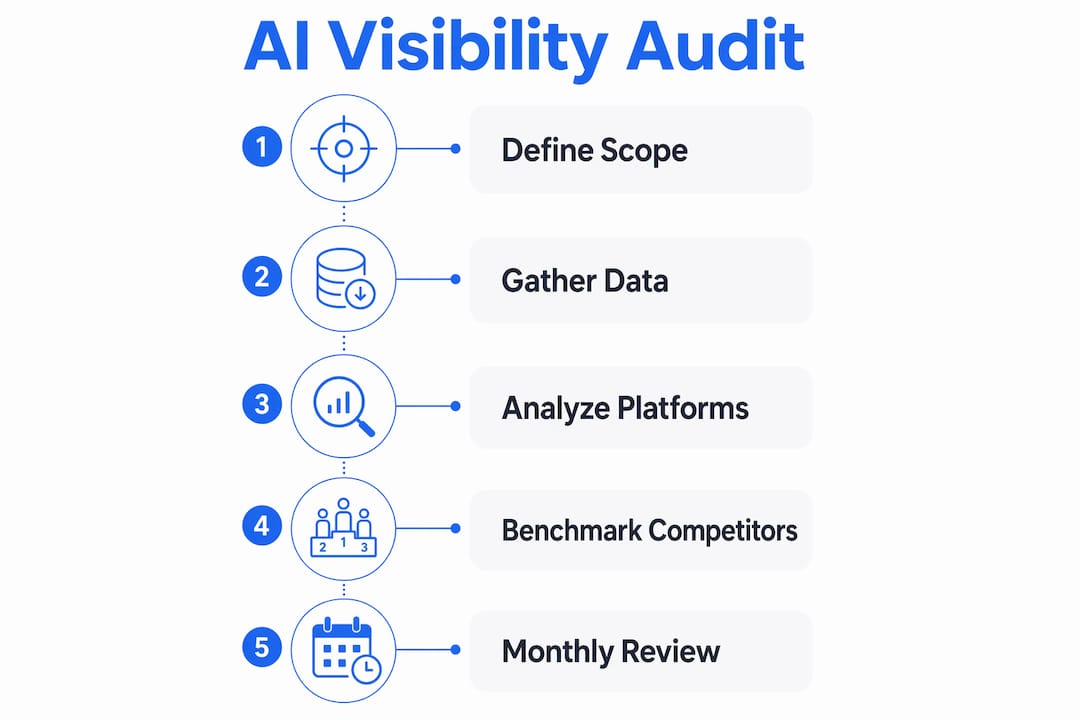
A structured audit follows five repeatable steps. Skipping any one of them produces incomplete findings and weak recommendations.
-
Connect your facility to an AI visibility dashboard. Your facility's name, address, phone number, website URL, and unit types must be consistent across every platform where they appear. Inconsistent data is the most common reason AI models misrepresent or omit a facility entirely.
-
Review your AI visibility scores across all platforms. Pull scores from ChatGPT, Gemini, Claude, Perplexity, and Google AI. Note which platforms rank you highest and which show the largest gaps. Platforms where you score low are your highest-priority targets.
-
Analyze competitor benchmarks and sentiment trends. Compare your scores against the top-performing facilities in your local market. Look at how AI platforms describe those facilities versus how they describe yours. Sentiment differences often reveal specific content gaps you can address directly.
-
Verify source attribution. Confirm that when AI platforms cite your facility, they are pulling from your website and not from outdated third-party listings. Source attribution verification catches citation errors that silently damage your credibility with AI systems.
-
Identify underperforming areas and build a fix list. Rank your gaps by impact. Missing structured data, thin content, and inconsistent business information are the three most common problems. Each has a direct fix.
Pro Tip: Run your audit on a monthly cycle, not a quarterly one. AI models update their training data and ranking signals more frequently than Google's crawl schedule. A monthly review catches drops before they cost you bookings.
Common audit mistakes include treating the audit as a one-time project, focusing only on Google AI while ignoring ChatGPT and Perplexity, and failing to re-audit after making changes. The audit is only useful if you close the loop and measure whether your fixes actually moved your scores.
What challenges arise during AI visibility audits?
The most common problems operators encounter fall into a predictable set. Knowing them in advance saves time and prevents false conclusions.
- Inconsistent structured data: If your facility's name, address, or phone number appears differently across your website, Google Business Profile, and third-party directories, AI models receive conflicting signals. The result is reduced confidence in your listing and lower visibility scores.
- Citation errors: AI platforms sometimes attribute information about your facility to the wrong source. This happens when outdated listings outrank your current website in the data sources AI models prefer.
- Misplaced SEO focus: Operators who have invested heavily in traditional SEO often assume their Google rankings translate directly to AI visibility. They don't.
- Data freshness delays: AI models don't update in real time. Changes you make today may take weeks to appear in AI-generated answers. Operators who expect instant results often abandon their fixes too early.
The critical mistake is ignoring answer-engine optimization and focusing instead on legacy SEO tactics that fail to influence AI citation and booking funnels. Prioritizing semantic authority and structured data is the direct path to AI citation and high-intent conversions.
Pro Tip: Build a structured data checklist that covers your facility name, address, phone, hours, unit types, pricing, and amenities. Verify this information matches exactly across your website, Google Business Profile, and every major directory. Consistency is what AI models reward.
Continuous audit cycles matter more than any single audit. Your competitors are making changes too. A facility that audits monthly and adjusts quickly will consistently outperform one that runs a single annual review.
How does AI visibility affect customer acquisition?
Higher AI visibility directly increases the number of customers who find your facility before they ever visit a competitor's website. AI visibility optimization has produced a 21% increase in AI-referred revenue and 278% growth in AI overview visibility within three months. Those numbers reflect what happens when a facility moves from invisible to recommended across major AI platforms.
The mechanism is straightforward. When a customer asks an AI assistant for storage recommendations, the platform returns one to three options. Facilities that appear in that set receive direct booking inquiries. Facilities that don't appear receive nothing, regardless of how well their website ranks on Google.
The competitive advantage compounds over time. Most operators in any given market have not yet run an AI visibility audit. That means being found on ChatGPT and other AI platforms is still an open opportunity in most local markets. Operators who act now build a visibility lead that is genuinely difficult for slower competitors to close.
AI visibility also integrates with broader digital marketing. A facility with strong AI presence typically has consistent structured data, authoritative content, and a well-maintained Google Business Profile. Those same assets improve traditional search rankings. The two disciplines reinforce each other when you build your site for AI search from the start.
AI search transforms consumer discovery of self storage. Operators who manage their AI brand presence actively will capture the move-ins that operators relying solely on traditional SEO will miss.
Key Takeaways
A self storage AI visibility audit is the most direct way to identify why AI platforms overlook your facility and what to fix to start capturing AI-driven bookings.
| Point | Details |
|---|---|
| Define your audit scope | Measure visibility across ChatGPT, Gemini, Claude, Perplexity, and Google AI, not just Google search. |
| Fix structured data first | Consistent name, address, phone, and unit data across all platforms is the foundation AI models require. |
| Benchmark against competitors | Your visibility score only matters in context. Know where you rank relative to nearby facilities. |
| Audit monthly, not annually | AI models update frequently. Monthly cycles catch drops before they cost you move-ins. |
| Measure revenue impact | Track AI-referred bookings after each audit cycle to confirm your fixes are producing real results. |
The audit most operators don't know they need
Operators ask me regularly why their Google rankings are strong but their occupancy has plateaued. The answer, almost every time, is AI visibility. They've built a solid traditional SEO foundation and assumed it would carry over to AI platforms. It doesn't work that way.
AI models don't read your website the way Google's crawler does. They pull from structured data sources, authoritative content signals, and verified business information. A facility with a well-ranked website but inconsistent directory listings and thin content will score poorly in AI-generated answers. The customer asking ChatGPT for storage recommendations near them will never see that facility's name.
What I've found actually works is treating the AI visibility audit as a monthly operational task, not a one-time marketing project. The operators who gain ground fastest are the ones who check their scores, fix the gaps, and check again. They treat AI visibility the way a good operator treats unit pricing: something you monitor and adjust regularly, not something you set once and forget.
The other misconception I see constantly is that AI visibility is only relevant for large multi-facility operators. A single-facility operator in a mid-sized market has more to gain from AI visibility than a regional chain does. The chain already has brand recognition. The independent operator needs every discovery advantage available.
AI platforms are where the next generation of storage customers starts their search. Getting your facility into those answers is not a future consideration. It's a current competitive requirement.
— Mike
Corvanesystems AI visibility for your storage facility
Corvanesystems is built specifically for self storage operators who need to be found across both traditional search and AI platforms.
Corvanesystems delivers AI visibility audits for storage that score your facility across ChatGPT, Claude, Perplexity, Google AI, and llms.txt, then give you a clear roadmap to improve each score. The service includes citation tracking, structured data corrections, AI-optimized content, and monthly performance reporting. Pricing is a single flat monthly rate with no contracts. For operators who need a stronger digital foundation, Corvanesystems also builds custom websites designed to perform in AI-powered search from day one. If your facility isn't showing up where customers are asking, that's the problem Corvanesystems solves.
FAQ
What is a self storage AI visibility audit?
A self storage AI visibility audit measures how your facility appears in AI-generated search answers across platforms like ChatGPT, Claude, Perplexity, Gemini, and Google AI. It identifies gaps in your AI representation and produces a fix list to improve your visibility and bookings.
Which AI platforms should I monitor for storage visibility?
Monitor ChatGPT, Gemini, Claude, Perplexity, and Google AI as a minimum. Each platform ingests data differently, so your visibility score can vary significantly across them.
Why doesn't my Google ranking improve my AI visibility?
Google rankings and AI visibility are separate signals. AI platforms require structured, verified data and authoritative content to recommend a facility. Strong Google rankings do not automatically transfer to AI-generated answers.
How often should I run an AI visibility audit?
Monthly audits are the standard for operators actively managing their AI presence. AI models update their data sources frequently, and monthly cycles let you catch and fix drops before they affect your occupancy rate.
What is the biggest mistake operators make with AI visibility?
The biggest mistake is focusing on legacy SEO tactics instead of answer-engine optimization. Operators who chase blue-link rankings while ignoring AI citation signals miss the customers who now book directly from AI-generated recommendations.