
Your storage website is not getting leads most likely because it has a friction problem, not a traffic problem. Visitors arrive, browse a few pages, and leave without calling, booking, or filling out a form. The site looks fine on the surface, but somewhere between landing and converting, something breaks the experience. Poor mobile performance, unclear calls to action, weak local SEO, and forms that demand commitment too early are the four most common culprits, and fixing even one of them can produce a measurable lift in inquiries.
Here is what tends to work immediately:
- Add a single, consistent CTA ("Reserve a Unit") to every page rather than scattering "Book Now," "Get a Quote," and "Contact Us" across different sections
- Display pricing and unit availability without requiring a click-through or a phone call
- Make sure the site loads in under two seconds on mobile
- Add a Google Business Profile with current hours, photos, and recent reviews
- Replace static contact forms with a chat or conversation-led tool that engages visitors while they are still exploring
Pro Tip: Trigger your lead capture after a visitor has viewed at least two pages or spent 45 seconds on a unit-size page. Visitors who reach that threshold have shown real intent. Asking for their contact details at that moment converts far better than a pop-up that fires the second they land.
Why storage websites fail to generate leads
The core issue is that most storage sites are built for the operator, not the visitor. They lead with the facility name, a hero image of the building, and a "Book Now" button, all before the visitor knows whether the unit sizes fit their needs or whether the price is in their range.

Website friction drives away high-intent visitors before they become leads. Owners often misread this as a traffic problem and pour money into ads, which only sends more people into the same broken funnel. The real diagnosis requires looking at where visitors drop off, not just how many arrive.
Common causes of low leads on storage sites:
- Slow load times. A site that takes more than three seconds to load on mobile loses a large share of visitors before they see a single unit listing.
- Cluttered layouts. Too many options, banners, and competing messages force visitors to work to find basic information.
- Missing or inconsistent CTAs. Inconsistent CTAs dilute clicks and confuse visitors about what to do next.
- Weak local SEO. A site optimized for generic terms like "storage units" instead of "10x10 storage unit in [city]" attracts low-intent traffic that was never going to convert.
- No trust signals. Visitors who do not see reviews, security badges, or real facility photos hesitate to share their contact details.
- Aggressive early forms. Pushing contact forms before visitors understand the offer causes silent drop-offs that look like bad traffic in your analytics.
65% of businesses report struggling to generate sufficient leads, and self-storage operators face the same challenge compounded by rising online expectations for instant pricing and frictionless booking.
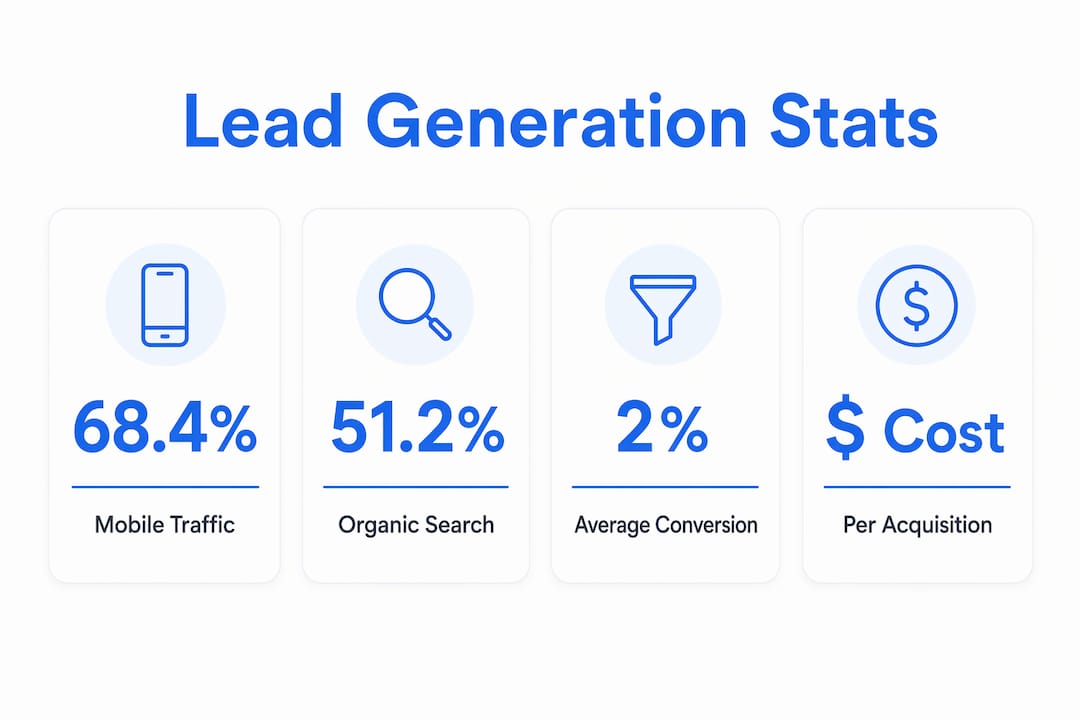
Poor mobile experience deserves its own mention. Mobile visits account for 68.4% of storage site traffic, yet mobile converts at roughly half the rate of desktop. That gap is not inevitable. It is a fixable design problem.
Proven strategies to fix your storage site's lead generation
The fastest wins come from UX fixes, not more ad spend. Start with the pages where visitors drop off most, usually the unit-size page or the booking flow, and remove every unnecessary step.

Speed and mobile design first. A page that loads in under two seconds on a smartphone, shows pricing immediately, and offers a one-tap call button will outperform a slower, prettier site every time. Google also ranks mobile-optimized pages higher in local search, so the fix improves both conversion and visibility simultaneously.
One CTA, everywhere. Pick a single primary action ("Reserve Your Unit") and place it consistently in the header, mid-page, and footer. Multiple competing buttons force a micro-decision that many visitors resolve by doing nothing.
Conversation-led lead capture. Static forms that appear immediately interrupt the visitor's flow and ask for commitment before value has been established. A chat-based tool that answers unit-size questions or explains pricing, then asks for an email to send details, feels like help rather than a demand. This approach aligns with how customers actually behave during the research phase.
Local SEO and Google Business Profile. Google Business Profile is one of the highest-leverage tools available to storage operators at no cost per click. A complete, regularly updated profile with photos, accurate hours, and responded-to reviews drives significant visibility in local map results. Pair it with city-specific landing pages targeting phrases like "climate-controlled storage in [neighborhood]" to capture searchers with clear local intent.
Fresh, relevant content. Organic search drives 51.2% of storage site traffic globally. Publishing monthly blog posts that answer common renter questions, such as "what size storage unit do I need for a two-bedroom apartment," builds topical authority and pulls in visitors who are actively researching, which is exactly the audience most likely to convert.
Pro Tip: Paid search delivers the highest-intent traffic in storage marketing, but the average cost per acquisition has risen to $62.50. Pair PPC campaigns with retargeting ads on Facebook to re-engage visitors who browsed but did not book. The combination of awareness and conversion campaigns balances short-term lead volume with long-term brand recognition.
| Strategy | Primary Benefit | Time to See Results |
|---|---|---|
| Mobile UX improvements | Closes the mobile conversion gap | 2–4 weeks |
| Single consistent CTA | Reduces visitor indecision | 1–2 weeks |
| Google Business Profile | Boosts local map visibility | 4 weeks |
| Conversation-led lead capture | Reduces silent drop-offs | 2–4 weeks |
| Local SEO content | Drives qualified organic traffic | 3 months |
| PPC + retargeting | Immediate high-intent traffic | 1–2 weeks |
For a deeper look at how local lead generation works across service-based websites in 2026, the tactical breakdown applies directly to storage operators competing in crowded local markets.
Advanced SEO and AI visibility for storage lead capture
Search behavior is shifting. A growing share of potential renters now ask AI assistants, "Where can I find storage near me?" before they ever open a browser tab. If your facility is not structured to appear in those AI-generated answers, you are invisible to a segment of the market that is only going to grow.
AI visibility audits identify exactly where your facility's digital presence breaks down for language models. They score how your site appears across ChatGPT, Claude, Perplexity, and Google's AI Overviews, then map the specific gaps in schema markup, content structure, and citation coverage that prevent AI systems from recommending your facility.
On-page SEO for storage sites in 2026 requires more than keyword placement. Semantic coverage matters: your site needs to answer the full range of questions a renter might ask, from unit sizes and access hours to security features and lease terms, in a format that both search engines and AI tools can parse cleanly. Structured data markup for local businesses, FAQ schema, and properly formatted service pages all contribute to how confidently a language model can describe your facility.
Mobile traffic represents 68.4% of storage site visits but converts at roughly half the desktop rate. Closing that gap with immediate pricing visibility, one-tap call buttons, and sub-two-second load times is the single highest-return fix available to most storage operators right now.
Key services that address these gaps directly:
- Full technical SEO audits covering indexing, metadata, and site health
- City-based keyword targeting and local pack positioning
- 30 keyword-optimized articles published monthly for semantic and conversational search coverage
- AI visibility scoring across major language model platforms
- Google Business Profile management and competitor tracking
Corvanesystems combines traditional local SEO with Generative Engine Optimization (GEO), structuring your facility's content so it is correctly understood and recommended by both search engines and AI systems. The result is that when someone asks an AI assistant where to rent a storage unit in your city, your facility surfaces rather than a competitor's.
How strategic planning and audience clarity affect lead volume
A storage website that tries to speak to everyone ends up converting no one. The most effective sites are built around a specific primary renter profile, whether that is a local homeowner downsizing, a small business owner needing document storage, or a college student storing furniture over the summer.
Knowing your primary audience shapes every element of the site: the unit sizes you feature first, the questions you answer in your content, the tone of your CTAs, and even the photos you choose. A facility near a university campus that leads with "semester storage plans" and "student move-in specials" will outperform a generic site targeting "storage units" in the same zip code.
Effective lead generation also requires matching your marketing investment to your facility's stage. A property in lease-up needs roughly equal spending on awareness and conversion campaigns to build local recognition while capturing immediate demand. A stabilized facility with 85% occupancy can shift more budget toward conversion-focused tactics like PPC and retargeting, since brand awareness is already established in the market.
How to audit and fix lead generation issues on your website
Start with Google Analytics or a comparable analytics platform. Look at the pages where visitors exit most often, the average time spent on unit-size and pricing pages, and the drop-off rate inside your booking flow. Those three data points tell you where the friction lives.
A practical audit covers five areas:
- Page speed. Run your site through Google PageSpeed Insights. Any mobile score below 70 is costing you leads.
- CTA audit. Count how many different call-to-action phrases appear across your site. More than two is too many.
- Form length. Count the fields in your contact or inquiry form. Every field beyond name, email, and message reduces completion rates.
- Trust signals. Check whether your homepage shows recent reviews, a security badge, and real facility photos. Missing any of these raises visitor hesitation.
- Local SEO check. Search "[your city] storage units" in an incognito browser. If your facility does not appear in the local pack or the first page of organic results, your Google Business Profile and on-page local signals need work.
UTM parameters on every campaign link, a call-tracking number for phone inquiries, and email match-backs against your tenant list give you a complete picture of which channels actually produce rentals, not just clicks. Without that attribution layer, you are optimizing for the wrong metrics.
Pro Tip: Poor website clarity can cost you up to 38% of potential customers. Run a five-second test: show your homepage to someone unfamiliar with your facility and ask what you offer, what it costs, and what they should do next. If they cannot answer all three, your layout needs work.
What timeline to expect after making fixes
UX and CTA changes produce results quickly. A cleaner booking flow, a single consistent CTA, and faster mobile load times typically show measurable improvement in form submissions and phone inquiries within two to four weeks of going live.
Local SEO takes longer. Google Business Profile updates and new local citations start influencing map rankings within four to eight weeks, but climbing into the local pack for competitive city-level terms usually takes three to six months of consistent effort. Content marketing compounds over time: the articles you publish today build authority that drives organic traffic six months from now.
Do not expect paid search to solve a conversion problem. If your site has a 2% conversion rate and you double your PPC budget, you get twice as many visitors converting at the same low rate. Fix the site first, then scale the traffic.
How to analyze your traffic quality and sources
Traffic volume is a vanity metric if the visitors arriving have no intent to rent. A site drawing thousands of monthly visitors from informational blog posts about "how to pack a moving truck" will generate far fewer leads than a smaller site ranking for "10x10 storage unit [city name]."
Pull your traffic source breakdown in Google Analytics. Organic search drives 51.2% of storage site traffic globally, with direct traffic at 18.5% and paid search at 16.3%. If your organic share is significantly below that benchmark, your local SEO is underperforming. If paid search is your dominant channel, you are paying for traffic that a well-optimized site would earn for free.
Check the search queries driving organic clicks in Google Search Console. Queries containing a city name, a unit size, or a specific feature like "climate-controlled" or "drive-up access" signal high intent. Generic queries like "storage tips" or "how to organize a garage" signal informational intent that rarely converts to a rental inquiry. Shift your content investment toward the high-intent queries and let the informational content serve as a secondary trust-builder.
Showcasing your services clearly online directly affects how well high-intent visitors convert once they land on your site. Visitors who immediately understand what you offer, at what price, and in which location have no reason to keep searching.
Why online booking integration changes your conversion rate
A storage site that requires a phone call to complete a reservation loses a predictable share of visitors who are ready to rent but unwilling to wait on hold or call during business hours. Online booking removes that barrier entirely.
The mechanics matter. An integrated reservation system should show real-time unit availability, display pricing without requiring a login or a form submission, and complete the rental in under five minutes. Every additional step in that flow reduces completion rates. Facilities that display pricing immediately and offer a one-tap call button alongside the online booking option consistently outperform those that gate either piece of information.
For operators who want a stronger digital foundation before integrating a booking system, custom storage website design built around conversion principles is often the right starting point. A booking integration layered onto a slow, cluttered site does not fix the underlying conversion problem.
88% of consumers trust online reviews as much as personal recommendations, so placing your Google review rating and total review count near the booking button gives hesitant visitors the social proof they need to complete the reservation rather than abandoning it.
Key Takeaways
A storage website that does not convert traffic into leads almost always has a fixable friction problem, not a traffic problem, and the highest-return fixes target mobile UX, local SEO, and lead capture timing simultaneously.
| Point | Details |
|---|---|
| Mobile gap is the biggest bottleneck | Mobile drives 68.4% of storage traffic but converts at half the desktop rate; fix load speed and pricing visibility first. |
| One CTA beats many | Inconsistent calls to action dilute clicks; pick one primary action and place it consistently across every page. |
| Time your lead capture | Triggering forms after visible browsing intent reduces silent drop-offs and improves lead quality. |
| Local SEO drives the majority of traffic | Organic search delivers 51.2% of storage site traffic globally; Google Business Profile and city-specific pages are essential for visibility. |
| Fix the site before scaling ad spend | A $62.50 average PPC cost per acquisition makes a high-converting site a prerequisite, not an afterthought. |
If you want your facility to appear not just in Google search but in the AI tools that increasingly drive booking decisions, Corvanesystems builds exactly that kind of visibility for self-storage operators. One flat monthly rate, no contracts, and a service built specifically for the storage industry.
Learn more about filling units faster with qualified leads, or explore how to get your facility found online through local search and AI-optimized content.