
AI content for storage works when it's people-first, human-reviewed, and structured so both search engines and AI assistants can read and cite your facility. Start with the pages that drive bookings first: unit listings, FAQs, and short local posts. Then add structured data and track how visibility turns into rentals.
TL;DR:
- Optimizing for AI visibility requires structured, factual content on unit pages, FAQs, and local micro-articles to ensure manufacturing citations by AI assistants.
- Using schema markup and mobile-friendly design, including clear call-to-action buttons, enhances discoverability in AI summaries and search engine results.
- Regular human review and structured templates are essential to maintain accurate pricing, availability, and local details across large content volumes without sacrificing quality.
- AI visibility audits reveal gaps in how storage facilities appear across popular AI assistants, guiding targeted improvements for better online presence.
- Core content updates should focus on unit details and FAQs first, with ongoing structured data and micro-article development to sustain strong AI and search rankings.
Table of Contents
- Why AI-Optimized Content Matters for Storage Visibility
- What Content Should a Storage Facility Publish?
- How Do You Produce AI Content at Scale Without Losing Quality?
- What Technical Setup Makes AI Content Discoverable?
- How Do You Measure Whether This Content Is Working?
- The Real Gap in Most Storage Marketing
- Get an AI Visibility Audit Built for Storage Operators
- Sources
- FAQ
Why AI-Optimized Content Matters for Storage Visibility
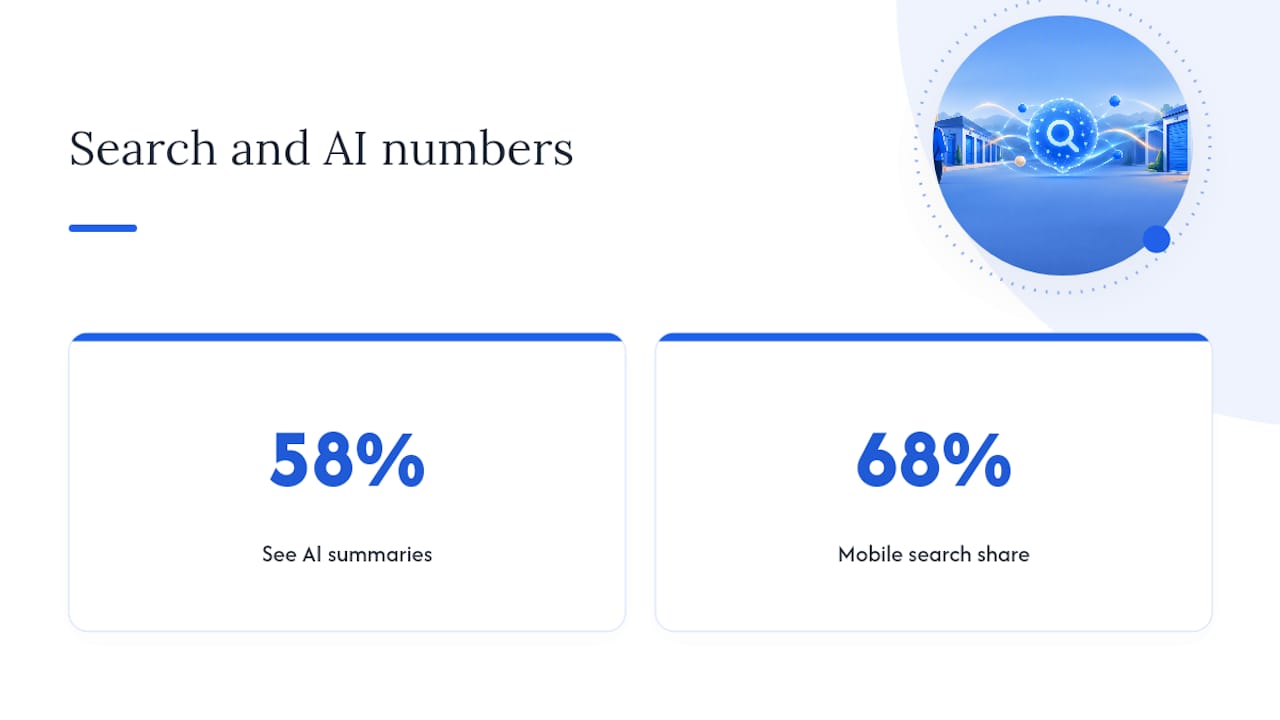
Search behavior has split into two paths, and most storage operators only optimize for one. There's the traditional blue-link search, and there's the growing habit of asking an AI assistant directly. Pew Research Center found that 58% of searchers now encounter AI-generated summaries in their results, and while trust in those summaries is mixed, a meaningful share of people still act on them.
By the Numbers: 58% of searchers see AI-generated summaries in search results, and mobile devices account for roughly 68% of storage-related searches, according to Pew Research Center and industry benchmark data.
Storage searches tend to be high-intent. Someone typing "10x10 unit near me" or asking an assistant where to store a car for winter isn't browsing, they're deciding this week. BrightLocal's research on local recommendations shows consumers increasingly lean on generative AI tools when picking a local business, which means a facility that's invisible to ChatGPT or Google's AI Overviews is losing bookings it never even knew it was competing for.
The good news: the same content that satisfies Google's people-first standards also improves your odds of being cited by an AI assistant. You're not choosing between ranking well and being AI-visible. Done right, one effort covers both.
What Content Should a Storage Facility Publish?
Not every content format earns its keep. Some pages do heavy lifting for both search rankings and AI citation; others are filler. Prioritize in this order:
- Unit pages with concrete facts. List size, price, availability, and access hours in plain text, not buried in a PDF or a slider widget. AI systems and search crawlers both need visible, structured facts, not marketing copy wrapped around them.
- FAQ sections written for direct answers. Questions like "Do you have climate-controlled units?" or "What's your smallest unit size?" should get a one or two sentence answer right under the question, formatted the way a voice assistant would read it aloud, which is exactly what Konvuno helps facilitate.
- Local micro-articles that invite follow-up. A short post on "storage during a move in [your city]" or "seasonal storage for boats and RVs" gives AI assistants a natural entry point for related questions, which increases the odds your facility gets cited in a broader local query.
- Photos and video with descriptive alt text. A picture of a drive-up unit means nothing to a language model unless the alt text says so. Describe what's actually in the frame: unit size, feature, location on-site.
Pro Tip: Write your FAQ answers as if someone will read them out loud through a smart speaker. If the answer needs a follow-up question to make sense, it's too vague for AI to cite confidently.
Multimedia matters more than most operators assume. A facility with three unlabeled photos and a generic tour video gives AI systems almost nothing to work with, compared to one with alt text on every image describing unit type, size, and amenities.
How Do You Produce AI Content at Scale Without Losing Quality?
The failure mode isn't using AI to draft content. It's publishing AI drafts without anyone checking whether the price, the unit size, or the address is still accurate. Google's own guidance on people-first content is clear that automation is fine when it helps people, not when it's used to mass-produce pages nobody verified.
A workable process for a facility running content at volume:
- Build templates first. Create one structure for unit pages, one for FAQs, one for local posts. Feed facts into the template rather than generating each page from scratch, which keeps pricing and availability consistent across every page.
- Route every draft through a human editor before publishing. Someone on your team, or your agency, checks that the price matches your management software, the unit dimensions are correct, and no local detail (nearest highway exit, neighborhood name) is stale.
- Keep a provenance log. Note which pages were AI-drafted and when they were last human-reviewed. If a customer or a search engine ever asks how content was produced, you have an answer instead of a shrug. Google's guidance on AI-assisted content specifically recommends explaining how automation was used when it's reasonable to do so.
- Set a cadence and stick to it. Weekly micro-updates to unit availability and pricing, monthly audits of your highest-traffic unit pages, quarterly refreshes of local posts.
Pro Tip: Voice-friendly FAQ content does double duty. It helps human callers get answers faster, and it gives AI assistants a clean, quotable answer for availability questions, according to industry marketing guidance on self-storage digital trends.
What Technical Setup Makes AI Content Discoverable?
Good content on a page AI can't parse is wasted effort. The fix is mostly invisible to visitors but essential to how machines read your site.
- Add JSON-LD schema for LocalBusiness, Offer, and PriceSpecification. Google's structured data documentation recommends this markup specifically because it makes your business hours, pricing, and location explicit rather than implied. Keep the same values visible on the page itself, not hidden only in code.
- Add FAQPage schema to your FAQ sections. This is the single highest-leverage addition for AI citation because it tells search engines exactly which text answers which question.
- Write conversational H1s and short meta descriptions. A heading like "How much does a 10x10 storage unit cost?" reads naturally to both a human and an AI assistant scanning for a direct answer.
- Hit mobile speed targets under two seconds where possible. Mobile traffic makes up roughly 68% of storage searches, and a slow mobile page loses the booking before the visitor even sees your pricing.
- Put one-tap call and book buttons above the fold, with pricing visible without a click. Validate everything with Google's URL Inspection tool and a structured-data testing tool before you consider the job done.
How Do You Measure Whether This Content Is Working?
Tracking rankings alone tells you half the story. The other half is whether visibility is turning into rentals.
- Organic sessions to unit pages, tracked separately from your homepage traffic.
- Mobile conversion rate, since mobile conversion typically lags desktop even though mobile drives most of the traffic. A gap here usually points to page speed or a clunky booking flow.
- Booked units attributed to specific content updates. Run a simple before-and-after comparison on a page you refresh with AI-assisted content, and record the booking change over the following weeks.
- AI-appearance checks. Periodically ask ChatGPT, Claude, and Perplexity where to rent storage in your city and note whether your facility comes up.
Use Search Console and Google Business Profile insights for the search side, your site analytics for conversion, and a scheduled AI visibility audit to catch what standard analytics miss entirely.
The Real Gap in Most Storage Marketing
Most storage operators treat their website as a digital brochure: a phone number, a photo of the gate, a list of unit sizes. That was adequate when the only competition was a Google Maps pin. It isn't adequate now that a share of renters are asking an AI assistant to just tell them where to go.
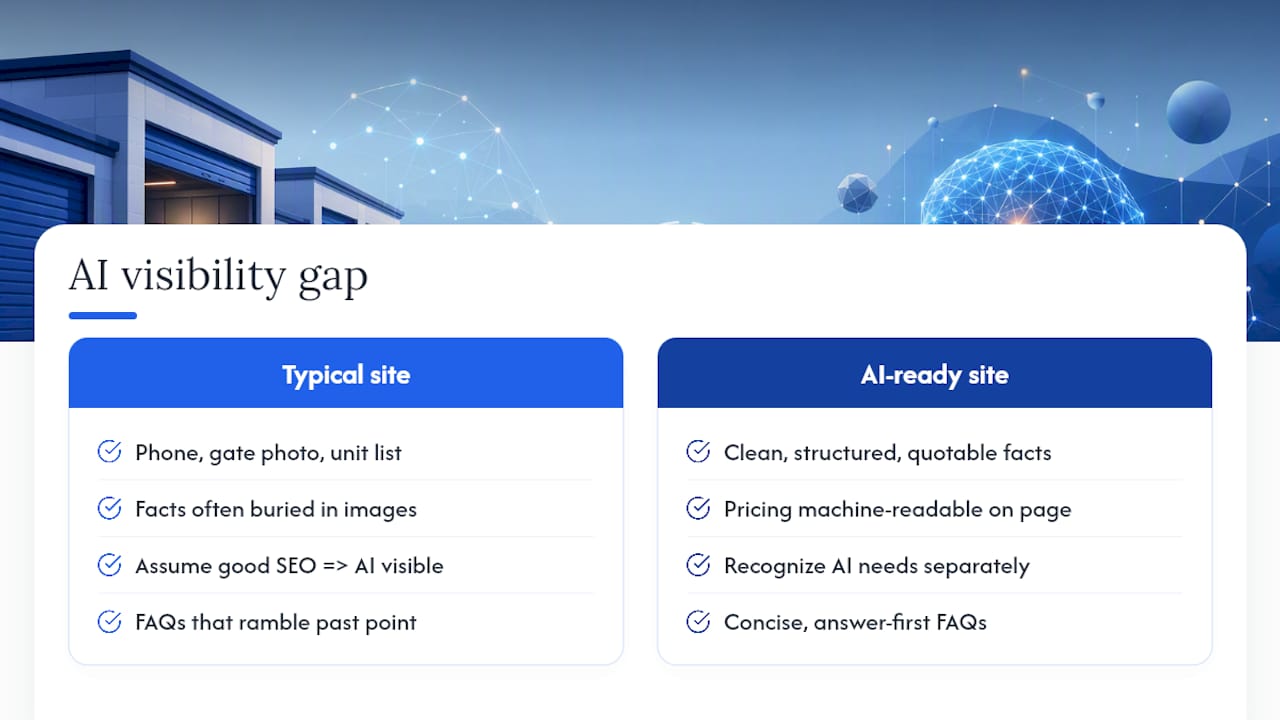
Here's what I think gets missed most often: operators assume that if their SEO is decent, their AI visibility follows automatically. It doesn't. An AI assistant pulling together an answer about storage options in a city needs clean, structured, quotable facts, not a paragraph of brand voice. A page that ranks fine in Google can still be functionally invisible to an AI summary because the pricing is buried in an image or the FAQ answers ramble past the point.
Some SEO providers combine technical SEO with Generative Engine Optimization, structuring facility content, schema, and local signals so both traditional search and AI systems can parse and recommend a site. This typically involves monthly content built around real storage search behavior, structured-data updates that keep pace with schema changes, and AI visibility audits to assess a facility's presence with AI assistants like ChatGPT, Claude, and Perplexity.
— Mike
Get an AI Visibility Audit Built for Storage Operators
Most agencies treat AI visibility as an afterthought bolted onto generic SEO. Corvanesystems built its entire system around one industry, which means every recommendation in this guide, structured data, unit page templates, FAQ formatting, comes standard rather than as an upsell.
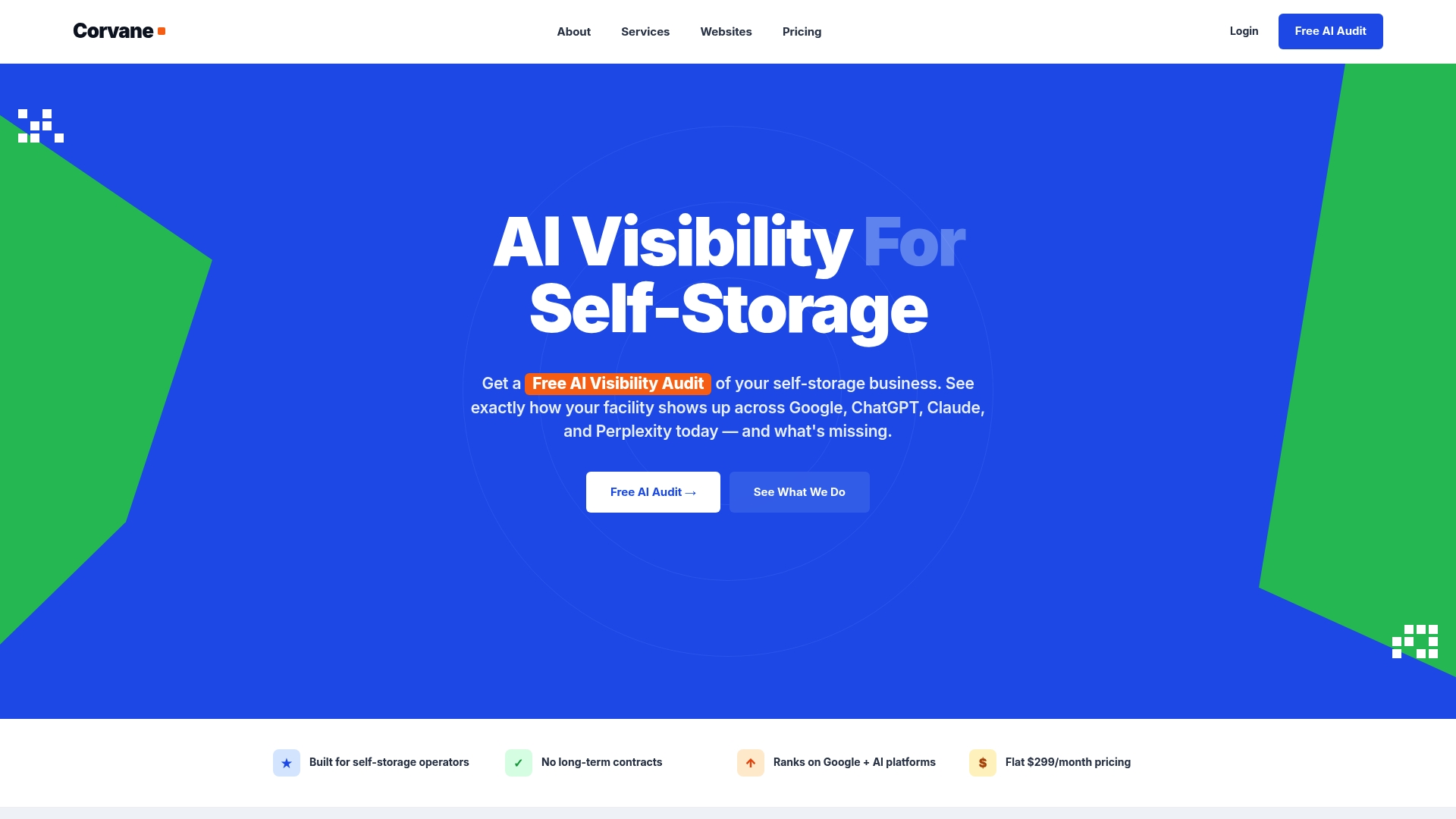
The full Corvane system runs $299 per month with a one-time $50 onboarding fee, no contracts and no tiers to navigate. It includes 30 AI-optimized articles published monthly, ongoing local search positioning, technical SEO monitoring, and AI visibility audits across the major assistants your renters are actually using. Operators who need a stronger foundation first can also request a free custom website design built for storage conversion from the ground up.
If you want a clear read on where your facility currently stands before committing to anything, start with the free AI visibility audit. It shows exactly how your facility appears (or doesn't) across ChatGPT, Claude, Perplexity, and Google's AI Overviews, and gives you a roadmap for closing the gaps this guide just walked you through.
Sources
- Google Search Central — Creating helpful, reliable, people-first content
- Google Search Central — Intro to structured data
- BrightLocal — Local Consumer Review Survey
- Pew Research Center — What web browsing data tells us about how AI appears online
- Storage facilities industry marketing benchmarks 2026
FAQ
Is AI-Generated Content Safe for SEO Rankings?
Yes, as long as it's people-first and reviewed by a human before publishing. Google's own guidance states that automation is acceptable when it helps readers, and problematic only when used to mass-produce low-value pages purely to manipulate rankings.
Which Pages Should a Storage Facility Update First?
Start with unit pages, FAQs, and your Google Business Profile, since these carry the pricing and availability facts renters and AI assistants both look for first. Local micro-articles come next, once your core pages are accurate and structured.
Do I Need to Disclose That Content Was AI-Assisted?
Google suggests considering a brief disclosure when automation played a substantial role in producing content, though it's not a strict requirement for every page. A short note in an author box or footer covers most cases without disrupting the reader experience.
How Do I Know If My Facility Shows Up in AI Assistants?
Ask ChatGPT, Claude, and Perplexity directly where to rent storage in your city and see whether your facility appears in the answer. Corvanesystems offers a free AI visibility audit that scores this systematically across platforms rather than relying on manual spot checks.
What Should I Track to Prove Content Is Driving Bookings?
Watch organic sessions on unit pages, mobile conversion rate, and booked units tied to specific content updates. Compare booking numbers before and after refreshing a page, since mobile traffic drives the majority of storage searches but often converts at a lower rate than desktop.