Build location-specific unit inventory pages that put facts above the fold: unit types, price ranges, availability, and hours. Add LocalBusiness and Offer schema, and match every detail to your Google Business Profile. That fact density and machine-readable structure is what gets AI Overviews to cite your facility instead of the one three exits down the highway. Specialized providers build and scale exactly this kind of page for storage operators.
TL;DR:
- Accurate unit size details with specific dimensions and pricing ranges improve AI recognition and ranking, especially for size-specific search queries.
- Maintaining a centralized dataset for NAP, hours, prices, and images ensures consistent updates across all location pages, avoiding data discrepancies that harm AI citations.
- Structured schema markup for local business, offers, and FAQs enhances machine readability and increases the likelihood of AI systems citing your facility.
- Including at least three location-specific landmarks or neighborhood images with descriptive filenames and alt text boosts geographic verification signals for AI systems.
- Regular data refreshes and targeted content updates aligned with local search intents are crucial to sustain and improve AI visibility over time.
Table of Contents
- What Makes a Storage Size Guide SEO-Ready?
- How Do AI Systems Decide What to Cite?
- How Do You Scale This Across Every Location?
- How Do You Know If It's Working?
- Explanation of How Storage Size Affects SEO Rankings
- Best Practices for Representing Storage Sizes in Metadata
- Impact of Storage Size Keywords on Local SEO
- User Intent Analysis Regarding Storage Size Queries
- Examples of Optimized Storage Size Usage in Titles and Descriptions
- Why This Approach Matters: a Corvane Systems Perspective
- How Corvane Systems Can Help You Implement This Plan
- Sources
- FAQ
What Makes a Storage Size Guide SEO-Ready?
A "storage size guide" for AI visibility purposes has nothing to do with helping renters pick between a 5x5 and a 10x10. It means structuring your location and unit inventory pages so Google's AI Overviews, ChatGPT, Perplexity, and Claude can read them, trust them, and recommend your facility by name. That distinction matters because most storage operators are still writing pages for humans scanning a screen, not for a language model trying to extract a verifiable fact in half a second.
Every page needs a checklist of fields that answer the machine's question before the human even finishes reading the headline.
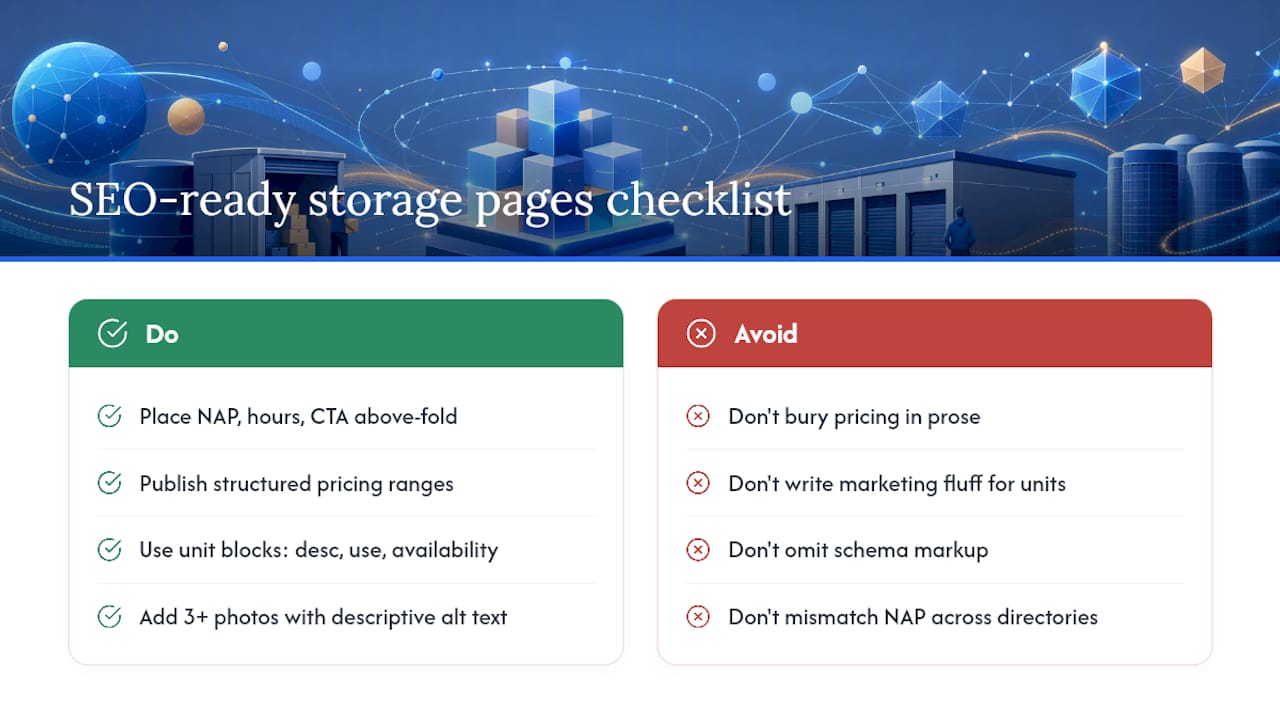
Above-the-fold facts. Your name, address, and phone number, current hours, a reservation call-to-action, and a plain-language unit summary (how many sizes, what's available right now) all need to sit in the first screen of content. No scrolling required.
Pricing ranges. AI Overviews increasingly answer cost-based queries directly, and pages with structured price ranges get pulled into those answers more often. A simple table works better than a paragraph buried in prose:
Unit inventory blocks. For each unit type, write two or three bullets covering the standardized description, the best use case, and a real-time availability flag. Skip the marketing copy. AI systems and skimming humans both want the fact, not the flourish.
Local FAQs. Answer three to six real buyer questions (drive-up access, gate hours, insurance requirements) in two sentences each, wrapped in FAQ schema.
Photo requirements. Include at least three landmark or neighborhood photos plus interior and security shots, with descriptive filenames and alt text that name the location.
Schema coverage. LocalBusiness for core facts, Offer/PriceSpecification for your ranges, Product or Service markup for unit types, and FAQ schema for your Q&A block. Keep NAP data embedded in the markup itself, not just in visible text.
Cross-directory verification. Check that your NAP, categories, and hours match exactly across Google Business Profile, Apple Maps, and the major storage directories. A mismatch on any one of these quietly erodes AI confidence in everything else on the page.
How Do AI Systems Decide What to Cite?
AI systems don't read pages the way people do. They scan for extractable, labeled facts, and they weigh how much verifiable evidence a page provides before deciding whether to surface it in an answer. Roughly 44% of AI citations come from the first 30% of a page, which means burying your pricing and availability data under three paragraphs of brand story is a wasted opportunity, not just a stylistic choice.
Fact density is the term for how many discrete, labeled data points appear in a small block of text. A page that says "affordable storage options in a convenient location" has zero fact density. A page that opens with "10x10 units from $95/month, climate-controlled options available, gate access 6 AM to 10 PM" gives a language model three separate, quotable facts in one sentence.
Schema does the translation work between your content and the machine reading it:
- LocalBusiness schema confirms your address, hours, and phone number as structured data, not just visible text.
- Offer/PriceSpecification schema tells AI systems your pricing ranges are real offers, not decorative numbers.
- FAQ schema packages your buyer questions into a format AI Overviews can lift directly into an answer.
Photos carry their own signal. A three-image landmark strategy, where you pair facility shots with recognizable nearby landmarks, gives vision models geographic evidence that a page is genuinely tied to a real place rather than a templated stub swapped across fifty city pages. Name the files with the location and unit type, write alt text that describes what's actually in the frame, and caption images instead of leaving them silent.
Pro Tip: Templated pages fail because they repeat the same paragraph with a city name swapped in. Enrich every location page with at least three facts a competitor couldn't copy paste: nearest cross street, a specific gate access detail, or a landmark within walking distance.
How Do You Scale This Across Every Location?
Publishing one great page is easy. Publishing fifty without NAP drift or contradictory pricing is where most multi-location operators lose control. The fix starts with a single source-of-truth dataset, not a folder of separately edited web pages.
- Build a canonical dataset. Maintain one spreadsheet or database with NAP, hours, categories, services, pricing ranges, and your image inventory for every location. Templates pull from this file, never the other way around.
- Run a five-step content workflow. Draft from the template, enrich with local facts, source location-specific images, inject schema, then run a QA checklist before anything goes live.
- Split automation from human review. Let automation handle schema injection and page skeletons. Require a human to verify local facts, choose images, and write FAQ answers, since templated pages that skip local enrichment read as low-context to both readers and AI systems.
- Set a refresh cadence. Audit data quarterly, refresh photos every 6 to 12 months, and confirm pricing monthly if your market shifts seasonally, or quarterly if it's stable.
- Push indexing signals immediately. Submit updated URLs through IndexNow and keep sitemaps current so search engines and AI crawlers pick up changes faster instead of waiting for a routine crawl cycle.
For operators managing several facilities, this governance layer matters more than the page design itself. A scalable playbook for multi-location storage brands keeps every location page accurate without requiring a full rewrite every time a price changes.
Pro Tip: Assign one person to own the canonical dataset. The moment two people are editing pricing in two different places, your NAP consistency starts to erode without anyone noticing until bookings drop.
How Do You Know If It's Working?
Four numbers tell you whether the work is paying off, and none of them require expensive tooling to track.
- Visibility. How often does your facility get mentioned or cited when you manually query ChatGPT, Perplexity, or Google's AI Overviews for storage near your locations?
- Share of voice. When AI names storage options for a given area, are you one of them, and how often relative to alternatives?
- Accuracy. Do the facts AI states about your facility (hours, pricing, unit availability) actually match reality?
- Outcomes. Are calls, direction requests, and reservation form submissions moving in the right direction?
Manual AI sampling once a week costs nothing but time. Pair it with a GA4 filter isolating AI-referred traffic, and check Google Business Profile insights for calls and direction requests weekly. Run a simple NAP audit across your top directories monthly.
Most operators who commit to consistent structured publishing and clean data governance start seeing measurable AI citation activity within three to six months. That's not instant, but it's faster than most operators expect once the source-of-truth dataset is actually in place.
Explanation of How Storage Size Affects SEO Rankings
Storage size, in the SEO sense that matters for AI visibility, isn't about server capacity or file storage. It refers to how you represent unit dimensions, pricing, and availability data on your pages, and how completely that information matches what a searcher or an AI system is actually looking for.
Pages that state unit sizes clearly (5x5, 10x10, 10x20) alongside price ranges and availability rank better for a straightforward reason: they answer the query completely in one place. A search engine or AI model doesn't have to infer anything or stitch together fragments from multiple pages. That completeness is a ranking and citation advantage, not a minor detail.
Vague size language ("small," "medium," "large") without dimensions or price context forces both search engines and AI systems to guess. Guessing means lower confidence, and lower confidence means your page gets skipped in favor of one that states dimensions plainly. This is where fact density and search ranking intersect directly: a page listing four unit sizes with specific measurements and prices carries more extractable value than a page describing "a variety of sizes to fit your needs."
The practical takeaway is simple. Every unit type on your site needs its own clearly labeled entry, with dimensions and a price range attached. Treat vague size descriptions as a ranking liability, not a stylistic shortcut.
Best Practices for Representing Storage Sizes in Metadata
Title tags and meta descriptions are often the first (and sometimes only) text an AI system or search engine reads before deciding whether your page matches a query. Storage size should appear in that metadata explicitly, not implied.
A title tag like "Self Storage in [City] | Units from 5x5 to 10x20" gives both a search engine and an AI system two facts instantly: you serve a specific city, and you carry a defined range of sizes. Compare that to "Affordable Storage Solutions," which tells the machine nothing concrete.
Meta descriptions should carry the same specificity. Include at least one price anchor and one size range within the 150 to 160 character limit: "10x10 and 10x20 units available in [City] starting at $95/month. Climate control, drive-up access, month-to-month leases." That single sentence hits size, price, and two amenity facts.
Structured data reinforces the metadata rather than duplicating it. Product or Service schema tied to each unit type, combined with Offer/PriceSpecification schema for the pricing range, lets an AI system confirm what your title tag and meta description already claim. When the visible metadata and the structured data agree, you remove any reason for an AI system to hedge on citing you.
Avoid stuffing every size variation into one title tag. Pick the two or three sizes with the highest search demand for that location and let the full inventory live on the page itself.
Impact of Storage Size Keywords on Local SEO
Storage size keywords carry weight in local search because they signal purchase intent tied to a specific need, not a general browse. Someone searching "10x10 storage unit near me" is closer to booking than someone searching "storage units," and both search engines and AI systems increasingly reward pages that match that specificity.
Local SEO for storage facilities depends on matching size-specific queries to size-specific content. A single generic location page that mentions "various unit sizes" once in a paragraph will rarely outrank a competitor whose page has a dedicated section, and ideally a dedicated URL or clear on-page block, for each common size query.
This is also where Google Business Profile optimization intersects with size-specific keywords. Facilities that fully populate GBP with accurate size categories and services have a measurably better chance of surfacing in discovery searches, and pairing that GBP completeness with matching on-site content compounds the effect rather than working in isolation.
The local ranking benefit compounds when size keywords appear consistently across your Google Business Profile categories, your on-page content, and your schema markup. Inconsistency between those three sources, say, GBP lists "small, medium, large" while your website lists exact dimensions, creates the same kind of confidence gap that hurts AI citation. Align the language everywhere a customer or a crawler might encounter it.
User Intent Analysis Regarding Storage Size Queries
Storage size queries split into a few distinct intent categories, and each one needs a slightly different content response.
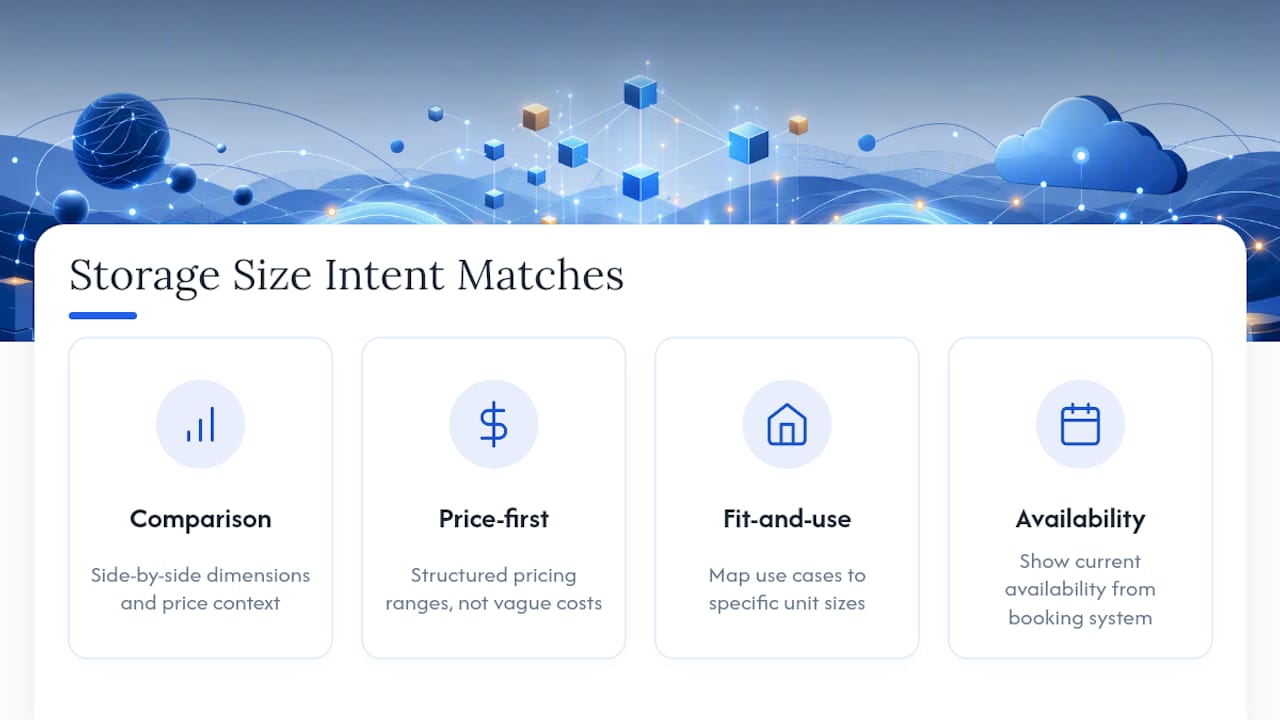
Comparison intent looks like "10x10 vs 10x20 storage unit." Searchers here want side-by-side dimension and price context, which favors a page or section that directly contrasts two or three sizes rather than listing them separately.
Price-first intent looks like "cheap storage units near me" or "storage unit prices [city]." These queries trigger AI Overviews and search snippets built around cost, which is exactly why pages need structured pricing ranges rather than vague cost language.
Fit-and-use intent looks like "storage unit for one bedroom apartment" or "unit size for a car." These searchers know their situation but not the matching dimension, so content that maps use cases to specific sizes performs better than a bare size chart with no context.
Availability intent looks like "storage units available now [city]." This is the most conversion-ready intent category, and it's also the one most operators handle worst, since availability data often lives in a booking system disconnected from the content a search engine or AI system actually reads.
Matching your page structure to these four intent types, rather than writing one generic page trying to cover all of them, is what separates a page that gets cited from one that gets skipped. A single FAQ block addressing all four intents in plain language often does more work than four separate pages.
Examples of Optimized Storage Size Usage in Titles and Descriptions
Concrete examples make the difference between theory and something you can copy into your CMS this afternoon.
A weak title tag: "Storage Units in [City]." A strong one: "5x5 to 10x30 Storage Units in [City] | From $45/Month." The second version gives a size range and a price anchor in the same breath a searcher or AI system reads the result.
A weak meta description: "We offer a variety of storage solutions to meet your needs." A strong one: "Climate-controlled 10x10 and 10x20 units in [City], available now from $95/month. Drive-up access, month-to-month leases, no long-term contract."
For individual unit-type sections on a page, a weak heading reads "Medium Units." A strong one reads "10x10 Storage Units: Fits a Studio Apartment, From $95/Month." The strong version answers three questions (size, use case, price) in a single line, which is exactly the kind of self-contained fact block that AI systems tend to lift into an answer.
The pattern holds across every example: pair the specific dimension with either a price, a use case, or both. Never let "small," "medium," or "large" stand alone as your only size descriptor anywhere a customer or a crawler might read it first.
Why This Approach Matters: a Corvane Systems Perspective
Corvane Systems built its entire model around one belief: SEO and GEO aren't separate disciplines anymore for storage operators. We combine technical SEO, GBP optimization, and AI visibility audits because governed, consistent facts paired with real photos are what earn an AI recommendation, not clever copywriting.
— Mike
How Corvane Systems Can Help You Implement This Plan
Specialized services offer flat-rate alternatives to piecing this together yourself across spreadsheets, freelancers, and GBP accounts. These services include AI visibility audits scoring how facilities show up across Google, ChatGPT, Claude, and Perplexity, then build prioritized rollouts including schema, pricing tables, unit inventory blocks, and photo strategies.
Onboarding starts with that audit, moves into a prioritized page rollout matched to your highest-opportunity locations first, and continues with monthly reporting so you can see rankings and AI citation activity move over time. Our AI-optimized content service publishes 30 keyword-focused articles a month structured for exactly this kind of machine readability, and for teams managing content velocity at scale, pairing that with AI-assisted production workflows keeps output consistent without sacrificing the local enrichment AI systems reward.
One flat monthly rate, no contracts, no tiers. If you want to see where your facility currently stands, request an AI visibility audit and get the prioritized roadmap before your next lease-up season starts.
Sources
Facts in this guide draw on Search Engine Journal's reporting on AI Overviews, Search Engine Land's Local 5.0 framework, BrightLocal's SMB local SEO research, and Storable's self-storage GBP guidance. For implementation templates, see our location page SEO playbook.
- AI Overviews Now Answer Most Local Searches – How To Get Your Business Cited
- Why photos on your Google Business Profile matter
- Local SEO that Works: Practical Tactics for SMBs in the Age of AI
- Local 5.0: The next evolution of local SEO is here
FAQ
What Is Local 5.0 for Storage Facilities?
Local 5.0 describes the shift toward AI systems evaluating governed, consistent, machine-readable location data across your website, GBP, and directories before recommending a business, rather than relying on rankings alone.
Do I Need Schema Markup on Every Unit Page?
Yes. LocalBusiness, Offer/PriceSpecification, and FAQ schema each give AI systems a different type of verifiable fact, and pages without them are far less likely to get cited in AI Overviews.
How Many Photos Does a Location Page Need?
Include at least three landmark or neighborhood photos plus interior and security images, since profiles with strong photo coverage see 42% more direction requests and 35% more click-throughs.
How Long Until I See AI Citation Results?
Most operators see measurable AI visibility signals within three to six months of consistent structured publishing and data governance.
Can Corvane Systems Manage This for Multiple Locations?
Yes. Corvane Systems runs AI visibility audits, GBP optimization, and monthly AI-optimized content publishing built specifically for multi-location storage operators.