
A Brand SERP is what shows up when someone searches your business name: the knowledge panel, sitelinks, social profiles, reviews, and now, an AI Overview summarizing all of it. If you haven't audited yours, do it this week. Run a neutral, unbiased search of your own brand name, then start publishing Organization schema with a complete sameAs array and confirm your homepage still ranks first for its own name.
That last part sounds obvious until you check. Plenty of established brands lose their own top spot to a review aggregator, a Reddit thread, or a outdated directory listing. According to Kalicube's Brand SERP methodology, this mix of results functions as a digital business card, and increasingly, as the raw material AI systems pull from when someone asks ChatGPT or Google's AI Overview "is this company legit?"
Three things to check right now:
- Does your homepage rank #1 for your own brand name?
- Do you have a knowledge panel, and is the information in it accurate?
- What shows up on page one that you don't control, and can you influence it?
Key Takeaways
A well-managed Brand SERP directly protects revenue, hiring, and reputation because it's the first thing every stakeholder checks, and AI Overviews now amplify whatever it says, good or bad.
| Point | Details |
|---|---|
| Audit before you optimize | Run a neutral, unbiased brand-name search and log all ten SERP elements before making changes. |
| Fix entity signals first | Publish Organization schema with complete sameAs links for the fastest, highest-impact result. |
| Track owned versus unowned share | Calculate what percentage of page one you control and use it as your recurring baseline metric. |
| Monitor with APIs, not memory | Use tools like OpenSERP or Serpyx for unbiased, real-time tracking instead of manual spot checks. |
| Storage operators need location-specific fixes | Corvanesystems runs audits, schema fixes, and monthly AI-optimized content for storage facilities at a flat monthly rate. |
Table of Contents
- Brand SERP Storage and Why It Differs From Regular SEO Tracking
- Why Brand SERPs Matter Now: the AI-Era Shift
- The Nine Elements of a Brand SERP and How Much You Control Each One
- How to Audit Your Brand SERP: a Ten-Step Checklist You Can Run Today
- Monitoring Options: Snapshot Tools, SERP APIs, and How Often to Check
- Optimization Tactics That Actually Move Your Brand SERP
- Timelines and KPIs: What to Expect and When
- Brand SERP Storage for Self-Storage Operators
- Why Brand SERP Deserves a Seat at the Leadership Table
- Corvane Systems Runs This for Storage Operators, Flat Rate, No Contract
- Sources
Brand SERP Storage and Why It Differs From Regular SEO Tracking
Think of brand SERP storage as the practice of capturing, organizing, and acting on what your Brand SERP looks like over time, not just glancing at it once. Regular SEO tracking watches keyword rankings for terms you're trying to win. Brand SERP work watches something different: what already exists when people search your name, and whether that mix helps or hurts you.
The distinction matters because branded queries carry high commercial intent. Someone searching "[your company name]" has usually already decided you're a candidate, and they're checking reputation, pricing, or legitimacy before committing. A generic keyword searcher is still shopping around.
This is why Brand SERP management sits at the intersection of SEO, PR, and entity data management rather than inside any single discipline. An SEO team can fix schema markup. A PR team can respond to a bad review or a negative article. But keeping the whole page coherent, accurate, and favorable requires someone watching the combined picture. HR departments rely on it during hiring (candidates Google employers before interviews). Investors and partners check it during due diligence. Customers check it before buying. Miss any one of those audiences and the page works against you instead of for you.
Why Brand SERPs Matter Now: the AI-Era Shift
An unmanaged Brand SERP doesn't just look messy. It costs you trust, conversions, and sometimes candidates who never apply because the first thing they saw was a three-year-old complaint thread. The commercial stakes have always been real, but AI search has raised them.

AI Overviews and chatbots like ChatGPT, Claude, and Perplexity summarize whatever they can find about a brand, and if your own site doesn't offer a clean, quotable answer, the AI Overview will lean on whoever does, including a competitor's comparison page or a third-party review site with an axe to grind. Jason Barnard's analysis of Brand SERP fundamentals argues this should be a CEO or CMO-level concern precisely because it reflects the health of the entire digital ecosystem, not a narrow technical metric.
Consider a candidate deciding between two job offers who searches both company names before accepting. Or a facility manager comparing storage operators who sees a knowledge panel with a wrong address and an outdated phone number, and simply moves to the next result. Neither person tells you why they didn't convert. Structured, well-maintained FAQ and About content matter more now because these are the exact passages LLMs quote verbatim when they answer a question about your brand.
The Nine Elements of a Brand SERP and How Much You Control Each One
Not every piece of a Brand SERP responds to effort the same way. Some elements bend quickly to direct technical work. Others take months of relationship building or simply sit outside your control no matter what you do. Knowing which is which keeps you from wasting a quarter chasing something unfixable while an easy win sits untouched.
| Element | Controllability | Typical lead time | Primary lever |
|---|---|---|---|
| Knowledge panel | Medium | 2–6 months | Organization schema, sameAs, Wikidata claim |
| Homepage + sitelinks | High | 2–8 weeks | Clean site hierarchy, internal linking, canonical tags |
| Social profiles | High | 1–4 weeks | Claim and optimize official accounts, link consistently |
| Wikipedia / Wikidata | Low | 6–18 months | Notability-compliant edits, third-party citations |
| News coverage | Medium | 1–6 months | PR outreach, press hub, digital PR pitches |
| Review sites | Medium | Ongoing | Review-request cadence, response protocol |
| People Also Ask | Medium | 4 to 8 weeks | FAQ schema, direct question-and-answer content |
| Third-party content | Low to medium | 2–9 months | Outrank with better owned content, dispute inaccuracies |
| Paid ads | High | Immediate | Brand keyword bidding |
Two patterns jump out here. First, the elements you control fastest, your homepage, sitelinks, social profiles, and ad placements, are also the ones most brands neglect because they seem "already handled." They're not. A sitelink structure degrades the moment your site architecture changes without a redirect plan. Second, the slowest-moving elements (Wikipedia, deeply entrenched third-party content) are exactly where competitors and critics tend to camp out, because they know it's hard for you to dislodge them.
- Claim and verify every social profile tied to your brand name, even ones you rarely use.
- Add FAQ schema to any page answering a question people search directly.
- Build a lightweight press hub page even if you're not actively pitching journalists yet.
- Treat review response as a weekly task, not a quarterly cleanup.
How to Audit Your Brand SERP: a Ten-Step Checklist You Can Run Today
You don't need expensive tooling to get a useful baseline. You need forty-five minutes, an incognito browser or a neutral proxy, and a spreadsheet.
- Search your brand name using a clean, logged-out session or a neutral proxy service, since personalized results skew what you see, a point KindProxy's SEO monitoring guidance makes directly.
- Screenshot or export the full top-10 organic results plus every visible SERP feature.
- Confirm your homepage holds the #1 organic position.
- Check whether sitelinks appear beneath your homepage and whether they point to your most important pages.
- Note which social profiles appear and in what order.
- Check for a video carousel and whether any videos are yours.
- List every review site appearing on page one and its star rating.
- Capture any news or press results and how recent they are.
- Expand the People Also Ask box and record every question shown.
- Check for a knowledge panel and audit every field for accuracy, plus note whether an AI Overview appears and what it says.
This process mirrors the field-tested approach Search Engine Land outlines for building a digital strategy around owned assets, social proof, and video. Once you've logged all ten data points, calculate one number: what percentage of page one is something you own or control versus something a third party controls. That single ratio, owned versus unowned first-page share, becomes your baseline metric for everything that follows.
Pro Tip: Run this audit again exactly 90 days after your first fixes go live. Most schema and content changes take 4 to 8 weeks to reflect in search results, so checking sooner just measures noise.
Monitoring Options: Snapshot Tools, SERP APIs, and How Often to Check
Manual audits work for a quarterly deep dive, but they miss the daily drift that happens between checks: a competitor outbidding you on brand terms, a new review dragging your average down, a knowledge panel field that silently changed. That's what monitoring tools are for, and the right one depends on budget and how often you need eyes on the page.
API-based tracking avoids the personalization bias that plagues manual browser checks, which is why it's become the standard for anyone monitoring more than one brand or location. If you're comfortable running your own infrastructure, OpenSERP is a free, self-hosted option that returns structured SERP data across multiple search engines, with an official managed cloud version if you'd rather skip the hosting. For teams that want a fully managed pipeline without touching a server, Serpyx's brand monitoring API tracks organic results, news, and map data in something close to real time, with pricing that scales by request volume. SerpApi is another managed option worth evaluating if you need broader search-engine coverage beyond Google.
A workable cadence looks like this:
- Weekly: a quick visual check of your brand SERP for anything that changed unexpectedly.
- Monthly: a full API-based data pull logged into a simple dashboard so you can see trend lines, not just snapshots.
- Quarterly: the full ten-step manual audit, cross-referenced against your API data to catch anything the automated pull missed.
Storing this data doesn't require enterprise software. A basic database paired with simple visualization is usually enough to spot trends before they become problems, an approach detailed in cost-conscious monitoring setups built for teams without a dedicated data engineering budget.
Optimization Tactics That Actually Move Your Brand SERP
Once you know where you stand, the fixes fall into four buckets, and they're not equally urgent. Technical fixes come first because they're fast and they feed everything downstream, including AI systems.
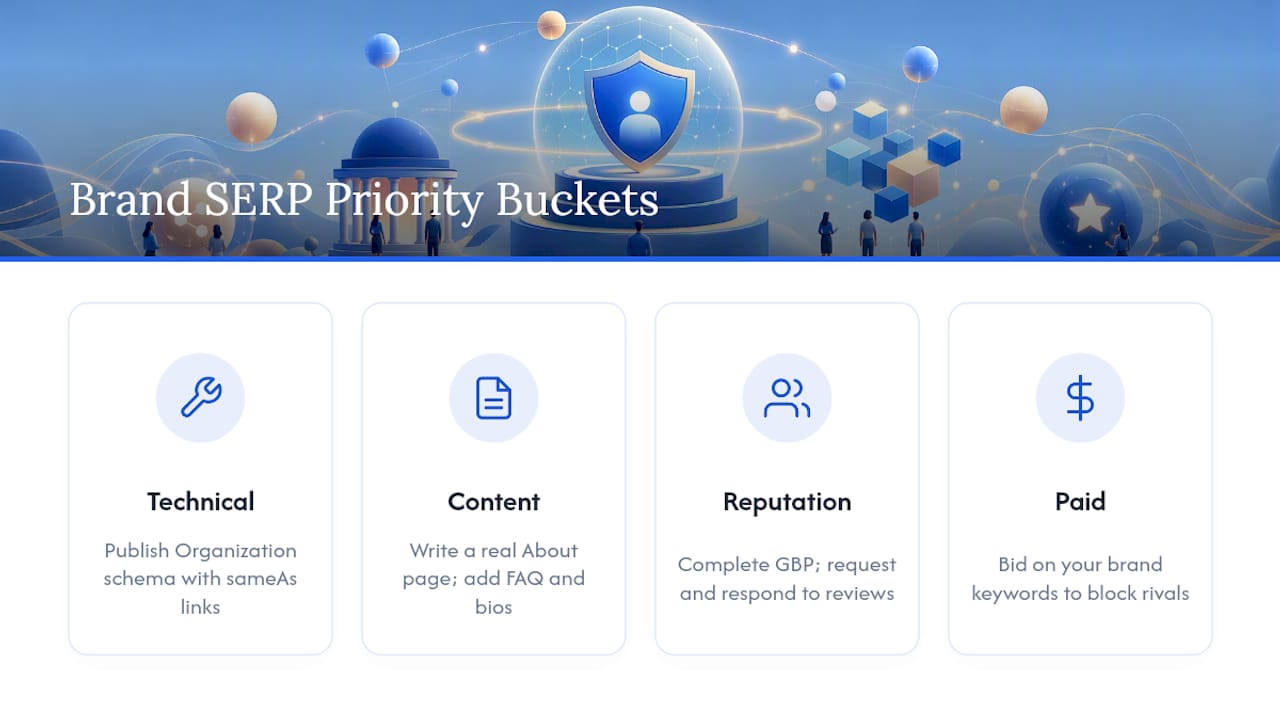
Technical priority. Publish complete Organization schema (or LocalBusiness, or Person schema if you're a solo operator or public figure) with a full sameAs array linking every verified social and directory profile you hold. This is consistently flagged as the single highest-impact fix available, according to Verlua's Brand SERP optimization guide, because it gives search engines and AI systems an unambiguous, machine-readable source of truth about who you are. Pair it with a canonical homepage URL (no duplicate versions competing against each other) and a clean sitemap that reinforces the page hierarchy Google uses to generate sitelinks.
Content priority. Write a real About page, not three sentences of corporate boilerplate. Aim for a few hundred words that answer "who are you, what do you do, why should I trust you" in plain, quotable sentences. This matters more than it used to, because AI Overviews and chatbots lift short, well-structured passages almost verbatim when answering questions about your brand. Add FAQ schema anywhere you're answering a direct question. Publish founder or leadership bios with real names and real photos. Stand up a basic press hub page, even a single page listing mentions and downloadable assets saves a journalist's time and improves how news results display. Add a handful of videos with clean, accurate metadata, since a video carousel is one of the easier SERP features to claim once you have even modest content.
Reputation priority. Optimize your Google Business Profile completely: hours, categories, photos, and posts. Build a consistent review-request cadence rather than sporadic asks, and respond to every review, good or bad, within a few days. A pattern of thoughtful responses to negative reviews often does more for trust than the star rating itself.
Paid priority. Bid on your own brand keywords. It feels wasteful until a competitor starts bidding on your name and captures clicks from people who were already looking for you.
Pro Tip: If you can only do one thing this month, do the Organization schema with sameAs links. Jason Barnard's analysis of entity signals notes that this is what Knowledge Panels and AI assistants extract first when building a canonical picture of a brand, and industry practitioners rank it as the top early-stage priority.
Timelines and KPIs: What to Expect and When
Set expectations before you start, or the first monthly report will feel like nothing happened. It didn't, not yet.
- 2 to 8 weeks: schema changes index, sitelinks stabilize, social profiles get claimed and cleaned up.
- 3 to 9 months: review scores climb, news coverage builds, PAA boxes start reflecting your content instead of a competitor's.
- 9 to 18 months: Wikipedia or Wikidata entries solidify, deeply entrenched third-party content finally gets outranked. This staged pattern matches the nine-element, 18-month roadmap many practitioners use to sequence Brand SERP work.
Track five numbers monthly: percentage of first-page results you own, branded click-through rate from Google Search Console, average review score and review velocity, whether a knowledge panel appears and stays accurate, and how often your brand gets cited correctly in AI answers. Reporting the owned-versus-unowned ratio alongside branded CTR gives a board or a client a number that moves, instead of a vague "things are improving."
Brand SERP Storage for Self-Storage Operators
Everything above applies directly to storage facilities, with a few industry-specific priorities layered on top. A renter searching your facility name before booking a unit is checking the exact same signals: is the address right, are the reviews recent, does the knowledge panel show accurate hours.
- Keep your Google Business Profile immaculate: correct unit sizes, current pricing ranges, accurate gate hours, and fresh photos of the actual facility, not stock images.
- Add LocalBusiness schema with your specific location data, not just a generic Organization block.
- Publish a unit-size and pricing FAQ using FAQ schema, since this is exactly the content AI assistants pull when someone asks "how much does a storage unit cost near me."
- Film short facility walkthrough videos with your business name in the title and thumbnail.
- Build a review-request workflow triggered at move-in and again a few weeks later, when tenants have real impressions to share.
Single-site operators should prioritize the Google Business Profile and reviews first, since local search dominates their branded queries. Multi-location operators face a harder problem: each facility needs its own accurate profile and review stream without diluting the parent brand's overall SERP, a challenge covered in more depth in a scalable playbook for multi-location storage SEO. For either scenario, Corvanesystems runs the audit, builds the schema, and produces the AI-optimized content that keeps a storage brand's SERP accurate across both Google and AI assistants like ChatGPT and Perplexity.
Why Brand SERP Deserves a Seat at the Leadership Table
Most companies treat their Brand SERP as an SEO afterthought, something the marketing intern checks once a year. That's backward. It's the one page every stakeholder, customer, candidate, investor, and journalist looks at before they decide anything about you, and it changes without your permission if you're not watching it.
Give it owner-level visibility. Run the audit quarterly, not annually, and treat the owned-versus-unowned ratio as a real business metric worth reporting alongside revenue.
— Mike
Corvane Systems Runs This for Storage Operators, Flat Rate, No Contract
If you run a storage facility, this whole process, the audit, the schema, the monitoring, the content, is exactly what Corvanesystems does every month, built specifically for the self-storage industry.
Corvanesystems starts with a full Brand SERP and AI visibility audit scored across Google, ChatGPT, Claude, and Perplexity, then builds out the technical fixes: complete Organization and LocalBusiness schema, sameAs links, Google Business Profile optimization, and competitor tracking for your service area. On top of that, Corvanesystems publishes 30 keyword-optimized, AI-structured articles every month so your facility shows up correctly whether someone types "storage near me" into Google or asks an AI assistant where to rent a unit nearby. One flat monthly rate covers all of it: no tiers, no contracts, no minimums, and Corvanesystems also builds custom, conversion-focused websites for operators who need a stronger foundation to start from. If your Brand SERP audit is overdue, request a Brand SERP and AI visibility audit from Corvanesystems and see exactly where your facility stands before your next lease-up push.
Sources
- Brand SERP — The AI Résumé That Determines ... (Kalicube)
- 10 simple steps to analyze your brand SERP and build an effective digital strategy (Search Engine Land)
- OpenSERP (OSS) project