
A focused local-first SEO program built around Google Business Profile completeness, unique location and unit pages, and a steady review velocity produces the fastest, highest-ROI lift in move-ins for self-storage operators. Skip the broad link-chasing campaigns most generalist agencies push. The operators winning their local map packs right now are doing three things consistently.
This week's priority checklist:
- Audit your Google Business Profile. Confirm your primary category is set to "Self-Storage Facility," every unit type is listed under Products/Services, and your hours, address, and phone number are exact. Upload new facility photos regularly.
- Publish or update one unique location page per facility. Each page needs a local headline, exact NAP, neighborhood context, unit inventory with original copy, and LocalBusiness schema in JSON-LD.
- Launch a review-request workflow tied to move-ins. Send a review request by text or email within 48 hours of a tenant's move-in date. Respond to every review within 24 hours.
Quick-win metrics to watch first: Map Pack impressions in Google Business Profile Insights, inbound calls attributed to GBP, and online reservations tagged to organic or local traffic in GA4.
Pro Tip: Set a recurring 15-minute weekly calendar block just for GBP: add one photo, respond to any new reviews, and check that your hours are current. Consistency here outperforms a one-time optimization sprint.
Table of Contents
- What does self-storage SEO actually need to deliver?
- How to win the local map pack for your storage facility
- How to design location pages and unit pages that rank and convert
- Which content topics and formats reliably convert local searchers into renters?
- Technical SEO checklist for storage websites
- How to build local authority through citations, partnerships, and community signals
- Turn visibility into move-ins: conversion flows and KPIs
- How to scale SEO across multiple storage facilities without cannibalization
- How long does self-storage SEO take, and what does it cost?
- How Corvanesystems implements this program end-to-end
- Key Takeaways
- Why storage-specific SEO beats a generalist agency every time
- Corvanesystems: flat-rate SEO built for storage operators
- Useful sources and references
What does self-storage SEO actually need to deliver?
Rankings are not the goal. Move-ins are. That distinction shapes every decision in this guide.
The funnel runs like this: a nearby searcher sees your facility in the Local Map Pack or an organic result, clicks through to your location page or GBP listing, calls or reserves online, and eventually moves in. Each step is measurable, and each step has specific signals that influence it. Treating SEO as a ranking exercise rather than a conversion funnel is how operators end up with traffic that never books a unit.
Three discovery channels feed that funnel, and they work differently:
- Local Map Pack (GBP-driven): Triggered by proximity and intent queries like "storage near me" or "storage units [city]." The ranking signals are GBP completeness, review volume and recency, and NAP consistency across the web. GBP completeness, consistent NAP, and review volume are the highest-leverage controllable factors for winning Local Map Pack rankings for self-storage.
- Organic location and unit pages (on-site): Triggered by more specific queries: "10x10 storage unit [neighborhood]," "climate-controlled storage [city]," "RV storage near [zip code]." These pages rank on content relevance, structured data, page authority, and technical health.
- AI and answer surfaces: ChatGPT, Perplexity, Claude, and Google's AI Overviews increasingly surface facility recommendations when someone asks "where should I rent a storage unit in [city]?" These surfaces pull from structured content, review signals, and how well your facility is described across the web. Most operators are invisible here. Understanding how AI surfaces your facility is now part of a complete local search strategy.
Searcher intent in self-storage clusters into five groups, and each one maps to a different page type or content format:
- Proximity-first: "storage units near me," "storage [neighborhood]" — these hit the Map Pack and location pages
- Unit-size intent: "10x10 storage unit," "5x5 storage unit [city]" — unit-size pages
- Specialty intent: "climate-controlled storage [city]," "RV storage [city]," "boat storage near me" — specialty landing pages
- Price/availability intent: "cheap storage [city]," "month-to-month storage [zip]" — transactional pages with pricing
- Moving-related: "storage during a move," "temporary storage [city]" — content guides and moving checklists
Operators who map keyword intent to specific page types stop wasting content effort on articles nobody searches for and start building pages that actually convert. The unit-size page and the specialty guide serve completely different searchers — conflating them into one generic "our units" page loses both.
How to win the local map pack for your storage facility
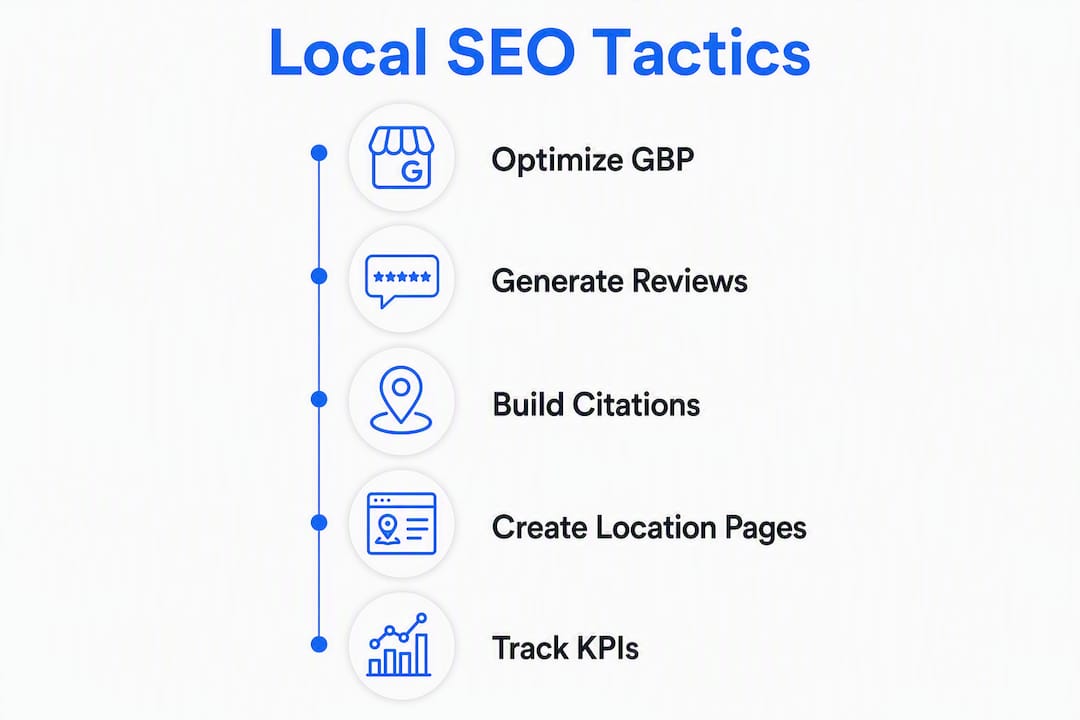
The Local Map Pack is where most storage rental decisions begin. Three to four facilities appear above the organic results for any proximity query, and the operators in those spots get the majority of clicks and calls. Getting there is not complicated, but it requires consistent attention to the right signals.
GBP completeness checklist
- Primary category:%20July%202015.pdf?ver=vtsrBGwfp8t9H9MGtsKBxQ%3d%3d) — Set to "Self-Storage Facility" — not "Moving Company" or "Warehouse."
Review strategy that actually works
Review content matters as much as review volume. Reviews that mention security, cleanliness, staff responsiveness, and accurate billing convert better for storage searches than generic five-star comments. When you request reviews, give tenants a gentle prompt: "If you're happy with your experience, a quick note about our security setup or our team would mean a lot."

Timing is everything. Send the review request within 48 hours of move-in, when the experience is fresh and the tenant is most likely to respond positively. A second touchpoint at the 30-day mark catches tenants who missed the first request. For detailed review-request templates and response workflows, storage facility review best practices covers the full sequence.
Respond to every review, positive or negative, within 24 hours. For negative reviews, acknowledge the issue, offer to resolve it offline, and keep the tone professional. Your response is as much for the next potential renter reading it as it is for the reviewer.
Pro Tip: Independent operators can outrank national storage chains in the Local Pack by maintaining an active, localized GBP with frequent photos and rapid, personalized review responses — tactics that corporate teams typically deprioritize. That gap is your opportunity.
Local signals beyond GBP
Citation consistency across the web reinforces your GBP's authority. Every directory listing — Yelp, Apple Maps, Bing Places, and industry aggregators — should carry the exact same NAP as your GBP. Listing on industry aggregators is a high-impact citation for the storage vertical; keep these listings current with photos and rates. The content on your own website also feeds GBP relevance: a well-structured location page with local keywords signals to Google that your GBP listing and your site are describing the same, authoritative facility.

How to design location pages and unit pages that rank and convert
Most storage websites have one generic "Our Units" page. That page ranks for almost nothing specific and converts at a fraction of what dedicated location and unit pages can achieve. The architecture fix is straightforward: one unique page per facility, one unique page per unit type, and structured data on both.
Location page skeleton
Each facility needs its own page built around these elements:
- Local headline: Include the city or neighborhood name and a primary keyword variant ("Climate-Controlled Storage in [Neighborhood], [City]").
- Exact NAP: Address, phone number, and hours in text format (not just an image or embedded map).
- Neighborhood context: Name nearby landmarks, major roads, and the communities you serve. This is what location-specific content does that generic copy cannot: it gives each facility a chance to rank in its own micro-market.
- Unit inventory: List every available unit size with original descriptions, not copy-pasted from another location page.
- Features and amenities: Climate control, drive-up access, RV/boat storage, 24-hour access, security cameras — list what this specific facility offers.
- Local FAQs: Answer questions specific to this location ("Is there parking for large trucks at the [Street] facility?").
- Call-to-action: Phone number (click-to-call on mobile), online reservation button, and directions link.
- Photos and testimonials: Real photos of this facility, not stock images. Testimonials from tenants at this location, not generic quotes.
Unit-size page template
| Element | What to include |
|---|---|
| Size description | Dimensions, square footage, and a visual comparison ("fits a one-bedroom apartment") |
| Real photos | Interior shots of that specific unit size at your facility |
| Typical uses | Student storage, moving, vehicle parts, business inventory |
| Pricing | A range or starting price; "call for availability" alone kills conversions |
| Availability CTA | Online reservation or waitlist link |
| Schema | Product or Service schema with name, description, and offer details |
Schema and structured data
Structured data for local business and product/service entries improves SERP presentation and can create additional click opportunities through knowledge panels and rich snippets. Every location page should carry a LocalBusiness schema block in JSON-LD with address, geo, openingHoursSpecification, and telephone. Unit pages benefit from Service or Product schema entries that describe the unit type, size, and availability.
Place JSON-LD in the <head> of each page. Validate every schema block with Google's Rich Results Test before publishing. A single syntax error can suppress the entire block.
Pro Tip: Add hasMap and geo coordinates to your LocalBusiness schema. It reinforces the physical location signal Google uses for proximity ranking and takes about two minutes to implement.
Which content topics and formats reliably convert local searchers into renters?
Content strategy for storage operators works best when keyword intent maps directly to page type. Mapping keyword buckets to page templates prevents wasted content effort and focuses writers on conversion-first copy.
Keyword buckets and page types
- Proximity-first: "storage units near me," "storage units [neighborhood]" → location pages
- Unit-size intent: "10x10 storage unit [city]," "small storage unit near me" → unit-size pages
- Specialty intent: "climate-controlled storage [city]," "RV storage [city]," "boat storage near me" → specialty landing pages
- Price/availability: "cheap storage [city]," "month-to-month storage [zip]" → transactional pages with pricing and availability CTAs
- Moving-related: "storage during a move [city]," "temporary storage [city]" → content guides
Targeting both proximity-first and specialty keywords matters because they serve different conversion dynamics. A "storage near me" searcher is ready to rent today. A "climate-controlled storage for wine collection" searcher has a specific need and will pay more for the right fit.
12-week content starter plan
| Week | Content type | Example topic |
|---|---|---|
| 1–2 | Location page | "[City] Storage Units: [Facility Name] on [Street]" |
| 3–4 | Unit-size page | "10x10 Storage Units in [City]: What Fits, What It Costs" |
| 5–6 | Specialty guide | "Climate-Controlled Storage in [City]: What to Know Before You Rent" |
| 7–8 | Moving guide | "How to Store Your Belongings During a Move in [City]" |
| 9–10 | Specialty landing page | "RV Storage in [City]: Covered and Uncovered Options" |
| 12 | FAQ page | "Storage Unit FAQs: [City] Renters Ask, We Answer" |
Pro Tip: Use AI tools to draft the structural skeleton of local content — headings, FAQ questions, schema copy — but always layer in original local details: the cross street, the nearby school, the specific unit dimensions at your facility. AI-drafted content without those local specifics reads generic and ranks accordingly.
- Start with location pages and unit-size pages before any blog content.
- Add specialty pages for your highest-margin unit types next.
- Build moving guides and FAQ pages to capture informational queries and support GBP relevance.
- Refresh each page quarterly with updated pricing, availability notes, and new photos.
Technical SEO checklist for storage websites
Technical problems are silent conversion killers. A location page with great content and perfect schema still loses if it loads in six seconds on mobile or has a canonical tag pointing to the wrong URL.
The core checklist
- Mobile-first responsive design. Most storage searches happen on phones. Test every location page and unit page on a real mobile device, not just a browser emulator.
- Page speed. Compress images before uploading. Use next-gen formats (WebP). Defer non-critical JavaScript. Target a Largest Contentful Paint under 2.5 seconds.
- Clean URL structure. Use
/locations/[city]-[street]/for location pages and/units/[size]/for unit pages. Avoid dynamic parameters like?id=123. - XML sitemaps. Maintain a dedicated sitemap for location pages and submit it in Google Search Console. Update it every time you add a new facility page.
- Canonicalization. Each location page must have a self-referencing canonical tag. Never let two location pages share a canonical.
- 301 redirects. If you restructure URLs, redirect old paths immediately. Broken location pages lose both rankings and conversions.
- Structured data validation. Run every schema block through Google's Rich Results Test after any site update.
Indexing and crawl health
Use Google Search Console to monitor indexing status for each location page individually. A location page that is not indexed is invisible, regardless of how well it is written. Fix soft-404s — pages that return a 200 status but display "no units available" or similar thin content — by adding real content or redirecting to the nearest relevant page.
Technical SEO features for storage sites include structured data, clean URL structures, dedicated location landing pages, and image tagging. Image tagging is frequently skipped: every facility photo should have a descriptive alt tag that includes the location name and unit type.
Common errors on storage site templates
- Duplicated location copy: Using the same boilerplate description across multiple location pages triggers thin-content issues. Each page needs at least 300 words of original, location-specific text.
- Missing unit-type schema: Most storage templates apply LocalBusiness schema but skip Product or Service entries for individual unit types.
- Image-heavy slow pages: Facility photo galleries are important for conversion but must be lazy-loaded and compressed.
- Incorrect canonicals on multi-location sites: A template error that sets all location pages to canonical to the homepage will suppress every location page from ranking.
Pro Tip: Run a monthly crawl with Screaming Frog or Sitebulb and filter for pages with duplicate title tags. On multi-location sites, this is the fastest way to catch template errors before they compound.
How to build local authority through citations, partnerships, and community signals
Local authority in Google's eyes comes from two sources: how consistently your facility is described across the web, and how many credible local entities reference it. Both are controllable.
Citation audit process
- Export your current listings using a tool like BrightLocal or Whitespark.
- Canonicalize your NAP: pick one exact format for your business name, address, and phone number, and use it everywhere.
- Prioritize corrections in this order: Google Business Profile, Apple Maps, Bing Places, Yelp, industry aggregators, then general directories.
- Schedule a quarterly re-check. Citations drift over time as directories auto-populate from each other.
Pro Tip: Industry aggregators often rank on their own in Google results for storage queries. Keeping your listing on these platforms accurate with current photos and rates means you can capture clicks even when you are not ranking organically.
Outreach and partnership tactics
| Tactic | What it produces | Effort level |
|---|---|---|
| Chamber of commerce membership | Directory listing + local credibility signal | Low |
| Moving company partnerships | Referral links from their site + co-marketing | Medium |
| Property manager relationships | Referral traffic + possible backlink | Medium |
| Local news coverage (community events, clean-outs) | High-authority backlink + brand awareness | High |
| Neighborhood directory listings | Citation + local relevance signal | Low |
| Sponsor local events | Backlink from event page + community visibility | Medium |
Backlinks that make sense for storage operators are local and contextual: a mention in a local news article about a community clean-out event you sponsored, a link from a moving company's "trusted partners" page, or a listing in a neighborhood business directory. Avoid link schemes, paid link networks, or mass directory submissions to low-quality sites. Google's local algorithm rewards genuine community presence, not link volume.
Turn visibility into move-ins: conversion flows and KPIs
Visibility without conversion is just vanity. The measurement framework below ties every SEO signal to a business outcome operators can actually report on.
Conversion path checklist
- GBP listing → click-to-call or "Get Directions" → phone inquiry or in-person visit
- GBP listing → "Website" click → location page → online reservation
- Organic search → location or unit page → online reservation or phone call
- Organic search → content guide → location page → reservation
Each path needs tracking at every step. Measurement that ties SEO work to move-ins requires instrumentation at the point of conversion — phone tracking, reservation UTM tagging, and CRM attribution — not just rank tracking.
Tracking essentials
- Phone call tracking: Assign a unique tracking number per location and per channel (GBP, organic, paid). Tools like CallRail or CallTrackingMetrics attribute calls to their source.
- UTM tagging: Tag every GBP "Website" link and every campaign URL so GA4 can separate organic, local, and paid traffic.
- GA4 Goals and Events: Set up conversion events for online reservations, phone number clicks, and form submissions.
- CRM attribution: When a tenant moves in, record the original source in your CRM. This closes the loop between a search click and a signed lease.
KPI table: from search to move-in
| KPI | What it measures | Target signal |
|---|---|---|
| Map Pack impressions | GBP visibility for local queries | Rising week-over-week |
| GBP calls | Direct conversion from local pack | Increasing call volume |
| Organic sessions to location pages | On-site local traffic | Growing month-over-month |
| Online reservation rate | Conversion from organic/local traffic | Benchmark against prior period |
| Call conversion rate | Calls that result in a reservation or move-in | Track per location |
| Online booking rate | Reservations completed without a phone call | Increasing with UX improvements |
| Time-to-occupancy | Days from unit vacancy to new tenant move-in | Decreasing as visibility improves |
| LTV per channel | Revenue per tenant by acquisition source | Organic/local vs. paid comparison |
How to scale SEO across multiple storage facilities without cannibalization
Multi-location SEO has one rule that overrides everything else: use a single website with individual, unique pages per location rather than separate domains. Separate domains split your authority and multiply your maintenance burden. One domain, one CMS, one location page per facility.
Governance checklist
- Build location pages from a shared template, but require a minimum of 300 words of original, location-specific copy per page before publishing.
- Centralize NAP management: one team owns the master NAP record and pushes updates to GBP, directories, and the website simultaneously.
- Use Google Business Profile's bulk management tools for portfolios with five or more locations.
- Schedule monthly photo uploads and GBP posts per location — assign this to local operations staff with a simple checklist.
- Establish an editorial QA step: no location page goes live without a review for duplicate copy, correct schema, and accurate NAP.
Content differentiation tactics
- Write neighborhood context that is genuinely specific: the cross street, the nearby school or business district, the communities within a five-mile radius.
- Use testimonials from tenants at each specific location, not a shared pool of generic quotes.
- Highlight features that differ between locations: only some facilities may have climate control, covered RV parking, or a drive-through gate.
- Cross-link between nearby locations with anchor text like "our [City] facility on [Street]" — this helps users find the nearest option and passes relevance signals between related pages without creating cannibalization.
Pro Tip: The fastest way to create unique location copy at scale is to interview your on-site managers. They know the neighborhood, the typical tenant, and the facility quirks better than any content writer. A 15-minute recorded conversation produces enough raw material for a fully differentiated location page.
How long does self-storage SEO take, and what does it cost?
Expectations matter here. Operators who expect page-one rankings in 30 days will abandon a program that would have paid off in month four.
Timeline benchmarks
- Days to weeks: GBP edits, photo uploads, review responses, and NAP corrections produce fast, trackable gains. Map Pack position shifts and GBP call volume often respond within two to four weeks of consistent GBP activity.
- 3–6 months: Location pages and unit-size content begin ranking for specific queries. Organic traffic to location pages grows steadily as pages accumulate authority and indexed content.
- 6–12+ months: Domain authority improvements, competitive specialty keywords, and full multi-location rollouts reach their potential. This is where operators who started early have a compounding advantage.
Cost comparison: three resourcing models
| Model | Typical cost range | Best for | Trade-offs |
|---|---|---|---|
| In-house / DIY | Staff time + monthly tools costs | Single-location operators with time | Slow execution; skill gaps in technical SEO and content |
| Generalist agency | varies widely per engagement | Operators with budget and patience | Not storage-specific; steep learning curve on the vertical |
| Flat-rate storage-specialized | Fixed monthly rate, no contracts | Multi-location operators needing speed and scale | Requires vetting the provider's storage-specific track record |
The decision checklist comes down to four factors: your internal bandwidth, the number of locations you need to cover, whether you need AI-optimized content alongside traditional SEO, and how quickly you need results. A single-location operator with time can run a solid GBP and content program in-house. A portfolio of five or more facilities almost always benefits from a specialized program with templated workflows, centralized GBP management, and scaled content production.
How Corvanesystems implements this program end-to-end
Corvanesystems is built specifically for self-storage operators. Every service component maps directly to the program described in this guide.
- Technical and on-page SEO: Full site audits, metadata optimization, indexing monitoring, and structured data implementation tuned for storage site templates.
- Local search positioning: GBP management, "storage near me" keyword targeting, city-based content strategy, and competitor tracking per service area.
- AI-optimized content: 30 keyword-focused articles published monthly, structured for both search engines and AI surfaces like ChatGPT, Perplexity, and Google's AI Overviews.
- AI visibility audits: Scoring of how your facility currently appears across major AI platforms, with a roadmap to improve it. Most storage operators have no idea what AI tools say about them when a potential tenant asks for a recommendation.
- Multi-location governance: Location page templates, centralized NAP management, bulk GBP posting, and QA workflows for portfolios of any size.
- Performance reporting: Monthly summaries of keyword rankings, organic traffic, GBP metrics, and conversion signals — tied to move-ins, not just impressions.
When evaluating any SEO provider for your storage business, ask for location-level performance data, not just top-line traffic numbers. A provider who can show you Map Pack placements, GBP call volume, and online reservation rates per facility is one who actually understands how storage SEO converts.
The operators who win local search in competitive storage markets are not the ones with the biggest budgets. They are the ones with the most consistent, localized presence: active GBPs, unique location pages, and a review program that runs automatically. The infrastructure to do that at scale is what a storage-specialized SEO program provides.
Pro Tip: Ask any prospective SEO partner to walk you through their location page template and their review-request workflow before signing anything. If they cannot show you a storage-specific version of both, they are learning on your dime.
Key Takeaways
Effective self-storage SEO requires GBP completeness, unique location and unit pages, and systematic review velocity working together to convert local search visibility into move-ins.
| Point | Details |
|---|---|
| GBP is the fastest lever | Audit and update your Google Business Profile this week; Map Pack gains can appear within days. |
| Location pages prevent cannibalization | Each facility needs 300+ words of original, location-specific copy and LocalBusiness schema to rank independently. |
| Review content drives conversions | Request reviews promptly after move-in and prompt tenants to mention security, cleanliness, and staff. |
| Measurement closes the loop | Use call tracking, UTM tags, and GA4 conversion events to tie organic traffic to actual move-ins. |
| Corvanesystems delivers the full program | Flat-rate SEO, GBP management, AI-optimized articles, and multi-location governance with no contracts. |
Why storage-specific SEO beats a generalist agency every time
The conventional wisdom in local SEO is that the tactics are universal: fix your GBP, build citations, publish content. That is technically true and practically useless for storage operators, because the execution details are what separate a program that fills units from one that generates a monthly report full of impressions.
Generalist agencies apply the same location page template to a dentist, a plumber, and a storage facility. The storage operator gets a page that mentions "convenient location" and "great customer service" — copy that could describe anything and ranks for nothing specific. A storage-specialized approach starts from unit-type schema, proximity-first keyword clusters, and review prompts that mention the signals renters actually search for: security, access hours, climate control.
The operational gains are just as real. A storage-specific location page template can be deployed to a new facility in hours, not weeks, because the schema structure, the keyword framework, and the content brief are already built for the vertical. A generalist agency rebuilds that from scratch for every client. Multi-location rollouts that would take a generalist months to execute can run in weeks when the workflows are already designed around storage site architecture.
The same logic applies to review programs. A generic "ask for a review" email gets ignored. A review request sent 48 hours after move-in, referencing the tenant's specific unit and prompting them to mention what they care about most, gets responses that actually influence the next renter's decision.
Prioritize case studies with location-level KPIs when choosing an SEO partner. Top-line traffic numbers are easy to manufacture. Map Pack placements, GBP call volume, and online reservation rates per facility are not.
Corvanesystems: flat-rate SEO built for storage operators
Most storage operators are paying generalist agency rates for a team that spends the first three months learning what a drive-up unit is. Corvanesystems starts from day one with storage-specific templates, GBP workflows, and content structures already built for the vertical. The result is faster implementation, less back-and-forth, and a program that ties directly to unit rentals rather than abstract traffic metrics.
The flat-rate service covers technical and on-page SEO, GBP management, 30 AI-optimized articles published monthly, AI visibility audits across ChatGPT, Claude, Perplexity, and Google's AI Overviews, and monthly performance reporting. One rate, no contracts, no minimums. For operators who need a stronger digital foundation, Corvanesystems also builds custom, conversion-focused websites designed specifically for storage businesses.
Onboarding starts with a location-level visibility audit: where you currently rank, what your GBP is missing, and which location pages need the most urgent attention. From there, the program runs on a defined monthly cadence with no ambiguity about what gets done and when.
Request your storage facility visibility audit at Corvanesystems and see exactly where your facilities stand in local search and AI discovery before committing to anything.
Useful sources and references
The claims in this guide are backed by the following resources. Each one is worth bookmarking for ongoing reference as you build and refine your storage SEO program.
- Local SEO for Self-Storage Facilities: How to Fill Units With Google Search (Flento) — Covers GBP completeness, review content signals, proximity vs. specialty keyword strategy, and industry aggregator citations. Backs the core GBP and review recommendations throughout this guide.
- A Complete Guide to Self Storage SEO (Stora) — Explains location-specific content strategy, keyword-to-page-type mapping, and how unique local copy prevents cannibalization across multi-location portfolios.
- SEO Best Practices for Self Storage (Storage Pug Help Center) — Technical implementation guide covering structured data, clean URL structures, dedicated location landing pages, and image tagging for storage sites.
- The Ultimate Guide to Self Storage SEO (StoragePug) — Timeline benchmarks for GBP changes vs. content and domain authority work; useful for setting realistic expectations with ownership.
- Self-Storage SEO Best Practices for Multi-Location Operators (Storage Commander) — Single-domain architecture for multi-location sites, internal linking strategy, and measurement frameworks that tie SEO activity to move-ins.
- Advanced SEO for Self Storage (StoragePug) — Covers local ranking factors, GBP optimization depth, and content strategy for operators ready to move beyond the basics.
- Google Business Profile Help: Improve your local ranking — Google's own documentation on the factors that influence Local Pack rankings: relevance, distance, and prominence. The primary source for any GBP claim.
- Google Search Central: Structured Data — Official reference for JSON-LD implementation, schema types, and the Rich Results Test. Use this to validate every schema block before publishing.
- Self Storage Association Fact Sheet%20July%202015.pdf?ver=vtsrBGwfp8t9H9MGtsKBxQ%3d%3d) — Industry context on the scale and structure of the U.S. self-storage market; useful background for understanding the competitive environment operators face.