
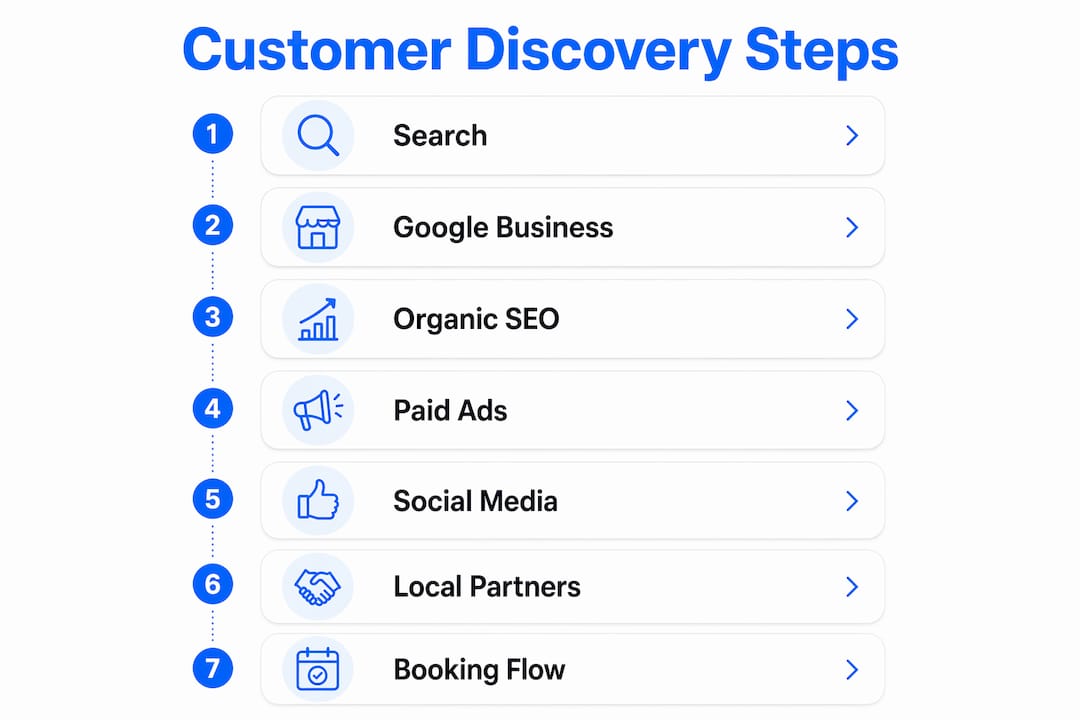
Most renters find storage through Google Maps, organic search results, and paid ads — in that order. If your Google Business Profile is incomplete, your location page is thin, and your site doesn't show pricing on the first screen, you're losing leads to whoever does those three things better. Here's what to fix first:
- Claim and complete your Google Business Profile (primary category: "Self-Storage Facility," add unit sizes as services, upload 20+ photos, enable relevant attributes). Impact: immediate — Maps ranking improves within days of verification and updates.
- Show clear pricing and availability on your location landing page, above the fold, on mobile. No "call for rates." Impact: days to weeks — conversion rate lifts as soon as the page is live.
- Enable online rentals or a one-tap call button and set up call tracking. Impact: weeks to months — gives you attribution data and removes the biggest friction point between discovery and booking.
Those three actions cover the most controllable levers in local storage discovery. Everything below explains how each channel works and how to layer them for compounding results.
Table of Contents
- 1. How customers find storage facilities through Google Business Profile
- 2. Organic SEO: which pages actually rank and convert
- 3. Google Ads capture renters who are ready to sign today
- 4. Meta and Facebook ads work best for awareness and retargeting
- 5. Listing sites and local partnerships drive discovery you don't fully control
- 6. Your website and booking flow are where discovery becomes revenue
- 7. Pricing transparency removes the friction that kills conversions
- 8. Reviews and reputation are a ranking signal and a conversion signal
- 9. Who your customers are and how they search differently
- 10. Mobile search behavior and offline channels that still drive discovery
- 11. Multi-channel integration: connecting discovery to a single customer journey
- 12. How to prioritize channels and set a realistic budget
- 13. What to measure: KPIs that show discovery is actually improving
- 14. AI visibility and structured content: getting found in AI-generated answers
- Key Takeaways
- The levers most operators underestimate
- Corvanesystems helps your facility get found where renters are looking
- Useful sources and further reading
1. How customers find storage facilities through Google Business Profile
GBP completeness and review cadence are the most impactful, controllable local ranking factors after proximity. Proximity is fixed. Everything else on this list is not.

When someone searches "storage near me" or "10x10 unit in [city]," Google's local pack pulls from three signals: how close you are, how complete your profile is, and how many recent reviews you have. You can't move your facility. You can absolutely fix your profile.
GBP completion checklist:
- Primary category set to "Self-Storage Facility" (not "Moving Company" or "Warehouse")
- Unit sizes listed as individual services (5x5, 5x10, 10x10, 10x20, etc.)
- Attributes enabled: 24-hour access, climate control, drive-up access, electronic gate, video surveillance
- Accurate hours for both gate access and office hours (these are often different)
- 20+ photos: exterior, interior units, gate, climate-control hallway, loading area
- Products or pricing entries where Google allows them
- Weekly posts (move-in specials, availability updates, seasonal tips)
- Q&A section seeded with your own common questions and answers
Pro Tip: Add unit-size-specific service items to your GBP (e.g., "10x10 Climate-Controlled Unit") so your profile surfaces for unit-size queries like "10x10 storage unit near me" — most operators skip this and leave those searches to aggregators.
Conversion-focused attributes matter as much as completeness. Renters scanning the local pack look for "24-hour access" and "climate control" before they click. If those attributes aren't visible, they click the next result. Response time to GBP messages also feeds into Google's ranking signals, so treat it like a live inbox.
2. Organic SEO: which pages actually rank and convert
Location landing pages and unit-type pages are the core organic assets. A homepage alone won't rank for "storage units in [neighborhood]" — Google wants a page that's specifically about that location, with local signals baked in.
Pages to build:
- Location landing page per facility: city/neighborhood in the H1, pricing snippet, unit availability, trust signals (reviews, security features), and a clear CTA
- Unit-size pages: one page per major size (5x5, 10x10, 10x20) explaining what fits, pricing range, and availability
- Specialty pages: climate-controlled storage, RV and boat storage, business storage — each targeting its own keyword cluster
- FAQ and pricing page: answer the questions renters actually type ("how much does a 10x10 cost," "do I need insurance")
Technical checklist for local SEO:
- Unique content per location (never duplicate the same page across multiple cities)
- LocalBusiness and SelfStorage schema markup with unit types, prices, hours, and access attributes
- Mobile page load under two seconds (Google's threshold for storage sites)
- Pricing and availability visible without scrolling on a phone screen
- Internal links from the homepage to each location page
A well-structured location page follows this pattern: headline with city + unit type, immediate price snippet ("5x10 units from $79/mo"), unit availability widget or "check availability" CTA, a short paragraph on security and access, and a block of recent Google reviews. That structure answers the renter's three questions — what's available, what does it cost, can I trust this place — without making them scroll.
Short, targeted local content gives independent operators a real edge against larger REITs, especially when paired with an active review-collection process. A national brand's generic city page rarely beats a locally specific page with fresh reviews and accurate pricing.
3. Google Ads capture renters who are ready to sign today
Search ads are the fastest path to a renter who's already decided to rent — they just haven't picked a facility yet. Someone typing "climate-controlled storage near me" or "10x10 unit available this week" is at the bottom of the funnel. A well-structured Google Ads campaign puts your facility in front of them before they click an aggregator.
Campaign fundamentals:
- Keywords to target: "[city] storage units," "storage near me," "10x10 storage [city]," "climate-controlled storage [zip]," "RV storage near me"
- Negative keywords: "free storage," "storage wars," "storage containers for sale" — these waste budget fast
- Location bid adjustments: increase bids within 3–5 miles of your facility, reduce or exclude beyond your realistic service radius
- Ad extensions: call extensions (click-to-call from mobile), price extensions (show unit sizes and starting rates), location extension (pulls from your GBP)
- Conversion tracking: track calls, form submissions, and online rental completions — not just clicks
On budget: paid search CPAs in the storage industry average $62.50 per acquired customer. That's a reasonable benchmark for planning, though your actual CPA will vary by market, competition, and landing page quality. A daily budget of $30–$50 in a mid-size market is enough to test performance before scaling.
The landing page matters as much as the ad. Send paid traffic to a single-purpose page: price and availability above the fold, one-tap call button, an online rental widget or reservation form, and nothing else competing for attention. Sending paid clicks to your homepage is one of the most common and costly mistakes in storage marketing.

4. Meta and Facebook ads work best for awareness and retargeting
Paid social isn't where renters go when they're ready to sign a lease. It's where you reach them before they start searching — and where you bring back the ones who visited your site but didn't convert.
The most effective use of Meta ads for storage is tied to life events. Moving, renovating, downsizing, and heading off to college all trigger storage needs, and Meta's targeting lets you reach people in those moments before they've typed a single search query.
Audience and creative checklist:
- In-market movers: target users who recently changed their address or are in the "likely to move" audience segment
- Apartment and university proximity: hyperlocal geofencing around large apartment complexes, college campuses, and new housing developments within 5 miles
- Retargeting: anyone who visited your website in the last 30 days but didn't reserve a unit
- Lookalike audiences: built from your existing customer list (email or phone upload)
- Ad creative: short testimonial video (15–30 seconds), unit walkthrough showing size and cleanliness, or a limited-time move-in offer with a clear expiration date
- Mobile-first format: single-image or short video with one CTA button ("Reserve Now" or "Check Availability") — no carousels for cold audiences
UTM and attribution checklist:
- Tag every Meta campaign with UTM parameters (utm_source=facebook, utm_medium=paid_social, utm_campaign=[campaign name])
- Use Google Analytics 4 to track assisted conversions — Meta often influences a renter who later converts through organic or direct
- Compare lead quality by channel: a Meta lead who calls and asks questions is different from a paid search lead who books online immediately
Meta ads rarely produce the same direct-conversion efficiency as search ads, but they fill the top of the funnel and keep your facility visible to people who are weeks away from needing storage.
5. Listing sites and local partnerships drive discovery you don't fully control
Aggregators like SpareFoot frequently appear in the top three Google results for local storage searches. That means a renter who finds your facility through Google might actually be clicking a SpareFoot listing — not your website. If that listing has outdated rates or no photos, you've lost a lead you didn't know you had.
Directory maintenance checklist:
- Rates and unit availability current (update weekly or connect via API if your management software supports it)
- 10+ photos per listing: exterior, interior units, gate, climate-control hallway
- Respond to inquiries within one hour (aggregators track response time and surface faster responders)
- Track which listings produce calls and reservations using unique phone numbers or UTM-tagged links
Partner outreach is underused and genuinely effective. The people most likely to refer storage customers are the ones who see them at the moment of need: local movers, apartment leasing offices, real estate agents, and estate sale companies. A short email to a local moving company offering a referral fee or a co-marketing arrangement takes 20 minutes and can produce steady leads for months.
A simple outreach note: introduce your facility, mention the unit types and features most relevant to their clients (climate control for realtors, drive-up for movers), and offer a referral arrangement or a co-branded flyer. Keep it brief and specific.
The tradeoff with marketplaces is real: aggregators generate lead volume but take a cut of the first month's rent or charge per lead, which compresses margin. Direct bookings through your own site cost less per acquisition and give you full customer data. The right answer for most operators is both — use aggregators for reach while investing in direct channels to reduce dependence over time.
6. Your website and booking flow are where discovery becomes revenue
A one-minute booking flow with visible pricing and availability is the difference between a renter who reserves and one who calls your competitor. Best-converting storage sites share three traits: fast mobile load times, immediate price and availability display, and a one-tap call option. Most storage websites fail at least one of these.
Website UX checklist:
- Mobile page load under two seconds
- Price and availability visible on the first screen, no scrolling required
- One-tap call button pinned to the top of the mobile page
- Simplified reservation form (name, email, phone, unit size — nothing else for the first step)
- Clear cancellation and price-lock policies stated before the payment step
- Security photos (gate, cameras, lighting) placed near the reservation CTA
- Recent Google review snippets on the location page
The booking funnel for a high-intent renter looks like this: search → Maps or organic result → location page (price check) → availability check → reservation form → confirmation. Trust signals belong at the availability and form steps, not buried at the bottom of the page. A photo of your gate and a review that mentions "easy access and great security" placed next to the reservation form can lift completions meaningfully.
Pro Tip: Enable guest checkout or a quick "hold this unit" reservation that requires only a phone number, then follow up by SMS within five minutes. Reducing the commitment at the first step dramatically cuts abandonment, and the follow-up converts the hesitant renter.
For operators who need a stronger digital foundation, custom storage websites built specifically for the industry handle these UX requirements out of the box, rather than retrofitting a generic template.
7. Pricing transparency removes the friction that kills conversions
Hidden fees are one of the top reasons renters abandon a storage booking. Administrative fees, mandatory insurance, deposits, and rate-increase clauses that appear at checkout destroy trust and send renters back to Google to find someone more straightforward.
Transparent pricing on your location page should include:
- Base monthly rate for each unit size
- What's included: 24-hour access, basic security, etc.
- Upfront fees: admin fee (state the amount), lock requirement, first/last month deposit if applicable
- Optional insurance: cost per month, what it covers, whether it's required
- Price-lock offer if you offer one: "Rate guaranteed for 3 months" stated clearly
Promotional structure and A/B test suggestion:
- Test "first month free" versus "price lock for 3 months" as your primary move-in offer
- Measure 30-day and 90-day retention for each group, plus revenue per available unit (RevPAU) at the 6-month mark
- "First month free" attracts higher volume but can pull in short-term renters who churn after month two; price-lock offers tend to attract renters who plan to stay longer
The pricing page is also where you can address the questions renters are already asking: "Will my rate go up?" "Do I need insurance?" "What happens if I'm late?" Answering these directly, in plain language, before the reservation step reduces inbound calls and increases online completions.
Presenting unit size guidance and full pricing disclosure alongside expected duration scenarios helps renters choose the right unit and reduces churn from mismatched expectations. A renter who picks the right size the first time is less likely to cancel after 60 days.
8. Reviews and reputation are a ranking signal and a conversion signal
Recent, active reviews with specific mentions of unit types or features are a decisive local ranking and conversion signal. A facility with 12 reviews from three years ago will consistently lose the local pack to a competitor with 60 reviews from the last six months, even if the older facility is closer.
Review-request cadence:
- Send a review request by SMS 48–72 hours after move-in (when the experience is fresh and positive)
- Follow up by email at the 30-day mark for renters who didn't respond to the first message
- For long-term renters, send a second request at the 6-month mark
SMS template (move-in): "Hi [Name], thanks for choosing [Facility Name]! We'd love to hear about your experience — it takes about 60 seconds: [Google review link]. Thanks!"
Response templates:
- Positive review: "Thank you, [Name]! We're glad the [unit type / access hours / climate control] worked well for you. We look forward to having you with us."
- Negative review: "We're sorry to hear this, [Name]. Please call us at [number] or email [address] — we want to make this right. We take [specific issue] seriously and would like to address it directly."
Responding to every review, positive and negative, signals to Google that the business is active and engaged. It also signals to the next renter reading your profile that complaints get addressed. Surface your best review snippets on your location landing page and GBP — a three-sentence review that mentions "clean units," "easy gate access," and "fair pricing" does more conversion work than any marketing copy you write yourself.
For a detailed review-collection process, storage facility review best practices covers cadence, templates, and how to handle review removal requests.
9. Who your customers are and how they search differently
Renters segment into four main groups, and each searches for storage in a distinct way. Messaging and channel allocation that ignores this wastes budget on the wrong audience.
Segment-to-channel mapping:
- Movers (residential relocation): high-intent, search-driven. Find storage through Google Maps and paid search. Keywords: "storage near [new zip code]," "storage units available now." Messaging: availability, drive-up access, flexible lease terms.
- Temporary storers (renovation, decluttering, college): moderate intent, often use aggregators and social. Find storage through SpareFoot, Meta ads, and word of mouth. Messaging: month-to-month flexibility, no long-term commitment.
- Long-term business storage: lower urgency, research-driven. Find storage through organic search and referrals. Keywords: "business storage [city]," "inventory storage near me." Messaging: security, 24-hour access, invoice billing.
- Vehicle/RV/boat owners: seasonal, niche. Find storage through specialty searches and local directories. Keywords: "RV storage near me," "covered boat storage [city]." Messaging: unit dimensions, outdoor vs. covered options, access hours.
A simple survey question at booking captures first-party data that sharpens future targeting: "What's the main reason you're renting storage today?" with options for moving, renovation, business use, vehicle storage, and other. That single data point, collected over 90 days, tells you which segment drives the most revenue and which channels they came from.
Operator content that addresses each segment's specific scenario — unit size guidance, duration scenarios, pricing disclosure — reduces cancellations and increases trust before the renter even calls.
10. Mobile search behavior and offline channels that still drive discovery
Roughly 68.4% of storage industry traffic comes from mobile devices, and organic search accounts for 51.2% of visits. Those two numbers together define the core optimization priority: a fast, clear mobile experience on pages that rank organically.
Mobile-specific optimizations that matter:
- Click-to-call button visible without scrolling
- Maps integration on the location page (tap to get directions)
- Reservation form with autofill enabled (reduces typing friction)
- No pop-ups that block the screen on mobile load
Across the industry in 2026, 68.4% of all website sessions come from mobile devices and 51.2% from organic search as of June 2026.
Offline channels still drive meaningful discovery, particularly for facilities in suburban and rural markets where digital competition is lower. Roadside signage remains one of the highest-ROI investments for a physical storage facility — a renter driving past a well-lit sign with a phone number and "Units Available" has already found you without a single click. Direct mail to apartment complexes within a 3-mile radius, timed around lease renewal periods (typically spring and fall), produces measurable call volume at a predictable cost.
Local events — sponsoring a neighborhood moving sale, partnering with a community organization, or setting up a booth at a home expo — build brand recognition that compounds over time. These channels rarely produce immediate bookings, but they shorten the consideration phase when a renter eventually searches online.
11. Multi-channel integration: connecting discovery to a single customer journey
Individual channels produce leads. Connected channels produce a predictable, measurable customer journey. The gap between a facility that fills units steadily and one that chases leads reactively is usually a matter of how well the channels talk to each other.
A referral program formalizes word-of-mouth discovery. Offer existing renters a one-month discount or a gift card for each new renter they refer. Track referrals with a unique promo code per referrer. Referral leads convert at higher rates than paid search leads and churn less, because they arrive with a trusted recommendation already in place.
Competitive analysis belongs in the same workflow. Search your primary keywords monthly and note which competitors appear in the local pack, which aggregator listings rank above yours, and what pricing and promotions your competitors are showing. Tools like Google Search Console, BrightLocal, or Whitespark surface ranking gaps and competitor movements without requiring a large budget. When a competitor drops out of the local pack or raises rates, that's a window to capture their displaced renters with a targeted ad or a timely GBP post.
The integration point that most operators miss is attribution. When a renter calls, asks how they found you, and you say "Google" — that's not attribution. Proper attribution means a unique call-tracking number on each channel (GBP, website, aggregator listings, direct mail), UTM tags on every digital link, and a monthly review of which channels produced qualified leads versus window shoppers. That data is what lets you reallocate budget with confidence rather than gut feel.
12. How to prioritize channels and set a realistic budget
Prioritize GBP completeness, on-site SEO, and mobile UX first. Run search ads for immediate demand. Layer marketplaces and paid social for additional reach once the foundation is solid. Spending on paid ads before your landing page converts is the most common budget mistake in storage marketing.
| Channel | Time to Impact | Expected Lead Type | Ongoing Effort |
|---|---|---|---|
| Google Business Profile | Immediate to 2 weeks | High-intent, local | Low (weekly updates) |
| On-site organic SEO | 2–6 months | High-intent, research-driven | Medium (content + technical) |
| Google Ads | Immediate | High-intent, ready to rent | High (daily monitoring) |
| Meta / Facebook Ads | 1–4 weeks | Awareness, retargeting | Medium (creative refresh) |
| Aggregator listings | 1–2 weeks | Moderate-intent | Low (rate/photo updates) |
| Local partnerships / referrals | 4–12 weeks | High-intent, high-trust | Low (relationship maintenance) |
| Offline (signage, direct mail) | 2–8 weeks | Variable | Low (periodic) |
Budget allocation by goal:
- Immediate fill (high vacancy): 60% paid search, 20% GBP and landing page fixes, 20% aggregator listings
- Steady growth (stable occupancy, building long-term): 40% organic SEO and content, 30% paid search, 20% Meta retargeting, 10% referral program
- New location launch: 50% paid search (immediate visibility), 30% GBP and local SEO setup, 20% aggregator listings and partner outreach
Reallocate budget when paid CPA exceeds your target by more than 30% for two consecutive months, or when a channel produces leads that don't convert to signed leases. Lead volume without conversion is a landing page or pricing problem, not a channel problem.
13. What to measure: KPIs that show discovery is actually improving
Track a small set of high-signal KPIs: calls from each channel, online reservations, occupancy lift month-over-month, paid CPA, and conversion rate by channel. More metrics than that and you're measuring noise.
KPI definitions and how to measure them:
- Calls by channel: use unique call-tracking numbers per channel (Google Ads, GBP, website, aggregators). Count only calls over 60 seconds as qualified.
- Online reservations: track in your property management software and in Google Analytics 4 as a conversion event.
- Occupancy lift: compare occupied units this month vs. the same month last year, adjusted for any new units added.
- Paid CPA: total ad spend divided by new leases signed from paid channels in the same period.
- Conversion rate by channel: reservations divided by unique sessions from each traffic source.
UTM and call-tracking checklist:
- Every paid ad links to a UTM-tagged URL (utm_source, utm_medium, utm_campaign, utm_content)
- GBP website link uses a UTM tag (utm_source=google_business_profile)
- Aggregator listings use unique phone numbers or UTM-tagged URLs
- Google Analytics 4 goals set for: form submission, reservation completion, call button click
A monthly dashboard for a single-location operator needs six numbers: total calls, total online reservations, occupancy rate, paid CPA, organic sessions to the location page, and average review rating. Those six numbers tell you whether discovery is improving and where the bottleneck is.
Organic search drives 51.2% of storage site visits, which means your location page's organic ranking is the single highest-leverage metric to track in Google Search Console. A drop in impressions for your primary city keyword is an early warning sign, weeks before it shows up in occupancy numbers.
14. AI visibility and structured content: getting found in AI-generated answers
AI tools and Google's AI Overviews increasingly answer "storage near me" queries directly, pulling from structured local signals rather than sending users to a list of blue links. A facility with complete GBP attributes, unit-level schema markup, and regularly published local content is far more likely to surface in those AI-generated answers than one with a sparse profile and a generic homepage.
AI visibility checklist:
- GBP: all attributes filled, unit types listed as services, hours accurate, photos current
- JSON-LD schema on location pages: LocalBusiness type, name, address, phone, hours, geo coordinates, priceRange, amenityFeature (climate control, 24-hour access, drive-up), and individual unit types with sizes and prices
- FAQ schema on your pricing and FAQ pages (answers the conversational queries AI systems pull from)
- Regular content publishing: 30+ keyword-focused articles per month signals topical authority to both search engines and language models
The research is clear: GBP completeness and review cadence are the top controllable factors for local ranking, and those same signals feed AI visibility. A facility that ranks well in Maps is also more likely to be cited by ChatGPT or Perplexity when a user asks "what's a good storage facility in [city]?"
Operators who want to understand their current AI visibility across ChatGPT, Claude, Perplexity, and Google AI Overviews can start with an AI visibility audit for storage businesses — it shows exactly where your facility appears (or doesn't) and what structured signals are missing.
Key Takeaways
Google Business Profile completeness, mobile-first local pages, and a steady review cadence are the three highest-ROI discovery levers available to self-storage operators in 2026.
| Point | Details |
|---|---|
| GBP is the top controllable lever | Set the correct primary category, list unit sizes as services, enable attributes, and maintain recent reviews. |
| Mobile-first UX drives conversions | With 68% of storage industry traffic coming from mobile devices, price and availability must be visible above the fold with a one-tap call option. |
| Paid search fills units immediately | Google Ads targeting unit-size and "near me" keywords captures ready-to-rent customers; benchmark CPA is at a typical industry level. |
| Pricing transparency reduces churn | Show base rate, fees, and optional insurance on the location page; test price-lock vs. first-month-free offers and track 90-day retention. |
| Corvanesystems closes the AI gap | Corvanesystems audits and improves how your facility appears across Google, ChatGPT, Claude, and Perplexity with flat-rate SEO and GEO services. |
The levers most operators underestimate
Most operators I talk to have spent money on paid ads before fixing their GBP or their location page. That's backwards. Paid search sends high-intent traffic to wherever your site is — if the site is slow, shows no pricing, and requires a phone call to reserve, you've paid to send someone to a dead end.
The two most underrated levers in storage marketing are reviews and GBP detail. Not because they're secret, but because they require consistency rather than a one-time spend. A facility that collects 5 new reviews every month and updates its GBP weekly will outperform a competitor with a bigger ad budget and a neglected profile. That's not a theory — it's what the local ranking data consistently shows.
The over-funded tactic is broad brand awareness without local targeting. Running display ads or boosting Facebook posts to a general audience in your metro area produces impressions, not leases. Every dollar spent on awareness that isn't tied to a specific life event, a specific radius, or a specific retargeting list is a dollar that could have gone to a search ad or a review-request SMS.
One more warning: teaser rates that jump after month one create the exact churn and negative reviews that undermine everything else you're building. A renter who feels misled will leave a review that cancels out ten positive ones. Transparent pricing isn't just an ethical choice — it's the most cost-effective retention strategy available.
Corvanesystems helps your facility get found where renters are looking
Most storage operators have a GBP, a website, and maybe a SpareFoot listing. What they're missing is the structured digital presence that gets them surfaced in AI-generated answers, Google AI Overviews, and the local pack consistently — not just occasionally.
Corvanesystems is built specifically for self-storage operators who want to stop losing leads to better-optimized competitors. The service covers technical and on-page SEO, Google Business Profile management, 30 keyword-focused articles published monthly, and AI visibility audits that show exactly how your facility appears across ChatGPT, Claude, Perplexity, and Google AI. One flat monthly rate, no contracts, no tiers. You know what you're paying and what you're getting.
If you want to see where your facility stands right now, request an AI visibility audit at Corvanesystems. You'll get a clear picture of your current search and AI visibility, the gaps that are costing you leads, and a prioritized roadmap to close them.
Useful sources and further reading
These sources informed the research behind this article. Use them when building benchmarks and KPIs for your own reporting.
- Local SEO for Self-Storage Facilities | Flento — Practical GBP checklist, review cadence guidance, and aggregator strategy for independent operators competing against national brands.
- Storage Facilities Industry Marketing Benchmarks | CUFinder — Industry-specific data on mobile traffic share, organic search share, paid CPA, and average customer tenure for self-storage.
- 4 Important Things to Consider When Renting a Storage Unit | U-Haul — Renter-facing guidance on pricing transparency, fees, and lease flexibility — useful for understanding what renters are reading before they contact you.
- Self-Storage Guide: How to Evaluate a Facility | SmartStop — Covers the security, lease, and review factors renters use to compare facilities; useful for aligning your location page content with renter decision criteria.
- What Size Storage Unit Do I Need? | StorageUnitGuide.org — Practical size-selection framework that mirrors how renters think when searching for unit-specific keywords.
- Smart Storage for Small Spaces: A Renter's 2026 Guide | PriceLows — Consumer-facing storage tips that reveal the questions and concerns renters bring to their facility search.
- Self Storage Research Data | SSA — The Self Storage Association's industry research hub; primary source for U.S. market size, occupancy trends, and operator benchmarks.
- AI Search Optimization for Storage Businesses | Corvanesystems — Explains GEO techniques and AI visibility strategies tailored specifically for storage operators navigating the shift from traditional search to AI-generated answers.