
Multi-location self-storage operators win the Google Local Pack by doing three things right: one authoritative location page per physical facility, a verified and fully configured Google Business Profile (GBP) per facility, and consistent hyperlocal data backed by a steady stream of reviews. Get those three pillars in place and you are already ahead of most competitors. Add structured data, UTM-tagged tracking, and a governance model that prevents data drift, and you have a program that scales from 5 locations to 500 without falling apart.
The industry term for this discipline is multi-location local SEO, sometimes called distributed SEO or branch SEO optimization. Whatever you call it, the mechanics are the same: each facility needs its own authoritative digital footprint, and every signal pointing to that facility must be consistent across Google, AI platforms, and third-party directories.
Here is your 72-hour start list:
- Claim and verify GBP for your 10 highest-priority locations.
- Publish one hyperlocal content block on each corresponding location page.
- Enable a review-request workflow at the point of sale for those same locations.
- Build or update your master data sheet with exact NAP fields, canonical URLs, and a "last verified" timestamp column.
- Add UTM parameters to every GBP website link so clicks are attributed by location from day one.
The sections below unpack each of these priorities in the order you should tackle them, with templates and governance rules you can hand directly to your team.
Key Takeaways
A successful multi-location SEO program for storage facilities requires one authoritative, schema-marked location page per facility, a verified GBP per location, and a central master data repo that keeps every signal consistent across search engines and AI platforms.
| Point | Details |
|---|---|
| One page per facility | Each location needs a unique, indexed URL with LocalBusiness schema and a sameAs link to its verified GBP. |
| GBP accuracy is non-negotiable | Standardize name, address, phone, hours, and UTM-tagged URL across every profile; audit monthly. |
| Hyperlocal content lifts rankings | A Wiideman study found up to a 107% ranking lift from hyperlocal content and 84% from custom images on location pages. |
| Central master repo prevents data drift | A single source of truth for NAP, hours, and URLs keeps GBP, schema, and citations consistent at scale. |
| Corvanesystems runs the full program | Flat-rate SEO, GBP management, AI-optimized content, and location-level reporting built for storage operators. |
Table of Contents
- How does multi-location SEO for storage work at the page level?
- How do you optimize Google Business Profiles across every facility?
- How do you collect and manage reviews at scale across locations?
- Why does NAP consistency matter and how do you audit it at scale?
- What local content and imagery actually move rankings for storage facilities?
- How do you build local backlinks for storage facilities without wasting resources?
- How do you track and attribute performance by location?
- What technical SEO and structured data does each location page need?
- How do you roll out multi-location SEO across a large storage portfolio?
- Which tool categories should you buy first for multi-location storage SEO?
- The part of multi-location SEO most storage operators get wrong
- Corvanesystems handles the entire multi-location SEO program for storage operators
- Sources
How does multi-location SEO for storage work at the page level?
Every storage facility deserves its own URL. Not a parameter-based variant, not a filtered page off a national directory listing — its own indexed, canonical page that lives at a predictable path like /locations/austin-tx/ or /storage/chicago-lincoln-park/. That URL is the anchor for every local signal: schema, GBP link, citations, and backlinks all point to it.
What a high-performing location page must contain
A complete location landing page covers the following without exception:
- NAP block: business name (exact match to GBP), street address, local phone number.
- Hours: displayed as visible text, not just in schema.
- Embedded map and written driving directions from at least two major landmarks.
- Original photos: exterior, interior units, access gate, and climate-control areas.
- Unit-size guide specific to that facility's actual inventory (5x5, 10x10, 10x20, etc.).
- Amenities list: climate control, 24-hour access, drive-up units, RV/boat storage, on-site manager.
- Local FAQs: questions specific to that neighborhood, not copy-pasted from a national FAQ.
- LocalBusiness JSON-LD block with sameAs linking to the verified GBP URL.
- Staff bio or manager name where available — a real person builds trust signals.
Modular templates: fixed vs. variable content
Split every page into two zones. The fixed zone carries brand elements, process descriptions, and legal copy that never changes. The variable zone pulls from your master data repo: address, phone, hours, unit inventory, local imagery, and the hyperlocal content block.
Automate the variable fields. If you run SiteLink or storEDGE, live unit availability and pricing can feed directly into the page, making each location page genuinely unique on every visit. That freshness signal matters.
When to consolidate vs. separate: if two facilities are within a mile of each other and target overlapping search queries, a single consolidated page with both addresses often outperforms two thin pages. The hub-and-spoke architecture principle applies here: build the fewest pages that accurately represent your real footprint, and make each one authoritative rather than spreading thin content across dozens of near-duplicate URLs.
Pro Tip: Connect SiteLink or storEDGE to your location pages via API so the unit-availability block updates in real time. A page showing "3 climate-controlled 10x10 units available" is never a thin page.
How do you optimize Google Business Profiles across every facility?
GBP is the single highest-leverage asset in local SEO for storage. A fully configured profile is what puts you in the Local Pack and, increasingly, in AI-generated recommendations from platforms like Google's AI Overviews, ChatGPT, and Perplexity.

Core fields to standardize across all locations
Every GBP must have:
- Business name: use the same convention everywhere (e.g., "StoreName — Austin South" not "StoreName Austin" at one location and "StoreName — South Austin" at another).
- Address: formatted to USPS standards, suite/unit on the second address line.
- Local phone number: unique per location, not a national call center number.
- Website URL: the location-specific landing page, UTM-tagged (e.g.,
?utm_source=google&utm_medium=local&utm_campaign=austin-south). - Primary category: "Self-Storage Facility" — do not leave this as a generic "Storage Facility."
- Secondary categories: add "Moving and Storage Service" or "Automobile Storage Facility" where applicable.
- Services: list unit sizes and amenities as individual service entries.
- Photos: minimum 10 per location, updated quarterly.
Consistent, verified GBP data is one of the primary trust signals that AI-driven discovery platforms use to recommend local businesses. LLMs and AI search tools pull from Maps data, third-party directories, and review sentiment — not just traditional rankings. A GBP with mismatched hours, a wrong phone number, or a missing location URL is effectively invisible to these systems. Winning AI-driven discovery requires the same data hygiene that wins the Local Pack, applied consistently at every location.
Bulk verification and Business Groups
For operators with 10 or more locations, Google's bulk verification process through Business Profile Manager is the right path. You submit a spreadsheet, Google verifies via postcard or video call, and you manage all profiles from a single dashboard. Assign access levels carefully: central SEO team gets owner access; local managers get manager access for photos and posts only, not address edits.
Add a "last verified" column to your master data sheet and check it monthly. GBP listings drift — hours change, phone numbers get updated locally, and someone at the facility edits the address without telling the central team.
How do you collect and manage reviews at scale across locations?
Reviews are a ranking signal and a trust signal for AI recommendations. Building review volume and quality across every location requires a repeatable system, not a one-time push.
Review acquisition workflow
- At move-in: send an automated SMS or email 48 hours after the customer accesses their unit for the first time. Keep the message short: "How was your move-in experience at [Facility Name]? A quick Google review helps us a lot: [link]."
- At renewal: trigger a second request at the 90-day mark for customers who have not yet reviewed.
- At move-out: a final request tied to the move-out confirmation email, with a direct link to the GBP review form.
- In-kiosk prompts: if your facility has a self-service kiosk, add a QR code linking to the review page at the payment confirmation screen.
Response playbook
- Positive reviews: respond within 48 hours. Thank the reviewer by first name, mention the specific facility, and add one sentence about a feature they mentioned.
- Neutral reviews (3 stars): acknowledge the experience, apologize for any friction, and offer a direct contact to resolve the issue offline.
- Negative reviews: respond within 24 hours. Never argue. Acknowledge, apologize, and move the conversation to a direct channel immediately.
Assign a local responder role for each facility and a central reviewer who audits responses quarterly. Escalate any review mentioning legal issues, safety incidents, or media threats to the central team before responding.
- Track review velocity (new reviews per week per location) and average rating trend monthly.
- A location gaining Local Pack visibility typically shows a correlation with review count increases, though the relationship is not strictly linear.
Why does NAP consistency matter and how do you audit it at scale?
Name, address, and phone number (NAP) consistency across every directory, map platform, and data aggregator is the foundation of local SEO for multiple sites. A single mismatched phone number on Apple Maps or HERE can suppress a facility's local ranking and confuse AI systems trying to verify the business's identity.
Master repo: the single source of truth
Your master data sheet should include one row per location with these exact fields:
- Legal business name, display name, and GBP name (all three, because they sometimes differ).
- Full street address, city, state, ZIP, formatted to USPS standards.
- Suite or unit number on a separate field.
- Local phone number and toll-free number (if applicable).
- Canonical location page URL.
- GBP URL and GBP listing ID.
- Hours (all seven days, plus holiday hours).
- "Last verified" timestamp.
Citation priority list
Work through platforms in this order: Google Business Profile, Bing Places, Apple Maps, HERE (which feeds many in-car navigation systems), Yelp, Facebook, and the national data aggregators (Data Axle, Neustar Localeze, Foursquare). After those, target local chamber of commerce directories, city business directories, and self-storage industry directories.
Niche and regional directories can provide incremental advantage when submissions are accurate and consistent. Run a quarterly audit using a citation-tracking tool to catch mismatches before they compound.
Pro Tip: Centralize all citation edits through the master repo. Never let a local manager update an address directly on Yelp or Bing — require a change-request ticket that flows through the central team first, then pushes to all platforms simultaneously.
What local content and imagery actually move rankings for storage facilities?
Thin pages are the most common reason multi-location storage sites fail to rank. A page with a name, address, phone, and a generic paragraph about "affordable storage solutions" is not a location page — it is a doorway page, and Google treats it accordingly.
Image asset checklist
- Original photos at 1,200 x 900 pixels, under 1MB per file.
- Descriptive filenames:
austin-south-storage-climate-controlled-units.jpg, notIMG_4821.jpg. - Alt text with locality terms: "climate-controlled storage units in South Austin, TX."
- At minimum: exterior shot, interior unit row, access gate, and one amenity-specific photo (climate control, RV lot, etc.).
Custom location images and hyperlocal content are strongly correlated with ranking lifts for location pages — a Wiideman study cited by BrightLocal found up to a 107% lift from hyperlocal content and 84% from custom images in tested location pages.
Hyperlocal content blocks
Each location page needs at least one content block that could not exist on any other page. Examples:
- "Our South Austin facility is two blocks from the Slaughter Lane H-E-B, with drive-up access off William Cannon Drive."
- A neighborhood history paragraph (two to three sentences) that references the local area by name.
- Unit availability snapshot tied to live inventory.
- Local FAQ: "Do you offer RV storage near the Austin airport?" — answered specifically for that location.
Pro Tip: On opening day for any new facility, collect two hero shots before the first customer arrives: one exterior with the sign visible and one interior unit row. Those two images prevent months of missing imagery that suppresses new listings.
Video and virtual tours
A 360° walkthrough published to Google Street View through the Business Profile gives the listing a visual edge and keeps users engaged longer. Short, 60-second facility walkthrough videos embedded on the location page also reduce bounce rate and give AI systems richer entity signals to process.
How do you build local backlinks for storage facilities without wasting resources?
Local backlinks are the most time-intensive part of multi-location SEO, so prioritize ruthlessly. The goal is relevant, location-specific links pointing to each facility's landing page, not to the homepage.
Local link priority matrix
| Priority | Link type | Example |
|---|---|---|
| High | Local news coverage | City business journal, neighborhood blog |
| High | Local business associations | Chamber of commerce, BIA membership |
| Medium | Cross-promotion partners | Moving companies, real estate agents, apartment complexes |
| Medium | Sponsorships | Little-league teams, local charity events |
| Low-effort | Citation directories | Industry and regional directories |
For a deeper breakdown of storage-specific link sources, the storage facility backlink guide covers niche opportunities most operators overlook.
Scaling outreach
Pilot outreach in your top three markets. Document what works — which email subject lines get responses, which partnership types convert — then roll the winning templates to lower-priority locations with localized messaging. Track every outreach opportunity in a shared sheet with columns for location, target site, contact, status, and link acquired date. This prevents two team members from emailing the same editor at the same local paper.
Always use the location landing page as the link target. A backlink to /locations/austin-south/ builds that page's authority directly. A backlink to the homepage does almost nothing for local rankings.
How do you track and attribute performance by location?
You cannot improve what you cannot measure by location. A single GA4 property with no UTM structure or call-tracking tells you the site is getting traffic — it tells you nothing about which facility is driving it.
Standard UTM schema
Use this convention for every GBP website link and any paid local placement:
utm_source=googleutm_medium=local(for GBP) orutm_medium=cpc(for paid)utm_campaign=[city-slug](e.g.,austin-south)utm_content=gbp(to distinguish GBP clicks from other Google sources)
Apply the same schema to any directory listing that allows a custom URL. UTM tags and call-tracking are the standard method for attributing leads and conversions to the correct location.
Call tracking setup
Assign a unique tracking number per location. Route calls through a call-tracking platform that logs caller ID, call duration, and outcome, then syncs to your CRM. Map each tracking number to the location ID in your master repo so attribution is automatic.
Dashboard KPIs by location
| Source | Metric | Check frequency |
|---|---|---|
| GBP Insights | Profile views, direction requests | Daily |
| GBP Insights | Phone calls via listing | Real-time |
| GA4 | Organic sessions by location page | Weekly |
| Call tracking | Calls by location, call-to-lead rate | Weekly |
| Rank tracker | Local Pack position by city | Weekly |
| CRM | Bookings / move-ins attributed to organic | Monthly |
A sudden drop usually signals an indexation problem, a GBP suspension, or a NAP mismatch that just propagated through the aggregators.
If your site is losing leads and you are not sure why, the storage website lead troubleshooting guide walks through the most common attribution and architecture failures.
What technical SEO and structured data does each location page need?
Technical SEO for multi-location storage sites has three non-negotiable requirements: correct LocalBusiness schema on every location page, a clean indexing strategy, and a crawl budget that does not waste resources on thin or duplicate URLs.
Required LocalBusiness schema fields
Google requires each physical location page to include LocalBusiness schema with the following fields populated dynamically from your master repo:
@type:SelfStorage(a valid LocalBusiness subtype)name: exact match to GBP display namestreetAddress,addressLocality,addressRegion,postalCodetelephone: local numberopeningHours: all days in ISO 8601 formatgeo:latitudeandlongitudesameAs: the verified GBP URL for that location
A minimal JSON-LD block looks like this:
{
  "@context": "https://schema.org",
  "@type": "SelfStorage",
  "name": "StoreName — Austin South",
  "streetAddress": "1234 William Cannon Dr",
  "addressLocality": "Austin",
  "addressRegion": "TX",
  "postalCode": "78745",
  "telephone": "+1-512-555-0100",
  "openingHours": ["Mo-Su 06:00-22:00"],
  "geo": {
    "@type": "GeoCoordinates",
    "latitude": 30.1849,
    "longitude": -97.8030
  },
  "sameAs": "https://maps.google.com/?cid=YOUR_LISTING_CID"
}
Populate every field dynamically from the master repo. A schema block that says "Austin" when the GBP says "Austin, TX" and the page says "South Austin" is a trust-signal failure.
Service-area businesses that have no public storefront must hide their street address on GBP and use the Service Area settings instead. Google still determines ranking proximity from the physical location, but the address is not shown publicly. For self-storage facilities with a physical gate and office, always display the address — hiding it suppresses Local Pack eligibility. The
sameAsproperty in your schema should link to the verified GBP URL, not a generic Maps search. This single field is how search engines and AI systems confirm that your location page and your GBP are the same entity.
Indexing and crawl rules
- Index every location page with unique content and a real physical address.
- Noindex any auto-generated service-area page that has no unique content (e.g., "storage in [city]" pages created programmatically with no real facility there).
- Canonical tags: point any paginated or filtered variant back to the primary location URL.
- Crawl budget: if your site has more than 200 location pages, submit a dedicated XML sitemap for location pages and monitor crawl stats in Google Search Console weekly.
Validate every schema block with Google's Rich Results Test before publishing. Then confirm the page is indexed and the schema is parsed correctly via the URL Inspection tool in Search Console.
For a full checklist of AI and search visibility signals, the storage facility visibility audit checklist covers schema, GBP, and content requirements in one place.
How do you roll out multi-location SEO across a large storage portfolio?
A phased rollout prevents the chaos that comes from trying to fix 80 locations simultaneously. Start small, measure everything, then scale what works.
Suggested rollout timeline
- Days 1–30 (Pilot setup): select your top 10 locations by revenue or search volume. Build or audit location pages, verify GBPs, implement schema, and enable call-tracking and UTMs.
- Days 31–60 (Pilot measurement): collect baseline data. Track Local Pack positions, GBP impressions, call volume, and organic sessions for each pilot location.
- Days 61–90 (Pilot analysis): compare two content template variants and two review-acquisition flows across similar markets. Document which combination produces the highest Local Pack lift.
- Months 4–6 (Phase 1 rollout): apply the winning template to the next 20–30 locations. Prioritize locations with the highest occupancy gap or the most competitive local markets.
- Months 7–12 (Full rollout): complete remaining locations in priority buckets. Lower-priority locations get the template applied with minimal customization; high-priority locations get full hyperlocal content treatment.
Role responsibility matrix
- Central SEO team: owns the master repo, schema templates, UTM schema, GBP bulk management, and reporting dashboards.
- Local facility managers: supply photos, confirm hours and amenities, respond to reviews (within the approved playbook), and flag address changes via ticket.
- Dev/IT: implements schema, manages URL structure, and handles CMS integrations with SiteLink or storEDGE.
- Vendor/agency: executes content production, citation cleanup, and outreach at scale.
Ongoing governance cadence
- Monthly: GBP accuracy check, review velocity report, UTM and call-tracking audit.
- Quarterly: full NAP audit across all citation platforms, Local Pack rank report by location, content refresh for any page that has not been updated in 90 days.
- Biannually: image refresh for all locations, schema re-validation, and a crawl audit for new thin or duplicate pages.
When a facility closes, immediately noindex the location page, redirect the URL to the nearest active location, and remove or update the GBP listing. Leaving a closed-location page indexed is a trust-signal problem for the entire domain.
Which tool categories should you buy first for multi-location storage SEO?
The right tool stack reduces manual work and prevents the data drift that kills multi-location programs. Buy in this order:
- Master data platform and GBP manager (e.g., a local listing management platform with bulk edit and API access): this is the foundation. Without it, every other tool is working from inconsistent data.
- Call-tracking platform with CRM integration: assign unique numbers per location and map them to your master repo.
- Review management platform: centralized monitoring, automated request workflows, and response assignment by location.
- Rank and Local Pack tracker: track Local Pack positions by city and facility, not just national keyword rankings.
- Dashboard/BI integration: pull GBP Insights, GA4, call-tracking, and CRM data into a single location-level view.
When evaluating any tool, require: API access for bulk edits, reporting filterable by individual location, data export in standard formats (CSV, JSON), and a documented exit plan so you are not locked in if you switch vendors.
AI search optimization for storage requires that your data flows cleanly from the master repo through GBP and into your website's structured data. Any tool that breaks that chain creates more work than it saves.
The part of multi-location SEO most storage operators get wrong
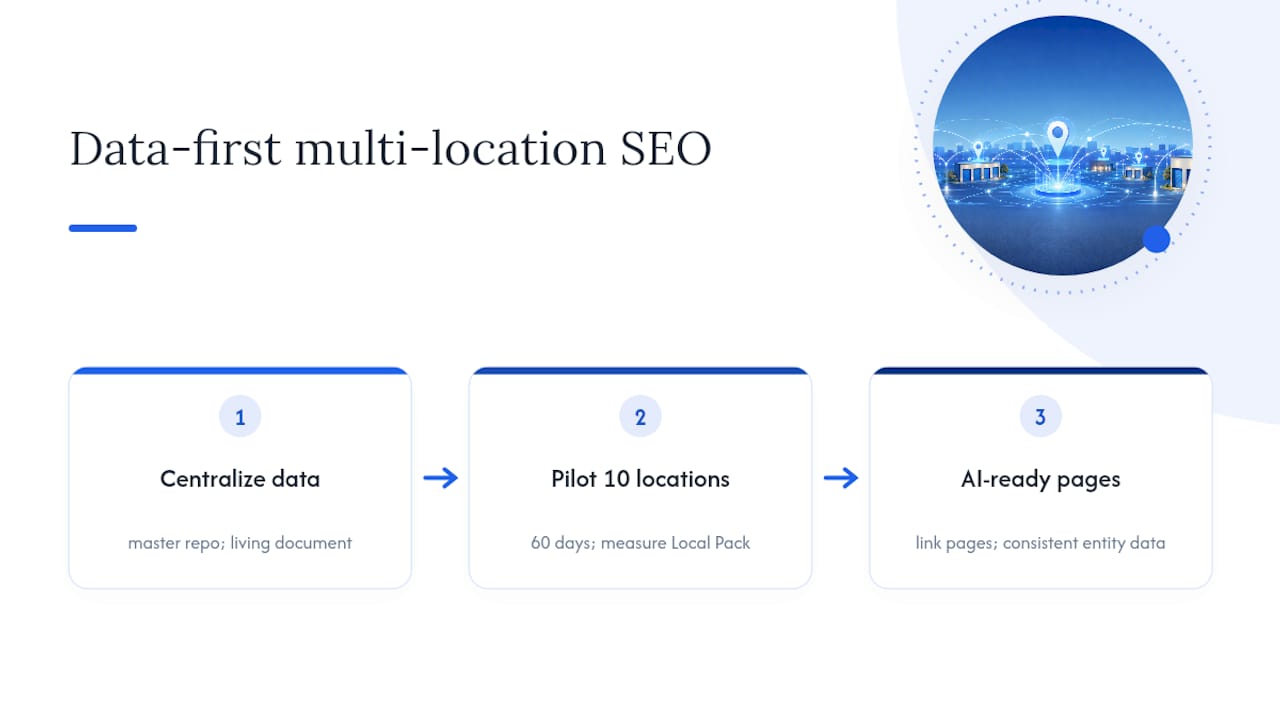
Most operators treat multi-location SEO as a content problem. They hire a writer, produce 50 location pages in a month, and wonder why nothing moves. The content is not the bottleneck. The data is.
Every ranking signal for a local storage facility traces back to a single question: does Google trust that this business is real, at this address, with these hours, offering these services? When the GBP says one thing, the website says another, and Yelp says a third, the answer is no. Google does not rank businesses it cannot verify. AI systems do not recommend businesses they cannot corroborate.
The operators who win local search at scale are not the ones with the most content. They are the ones with the cleanest data. A master repo that is treated as a living document, updated every time a phone number changes or a facility adds Sunday hours, is worth more than a hundred blog posts about "storage tips."
The second mistake is skipping the pilot. Operators with 40 locations try to fix all 40 at once, produce inconsistent work, and have no baseline to measure against. A 10-location pilot with clean measurement takes 60 days and tells you exactly which content template, which review-acquisition flow, and which schema configuration produces the best Local Pack lift in your specific markets. That data is worth the delay.
AI-driven discovery adds a third layer most operators have not considered yet. ChatGPT, Perplexity, and Google's AI Overviews do not just pull from rankings — they pull from the entire web of signals around a business: reviews, citations, structured data, and the relationships between entities on your site. A facility page that links to a staff page, a services page, and a local FAQ page, all with consistent entity data, looks like a real business to an AI system. A standalone page with a name and address looks like a placeholder.
Corvanesystems handles the entire multi-location SEO program for storage operators
Running a multi-location SEO program in-house requires a master data repo, GBP management across every facility, consistent content production, schema implementation, call-tracking setup, and monthly reporting by location. For most storage operators, that is a full-time function that does not exist yet.
Corvanesystems is built specifically for self-storage operators who need all of that done without hiring an internal team or signing a long-term agency contract. The flat-rate monthly service covers technical and on-page SEO, GBP optimization and monitoring, 30 keyword-focused articles per month structured for both search engines and AI platforms, AI visibility audits across ChatGPT, Claude, Perplexity, and Google's AI Overviews, and a monthly performance report by location. No tiers, no minimums, no contracts.
If your portfolio has more than five locations with inconsistent GBPs, no call-tracking, or location pages that have not been updated in six months, that is the signal to bring in a specialist. Corvanesystems runs a no-commitment pilot for your top-priority locations so you see real ranking and visibility data before committing to a full rollout. Corvanesystems and know within 60 days whether the program is working.
Sources
The following references support the tactics in this guide and are worth bookmarking when building internal SOPs or briefing vendors:
- The Complete Guide To Local SEO For Multiple Locations
- Multi-location SEO: How to structure geographic pages at scale
- Multi-Location SEO (BrightLocal)
- Multi-Location SEO — Rank Every Store (Backlinko)