
Data aggregators won't push your storage facility to the top of Google by themselves, but skipping them leaves your business data scattered, outdated, and easy for AI tools to get wrong. They're the plumbing behind local search, not the faucet. If you run a single, well-managed location with a clean Google Business Profile, aggregators are cheap insurance. If you run multiple locations or inherited a mess of duplicate listings, they're close to mandatory.
TL;DR:
- Using all five major U.S. data aggregators ensures your business information is widely consistent across directories, maps, and voice platforms.
- Properly managing and verifying your canonical business name, address, and phone number can prevent outdated or conflicting listings from damaging your local search presence.
- Aggregator cleanup is especially critical for multi-location businesses or those with recent address changes, while single-location owners with a verified profile may prioritize other SEO tasks first.
- Merging duplicate listings and checking your presence regularly helps avoid obsolete or incorrect data that can lead potential customers to the wrong contact points.
- Aggregator hygiene complements other local SEO efforts but does not replace optimization of your Google Business Profile, website content, and review management.
Table of Contents
- What Is a Local Data Aggregator, and What Data Does It Distribute?
- The Main U.S. Data Aggregators You Need to Know
- How Aggregators Support Local SEO, AI, and Voice Search
- How to Submit Your Business Data and What Verification Looks Like
- When Aggregators Matter Most vs. When to Focus Elsewhere First
- Common Pitfalls, Duplicate Listings, and a Cleanup Checklist
- Corvane Systems' Take on Aggregator Hygiene for Storage Operators
- Sources
- FAQ
What Is a Local Data Aggregator, and What Data Does It Distribute?
A local data aggregator collects your business information once and pushes it out to dozens of directories, map platforms, and apps that would otherwise never talk to each other. That's the key difference from a public directory like Yelp: a directory displays your listing to consumers, while an aggregator feeds data behind the scenes to other systems that build their own listings from it.
The fields aggregators distribute are fairly standardized:
- Business name, address, and phone number (the "NAP" data local SEO people obsess over)
- Website URL and hours of operation, including holiday hours where supported
- Business categories and subcategories (self storage, RV storage, climate controlled storage, etc.)
- Geographic coordinates for map placement
- Special attributes like accessibility features, payment types, or unit sizes
Search engines, GPS and navigation systems, voice assistants, mapping apps, and thousands of smaller directories all pull from this data pool at some point. When one aggregator record is wrong, that error can quietly ripple into thirty places you've never heard of.
The Main U.S. Data Aggregators You Need to Know
A small handful of aggregator services dominate the U.S. market, and each one feeds a slightly different slice of the ecosystem. Here's what each one actually does.
- Foursquare (including Factual): Foursquare absorbed Factual's dataset and now supplies location and point-of-interest data to a wide range of apps and mapping services through its Places product. It's a developer-facing data source, meaning your listing accuracy here affects apps you'll never directly interact with.
- Data Axle: One of the older players in business data, Data Axle maintains large commercial databases used by search engines, financial institutions, and marketing platforms. It supports both self-service claims and bulk submissions for multi-location brands.
- TransUnion Digital Business Profile (formerly Localeze): This aggregator specializes in feeding mobile and voice-search platforms. It offers phone-based verification alongside its online submission process, which some owners find faster for confirming a single record.
- GPS Network: As the name suggests, this aggregator focuses on navigation and mapping accuracy, feeding GPS device manufacturers and in-car navigation systems, an underrated channel for storage customers driving to a facility for the first time.
- YP Network: Built on the old Yellow Pages infrastructure, this network still feeds a surprising number of directory sites and local search partners.
None of these five accept identical formats or verification steps, and their coverage overlaps just enough that skipping one usually means some app or directory somewhere is working off stale data. Submitting to all five closes that gap rather than leaving it to chance.
How Aggregators Support Local SEO, AI, and Voice Search
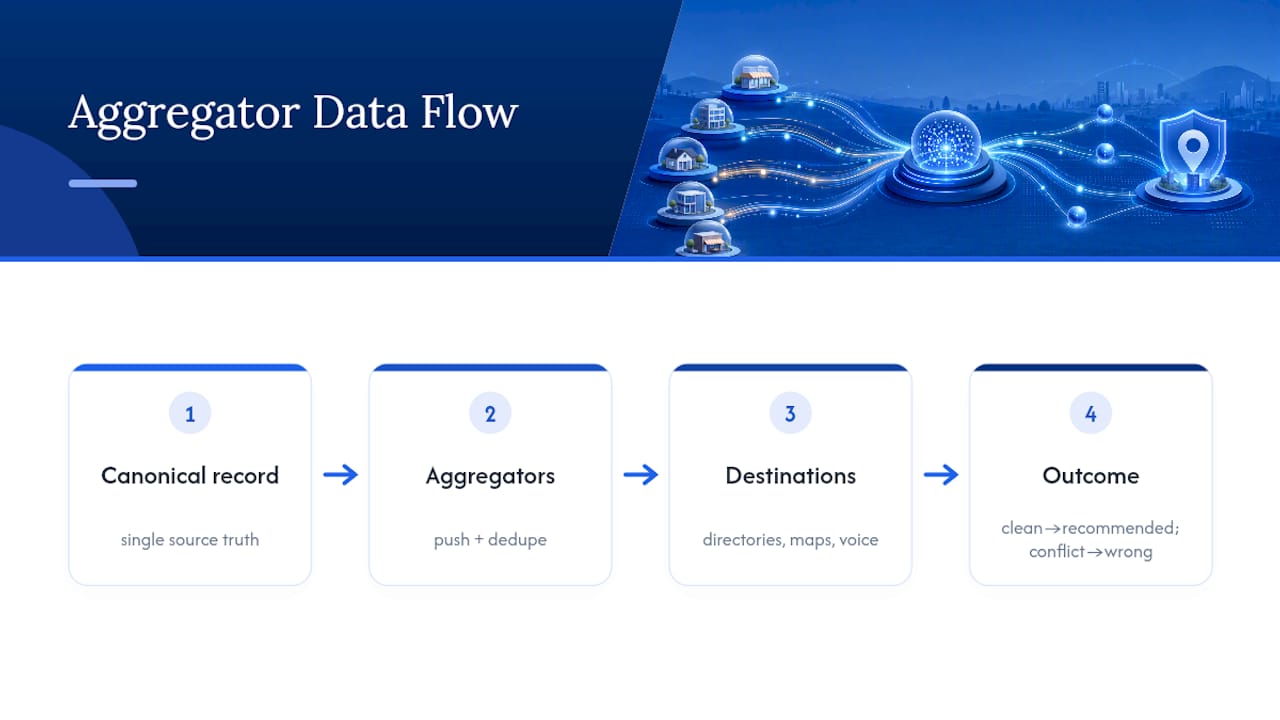
Aggregators work by pushing your canonical data downstream to the directories, map providers, and voice platforms that don't have a direct relationship with your business. Once Foursquare or Data Axle has your correct hours and address, that record can populate dozens of secondary sites automatically instead of you filling out forty separate forms.
They also handle duplicate cleanup. Aggregators match submitted data against their existing internal records and flag or merge conflicting entries, which matters more than most owners realize. A facility that changed addresses five years ago might still have an old listing floating around that a customer's GPS pulls up instead of the current one.
The 2026 wrinkle is AI. Voice assistants and AI-generated search answers don't verify your business the way a human does. They synthesize an answer from whatever structured data they can find, and industry analysis increasingly notes that AI systems favor businesses with consistent, machine-readable listings over ones with mismatched addresses or phone numbers scattered across the web. Feed the AI conflicting signals, and it either picks the wrong one or hedges its answer, which means your competitor gets recommended instead.
Pro Tip: Check how ChatGPT, Perplexity, or Google's AI Overview describe your facility's hours and address. If the answer is wrong or outdated, that's usually a data consistency problem, not a content problem.
Here's the caveat that matters most: aggregator submissions strengthen your data foundation, but they don't guarantee a ranking bump. Your position in Google's local results still depends heavily on Google Business Profile management, website quality, and the content you publish. Aggregators reduce the noise; they don't do the winning for you.
How to Submit Your Business Data and What Verification Looks Like
Getting your data into the aggregator ecosystem cleanly takes some prep work upfront. Rushing this step is the single biggest reason submissions get delayed or rejected.
- Canonicalize your NAP data first. Pick one exact version of your business name, address, and phone number and use it everywhere. Inconsistent abbreviations ("Ste 4" versus "Suite 4") trip up automated matching more than you'd expect.
- Prepare accurate categories and landing pages. If you offer climate-controlled units, RV parking, and moving supplies, make sure your categories reflect that and that your website has pages to back each claim up.
- Choose your submission method. You can self-submit to each aggregator directly through their web portals, use a bulk upload if you manage multiple locations, or work through a provider that already has established pipelines and API access to update several aggregators at once.
- Complete verification. Expect phone verification, email confirmation, or in some cases a request for business documents. TransUnion's Digital Business Profile leans on phone verification; others rely more on email or automated checks.
- Monitor propagation. Changes don't show up everywhere overnight. Set a calendar reminder to recheck your listings across major directories 30 to 60 days after submission, and escalate any aggregator still showing old data.
Single-location owners can usually handle this DIY in an afternoon. Multi-location operators juggling ten or more facilities almost always save time going through a partner pipeline instead of repeating the same manual process across every location.
When Aggregators Matter Most vs. When to Focus Elsewhere First
Not every storage operator needs to prioritize aggregator cleanup right now. It depends on where your listing data actually stands today.
- If you're a single-location facility with a clean, verified Google Business Profile and no history of address changes, aggregator work is a lower-priority maintenance task, not an emergency.
- If you operate multiple locations, or your facility has changed names, addresses, or ownership in the past few years, aggregator cleanup should move up your list. Legacy records tend to linger exactly in these situations.
- If your Google Business Profile itself is thin, unclaimed, or has few reviews, fix that first. Aggregators feed secondary platforms; they don't substitute for an active, well-optimized primary profile.
- Weigh the cost and time trade-off honestly. DIY submission costs nothing but your time, and can take several hours per location once you factor in verification delays. A partner with existing aggregator relationships often works faster for multi-location brands, especially when format requirements differ across each aggregator.
Aggregator hygiene works best as one layer in a broader stack, alongside your website's location pages, your review program, and your Google Business Profile, not as a replacement for any of them.
Common Pitfalls, Duplicate Listings, and a Cleanup Checklist
The mistakes that hurt storage operators most are almost always avoidable. Inconsistent formatting across listings (spelling out "Street" in one place and abbreviating it in another) confuses automated matching systems more than you'd think. Old phone numbers left active on secondary directories send customers straight to voicemail or a disconnected line. And closed or relocated facilities that still show as "open" on a stray directory actively cost you business.
Duplicate listings usually trace back to legacy data: an old address, a previous owner's business name, or a listing created by a directory scraping outdated public records. Aggregators can auto-match and merge many of these, but the process isn't perfect, especially when a business name changed entirely.
A practical cleanup checklist looks like this:
- Audit your current listings across Google, the five major aggregators, and any directory where customers are likely to find you.
- Pick one canonical version of your NAP data and designate it as the source of truth.
- Submit that canonical version to each primary aggregator, correcting or merging any duplicate records you find along the way.
- Track propagation over the following month and follow up on any aggregator still showing outdated information.
Pro Tip: Search your business name plus "storage" in an incognito browser window every few months. It's the fastest way to spot a rogue listing before a customer does.
Corvane Systems' Take on Aggregator Hygiene for Storage Operators
Corvanesystems treats aggregator data the same way a facility manager treats gate access codes: unglamorous, easy to ignore, and a real problem the moment it fails. Aggregator submissions aren't a growth tactic on their own. They're the foundation that keeps everything else, Google Business Profile, AI visibility, review management, from working against itself.
For storage operators specifically, the risk of messy aggregator data compounds. A facility that's changed ownership, added a second location, or rebranded in the last few years is exactly the kind of business that ends up with three different phone numbers floating around the web. That's a problem addressed as part of local search positioning work, pairing aggregator cleanup with Google Business Profile optimization and city-based keyword targeting so the data feeding AI systems and search engines tells one consistent story.
A managed aggregator workflow is generally recommended over DIY submission once a business operates more than one location, a pattern that also shows up in multi-location SEO playbooks for storage brands. Below that threshold, a single owner can often handle direct submissions without much friction. Either way, aggregator hygiene works best as part of a broader system, one that also includes content at the pace rankings need rather than treating listing consistency as an isolated project. Operators who want a full picture of where their facility stands can start with Corvane Systems' AI visibility work for self-storage.
— Mike
Sources
BrightLocal's data aggregator guide remains the clearest breakdown of how the major U.S. aggregators operate and how submission formats differ. Google's Business Profile support documentation covers how review moderation and content removal actually work. Foursquare's Places product page explains how its location data reaches third-party apps.
- Using Data Aggregators for Local Citations — BrightLocal
- What Are Data Aggregators? Local SEO, AI & Voice Search — TK Internet Marketing
FAQ
What Is the Best Data Aggregator for Local SEO?
There isn't a single best one. Foursquare, Data Axle, TransUnion's Digital Business Profile, GPS Network, and YP Network each feed different platforms, so most local SEO guidance recommends submitting to all five rather than picking a favorite.
Is Local SEO Still Relevant?
Local SEO remains a core discipline for any business with a physical location, and it's expanding rather than shrinking. AI assistants and voice search now rely on the same structured data that traditional local SEO has always prioritized, which makes accurate listings more important, not less.
What Will Local SEO Look Like in 2026?
Expect local SEO in 2026 to weigh AI and voice visibility as heavily as traditional map rankings. Consistent, machine-readable business data increasingly determines whether AI tools recommend a business accurately, which makes aggregator hygiene and structured data more relevant than in past years.
How Much Should I Pay for Local SEO?
Pricing varies widely depending on scope, from a few hundred dollars a month for basic listing management to flat monthly rates for full-service programs covering technical SEO, content, and AI visibility work. The right budget depends on how many locations you manage and how competitive your local market is.