
Self-storage occupancy rate is the single most important metric for facility profitability. The industry sweet spot sits between 85% and 92%. Below 80% signals structural problems. Above 95% almost always means you are leaving money on the table through underpricing. To boost storage facility occupancy sustainably, operators need four things working together: local search visibility, demand-driven pricing, tenant retention, and granular unit-level tracking. This guide covers each one with the specificity that actually moves the needle.
How does local SEO and your Google Business Profile increase storage occupancy?
Your Google Business Profile is the first thing a potential tenant sees when they search "storage near me." An incomplete or outdated profile costs you rentals before a prospect ever visits your website. Facilities with complete profiles, including accurate hours, photos, service categories, and a consistent NAP (name, address, phone number), rank higher in Google's local pack and attract more clicks.
Photos matter more than most operators realize. Google's own data shows that businesses with photos receive significantly more direction requests and website clicks than those without. Post interior unit photos, gate access images, and climate-controlled hallways. These visuals answer the questions tenants ask before they call.
Online reviews directly influence conversion. Facilities with a strong review volume and a high average rating outperform competitors in local search rankings. Review management practices include responding to every review, positive or negative, within 48 hours. A thoughtful response to a one-star review signals professionalism to every future reader.
- Claim and fully complete your Google Business Profile with all relevant categories
- Upload at least 20 photos covering unit types, security features, and access areas
- Post weekly Google Business Profile updates about promotions or availability
- Build local citations on Yelp, Bing Places, and Apple Maps for consistent NAP data
- Partner with local real estate agents, moving companies, and apartment complexes for referral traffic
Pro Tip: Ask tenants for a review at the moment of move-in, not at move-out. Satisfaction is highest right after a smooth rental experience, and that is when you will get the most honest, positive feedback.
Local partnerships are an underused channel. A referral agreement with two or three nearby moving companies can generate a steady stream of warm leads every month without paid advertising spend.

What dynamic pricing and AI tools do to increase storage unit rentals
Static pricing is the fastest way to leave revenue uncollected. A fixed rate set once per year ignores demand shifts, seasonal patterns, and competitor moves happening in real time. AI-driven management tools can raise space utilization by 20–30% through demand forecasting, competitor rate tracking, and layout recommendations. That is not a marginal improvement. For a 500-unit facility, a 5-percentage-point occupancy gain translates to $30,000 to $60,000 in annual revenue.
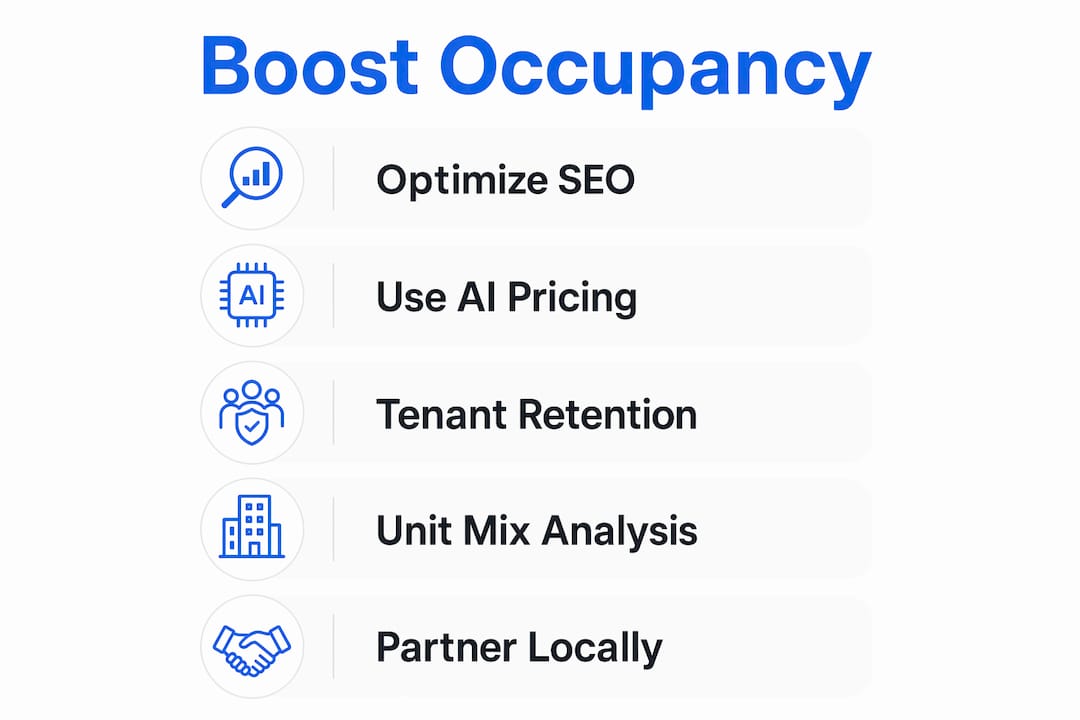
AI pricing algorithms work by pulling in three data streams simultaneously: your current occupancy by unit type, competitor street rates in your zip code, and historical demand patterns by season. The system then adjusts your street rates up or down in real time to hit your target occupancy band. Operators using AI-assisted rate management executed over 14,700 rate increases with a move-out rate of only 1.7%. That result is impossible to replicate with manual pricing reviews.
How to structure your pricing tiers
- Set a floor rate based on your minimum acceptable revenue per unit type, accounting for fixed costs
- Define your target occupancy band at 88–92% per unit category, not for the whole facility
- Apply a Good/Better/Best framework to steer tenants toward higher-value units with incremental price steps
- Layer in existing customer rate increases (ECRI) once occupancy stabilizes above 88%
- Run churn sensitivity modeling before any ECRI to identify which tenants are price-sensitive
| Pricing method | Occupancy impact | Revenue impact |
|---|---|---|
| Static annual rate | Minimal adjustment | Misses demand peaks |
| Manual monthly review | Moderate adjustment | Slow to respond |
| AI dynamic pricing | 20–30% utilization gain | Captures peak demand revenue |
Tiered Good/Better/Best pricing increases average revenue per rental compared to single-price offerings. The key is making the price steps feel like genuine value differences, not arbitrary tiers. Climate control, drive-up access, and floor level are natural differentiators.
Pro Tip: Never raise street rates and existing customer rates at the same time. Dropping street rates to fill vacancies while holding ECRI steady is the playbook that fills units without triggering a wave of move-outs.
Operators who respond quickly to occupancy trends by adjusting street rates and layering ECRI consistently outperform those maintaining static price points. Speed of response is the competitive advantage that pricing software gives independent operators.
What retention programs and promotions reduce move-outs and fill spaces?
Reducing move-outs is the most cost-effective way to maintain high occupancy. Cutting the move-out rate by just 1% adds approximately $9,000 in annual revenue at a typical 500-unit facility. Acquisition costs for a new tenant are always higher than the cost of keeping an existing one happy.
Move-in specials are a proven tool for filling spaces, but they require careful design to protect long-term revenue. A first-month-free offer on a 10x10 unit costs you one month of rent. If that tenant stays 18 months, the lifetime value far exceeds the promotional cost. The mistake operators make is offering discounts without a minimum stay commitment or a clear rate escalation schedule after the promotional period.
- Offer first-month or first-two-weeks-free promotions tied to a standard lease agreement
- Send a "welcome" communication within 24 hours of move-in with access instructions and contact information
- Schedule a 30-day check-in call or text to address any early concerns before they become move-out reasons
- Provide loyalty discounts or rate freezes for tenants who reach 12-month and 24-month milestones
- Upsell packing supplies, moving boxes, and tenant insurance at move-in to increase revenue per tenant
Pro Tip: Model churn sensitivity before sending any ECRI notice. Segment your tenant base by length of stay and unit size. Long-term tenants in large units are far less price-sensitive than short-term tenants in small units. Target rate increases accordingly.
Communication is the most underrated retention tool. Tenants who feel ignored are far more likely to move out when a competitor runs a promotion. A simple monthly email with facility updates, tips for organizing their unit, and a reminder of your referral program keeps your facility top of mind and builds loyalty that pricing alone cannot create.
Upselling ancillary products adds revenue without adding units. Tenant insurance, packing supplies, and moving truck referrals each generate margin. Facilities that treat these as core offerings rather than afterthoughts consistently report higher revenue per occupied unit.
How does unit mix analysis improve occupancy at a granular level?
Aggregate occupancy numbers hide the real story. A facility reporting 88% overall occupancy might have 100% occupancy on 5x5 units and 65% occupancy on 10x20 units. Managing occupancy at the unit-type level prevents hidden vacancies and missed revenue opportunities. Blanket discounts applied to the whole facility fix nothing and cost you margin on units that were already full.
The first step is pulling a unit-type occupancy report every week, not every month. Weekly data lets you spot a demand shift in 10x10 units before it becomes a vacancy problem. If a specific size category drops below 80%, that is a signal to adjust street rates downward for that type and increase marketing emphasis on that unit size.
| Unit type | Occupancy below 80% | Recommended action |
|---|---|---|
| 5x5 and 5x10 | Reduce street rate 5–10% | Promote for decluttering and student storage |
| 10x10 | Adjust rate and add move-in special | Target apartment renters and small business owners |
| 10x20 and larger | Review competitor rates and reconfigure if needed | Target vehicle storage or business inventory customers |
Reconfiguration is a longer-term lever but a powerful one. If demand for large units is consistently low and demand for small units consistently exceeds supply, converting oversized units into two smaller ones can materially improve both occupancy and revenue per square foot. AI-driven layout recommendations can model the revenue impact of reconfiguration before you commit to construction costs.
Specialty units are another underused tool for filling spaces. Climate-controlled wine storage, vehicle storage, and document storage for small businesses each target a customer segment that standard self-storage marketing ignores. Adding even a small number of specialty units creates a differentiated offering that attracts tenants who would otherwise go elsewhere. AI recommendations for operators increasingly include spatial optimization models that identify which specialty conversions generate the best return.
Key Takeaways
Combining local SEO, AI-driven pricing, tenant retention programs, and unit-level occupancy tracking is the most reliable way to reach and hold the 88–92% occupancy target that defines a healthy, profitable self-storage facility.
| Point | Details |
|---|---|
| Target the right occupancy band | Aim for 88–92% per unit type; above 95% signals underpricing, not success. |
| Use AI pricing tools | AI dynamic pricing can raise utilization by 20–30% with minimal tenant churn. |
| Prioritize retention over acquisition | A 1% reduction in move-outs adds roughly $9,000 annually at a 500-unit facility. |
| Track occupancy by unit type | Aggregate numbers mask underperforming categories that drag down total revenue. |
| Combine all four strategies | Local SEO, pricing, retention, and unit mix optimization work best in parallel. |
The uncomfortable truth about chasing high occupancy
Most operators I work with treat occupancy as a single number. They check the dashboard, see 87%, and feel fine. The problem is that 87% overall can mask a 10x20 category sitting at 62% for three straight months. By the time the aggregate number drops, the revenue damage is already done.
The other mistake I see constantly is cutting prices across the board the moment occupancy dips. Price cuts are a short-term fix that trains your market to wait for discounts. The operators who build durable occupancy growth do the opposite. They fill units first with competitive street rates, then layer in ECRI carefully, using churn sensitivity data to protect the tenants most likely to leave. They treat pricing as a precision tool, not a panic button.
Technology changes the math for independent operators. AI pricing and revenue growth strategies that were once available only to large REITs are now accessible at a flat monthly cost. The operators who adopt these tools in 2026 will have a structural advantage over those still managing rates on a spreadsheet. The gap between tech-enabled and manual operators is widening every quarter.
The long game is customer-centric. Tenants who feel valued, communicate with a responsive team, and receive fair rate increases stay longer. Longer tenancy means lower acquisition costs, more stable occupancy, and compounding revenue growth. That is the outcome worth building toward.
— Mike
How Corvanesystems helps you fill more units
Corvanesystems is built specifically for self-storage operators who want their facility found online and recommended by AI tools like ChatGPT, Perplexity, and Google AI Overviews.
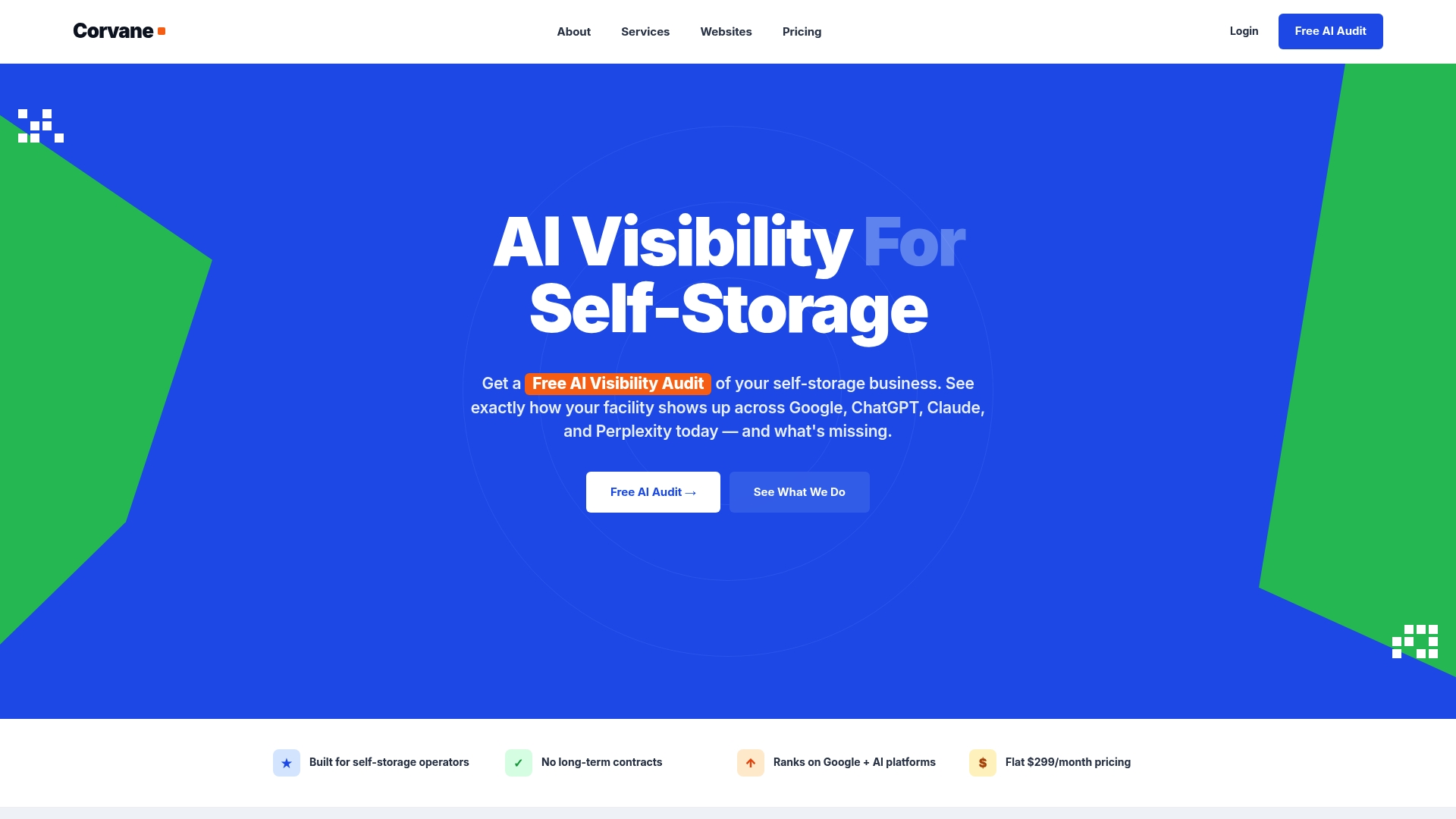
When a potential tenant searches "storage near me" or asks an AI assistant for a recommendation, your facility needs to surface. Corvanesystems combines local SEO, Google Business Profile optimization, and AI-optimized content to make that happen. The service includes 30 keyword-targeted articles published monthly, AI visibility audits across major platforms, and performance tracking in a clear monthly report. Pricing is one flat monthly rate with no contracts. Operators who want a stronger digital foundation can also get a custom, conversion-focused website. Visit Corvanesystems to see how AI visibility turns online searches into booked units.
FAQ
What is the ideal occupancy rate for a self-storage facility?
The target occupancy rate for a healthy self-storage facility is 88–92% per unit type. Occupancy above 95% typically signals underpricing, while anything below 80% indicates a structural problem requiring immediate attention.
How much revenue does a 5% occupancy increase generate?
At a typical 500-unit facility, a 5-percentage-point occupancy gain generates $30,000 to $60,000 in additional annual revenue. The exact figure depends on your average unit rate and unit mix.
How do AI pricing tools help increase storage unit rentals?
AI pricing tools adjust street rates in real time based on your current occupancy, competitor rates, and seasonal demand signals. Operators using AI-assisted pricing have executed thousands of rate increases while maintaining move-out rates as low as 1.7%.
What is the best move-in promotion to fill storage spaces?
A first-month-free or first-two-weeks-free offer tied to a standard lease agreement fills units quickly without permanently reducing your rate. Pair the promotion with a clear rate escalation schedule after the promotional period to protect long-term revenue.
Why should I track occupancy by unit type instead of overall?
Overall occupancy masks underperforming unit categories. A facility at 88% overall can have a 10x20 category sitting at 62%, which represents significant lost revenue. Unit-type tracking lets you apply targeted pricing and marketing adjustments where they are actually needed.