
Self storage revenue growth is defined as the measurable increase in total facility income driven by pricing discipline, occupancy optimization, and ancillary service expansion. The industry entered 2026 on firm footing. New competitive supply dropped to 8% in 2025 and is forecast to fall further to 6% in 2026, easing the price pressure that squeezed margins for the past two years. Self-storage REITs posted broad year-over-year revenue gains in Q1 2026, with same-store growth reaching 1.7% at some operators. That signal matters for independent owners because REIT performance typically leads the broader market by one to two quarters. The operators who capture the most income this cycle will be those who treat their facility as a financial engine, not a passive real estate asset.
How does market segmentation drive self storage revenue growth?
Geographic market selection is the single most underrated lever in self storage revenue growth. Most owners focus on operations inside their four walls while ignoring the structural advantage or disadvantage baked into their location.
The data tells a clear story. Smaller secondary markets under 200,000 in population show occupancy rates above 92% and annual rent growth between 3%–6%. The top 25 metros, by contrast, show flat to negative 2% rent growth due to oversupply from institutional development. That gap is not a temporary anomaly. It reflects a structural mismatch between where capital flows and where real demand lives.

Why secondary markets outperform large metros
Large metro markets attracted aggressive REIT and institutional development through 2022 and 2023. That supply wave is now working through the system, suppressing street rates and occupancy in cities like Phoenix, Dallas, and Charlotte. Secondary markets never attracted that level of construction activity, so supply stayed tight while demand from local households, small businesses, and life-event renters remained steady.
Ground-up development in smaller secondary markets can achieve yields of 9%–12% due to lower land costs, faster lease-up timelines, and limited competition. Owners already operating in these markets hold a structural pricing advantage they should actively protect.
The practical takeaway for owners evaluating expansion or acquisition:
- Primary metros (500K+ population): Expect flat rent growth and higher competition from REIT operators averaging 90.9% occupancy
- Secondary markets (100K–500K population): Moderate competition, stable demand, and room for disciplined rent increases
- Smaller markets (under 200K population): Highest rent growth potential, lowest new supply risk, and fastest lease-up for new builds
Pro Tip: If you operate in a secondary market, do not benchmark your pricing against REIT street rates in major metros. Your local supply-demand balance likely supports higher rates than national averages suggest.
What pricing strategies actually increase self storage profits?
Pricing is where most independent operators leave the most money on the table. The instinct to cut rates when occupancy dips is understandable, but it is also the fastest way to erode net operating income (NOI) permanently.
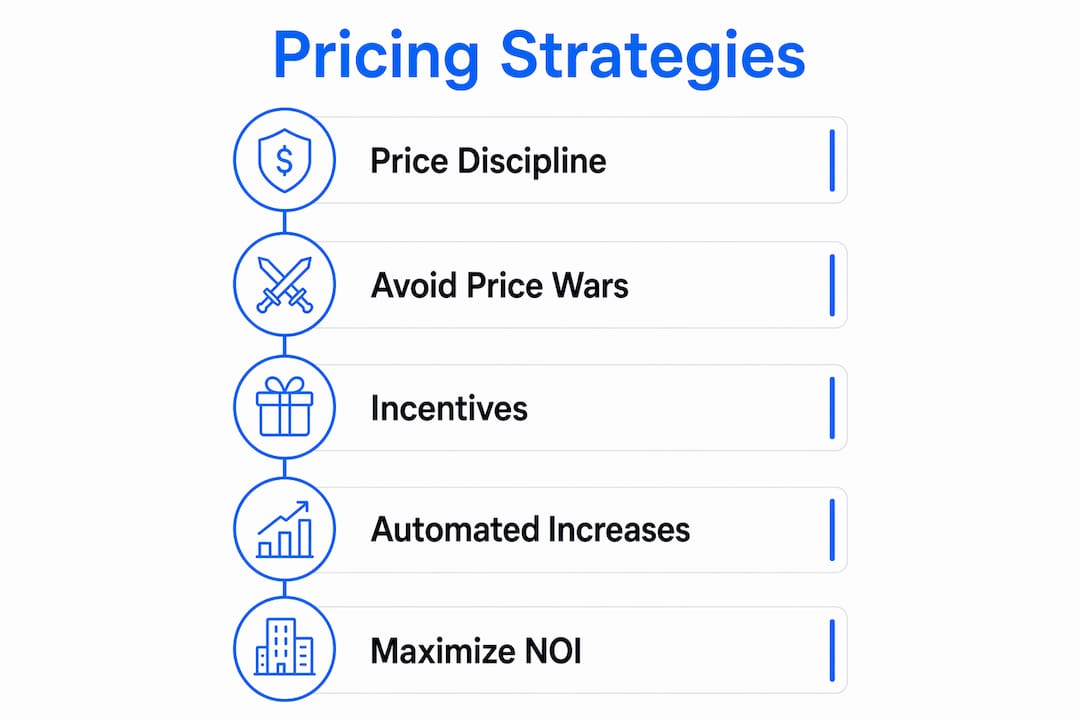
Facilities focused on maximizing NOI rather than pure occupancy see greater long-term value creation. The math is straightforward: a $5 rate increase across 200 occupied units adds $12,000 in annual revenue with zero additional cost. A 2% occupancy gain at the same facility might add only $3,600 at a $150 average rent. Rate discipline beats occupancy chasing every time.
Avoiding reactive pricing and price wars
Owners who avoid reactive pricing and use targeted, time-bound incentives consistently outperform those who simply lower street rates. Cutting rates to match a REIT competitor is a losing strategy. REITs operate at scale with marketing budgets and revenue management systems that independent owners cannot replicate. Competing on price alone accelerates a race to the bottom.
The better approach uses category-based rate adjustments. Review your unit mix and identify which sizes are undersupplied locally. Raise rates on those units first. Hold rates on oversupplied sizes and use non-monetary incentives to drive move-ins without permanently lowering your street rate.
Non-monetary incentives create move-in traction as effectively as price cuts while preserving long-term pricing power. Proven options include:
- Free disc locks at move-in (cost: $8–$12, perceived value: $25+)
- One month of free tenant insurance bundled into the lease
- Moving truck access for the first 24 hours
- Waived admin fees for online reservations
These offers create urgency and perceived value without touching your street rate. When the promotion ends, your base rate remains intact.
Pro Tip: Implement automated rent increases for existing tenants on a 6-month or 12-month cycle. Revenue leakages occur most often when owners skip increases on long-term tenants, effectively giving them a discount that compounds over time.
How can you improve occupancy rates at your storage facility?
Occupancy optimization is the foundation of optimizing storage facility income, but the goal is not 100% occupancy. It is the right occupancy at the right rate.
Increasing occupancy from 85% to 92% at a 500-unit facility generates an additional $30,000 to $60,000 in annual revenue. That range depends on your average unit rate, but the directional impact is significant at any price point. Equally important: reducing your move-out rate by just 1% is worth approximately $9,000 annually at a $150 average rent. Retention is cheaper than acquisition.
Here are four tactics that reduce move-outs and build long-term occupancy:
- Call every tenant who submits a move-out notice. A personal call from a manager converts a meaningful share of move-outs into stays, especially when paired with a rate adjustment or a short-term discount offer.
- Survey tenants at the 90-day mark. Early dissatisfaction is the leading predictor of move-out. A brief check-in call or email surfaces problems before they become cancellations.
- Add amenities that increase perceived value. Covered loading areas, 24-hour access, and package acceptance services all reduce price sensitivity. Tenants who rely on your facility for convenience are far less likely to leave over a $10 rate increase.
- Use digital marketing to fill vacancies before they hurt occupancy. Understanding what drives storage unit demand in your local market helps you target the right renters at the right time, reducing the gap between move-outs and move-ins.
REIT facilities average 90.9% occupancy compared to 79.6% for non-REIT facilities. That 11-point gap is not explained by location alone. It reflects the operational systems, digital marketing reach, and revenue management discipline that larger operators apply consistently.
Pro Tip: Track your move-out reasons in a simple spreadsheet. After 90 days, you will see patterns. Price sensitivity, relocation, and life events each require a different retention response.
What revenue streams can storage facilities add beyond unit rentals?
Diversifying income is one of the most direct ways to increase self storage profits without adding physical units. Most facilities already have the customer relationships and foot traffic needed to support additional revenue lines.
The most accessible ancillary revenue sources for independent operators are:
- Tenant insurance programs: Partnering with a storage-specific insurance provider generates a monthly commission on every enrolled tenant. Enrollment rates of 40%–60% are achievable with proper onboarding scripts.
- Retail merchandise sales: Boxes, tape, locks, and packing supplies carry margins of 30%–50% and serve a genuine customer need. A small retail display near the office requires minimal investment and generates consistent add-on sales.
- Moving truck or van rental: Partnering with a truck rental company or operating your own vehicle creates a revenue stream that also drives move-ins. Tenants who rent a truck from you are more likely to rent a unit from you.
- Business storage packages: Small business owners need reliable, accessible storage for inventory and equipment. Positioning specific unit sizes as business inventory storage with features like extended access hours and package receipt services commands a premium rate.
- Climate-controlled unit upgrades: If your facility has climate-controlled inventory, price it at a meaningful premium to standard units. The cost differential to operate is modest; the rate premium is substantial.
Automated, data-driven revenue management systems outperform manual pricing by adjusting rates based on unit availability and demand in real time. The same principle applies to ancillary revenue. Track which add-ons generate the highest margin per transaction and allocate your front-desk training time accordingly.
Key Takeaways
Self storage revenue growth in 2026 depends on pricing discipline, market positioning, and retention, not just occupancy rate alone.
| Point | Details |
|---|---|
| Market selection matters most | Secondary markets under 200K population deliver 3%–6% annual rent growth versus flat or negative growth in oversupplied metros. |
| NOI beats occupancy as a goal | A $5 rate increase across 200 units adds $12,000 annually; a 2% occupancy gain at $150 average rent adds far less. |
| Non-monetary incentives protect rates | Free locks, insurance bundles, and moving truck access drive move-ins without permanently lowering your street rate. |
| Retention is cheaper than acquisition | Reducing move-outs by 1% is worth approximately $9,000 per year at a $150 average rent. |
| Ancillary revenue adds margin with low overhead | Tenant insurance, retail sales, and business storage packages generate income without requiring additional units. |
The uncomfortable truth about chasing occupancy
I have worked with storage operators across markets ranging from rural Texas to suburban Ohio, and the pattern I see most often is this: owners obsess over occupancy percentage while their NOI quietly stagnates. They fill units by cutting rates, then wonder why their facility appraises below expectations.
The operators who grow revenue consistently treat their facility the way a hotel revenue manager treats room inventory. They price by unit type, by season, and by local demand signals. They raise rates on long-term tenants on a schedule, not when they feel brave enough. They use incentives surgically, not as a default response to every slow week.
The REIT occupancy gap is real. Non-REIT facilities average 79.6% occupancy versus 90.9% for REIT-managed properties. But that gap is not inevitable. Independent operators close it by adopting the same systems, not by competing on price. Automated rent increases, structured move-out retention calls, and a clear ancillary revenue program are all within reach for a single-facility owner.
The self storage industry keeps growing because demand is durable. Life events, household transitions, and small business needs create a steady pipeline of renters in almost every market. The question is not whether demand exists. The question is whether your facility is visible, priced correctly, and operationally ready to capture it.
— Mike
How Corvanesystems helps storage owners capture more revenue
Revenue growth requires more than good operations. It requires visibility. When a potential tenant searches "storage near me" or asks an AI assistant for a recommendation, your facility needs to appear, and appear favorably.
Corvanesystems is built specifically for self-storage operators who want to compete for that visibility. The platform combines traditional SEO with Generative Engine Optimization (GEO), structuring your facility's digital presence so it surfaces in Google search, Google AI Overviews, ChatGPT, Perplexity, and Claude. Monthly AI-optimized content, local search positioning, and AI visibility audits give you a clear picture of where you stand and what to fix. Pricing is a single flat monthly rate with no contracts. If your facility is not showing up where renters are searching, visit Corvanesystems to see what that costs you.
FAQ
What is driving self storage revenue growth in 2026?
Easing competitive supply and recovering REIT same-store revenue are the primary drivers. New supply deliveries are forecast to fall to 6% of total stock in 2026, reducing price pressure across most markets.
How much revenue does a 1% occupancy improvement generate?
At a $150 average monthly rent, reducing your move-out rate by 1% generates approximately $9,000 in additional annual revenue at a 500-unit facility.
Should independent operators compete on price with REITs?
No. Competing on price with REIT operators accelerates margin erosion. Independent owners outperform by using non-monetary incentives, targeted rate adjustments, and differentiated services rather than matching REIT street rates.
What is net operating income and why does it matter more than occupancy?
Net operating income (NOI) is total revenue minus operating expenses, and it is the primary driver of facility valuation. Incremental rate increases across many units raise NOI more effectively than filling vacant units at discounted rates.
Which markets offer the best opportunity for storage facility expansion?
Secondary markets under 200,000 in population currently show the strongest rent growth at 3%–6% annually and the lowest new supply risk, making them the highest-opportunity targets for both acquisition and ground-up development in 2026.