
Run a prioritized 90-day sprint that fixes discovery, removes friction from renting, and captures every lead with automation. That's the whole strategy in one sentence. Everything else is execution.
Before you read another word, do three things in the next 72 hours:
- Audit your Google Business Profile (GBP) for hours, photos, and unanswered questions
- Confirm your website shows real-time pricing and unit availability, not "call for rates"
- Set up a lead-capture fallback so no call or web form goes unanswered overnight
Pro Tip: If you fix nothing else this week, fix the phone. A 90-day, data-backed sprint built on foundations and targeted visibility consistently outperforms scattershot ad spending, and it starts with never letting a lead go cold. Expect slower gains in week one and faster ones by week six. Watch cost per move-in from day one.
Key Takeaways
A disciplined 90-day sprint that fixes discovery, removes rental friction, and automates lead follow-up leases up units faster than any single ad campaign or discount alone.
| Point | Details |
|---|---|
| Fix foundations first | Audit GBP, verify real-time pricing on your site, and close the after-hours lead gap before spending on ads. |
| Sequence the sprint | Run days 1 to 30 on fixes, 31 to 60 on visibility, and 61 to 90 on rate lifts and channel cuts. |
| Blend channels | Combine paid search, referrals, signage, and video rather than betting on one channel. |
| Protect rates | Use scarcity and feature messaging over blanket discounts to avoid a race to the bottom. |
| Track cost per move-in | Watch this metric weekly, alongside occupancy by unit type, to know where to shift budget. |
| Get found by search and AI | Corvane Systems runs flat-rate SEO and AI visibility programs built specifically for self-storage lease-up. |
Table of Contents
- Operational Foundations Checklist For Storage Lease-Up Marketing
- The 90-Day Lease-Up Sprint, Week by Week
- Which Marketing Channels Actually Fill Units Fastest?
- Turning Leads Into Move-Ins: Conversion and Tech
- Pricing and Promotions Without a Race to the Bottom
- What Should You Track Every Day, Week, and Month?
- Why Most Lease-Up Plans Fail Before They Start
- How Corvane Systems Helps You Lease Up Faster
- Sources
Operational Foundations Checklist For Storage Lease-Up Marketing
Hand this to whoever runs your facility day to day. It's the baseline every lease-up campaign needs before you spend a dollar on ads.
- GBP: Update hours, upload current unit and facility photos, answer every open question, and add a review-request script to your move-in checklist.
- Website: Show transparent pricing by unit size, a direct "reserve now" button, and a mobile checkout that takes under two minutes.
- Lead handling: Set a response-time standard (under five minutes for calls, same-day for web leads), write a voicemail script, and add call tracking so you know which channel a lead came from.
- Signage and visibility: Check street-facing signs, banners, and directional flags are current and visible from the nearest arterial road.
- Referral outreach: Visit or call five apartment managers, movers, or realtors this month with a simple cross-referral offer.
Pro Tip: Assign one person to own the lead-response SLA. When responsibility is shared, follow-up gets missed.
The 90-Day Lease-Up Sprint, Week by Week
A structured sprint beats ad-hoc marketing because it forces sequencing: fix the leaks before you pour in traffic. Swivl's 90-day playbook built from the SSA's demand study breaks this into three clean phases, and mapping your 20-minute trade area first keeps every later dollar targeted at people who could plausibly rent from you.
- Days 1 to 30, foundation. Fix GBP, website conversion paths, and lead handling. Map your drive-time trade area. Set baseline metrics: current occupancy by unit type, average leads per week, and cost per move-in if you're already running ads.
- Days 31 to 60, visibility ramp. Turn on geo-targeted paid search once your landing pages convert. Launch referral outreach to movers, apartment complexes, and real estate offices. Start local social content, unit tours, and any community events. This is when direct mail or bench/bus signage often earns its keep in denser markets.
- Days 61 to 90, optimization. Raise rates on unit types running above 90% occupancy. Cut or pause channels with the weakest lead-to-lease conversion. Double down on whatever referral source produced the cheapest move-ins.
Daily, spend 15 minutes checking new leads, answer rate, and any unanswered GBP messages. Weekly, review a short dashboard:
- Leads by channel and their conversion rate
- Cost per move-in, trending week over week
- Occupancy by unit size, not just overall percentage
Skipping the daily check is how leads go cold. Skipping the weekly dashboard is how you keep spending on a channel that stopped working three weeks ago.
Which Marketing Channels Actually Fill Units Fastest?
No single channel carries a lease-up alone. Operators get the best results blending digital visibility with traditional local tactics, since search traffic, drive-by visibility, and referrals together account for most move-ins.
Google Business Profile and local search. Post new photos monthly, respond to every review within 48 hours, and answer GBP questions the day they're posted. This is free, and it's often the single highest-leverage channel you have.
Paid search. Build separate campaigns by unit type (10x10, climate-controlled, vehicle storage) rather than one generic campaign. Keep the geo radius tight to your actual trade area and send clicks to a landing page showing live pricing, not your homepage.
Social and video. A 30-second unit tour shot on a phone outperforms a stock photo ad. Upload to YouTube too. Video gets indexed and surfaced by AI search tools in ways a static webpage often doesn't.
Direct mail and signage. In dense urban markets where PPC costs run high, a well-placed banner or a targeted mail drop to nearby apartment complexes can beat digital on cost per lead.
Referral partnerships. Build a short list of ten local movers, property managers, and realtors. A simple $50 referral bonus, tracked by name, turns casual contacts into a repeat lead source.
Pro Tip: Test one new channel at a time during the ramp phase. If you launch paid search, social, and direct mail simultaneously, you won't know which one moved the needle.
Turning Leads Into Move-Ins: Conversion and Tech
Marketing that generates calls and clicks is wasted if your website or your phone can't close the loop. Real-time availability tied directly to your website and an online reservation flow, ideally with payment, cuts abandonment because prospects don't have to wait for a callback to commit.
A chatbot or an AI phone agent answering after hours captures leads a voicemail would lose entirely, and it can qualify unit size and move-in date before a human ever calls back.
Integrating unit inventory with the website and enabling online lease and reserve flows reduces abandoned leads and measurably improves conversion, according to Storable's tenant growth research.
Keep the tracking simple:
- Log every lead source in a CRM or even a shared spreadsheet
- Set a follow-up SLA (same day, no exceptions)
- Flag any lead untouched after 24 hours for manager review
A tool like Corvane Systems can help track where leads are slipping through follow-up gaps.
Pricing and Promotions Without a Race to the Bottom
Discount-first lease-up marketing tends to erode revenue that's hard to recover later. Operators who lean on scarcity messaging, facility features, and referral networks often lease up just as fast while protecting their rate structure.
- Use "only 3 units left at this size" messaging over blanket percentage-off deals
- Run short promotions with a hard end date, and track redemptions by channel
- Check revenue per available square foot and cost per move-in before you cut a rate, not after
- Sell ancillaries (truck rental, insurance, boxes) as both revenue and a reason to choose you over a cheaper competitor
What Should You Track Every Day, Week, and Month?
You need a dashboard small enough to check in under five minutes, but sharp enough to tell you when to shift budget.
| Cadence | Metric | Why it matters |
|---|---|---|
| Daily | New leads, answer rate, web reservations | Catches a broken form or a missed call fast |
| Weekly | Lead-to-lease conversion by channel, cost per move-in | Shows which channel deserves more budget |
| Weekly | Occupancy by unit type | Flags which sizes to raise rates on first |
| Monthly | Revenue per available square foot, churn, average length of stay | Tracks whether lease-up gains are holding |
Rules of thumb: if a channel's cost per move-in runs above your average for three straight weeks, pause it. If a unit type sits above 90% occupancy, test a rate increase on new rentals before touching existing tenants.
- Reallocate weekly, not monthly. A stalled channel bleeds budget fast.
- Occupancy by unit type usually outranks overall occupancy as a decision-making number.
Why Most Lease-Up Plans Fail Before They Start
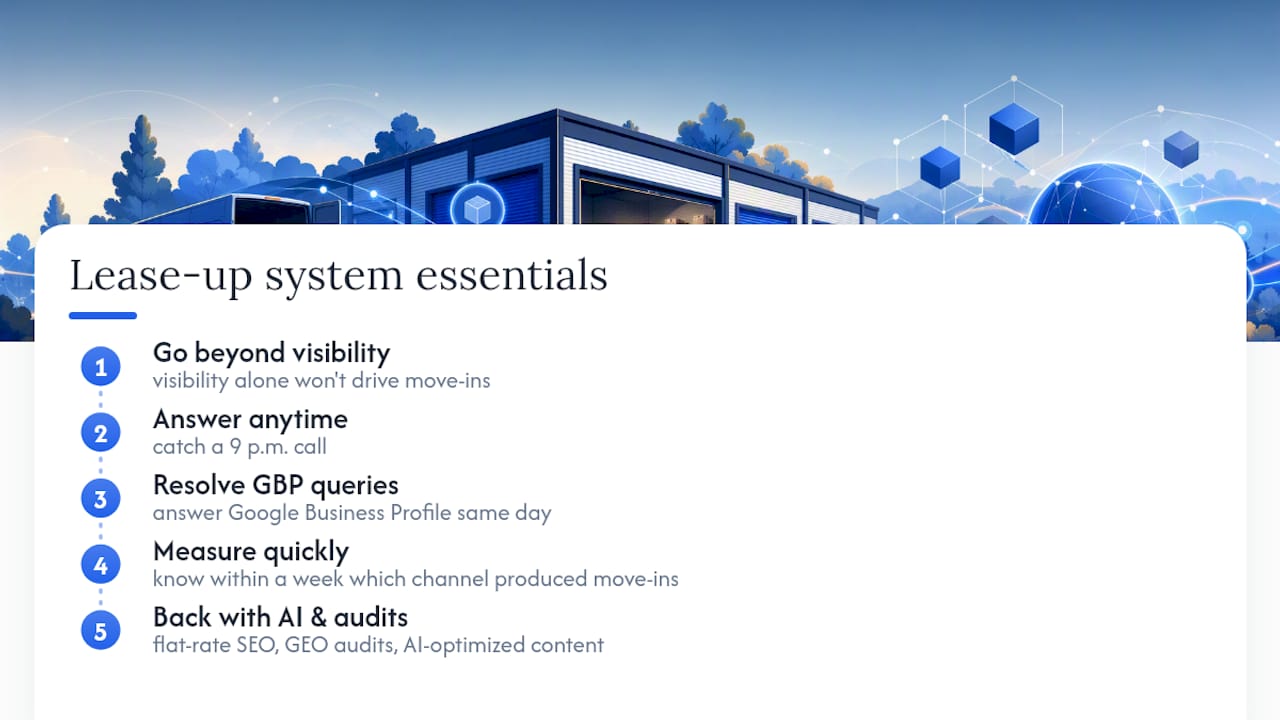
Most self-storage marketing advice treats visibility as the whole problem. It isn't. The facilities that lease up slowest usually rank fine already. What they're missing is a system: a way to catch a 9 p.m. call, answer a GBP question same day, and know within a week which channel is actually producing move-ins instead of just leads. Corvane Systems builds flat-rate SEO and AI visibility programs, backed by GEO audits and AI-optimized content, specifically so storage operators show up correctly across Google and tools like ChatGPT and Perplexity when someone is deciding where to rent.
How Corvane Systems Helps You Lease Up Faster
Running a 90-day sprint solo means juggling GBP updates, ad campaigns, content, and AI visibility checks on top of actually operating a facility. Corvane Systems is built to carry that load for self-storage operators specifically, not as a generic marketing add-on.
The service covers what this guide just walked through: GBP optimization and local search positioning, AI visibility audits across ChatGPT, Claude, Perplexity, and Google's AI Overviews, and 30 AI-optimized articles published monthly so your facility gets found whether someone types "storage near me" or asks an AI assistant directly. It runs on one flat monthly rate, no contracts, no tiers. Book an AI visibility audit to see exactly where your facility is invisible right now, and where the fastest wins are sitting.
Sources
- Self Storage Marketing Plan: 90-Day, Data-Backed Playbook From The SSA Demand Study | swivl
- Self-Storage Marketing 2026: Crossing the Ever-Shifting Landscape
- Self-Storage Marketing: New Tenant Growth Strategies | Storable