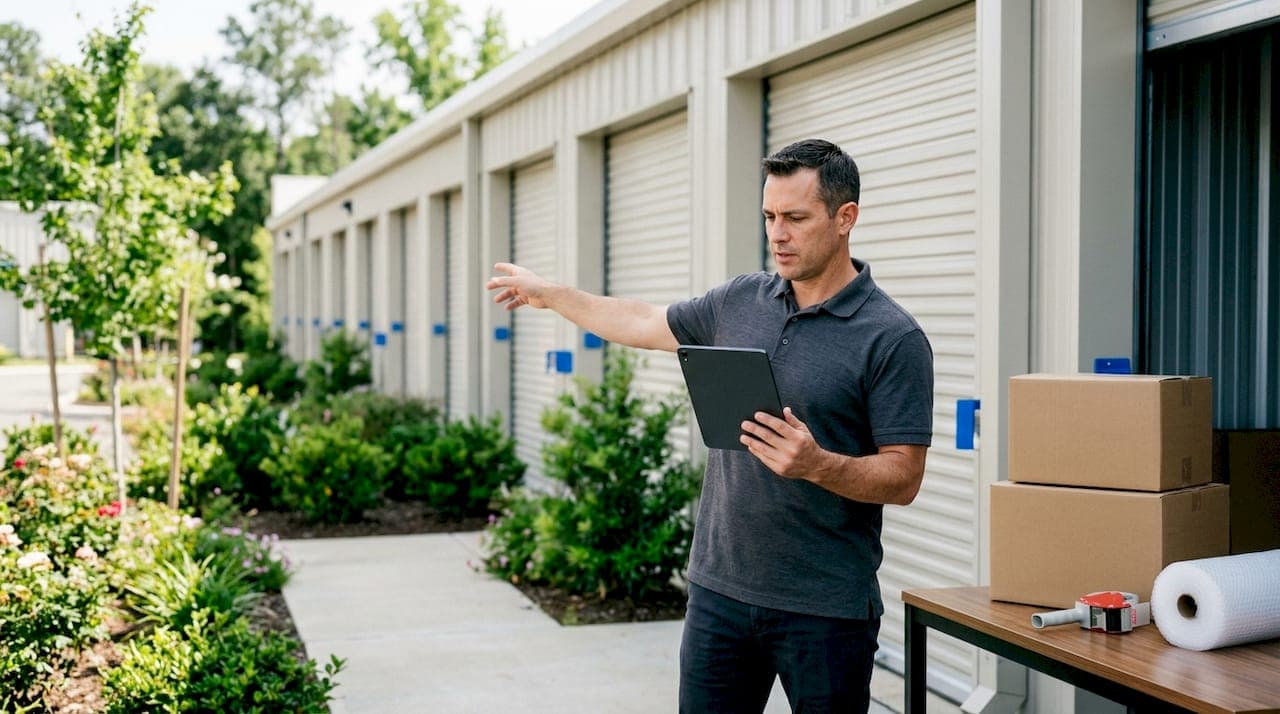
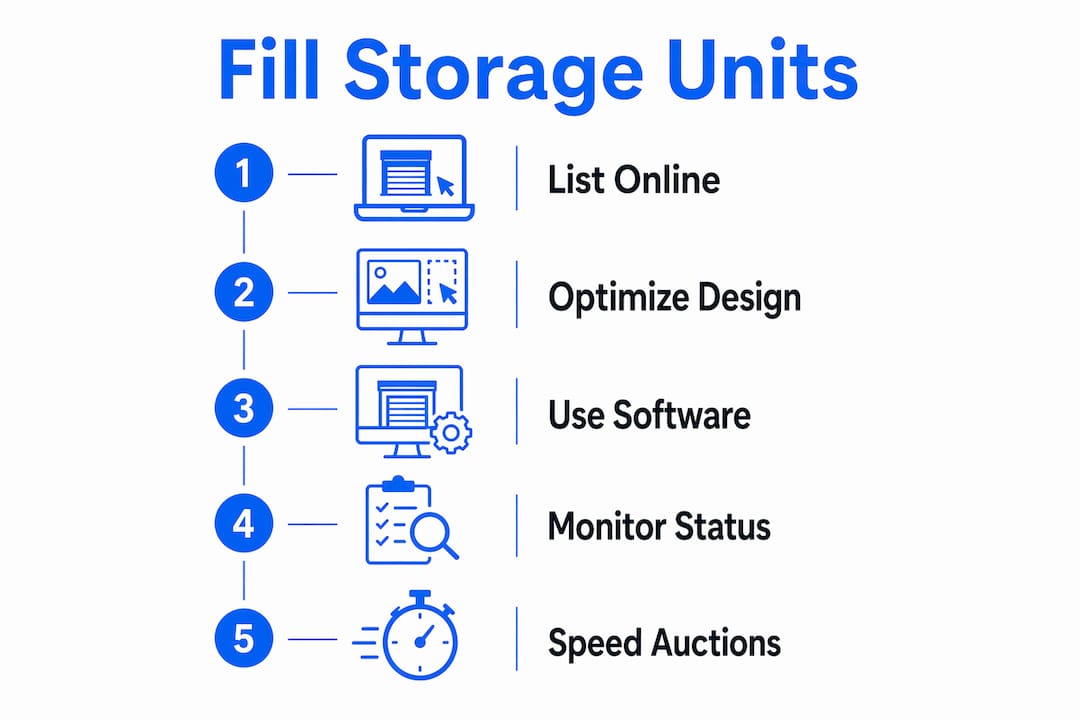
Filling empty storage units is the central revenue challenge for every self-storage operator. Vacancy is not a passive condition. It is the direct result of gaps in digital visibility, facility design, and operational systems. The most effective operators treat occupancy as a managed outcome, not a market-dependent one. They use integrated marketplace listings, net rentable area (NRA) optimization, and automated management tools to keep units rented. This guide covers each of those levers in practical detail.
How can integrated marketplaces help fill empty storage units?
Listing on centralized online marketplaces is the fastest way to reduce vacancy duration. Platforms like SpareFoot and Storage.com connect your facility to millions of renters searching for storage daily. These renters are high-intent. They are not browsing. They are ready to rent.

Facilities using integrated marketplace software fill vacant units 30% faster than those relying on walk-in traffic and manual inquiry systems. That gap compounds over time. A unit rented 30% faster each cycle generates meaningfully more annual revenue than one sitting idle for weeks.
The mechanics of marketplace integration matter. Batch listing tools let you push all available units to multiple platforms simultaneously. Real-time availability updates prevent the most common marketplace failure: a renter books a unit that is already taken, creating a bad experience and a manual fix. Integrated software eliminates that problem by syncing your inventory the moment a lease is signed or a unit is vacated.
Key benefits of marketplace integration include:
- Instant availability sync across all connected platforms when a unit status changes
- Batch listing that pushes multiple unit types and sizes in one action
- High-intent renter targeting through platforms that filter by location, size, and price
- Reduced manual workload by automating inquiry routing and reservation confirmation
Pro Tip: Keep your unit descriptions, photos, and pricing current on every platform. Stale listings rank lower and convert worse, even when the unit is genuinely available.
Operators who treat marketplace listings as a set-and-forget task consistently underperform those who maintain listing accuracy as a daily operational habit. Renter expectations for digital reservation experiences have risen sharply. A listing with outdated photos or missing pricing loses the booking to a competitor with a cleaner profile.
What facility design choices maximize rentable space?
Net rentable area efficiency is the core profitability metric in self-storage. NRA is the percentage of your total building footprint that generates rent. Corridors, stairwells, plant rooms, and fire egress paths all reduce NRA. Every square foot lost to non-rentable space is revenue that cannot be recovered without physical changes.
Careful layout planning is the difference between a facility that runs at 70% NRA efficiency and one that runs at 85%. That 15-point gap on a 50,000-square-foot building represents thousands of square feet of lost rentable space.
Ceiling height and mezzanines
Clear ceiling height directly determines whether mezzanine installation is viable. A clear height of 4 meters enables a mezzanine level that effectively doubles the rentable area on that floor without expanding the building footprint. Mezzanines are the highest-return physical investment most operators can make in an existing facility.
Floor loading capacity must be verified before mezzanine installation. A structural engineer should assess the slab before any design work begins. Building code compliance for fire egress, sprinkler coverage, and corridor width must be maintained on both levels.
Unit mix strategy
The right unit mix reduces vacancy by matching supply to local demand. A facility with only large units in a market dominated by apartment renters will always carry excess vacancy. A well-designed mix typically includes:
- Small units (5x5 to 5x10): High demand from apartment renters and students
- Medium units (10x10 to 10x15): The most versatile size for residential and small business renters
- Large units (10x20 and above): Suited for household moves, vehicle storage, and business inventory
Repurposing underused commercial space is another path to increasing rentable area. A 30,000-square-foot site in Los Angeles was converted from underperforming commercial use to self-storage and generated yields that exceeded the original use. Underutilized commercial floors, rooftops, and facades can all be converted when structural and code requirements are met. Operators considering conversion should review a facility location checklist before committing capital.
| Space Type | NRA Impact | Key Requirement |
|---|---|---|
| Mezzanine level | High: doubles floor area | 4-meter clear height, floor load rating |
| Repurposed commercial floor | High: adds full floor NRA | Structural assessment, fire egress |
| Corridor width reduction | Moderate: recovers linear footage | Minimum code-compliant width |
| Rooftop or facade use | Variable: depends on structure | Engineering review, waterproofing |
Which digital tools improve occupancy management?
Property management software is the operational backbone of a high-occupancy facility. Integrated software manages occupancy, billing, and access control from a single dashboard. That consolidation removes the manual errors that create vacancy. A unit that is not properly marked as available in your system is effectively invisible to renters, even if it is physically empty.
Automated billing eliminates the most common source of delinquency. When late fees apply automatically and payment reminders go out without staff intervention, renters pay on time at higher rates. Fewer delinquencies mean fewer units tied up in the collections process and faster turnover when leases end.
Access control integration is equally important. Renters who receive instant digital access codes at move-in report higher satisfaction than those who wait for a staff member to activate their access. That satisfaction translates directly into higher move-in rates and better online reviews, which feed back into marketplace ranking and organic search visibility. Operators focused on renter experience should also review self-storage access options to match their technology to renter expectations.
Key operational tools that reduce vacancy include:
- Real-time occupancy dashboards that flag available units the moment a lease ends
- Automated billing and late fee systems that reduce delinquency without staff time
- Instant digital access codes delivered at lease signing for contactless move-in
- Online reservation systems that allow renters to book, sign, and pay without calling
Pro Tip: Synchronize your property management software with your marketplace listings so that every status change, whether a move-out or a new lease, updates across all platforms within minutes. Double bookings and stale listings are the two fastest ways to lose renter trust.
Operational transparency also reduces vacancy indirectly. When your team can see exactly which units are available, which are delinquent, and which are in the move-out process, they can act on each situation faster. That speed compounds across hundreds of units and dozens of lease cycles per year. Operators looking to lease more units with digital tools will find that software consolidation is the single highest-leverage change they can make.
How do online auctions speed up vacancy turnover?
Delinquent units are a hidden vacancy problem. A unit occupied by a non-paying renter is not generating revenue, but it is also not available to rent. The faster you resolve delinquency, the faster you recover that unit and that revenue.
Traditional in-person auctions are slow. Traditional delinquent unit auctions often take over 30 days from the point of delinquency to the point of a cleared unit. That timeline includes legal notice periods, scheduling, advertising, and the auction event itself. The unit sits idle through all of it.
Online auction platforms remove most of that friction. The process works as follows:
- Lock the unit after the legally required notice period expires
- Photograph the contents and upload images directly to the auction platform
- List the unit immediately as a single listing, not as part of a batch release
- Accept bids from a broad pool of registered buyers across your region
- Collect payment digitally and schedule cleanout, typically within 72 hours of auction close
Digital platforms eliminate the need for batch auctions and in-person attendance. That means you do not have to wait until you have ten delinquent units to justify an auction event. You list one unit the day it qualifies and move on.
"The shift from batch in-person auctions to single-unit digital listings is one of the most underused operational changes in self-storage. Operators who list delinquent units individually and immediately recover revenue weeks faster than those who wait for a scheduled auction event. That speed difference, multiplied across a year of delinquencies, is a material occupancy and revenue gain."
Key Takeaways
The most effective strategy to fill vacant storage space combines marketplace visibility, NRA-focused facility design, automated operations, and fast delinquency resolution.
| Point | Details |
|---|---|
| Marketplace integration accelerates fill rates | Integrated listings reduce vacancy duration and target renters who are ready to book. |
| NRA efficiency drives revenue per square foot | Mezzanines, unit mix planning, and corridor optimization recover rentable area without new construction. |
| Automated operations reduce hidden vacancy | Real-time dashboards and billing automation keep units available and renters current. |
| Online auctions speed up delinquency resolution | Single-unit digital listings clear delinquent units weeks faster than traditional auction events. |
| Digital renter experience raises move-in rates | Instant access codes and online reservations convert more inquiries into signed leases. |
The real cost of treating storage as just physical space
Most operators I work with come in thinking their vacancy problem is a marketing problem. They want more leads. What they actually have is a systems problem. The leads exist. The renters are searching on SpareFoot, on Google, on AI assistants. The facility is just not showing up, or when it does, the booking experience loses them.
The operators who consistently run above 90% occupancy do not have better locations or lower prices. They have better systems. Their listings are accurate. Their software talks to their marketplace. Their delinquent units are cleared in days, not months. Their renters can sign a lease at 11 PM from a phone without calling anyone.
The physical space matters, obviously. A facility with poor ceiling height or a bad unit mix will always fight against itself. But I have seen well-designed facilities with chronic vacancy because the operator was running the business on spreadsheets and phone calls. And I have seen average facilities punch well above their weight because the operator treated the business as an operating system, not just a building.
The capital investment question is real. Mezzanines cost money. Software subscriptions cost money. But the math on a single recovered unit, rented for 12 months, almost always justifies the operational investment. Start with software and marketplace integration. Those changes cost the least and return the fastest. Physical upgrades follow once the operational foundation is solid.
— Mike
How Corvanesystems helps storage operators get found and stay full
Empty units cost you money every day they sit vacant. Corvanesystems is built specifically for self-storage operators who need more than a website. We combine traditional SEO with Generative Engine Optimization (GEO) so your facility appears when renters search on Google and when they ask ChatGPT or Perplexity where to rent a unit near them.
Our service includes technical SEO, Google Business Profile optimization, and 30 keyword-targeted articles published monthly. Every piece of content is structured so AI systems recognize and recommend your facility. If you want to see how your facility currently ranks across AI platforms, Corvanesystems AI visibility audits give you a clear score and a roadmap to improve it. One flat monthly rate. No contracts. No minimums.
FAQ
How do I fill empty storage units faster?
List your available units on integrated marketplaces like SpareFoot and Storage.com, and use property management software that syncs availability in real time. Facilities using integrated marketplace software fill vacant units 30% faster than those relying on manual systems.
What is net rentable area and why does it matter?
Net rentable area (NRA) is the percentage of your building's total footprint that generates rent. Maximizing NRA through mezzanines, efficient corridor widths, and smart unit mix planning is the primary driver of revenue per square foot.
How do online auctions help with vacancy turnover?
Online auction platforms allow you to list a single delinquent unit immediately after the notice period expires, rather than waiting for a scheduled batch auction. Digital auctions clear units and recover revenue weeks faster than traditional in-person events.
What digital tools do storage operators need to manage occupancy?
A property management platform that integrates billing, access control, and real-time occupancy tracking is the foundation. Automated late fees, instant digital access codes, and online reservation systems reduce vacancy and improve the renter experience.
How does AI search affect storage facility occupancy?
Renters increasingly use AI tools like ChatGPT and Perplexity to find local storage options. Facilities that are not structured for AI visibility miss bookings that never appear in traditional analytics. Corvanesystems specializes in making storage facilities visible across both search engines and AI platforms.