
A proper local SEO audit for a storage facility checks eight things: Google Business Profile accuracy, site technical health, on-page local content, citation consistency, reviews, backlinks, Search Console data, and now AI/LLM visibility. Run through those in order, fix what's broken by priority, and re-audit every 6 to 12 months. Start today by pulling your Google Business Profile insights and running your homepage through Google's Rich Results test.
TL;DR:
- Fixing Google Business Profile and citation errors first can significantly improve map-pack rankings within a short timeframe.
- Most storage profiles lack complete information such as accurate NAP details, service lists, and up-to-date photos, which harm visibility.
- Website technical issues like crawl errors, slow mobile loading, and schema markup errors can prevent ranking despite positive reviews.
- AI and large language model visibility is an emerging priority, with many storage facilities invisible to conversational search tools.
- Regular audits should be scored and scheduled into 30, 60, and 90-day plans, focusing initially on fast-impact fixes like citations and GBP updates.
Table of Contents
- What Does a Full Local SEO Audit for Storage Facilities Cover?
- Is Your Google Business Profile Actually Complete?
- Does Your Website Pass a Technical SEO Check?
- Are Your Local Landing Pages Actually Optimized?
- Where Is Your Business Name Listed Incorrectly?
- How Healthy Is Your Review Profile?
- Is Your Backlink Profile Helping or Hurting You?
- What Should You Look for in Search Console?
- How Do You Compare to Nearby Storage Facilities?
- How Do Storage Facilities Show Up in AI Search Results?
- How Do You Turn Findings Into a 30/60/90 Plan?
- Corvane Systems' Perspective: Why Storage Audits Need Specialist Attention
- Get Your Audit Findings Fixed, Not Just Documented
- Where to Verify These Checks Yourself
- Sources
- FAQ
What Does a Full Local SEO Audit for Storage Facilities Cover?
Most storage operators skip half the checklist because nobody wrote it down for their industry specifically. Here's the version built for facilities, not generic local businesses.
The order matters. Fix Google Business Profile and citation errors first, since those tend to be the fastest to correct and the quickest to move map-pack rankings. Technical and content fixes take longer to show results but compound over months. AI visibility work is newer territory, and few competitors have touched it yet, which makes it a real opportunity right now.
- Google Business Profile: categories, hours, services, photos, posts
- Website technical health: crawlability, mobile speed, schema markup
- On-page and local content: keyword mapping, metadata, FAQ sections
- Citations and NAP consistency across directories and aggregators
- Reviews and reputation across Google, Facebook, and niche sites
- Backlink profile and local authority signals
- Google Search Console and analytics data
- Competitor local visibility comparison
- AI/LLM visibility (how ChatGPT, Perplexity, and Google AI describe you)
A single-location manual audit takes a few hours if you know where to look. Multi-location operators generally need tool-assisted audits since manually checking citation consistency across ten properties eats a full week otherwise. That's the point where hiring outside help usually pays for itself.
After fixes go live, track map-pack placement for your top three keywords, phone call volume from GBP, online booking conversions, and whether AI tools now name your facility when asked about storage near your city.
Is Your Google Business Profile Actually Complete?
Probably not. Most storage GBP listings are missing at least one field that directly affects map-pack ranking, and the gaps are rarely obvious unless you go field by field.
- Verify NAP accuracy. Name, address, and phone number must match your website exactly, including suite numbers and abbreviations like "St." versus "Street."
- Check your primary and secondary categories. "Self Storage Facility" should be primary. Add relevant secondary categories like "Moving Supply Store" or "RV Storage Facility" if you offer those services.
- Confirm your services list is populated. Climate control, drive-up units, vehicle storage, and moving truck rental should each appear as distinct services, not buried in your description.
- Review hours, including seasonal and holiday hours. Gate access hours often differ from office hours, and unlisted differences generate one-star reviews from frustrated customers who show up locked out.
- Search your business name plus city to spot duplicate listings. Duplicates split your review count and confuse Google about which listing is authoritative.
- Confirm account ownership. If a previous manager or agency still holds admin access, request transfer or file a reinstatement request before you lose control of the listing entirely.
- Audit your photo library. Unit interiors, gate access points, and office exteriors perform better than stock photography, and profiles with recent photos tend to get more direction requests.
- Post weekly using GBP Posts. Promotions, move-in specials, and seasonal reminders keep the profile active, and Google appears to favor listings with regular engagement.
- Check GBP Insights monthly for calls, direction requests, and website clicks. A sudden drop usually signals a suspended listing or a technical indexing problem.
Pro Tip: If your listing gets suspended, don't create a new one. Filing a reinstatement request through Google's support channel preserves your review history, which a brand-new listing loses entirely.
Does Your Website Pass a Technical SEO Check?
Technical problems are invisible to customers but devastating to rankings, and they're the reason a facility with great reviews still doesn't show up.
Start with a crawl using any standard site crawler to catch indexing issues before they compound. Look for:
- Broken or missing robots.txt directives that accidentally block your unit-size or pricing pages
- An outdated or missing XML sitemap that hasn't been resubmitted since your last redesign
- Canonical tag errors that split ranking signals between duplicate URLs (common after a URL structure change)
- Redirect chains longer than two hops, which slow crawling and waste your crawl budget
Mobile usability matters more for storage searches than almost any other local category. Mobile devices dominate local search access according to Statista's device usage data, and someone searching "storage near me" from a parking lot with a full truck has zero patience for a slow-loading page. Prioritize fixes that reduce friction at the moment of decision: a tap-to-call button above the fold, a booking flow that works without pinching and zooming, and Core Web Vitals scores in the "good" range for your unit-availability pages specifically, not just your homepage.
Schema markup is where most storage sites fall short compared to other local business categories. Implementing LocalBusiness schema lets you explicitly define your address, service area, opening hours, and unit types in a format search engines and AI crawlers can parse without guessing. Add Service schema for each unit category and FAQ schema on your pricing and access pages. Validate everything with Google's Rich Results test and the schema.org validator before you consider the job done. A markup error that silently fails validation is worse than no markup at all, since it gives you false confidence.

Are Your Local Landing Pages Actually Optimized?
Every city or neighborhood you serve needs its own page, and that page needs to answer a specific question, not repeat your homepage copy with a different city name swapped in.
- Map primary keywords ("storage units in [city]") and modifiers ("climate controlled storage near [neighborhood]," "10x10 storage unit") to individual landing pages rather than cramming everything onto one page
- Confirm every page has a unique title tag, meta description, and H1 that includes the city or neighborhood name naturally
- Check that local signals appear in the body copy itself: nearby landmarks, service area boundaries, and driving directions from major roads
- Verify unit-size pages exist separately from city pages, since "5x10 storage unit" and "storage near me" are different search intents that deserve different content
- Add a conversational FAQ section to each key page answering questions like "What size unit do I need for a one-bedroom apartment?" or "Do you require a lease?"
That last point matters more than it used to. Conversational Q&A content is exactly what AI assistants pull from when someone asks a chatbot where to rent storage nearby, so a page that answers real questions in plain language does double duty: it ranks in traditional search and it gets cited in AI-generated answers. The Search Engine Journal local audit checklist treats content and AI visibility as connected steps rather than separate ones, and that's the right framing. Facilities that write for humans first tend to end up more visible to machines too.
For a deeper breakdown of city-page structure and unit-size targeting specific to storage, the self storage SEO tactics guide covers the mapping process in more detail.
Where Is Your Business Name Listed Incorrectly?
Citation inconsistency is the silent killer of local rankings. A facility with 40 directory listings and even five mismatched addresses sends Google a confusing signal about which version of your business information is correct.
- Build a master spreadsheet listing every directory where your facility appears, including Google, Bing, Apple Maps, Yelp, and self-storage-specific directories like SpareFoot or Storage.com.
- Flag every inconsistency in name formatting, suite numbers, phone number formatting, and website URLs (www versus non-www counts).
- Fix Google and major data aggregators first. Data aggregators like Data Axle and Foursquare feed dozens of smaller directories automatically, so correcting the source fixes downstream listings without touching each one individually.
- Prioritize industry-specific directories next, since a storage-specific listing carries more topical relevance than a generic business directory entry.
- Decide between manual correction and a listings-management tool. A single-location facility can usually fix citations manually in an afternoon. Multi-location operators benefit from aggregator-based tools that push corrections across dozens of directories simultaneously and keep listings synced going forward.
A dedicated citation checklist walks through the directory-by-directory process in more depth, including which self-storage-specific directories carry the most weight for facility listings.
How Healthy Is Your Review Profile?
Review health isn't just star rating. It's volume, recency, and spread across platforms, and most operators only look at the number without checking the other two.
- Pull review counts and average ratings from Google, Facebook, and any niche storage directories that accept reviews
- Check recency specifically: a 4.8 rating built entirely from reviews older than two years reads as stale to both customers and Google's ranking algorithm
- Build a response template for negative reviews that acknowledges the specific complaint, offers a path to resolution offline, and never gets defensive in public
- Set a response timeline: within 24 to 48 hours for negative reviews, within a week for positive ones
- Escalate reviews mentioning safety, theft, or unit damage to management immediately rather than letting a template response stand in for real follow-up
Legitimate review acquisition beats any shortcut. Post-move-in SMS prompts, a QR code on the receipt, and signage near the gate asking satisfied tenants to leave a review all work without violating platform policies. What doesn't work: incentivizing reviews with discounts, which both Google and Yelp explicitly prohibit and can get a listing penalized.
Pro Tip: Time your review requests to the move-in experience, not the move-out. Someone who just secured a clean unit and a working gate code is in a better mood than someone hauling boxes out three years later.
Is Your Backlink Profile Helping or Hurting You?
Most storage facilities have thin backlink profiles, and that's not automatically a problem. What matters is whether the links you do have are relevant and whether any are actively toxic.
- Run a backlink audit using any standard backlink tool and flag links from spam directories, expired-domain networks, or unrelated foreign-language sites
- Disavow genuinely toxic links only after confirming they're causing harm. Most low-quality links are simply ignored by Google rather than penalizing you, so disavow sparingly
- Pursue sponsorships of local youth sports teams or community events, which generate a natural local link plus goodwill
- Reach out to local news outlets covering moving trends, downsizing, or seasonal storage needs, since a quoted expert mention often comes with a link
- Build relationships with property managers and real estate agents who regularly refer tenants needing storage during a move
Prioritize outreach by expected impact, not effort saved. A single link from your local Chamber of Commerce or a regional news site usually outweighs a dozen low-value directory submissions.
What Should You Look for in Search Console?
Google Search Console tells you what's actually happening with your indexing and visibility, and most operators check it once and never return.
- Check the Coverage report for pages that are indexed but not showing, or worse, excluded entirely due to a crawl error you didn't know existed
- Look at the Performance report for pages with high impressions but low click-through rate. That combination usually means your title tag or meta description isn't compelling, not that your ranking is bad
- Watch for AI Overview impressions showing up in your impression counts without matching click data, which signals Google's AI is summarizing your content without sending traffic. That's a sign to make your content more citation-worthy, not necessarily more click-worthy
- Set up conversion tracking for phone calls, contact form submissions, and online booking completions so you can tie ranking changes to actual leads, not just traffic numbers
Without conversion tracking in place, every other audit fix is a guess about whether it worked.
How Do You Compare to Nearby Storage Facilities?
You don't need competitor names to run a useful gap analysis. You need signals, scored consistently, so you know exactly where you're behind and by how much.
- Score each nearby facility's GBP completeness, review count, review recency, and whether they have city-specific landing pages
- Note content gaps: do they answer questions on their site that you don't answer on yours?
- Flag low-effort fixes first, like adding a missing service category or posting weekly GBP updates, since those close gaps in days rather than months
- Save harder gaps, like building a stronger backlink profile or launching a full content library, for your 60 and 90 day priorities
The point isn't to copy what others do. It's to find the specific fields and content types where you're leaving easy visibility on the table.
How Do Storage Facilities Show Up in AI Search Results?
This is the part almost nobody in self storage has audited yet, and it's becoming the part that matters most. Local SEO audits now need to check AI and LLM visibility alongside traditional rankings, because a growing share of "storage near me" research now happens inside a chatbot instead of a search bar.
Run a practical test: ask ChatGPT, Claude, or Perplexity a natural question like "Where can I rent a 10x10 storage unit near [your city]?" and see whether your facility gets named. If it doesn't, that's a visibility gap no amount of traditional ranking work will fix on its own, since these tools rely on structured, crawlable business information rather than traditional ranking signals.
Fixes that move the needle:
- Confirm your business name, address, categories, and service descriptions appear as clean, explicit text, not buried in an image or a JavaScript-rendered element the crawler can't read
- Verify your FAQ content is crawlable HTML, not a collapsed accordion that hides text until a user clicks it
- Check whether an llms.txt file exists on your site and whether it correctly points AI crawlers to your key pages
- Compare your structured data against a checklist built specifically for storage facility AI visibility, since generic local SEO checklists rarely address entity clarity the way an industry-specific one does
Pro Tip: Run the same AI prompt from a different city name to see if your facility surfaces for neighboring service areas too. If it only shows up for your exact city and not the towns 15 minutes away, your service-area content probably needs work.
For a deeper look at why a facility might be invisible to conversational search specifically, the ChatGPT visibility troubleshooting guide walks through common causes. Independent commentary on why businesses don't show up in ChatGPT makes a similar point: the businesses missing from AI answers are almost always the ones with unclear or inaccessible entity data, not necessarily weaker businesses.
How Do You Turn Findings Into a 30/60/90 Plan?
An audit that ends in a spreadsheet nobody opens again wasn't worth running. Score every finding, then build a schedule around the scores.
- Score each issue on urgency, impact, and effort, using a simple 1 to 5 scale for each. A suspended GBP listing scores maximum urgency and impact with minimal effort, so it goes first regardless of anything else on the list.
- Assign the 30-day window to high-impact, low-effort fixes: GBP corrections, citation cleanup on major aggregators, and any broken indexing issues from your crawl.
- Assign the 60-day window to content and technical work: schema implementation, city-page rewrites, and Core Web Vitals fixes that require developer time.
- Assign the 90-day window to authority building: backlink outreach, review acquisition campaigns, and AI visibility improvements that take longer to register with crawlers and language models.
- Name an owner for each task and set a verification date so fixes don't quietly stall halfway through implementation.
- Re-run the full audit every 6 to 12 months, with larger multi-location operators leaning toward the 6-month end of that range given how much more surface area they have for things to drift out of sync.
Corvane Systems' Perspective: Why Storage Audits Need Specialist Attention
Generic local SEO advice treats every business the same, and storage facilities aren't every business. Unit sizes, gate hours, and seasonal demand create local search patterns a general SEO checklist misses. That gap is exactly why Corvane Systems built its process around storage specifically, pairing standard technical SEO with AI visibility work most agencies haven't started offering yet. Operators who run this audit themselves usually find real value. Operators who'd rather hand it to a team that already knows storage inside and out tend to move faster.
— Mike
Get Your Audit Findings Fixed, Not Just Documented
An alternative to hiring a generalist agency for a self-storage audit bundles technical fixes, Google Business Profile optimization, AI-optimized content, AI visibility scoring, and monthly tracking into one flat rate instead of separate line items and change orders.
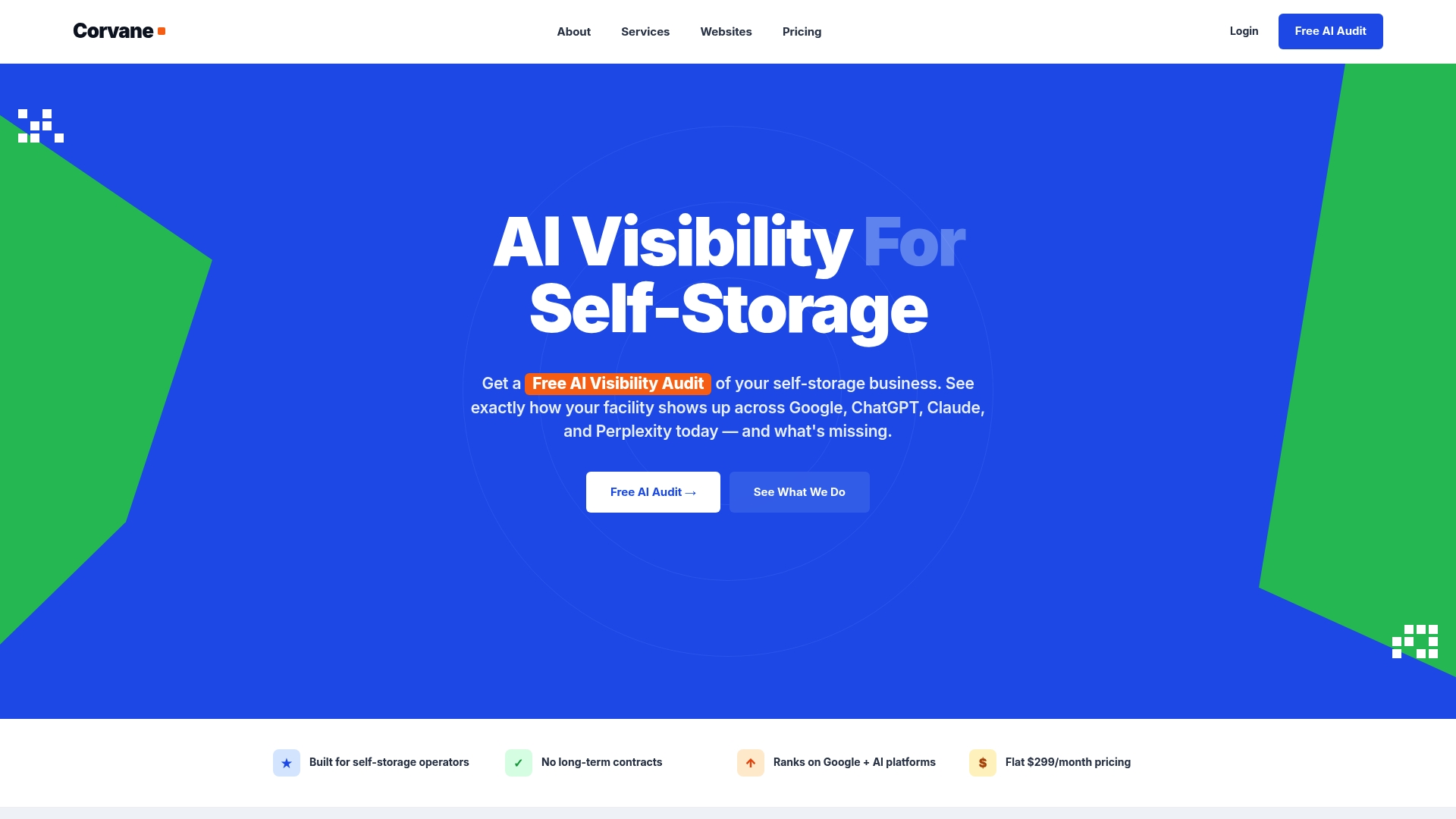
A system is offered at a flat monthly rate with a one-time onboarding fee, no contracts, and no tiers. It covers technical and on-page SEO tuned for storage sites, local positioning and Google Business Profile management, monthly AI-optimized articles, and AI visibility audits across major AI platforms. Operators who need a stronger site foundation can also request a custom website build.
If you want to see exactly where your facility stands before committing to anything, request a free AI visibility audit and get a clear score on how you currently appear across major AI platforms, plus a roadmap for closing the gaps this article just walked you through.
Where to Verify These Checks Yourself
Run your own audit alongside a few essential references: Google Search Console for indexing and impression data, the schema.org LocalBusiness vocabulary for structured data properties, and the Search Engine Journal 11-point checklist for a broader industry-standard framework. For storage-specific citation work, the citation building checklist covers directory prioritization in more depth than a generic guide can.
Sources
- How To Do A Complete Local SEO Audit: 11-Point Checklist — Search Engine Journal
- Schema
- US local search device usage — Statista
- Moz local SEO guide
FAQ
How Long Does a Local SEO Audit Take?
A single-location manual audit typically takes 2 to 4 hours if you're working through each section methodically. Multi-location operators usually need tool-assisted audits that take longer per property but scale better than manual checks across every listing.
How Often Should Storage Facilities Run a Local SEO Audit?
Most guides recommend auditing every 6 to 12 months, with multi-location operators leaning toward the 6-month end given how much more listing and citation data they manage. A quick GBP and citation check makes sense quarterly even between full audits.
What's the Biggest Local SEO Mistake Storage Facilities Make?
Letting Google Business Profile go stale is the most common and most costly mistake. Missing service categories, outdated hours, and duplicate listings quietly drag down map-pack rankings even when the rest of the site looks fine.
Does AI Visibility Really Matter for a Storage Facility?
Yes, and it's growing fast. AI/LLM visibility checks are now part of a complete local SEO audit because customers increasingly ask conversational assistants where to rent storage before they ever open a search engine.
What Does Corvane Systems Charge for a Local SEO Audit and Fixes?
Corvane Systems runs on a flat monthly rate of $299 with a one-time $50 onboarding fee, covering technical SEO, Google Business Profile optimization, AI-optimized content, and AI visibility audits. Full pricing details are available directly at Corvanesystems.