
Your Google Business Profile is claimed. Your website is live. But when someone asks ChatGPT or Perplexity "where can I rent a storage unit near me," your facility doesn't show up. That gap is almost always a citation problem.
A local citation is any online mention of your facility's Name, Address, and Phone number (NAP). When those mentions are consistent and verified across the right platforms, search engines and AI assistants treat your facility as a trusted, real business. When they're inconsistent, fragmented, or missing, you're invisible. This storage facility citation building checklist gives you the exact sequence to fix that, from locking your canonical NAP to registering with national data aggregators and implementing structured data that AI systems can actually read.
Start here, right now:
- Open your Google Business Profile and confirm the name, address, and phone match your website's contact page exactly, character for character.
- Copy that exact NAP into a master spreadsheet. That spreadsheet is your source of truth for every submission that follows.
- Submit or correct your record at Data Axle (Infogroup), Neustar/Localeze, and Foursquare. These aggregators feed dozens of downstream directories automatically.
- Verify your GBP listing if it isn't already verified. Nothing else matters until that's done.
Industry guidance recommends targeting 30–50 high-quality citations across major platforms, core self-storage industry directories, and relevant local associations rather than blasting your NAP to hundreds of low-quality sites. Aim to fill these 30–50 key slots with verified, matching information, as research suggests this improves local SEO outcomes. Quality and consistency beat volume every time.
Pro Tip: If you're short on time, the five-minute version is this: verify GBP, lock your canonical NAP on your website, and submit to the three core aggregators. That single pass does more than 200 random directory submissions.
Key Takeaways
Consistent, verified citations across 30–50 high-quality platforms—meaning major general platforms, core industry directories, and key local associations—are the single most effective step a storage operator can take to improve local search and AI visibility in 2026. Rather than mass submissions, focus on reaching this 30–50 mark with accurate, verified data.
| Point | Details |
|---|---|
| Lock canonical NAP first | Document one exact Name, Address, Phone format and apply it everywhere before any submission. |
| Verify GBP before anything else | Google Business Profile is the canonical local entity; all other platforms reconcile to it. |
| Fix aggregators early | Data Axle, Neustar/Localeze, and Foursquare feed downstream directories; submit them in week one. |
| Target 30–50 quality citations (major, industry, and local association platforms) | Consistent, verified citations on the right platforms outperform mass submissions to low-authority sites. |
| Corvanesystems | Handles GBP management, aggregator submissions, schema, and quarterly audits for storage operators at a flat monthly rate. |
Table of Contents
- Your Storage Facility Citation Building Checklist, in Order
- How to Audit Your Existing Citation Profile Quickly
- How to Standardize Your Canonical NAP
- Claim and Verify Your Primary Listings
- Which Industry Directories Should Storage Operators Prioritize?
- Register with National Data Aggregators
- How to Find and Remove Duplicate Listings
- On-Site Signals and Structured Data for AI and Local Search
- How to Monitor and Maintain Your Citation Program
- Common Mistakes That Damage Citation Health
- Why Citation Health Is the Foundation of AI Visibility
- Corvanesystems Handles Citation Cleanup and AI Visibility for Storage Operators
- Sources
Your Storage Facility Citation Building Checklist, in Order
Run these tasks in sequence. Skipping ahead creates downstream problems.
Phase 1: Lock your foundation
- Decide on your canonical NAP format (legal name vs. DBA, address abbreviation style, phone format).
- Add LocalBusiness JSON-LD to your location page and match it to your GBP exactly.
- Publish the canonical NAP on your website's contact page and footer.
Phase 2: Claim and verify primary listings
- Verify Google Business Profile (postcard, phone, or instant via Search Console).
- Claim and verify Apple Business Connect (Apple Maps).
- Claim and verify Bing Places.
- Claim and verify Yelp, Facebook Business, and YellowPages.
Phase 3: Industry directories
- Claim or create listings on SpareFoot, SelfStorage.com, USStorageSearch, and Neighbor.
- Add unit types, access types, photos, and hours to each.
Phase 4: Data aggregators
- Submit/correct records at Data Axle (Infogroup), Neustar/Localeze, and Foursquare/HERE.
- Log submission date, method, and confirmation ID for each.
Phase 5: Cleanup and maintenance
- Find and merge or suppress duplicate listings.
- Schedule follow-up checks at 30, 60, and 90 days, then quarterly.
Pro Tip: Print this list and assign each phase to a specific person. Citation work that "everyone is responsible for" gets done by no one.
How to Audit Your Existing Citation Profile Quickly
Before you build anything new, you need to know what's already out there. Skipping the audit means you'll spend time creating listings that already exist, often with wrong information.
Step 1: Run exact-string Google searches: "Your Facility Name" "your phone number" and "Your Facility Name" "your street address". Screenshot every result. This surfaces listings you didn't know existed.
Step 2: Build a spreadsheet with these columns: Platform, URL, Name Shown, Address Shown, Phone Shown, Verified (Y/N), Notes, Last Checked. Fill in every listing you find.
Step 3: Run an automated scan using BrightLocal, Whitespark, or Moz Local to catch platforms your manual search missed. These tools automate discovery and monitoring, but manual verification of your top 15 listings remains essential for accurate citation health.
Prioritize your audit in this order: GBP first, then Apple Business Connect, Bing Places, Yelp, Facebook, BBB, and your top industry directories.
A cross-platform NAP audit across 41 platforms found that businesses with perfect NAP consistency appeared in the local pack more often in the sample tested. That's the concrete payoff for doing this audit correctly.
Pro Tip: Screenshot each listing before you edit it, and save the confirmation ID from every submission. That before/after record is your audit trail if something breaks later.
How to Standardize Your Canonical NAP
Pick one format and never deviate from it. Exact NAP mismatches like "St." versus "Street" or different phone formats cause search engines to trust your business data less, which directly harms local visibility.
Canonical NAP decisions to make once:
- Business name: Legal name or DBA? Include "LLC" or not? Pick one and document it.
- Address: Use USPS-standardized formatting. "123 Main Street" not "123 Main St" unless USPS abbreviates it that way for your address.
- Phone: Choose one format: (555) 867-5309. Never mix formats across listings.
- Website URL: Always use the full https:// version. Decide whether to include a trailing slash and stick to it.
Add LocalBusiness JSON-LD to your location landing page. The name, address, telephone, and url fields must match your GBP character for character. For multi-location facilities, use a unique @id for each location that points to that location's canonical page.
Document the final canonical NAP in a shared master sheet. Anyone submitting to a new directory pulls from that sheet, not from memory.
Pro Tip: Use a real local phone number for each location as your canonical citation number. Call-tracking numbers belong on your website only, never in a directory listing. Aggregators reconcile phone numbers across sources, and a tracking number creates a mismatch that splits your citation authority.
Claim and Verify Your Primary Listings
Verification is what separates a citation that helps you from one that's just noise. An unverified listing can be edited by anyone.
Priority platforms to claim and verify:
- Google Business Profile
- Apple Business Connect (Apple Maps)
- Bing Places
- Yelp
- Facebook Business
- YellowPages
For each platform, confirm: ownership verified, correct NAP, category set to "Self-Storage Facility" or equivalent, hours accurate, at least five photos uploaded, services listed, and website URL pointing to your canonical domain.
Verification methods vary. GBP offers postcard, phone, email, or instant verification via Google Search Console. Apple Business Connect uses email verification. Bing Places mirrors GBP verification in many cases. Document the method and date for each platform in your master spreadsheet.
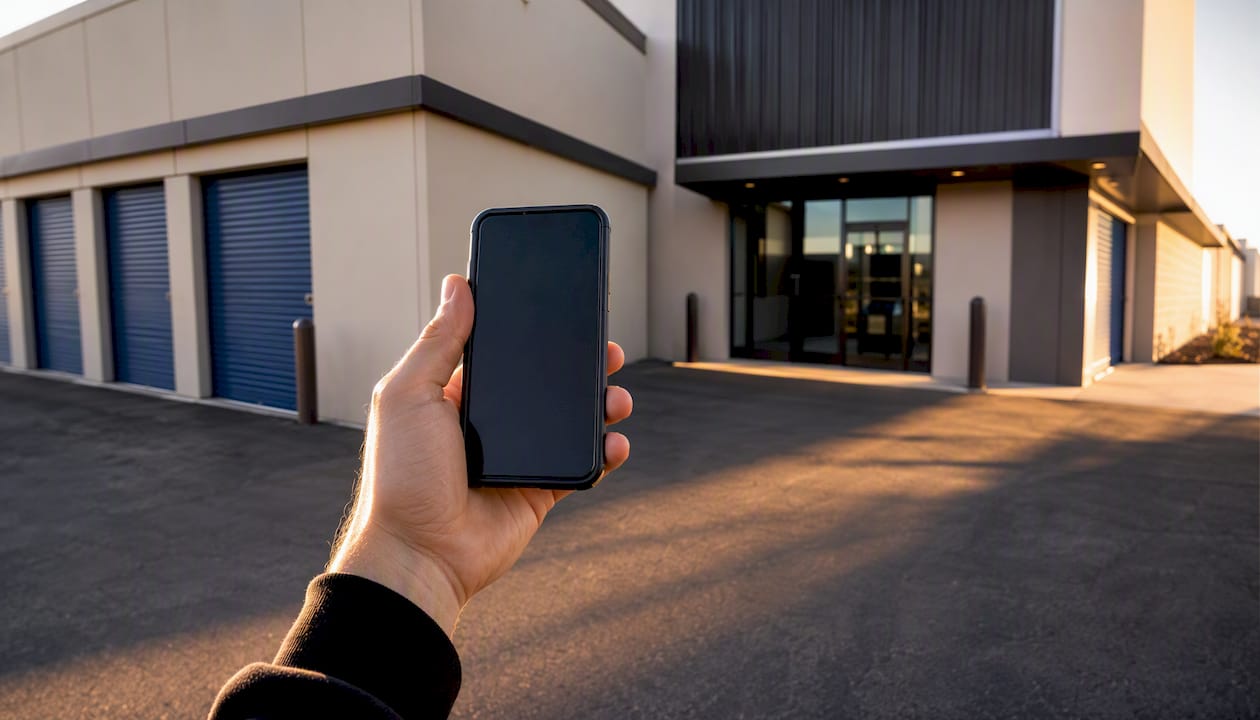
Claiming GBP and major directories, then prioritizing industry-specific directories, is the sequence storage customers actually follow when searching. Your GBP is Google's canonical local entity for your facility. Fix it first, and other platforms often reconcile to it.
Pro Tip: When you upload photos, include exterior shots, gate/access area, and unit interiors. Listings with photos consistently outperform text-only listings in click-through rates.
Which Industry Directories Should Storage Operators Prioritize?
General directories matter, but storage customers also use industry-specific platforms before they book. Missing from these means losing to a competitor who isn't.
Industry directories to target:
- SpareFoot: The largest storage marketplace in the U.S. Search for an existing listing before creating one.
- SelfStorage.com: High-intent traffic from renters actively comparing facilities.
- USStorageSearch: Smaller but storage-specific; worth the submission.
- Neighbor: Peer-to-peer storage platform; relevant if you offer flexible unit options.
- State and city chamber directories, local moving portals, and real estate sites where storage seekers browse.
For each listing: use your canonical NAP, select the correct category, specify unit types (climate-controlled, drive-up, vehicle storage), include access hours, and upload facility photos. Where rates are allowed, add them. Specificity drives conversions.
Search for existing listings before submitting. Duplicate profiles split your reviews and confuse aggregators. Claim the existing record and update it rather than creating a second one.
Pro Tip: If a paid listing option exists (SpareFoot charges for premium placement), track the lead volume it generates after 30 days. If it doesn't produce measurable inquiries, downgrade or cancel. Document the cost and the result.
Register with National Data Aggregators
Data aggregators are the backplane of local search. Data Axle (Infogroup), Neustar/Localeze, Foursquare, and HERE feed business data to hundreds of downstream directories, apps, and navigation systems. A wrong record at the aggregator level repopulates errors across the web automatically.
Fix your website schema and GBP before pushing to aggregators. Aggregators reconcile to your canonical source, so if your GBP still shows an old address, the aggregator push locks in the wrong data.
Submission order:
- Confirm GBP and website JSON-LD are correct.
- Submit to Data Axle (Infogroup) via their business listing portal.
- Submit to Neustar/Localeze.
- Submit to Foursquare and HERE.
- Log submission date, confirmation ID, and a 30-day follow-up reminder for each.
Aggregator updates take 2–12 weeks to propagate fully. Submit early in your process, not after you've finished everything else.
Pro Tip: Check your aggregator records six weeks after submission. Some platforms require a second confirmation step that's easy to miss, and an unconfirmed submission doesn't push.
How to Find and Remove Duplicate Listings
Duplicates split your reviews, confuse search engines, and sometimes show wrong hours or addresses to customers. They appear from old addresses, name variations, franchise records, or third-party scrapers.
Step-by-step duplicate removal:
- Identify duplicates using your audit spreadsheet and the exact-string Google searches from the audit section.
- For each duplicate: claim it if you can, then request a merge with the correct listing.
- If a merge isn't available, mark the duplicate as "permanently closed" only if it refers to a genuinely closed location. Otherwise, suppress it through the platform's duplicate-reporting tool.
- Correct the upstream aggregator record. If the aggregator still shows the old address, the duplicate will repopulate.
- Log each request with the date, platform, and expected resolution time.
Platform timelines vary. Some merges resolve in days; others take weeks. Follow up every two weeks until resolved.
Pro Tip: If you're dealing with more than 20 duplicates, the math usually favors a paid cleanup service. Manual cleanup runs roughly $500–$1,500 depending on volume and complexity, while subscription tools like BrightLocal or Whitespark can handle ongoing suppression at a lower monthly cost.
On-Site Signals and Structured Data for AI and Local Search
Structured data is how AI systems read your facility's identity without guessing. A well-formed LocalBusiness JSON-LD block on your location page tells Google, ChatGPT, and Perplexity exactly who you are, where you are, and when you're open.
Citation profiles act as a digital identity for generative AI systems; inconsistent data reduces the likelihood AI assistants will recommend your business. Structured data is the on-site layer that anchors that identity.
Required JSON-LD fields for a storage facility:
@type:SelfStorage(orLocalBusinessif SelfStorage isn't recognized by your CMS)name: exact canonical nameaddress: withstreetAddress,addressLocality,addressRegion,postalCodetelephone: callable format, e.g.,tel:+15558675309url: canonical https:// URLopeningHoursSpecification: each day with open/close timesgeo: latitude and longitude@id: canonical GBP URL for the location (critical for multi-location setups)
Validate your JSON-LD using Google's Rich Results Test before publishing. A single syntax error silently breaks the entire block, and you won't know unless you check.
Add an llms.txt file to your root domain. This plain-text file gives AI crawlers a machine-readable summary of your facility, including canonical NAP and a one-paragraph description. It's a lightweight signal that helps AI overviews verify your entity. Learn more about how on-site signals feed AI discoverability.
Pro Tip: For multi-location operators, each location needs its own landing page with its own JSON-LD block and a unique @id. One page covering all locations produces one citation signal, not five.
How to Monitor and Maintain Your Citation Program
Citation work isn't a one-time project. Aggregators re-scrape, platforms update their data, and your own business details change. Without a maintenance cadence, the work you did in month one degrades by month six.
Recommended schedule:
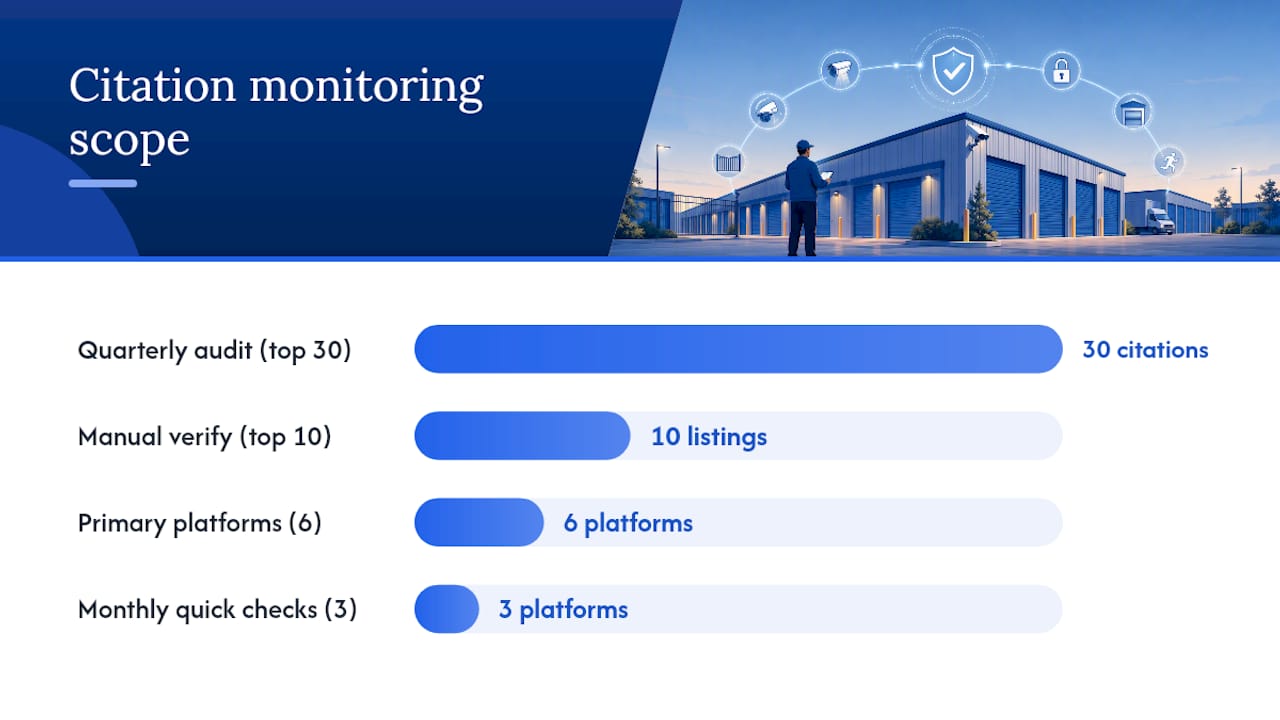
- Days 0–90: Initial audit, fixes, and submissions. Recheck at 30, 60, and 90 days for propagation.
- Monthly: Quick check on GBP, Apple Business Connect, and Yelp for unauthorized edits or new duplicates. High-competition markets warrant monthly checks on the full top 10.
- Quarterly: Full audit of top 30 citations using your master spreadsheet. Update last-verified dates.
KPIs to track:
- NAP match rate across your top 30 citations (target: 100%)
- Number of verified key platforms (target: all 6 primary platforms verified)
- Citation change log entries (any change gets logged with date and reason)
- Lead volume from GBP and industry directories (track monthly)
Your master spreadsheet should include: Platform, URL, Last Verified Date, Verifier Name, Notes, Screenshot Link, and Next Check Date. Use BrightLocal or Whitespark for automated monitoring, but keep manual verification for your top 10 listings. Automated tools miss platform-specific display issues that a human catches in 30 seconds.
Pro Tip: Set a calendar reminder for your quarterly audit. It takes about two hours for a single-location facility and is the single highest-ROI maintenance task in local SEO.
Common Mistakes That Damage Citation Health
Most citation problems aren't dramatic. They're small, accumulated inconsistencies that compound over time.
Top mistakes storage operators make:
- Using "St." in one listing and "Street" in another
- Listing a call-tracking number as the canonical phone
- Leaving unverified duplicate listings to accumulate
- Setting the wrong GBP category (e.g., "Warehouse" instead of "Self-Storage Facility")
- Letting listings show old hours after a schedule change
- Having schema on the website that doesn't match GBP
Red flags to check immediately:
- Any listing showing "permanently closed" for an open location
- Aggregator records with a ZIP code from a previous address
- GBP showing a phone number that's no longer in service
Quick fixes:
- Open your master NAP sheet and compare it against your GBP, website footer, and top five directory listings right now.
- Correct GBP first. It's the canonical source other platforms reconcile to.
- Push corrections to aggregators. Don't wait for them to re-scrape.
- Log every change with a date and a screenshot.
Citation building spans structured, unstructured, and owned citations. Your website is the owned citation, and it's the one you control completely. Get it right, and everything downstream is easier to fix.
Pro Tip: Run the exact-string search "Your Facility Name" "old phone number" every quarter. Old phone numbers in active listings are one of the most common and most damaging citation errors, and they're invisible unless you search for them specifically.
Why Citation Health Is the Foundation of AI Visibility
Most storage operators treat citation work as a one-time cleanup task. It's not. It's ongoing infrastructure, and the stakes are higher now than they were two years ago.
When someone asks an AI assistant "what's the best storage facility near downtown Austin," the AI doesn't browse your website. It queries its training data and real-time retrieval sources, which include your citation profile. If your NAP is inconsistent across those sources, the AI either surfaces a competitor with cleaner data or gives no recommendation at all.
The operators who will win in AI-assisted local search aren't necessarily the ones with the most citations. They're the ones with the most consistent, verified, and structured citation profiles. A facility with 35 perfectly matched citations across GBP, the core aggregators, and the top industry directories will outperform a competitor with 200 inconsistent ones. That's not a theory. It's how entity resolution works in both traditional search and generative AI.
Corvanesystems builds citation programs for storage operators as part of a broader AI visibility strategy, combining the structured data work, aggregator submissions, and GBP management into a single documented process with a maintained change log. The audit methodology matters as much as the submissions themselves.
Corvanesystems Handles Citation Cleanup and AI Visibility for Storage Operators
Running a storage facility leaves little time for quarterly citation audits, aggregator submissions, and JSON-LD validation. Corvanesystems does this work for you, purpose-built for the self-storage industry.
The service covers GBP management, Data Axle and Neustar/Localeze submissions, schema implementation, duplicate suppression, and ongoing monitoring, all at a flat monthly rate with no contracts. You get consistent NAP across your priority platforms, verified listings, quarterly audits, and the structured AI visibility signals that help ChatGPT, Perplexity, and Google's AI Overviews surface your facility when a renter is ready to book.
Get your facility's AI visibility audit and see exactly where your citation profile stands today. It's the clearest first step toward turning search and AI discovery into booked units.
Sources
Official platform documentation:
Citation audit and monitoring tools:
Aggregator submission portals:
Industry directories:
The most important resource is your own master NAP spreadsheet. Every tool and directory in this list is only as useful as the canonical data you feed into it.