
To optimize storage for AI overviews, align three factual sources: your facility website, your Google Business Profile, and your directory listings. When all three agree on the same facts, AI systems treat your facility as a verified, citable entity.
Here is the six-step checklist to start this week:
- Audit your facility page. Confirm exact address, hours, unit sizes, starting prices, gate rules, and amenities appear as plain text.
- Complete every GBP field. Name, phone, categories, attributes, 750-character description, Q&A, posts, and photos.
- Fix directory inconsistencies. Match your NAP exactly across Google, Apple Maps, Yelp, and storage-specific directories.
- Publish answer-first FAQs. Write short, factual answers to tenant questions AI can lift verbatim.
- Add LocalBusiness schema. Give AI a machine-readable confirmation of your website facts.
- Test and measure. Run queries in ChatGPT, Perplexity, and Google AI Overviews weekly and log whether your facility is cited.
According to a 10,000-business audit by Insites, a business's own website is the single most-cited source in AI awareness queries, appearing in a majority of cases, while directories appear in a significant minority. That gap tells you where to focus first.
Key Takeaways
Self-storage facilities that align their website facts, Google Business Profile, and directory listings give AI systems everything they need to cite and recommend them in local queries.
| Point | Details |
|---|---|
| Website is the primary source | AI cites facility websites in 72.3% of awareness queries; plain-text facts are non-negotiable. |
| GBP completeness drives AI trust | Complete all fields, attributes, Q&A, posts, and photos; expect visibility changes within 2–12 weeks. |
| Directory consistency matters | Fix NAP mismatches across Google, Apple Maps, Yelp, and storage directories; aggregator corrections take 6–12 weeks. |
| Answer-first FAQs get extracted | Write one fact per sentence; AI ignores marketing copy and lifts direct, specific answers. |
| Corvanesystems manages it end-to-end | Flat-rate managed GSO for storage operators covers audits, GBP, schema, content, and monthly AI citation tracking. |
Table of Contents
- How do you audit your facility website so AI reads the right facts?
- How does your Google Business Profile become a primary AI data source?
- Which directory listings matter most for AI corroboration?
- How do you write facility pages and FAQs that AI actually extracts?
- What technical requirements help AI verify your facility's facts?
- How do you test whether AI engines are citing your facility?
- What does a practical 90-day roadmap look like?
- How do you build the third-party signals AI trusts?
- What should you do this week to start capturing AI-driven bookings?
- Why GSO is a different game for self-storage operators
- Corvanesystems handles the GSO work so you can run your facility
- Sources
How do you audit your facility website so AI reads the right facts?
Your website is where AI defines your facility as an entity. Before anything else, load each facility page and check for these items as plain, crawlable text:
- Full street address (not just a map embed)
- Phone number and manager contact
- Current hours, including gate access hours
- Unit sizes with dimensions (5×5, 5×10, 10×10, 10×20)
- Starting prices for each unit type
- Climate control, drive-up access, and other amenities
- Gate code rules and after-hours access policy
- Recent review snippets
Inside Self-Storage reports that AI platforms ignore generic marketing claims and only extract concrete answers to tenant questions. "Affordable, convenient storage" gets skipped. "5×10 units starting at $59/month, drive-up access, gate open 6 AM–10 PM" gets cited.
Here are two FAQ snippet examples written in the answer-first style AI can extract:
| Question | Answer |
|---|---|
| What are your gate hours? | The gate is open daily from 6 AM to 10 PM. After-hours access requires a manager call 24 hours in advance. |
| Do you offer climate-controlled units? | Yes. Climate-controlled units range from 5×5 to 10×20 and maintain stable temperatures year-round. |
Pro Tip: Disable JavaScript in your browser and reload your facility page. If your address, hours, and unit sizes disappear, AI crawlers likely can't read them either. Move that content to plain HTML.
How does your Google Business Profile become a primary AI data source?
A fully optimized GBP functions as a structured data API that AI systems query directly for local recommendations. Completeness is not optional here.
Work through these fields in order:
- Name, address, phone. Must match your website and every directory exactly, character for character.
- Primary category. Use "Self-Storage Facility." Add secondary categories for moving truck rental or portable storage if applicable.
- Attributes. Check every relevant box: 24-hour access, climate control, drive-up access, security cameras, online payments.
- Description. Write 750 characters of short, declarative sentences covering unit types, location, and access rules. No slogans.
- Services. List each unit size as a separate service with a one-sentence description.
- Hours. Set regular hours and add special hours for holidays. Include gate hours in the description if they differ from office hours.
- Photos. Upload exterior, interior, unit interiors, and signage. Aim for at least 20 photos at launch.
- Q&A. Seed your own questions and answer them in the same factual style as your FAQ page.
- Posts. Publish at least one post per week covering current specials, seasonal tips, or unit availability.
- Reviews. Respond to every review within 48 hours.
Weekly posts, frequent photo uploads, and rapid review responses create freshness signals that AI systems weigh when recommending businesses. Expect GBP changes to influence AI visibility within 2–12 weeks, with immediate fields like hours and NAP updating faster than engagement signals like review velocity.
Which directory listings matter most for AI corroboration?
AI builds confidence when multiple independent sources agree on the same facts. Your website defines the entity; directories corroborate it. When they conflict, AI confidence drops and your facility gets skipped.
Priority platforms to audit:
- Google Business Profile (primary)
- Apple Maps
- Yelp
- Bing Places
- Facebook Business
- SpareFoot, StorageCafe, and Self Storage Association directories
- Data aggregators: Foursquare, Data Axle, Neustar Localeze
Audit and fix steps:
- Search your facility name on each platform and screenshot the current NAP.
- Compare against your canonical NAP (the version on your website).
- Fix formatting mismatches: "St." vs. "Street," "Ste" vs. "Suite," missing suite numbers, and phone format inconsistencies.
- Claim unclaimed listings before fixing them.
- Submit corrections through each platform's owner portal; aggregator corrections propagate to downstream directories within 4–8 weeks.
A diversified local citation strategy across GBP, major directories, and industry-specific listings improves both traditional ranking and AI visibility. You can also use Cited to check how consistently your facility appears across AI engines and spot citation gaps before they cost you bookings.
How do you write facility pages and FAQs that AI actually extracts?
The writing rule is simple: one fact per sentence, no marketing fog. AI extracts short, specific statements and ignores paragraphs that build to a vague conclusion.
A facility page that AI can cite includes:
- Header facts block. Address, phone, hours, and gate hours in the first 100 words.
- Unit grid. A plain-text or HTML table listing each unit size, typical use, starting price, and climate control status.
- Short FAQ. Five to ten questions answered in one to two sentences each.
- Nearby landmarks. Two or three named neighborhoods or intersections AI uses for geographic matching.
- Manager contact. Name and direct phone or email.
(Use your actual prices. Generic placeholders will not help AI cite your facility.)
Pro Tip: Never embed your pricing or unit availability inside a JavaScript widget or image. AI crawlers often skip JS-rendered content entirely, so a price that only loads after a script runs is effectively invisible.
What technical requirements help AI verify your facility's facts?
Google's guidance is direct: pages must be crawlable and indexable to be eligible for generative AI features. Structured data helps verification but is not strictly required. That said, LocalBusiness schema removes ambiguity and is worth implementing.
Technical checklist:
- Pages are indexed (check via
site:yourdomain.comin Google) - XML sitemap submitted to Google Search Console
- No
noindextags on facility pages - Canonical URLs set correctly for each location
- Core facts load without JavaScript
LocalBusiness schema essentials (hand this list to your developer):
name,address,telephone,geo(latitude/longitude)openingHoursSpecificationfor office and gate hours separatelyaggregateRatingpulled from your review count and averagesameAslinks pointing to your GBP URL, Yelp, and SpareFoot profiles
Validate your schema at schema.org's validator, then request reindexing in Search Console after any major page update.
How do you test whether AI engines are citing your facility?
Run these queries in ChatGPT, Perplexity, and Google AI Overviews, substituting your city and unit type:
- "Best self-storage near [city]"
- "Where can I rent a 10×10 storage unit in [neighborhood]?"
- "Self-storage with climate control in [zip code]"
- "Storage facility with 24-hour access in [city]"
Log the results in a simple spreadsheet:
- Date of query
- AI platform used
- Whether your facility was cited (yes/no)
- Exact phrasing used to describe your facility
- Source cited (website, GBP, directory)
Weekly metrics to track:
- AI citation count per platform
- GBP impressions and search queries (Search Console Generative AI report)
- Directory consistency score (audit monthly)
- New review count and average rating
- Organic traffic to facility pages
Expect your first measurable changes within 4–8 weeks of completing GBP and website updates. Directory corrections take longer, typically 6–12 weeks to propagate fully.
What does a practical 90-day roadmap look like?
Weeks 1–2: Audit and fix the foundation. Run the JS-off test on every facility page. Update GBP NAP, hours, and categories. Identify the top five directory inconsistencies and submit corrections.
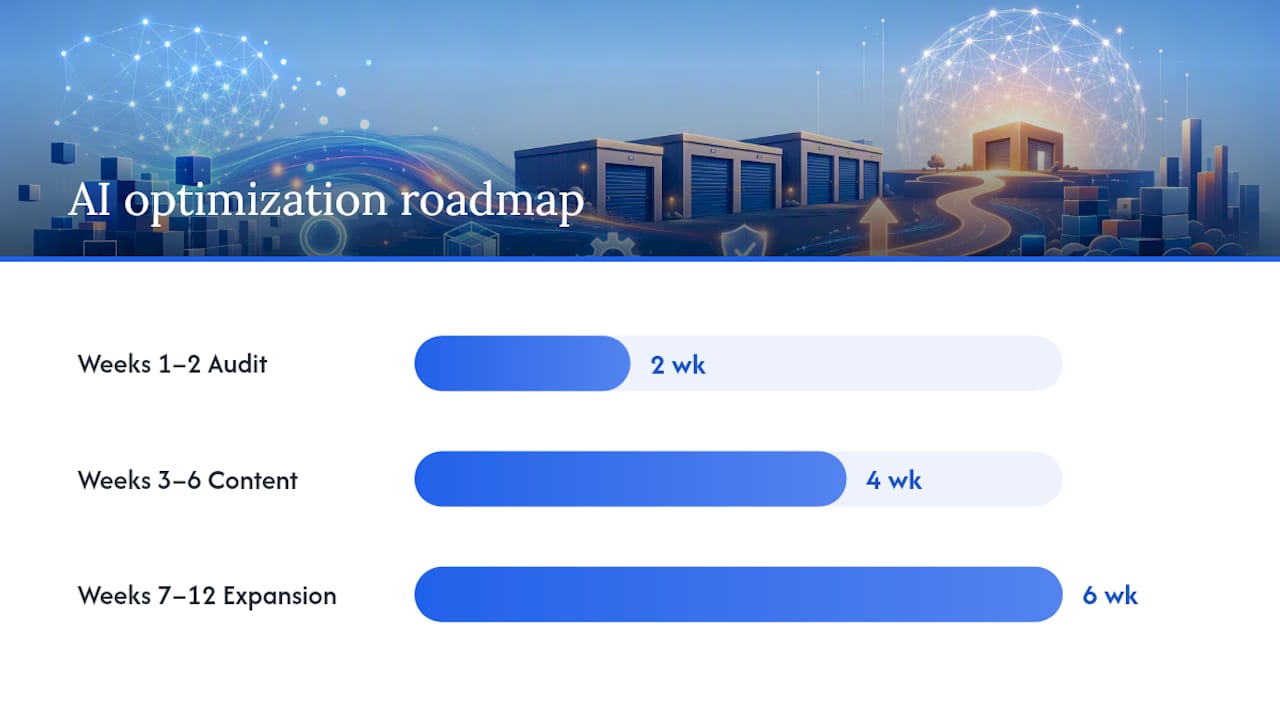
Weeks 3–6: Build the content layer. Publish answer-first FAQ pages for each location. Add the unit size table in plain HTML. Implement LocalBusiness schema and validate. Submit your sitemap.
Weeks 7–12: Expand corroboration. Fix remaining directory listings. Begin weekly GBP posts. Start a review request cadence at move-in. Pitch one local guide or moving company for a mention.
Ongoing: Weekly GBP posts, monthly directory audits, and quarterly AI citation tests.
Cost models:
- DIY: 15–20 hours upfront for audit and fixes; 2–3 hours per week ongoing.
- One-off developer work: Schema implementation and site updates typically run $500–$2,000 depending on site complexity.
- Managed service: Monthly retainers for full GSO management, content, and monitoring vary widely. Flat-rate options purpose-built for storage operators eliminate the guesswork.
How do you build the third-party signals AI trusts?
Reviews and editorial mentions are the corroboration layer that makes AI confident enough to recommend your facility by name.
Review strategy:
- Ask every new tenant for a review at move-in, not at move-out.
- Send a follow-up text or email at day 7 with a direct link to your GBP review form.
- Respond to every review within 48 hours. Responses that mention specific attributes ("glad our climate-controlled units worked for your wine collection") reinforce those attributes as facts AI can extract.
Editorial outreach steps:
- Identify local moving company blogs, neighborhood guides, and chamber of commerce resource pages.
- Pitch a short, useful asset: a neighborhood storage guide, a "what fits in a 10×10" packing checklist, or a seasonal storage tips post.
- Ask for a link or a mention with your facility name and city.
- Track mentions monthly using Google Alerts set to your facility name and address.
Local SEO and citation-building tactics that earn genuine editorial mentions carry more weight with AI systems than directory submissions alone, because they represent independent third-party validation.
What should you do this week to start capturing AI-driven bookings?
Three actions, in order of impact:
- Audit one facility page today. Run the JS-off test, confirm all facts are in plain text, and fix anything that disappears.
- Update your GBP fields this week. Complete the description, add attributes, seed three Q&A pairs, and upload ten photos.
- Publish one FAQ page before the week ends. Five questions, five direct answers, each under two sentences.
These three steps address the two layers AI uses most: your website defines the entity, and your GBP corroborates it. Getting both right is the fastest path from invisible to cited.
For operators who want help running this at scale across multiple locations, Corvanesystems offers managed GSO services built specifically for self-storage.
Why GSO is a different game for self-storage operators
The conventional SEO playbook optimizes for ranking. GSO optimizes for being extracted. That is a meaningful difference, and self-storage operators are unusually well-positioned to win at it.

Here is why: self-storage queries are hyper-local and highly specific. A tenant asking an AI assistant "where can I rent a 10×10 climate-controlled unit near downtown Austin?" is not browsing. They are ready to book. AI systems answer that query by pulling from the most factually complete, consistently corroborated source they can find. A facility page with plain-text unit sizes, a complete GBP, and matching directory listings wins that query almost by default, because most competitors have thin location pages and inconsistent listings.
Multi-location operators face the biggest risk here. A chain with 12 locations and 12 nearly identical, lightly populated pages gives AI almost nothing to differentiate. Each location needs its own facts: its own address, its own unit mix, its own gate hours, its own FAQ. Generic copy pasted across locations is the fastest way to be invisible in AI answers.
The operators who move first on GSO will hold a structural advantage that compounds. AI systems learn from consistent, corroborated data over time. The facility that builds that foundation now will be harder to displace six months from now.
Corvanesystems handles the GSO work so you can run your facility
Most storage operators know what needs to be done. The problem is time. Auditing 12 location pages, managing GBP fields across every location, building schema, publishing 30 articles a month, and running weekly AI citation tests is a full-time job on top of running a storage business.
Corvanesystems is the managed GSO service built for exactly this situation. One flat monthly rate covers your full AI visibility program: technical and on-page SEO, GBP management, LocalBusiness schema, 30 keyword-optimized articles per month, AI visibility audits across ChatGPT, Claude, Perplexity, and Google AI Overviews, and monthly performance reporting. No contracts, no tiers, no minimums.
If you want to know where your facility stands right now, start with an AI visibility audit. You will see exactly which AI platforms cite you, which sources they pull from, and what is blocking your facility from appearing in the answers that drive bookings.
Sources
These are the most authoritative references for operators and developers implementing GSO for self-storage:
- Where does ChatGPT get its information about local businesses? | Insites
- AI search and business discoverability: what self-storage operators need to know and strategies to remain visible