
Storage unit pricing is a strategic, dynamic process driven by unit size, location, amenities, occupancy data, and competitive benchmarking. Understanding how storage facilities set prices is the difference between leaving revenue on the table and running a facility that consistently hits its net operating income targets. This guide breaks down every major pricing lever, from baseline unit factors to AI-powered revenue management, so you can make smarter rate decisions in 2026.
What are the primary factors influencing storage unit pricing?
Unit size is the foundation of every storage pricing model. Larger units carry higher base rates, but size alone does not explain the full range of prices you see across a market. Location, amenities, and access type layer premiums on top of that base.
Location is the single most powerful market-level variable. Urban storage markets like New York command prices 200–300% above the national average, while comparable suburban units run 30–50% cheaper. That gap reflects land cost, population density, and the scarcity of competing facilities within a short drive.

Amenities create the next tier of pricing differentiation. Climate control is the most significant feature premium in the industry. Climate-controlled units carry a 25–50% price premium over standard units because of the real operational cost of maintaining temperature and humidity. That cost gets passed directly to the tenant, and most tenants storing furniture, electronics, or documents will pay it without hesitation.
Access type also moves the needle. Ground-floor drive-up units command the highest prices in any facility. Upper-floor units accessible only by elevator run 10–20% cheaper for the same square footage. Tenants pay for convenience, and drive-up access is the most convenient option available.
Administrative and ancillary fees round out the cost picture. Administrative fees range from $0 to $50 depending on the operator. Some facilities waive these fees entirely to improve conversion rates, which is a legitimate tactic when your street rate is already competitive.
Pro Tip: Build a simple pricing matrix that maps unit size, floor level, and access type against your current rates. You will almost always find units that are underpriced relative to their features.
| Unit Feature | Typical Price Impact |
|---|---|
| Climate control | +25–50% over standard rate |
| Ground-floor drive-up | Highest price tier in facility |
| Upper-floor elevator access | 10–20% below ground-floor rate |
| Administrative fee | $0–$50 per move-in |
How does competitive analysis and market demand shape storage pricing strategies?
Competitive pricing analysis in self-storage goes far beyond comparing headline monthly rates. True effective pricing includes hidden fees, move-in specials, deposits, insurance requirements, and lock charges. A competitor advertising $89 per month may actually cost the tenant $120 after fees. You need to know that number, not just the advertised rate.
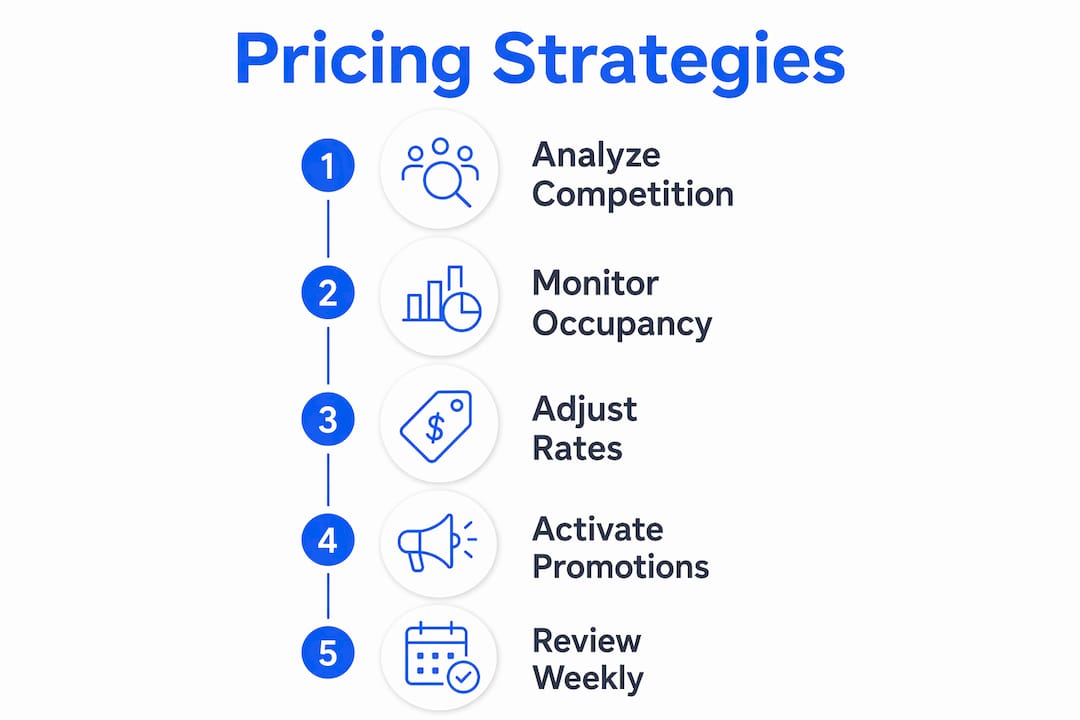
Market demand signals tell you when to move rates up or down. The most reliable operational trigger is occupancy. Occupancy thresholds are the strongest signal for pricing adjustments. When a unit type hits 85–95% occupancy, that is your trigger to raise street rates. When occupancy dips below a defined floor, that is your trigger to activate promotions. This is not guesswork. It is a rules-based system you can automate.
Price momentum is a more useful metric than any single monthly snapshot. Tracking price momentum over 7, 30, and 90-day periods gives you a directional read on market health that a single data point cannot provide. A market where rates have risen 8% over 90 days tells a very different story than one where rates have been flat for six months.
Here is a practical sequence for competitive analysis:
- Pull street rates for every major competitor within a 3-mile radius.
- Add all mandatory fees to calculate the true effective monthly cost.
- Note active promotions and estimate their effective annual discount.
- Track those numbers weekly over a 90-day window to identify price momentum.
- Compare your own lead volume, conversion rate, and move-in pace against that market data to calibrate your response.
"The facilities that win on pricing are not the ones with the lowest rates. They are the ones that understand their market well enough to know exactly when to raise rates and when to promote." This is the discipline that separates revenue-managed facilities from those running on intuition.
Seasonal demand adds another layer. Self-storage demand peaks in summer months when residential moves cluster, and softens in winter. Facilities that adjust street rates to reflect seasonal demand cycles capture revenue that static-rate operators leave behind.
What role does tenant segmentation and ECRI play in pricing optimization?
ECRI stands for existing customer rate increase. It is the most underused revenue lever in self-storage. Street rates attract new tenants. ECRI is how you grow revenue from the tenants already in your units. These are two distinct optimization levers, and most operators conflate them or ignore ECRI entirely.
Revenue management treats street rates and ECRI as separate tools with different impacts on net operating income and churn. Street rates affect acquisition. ECRI affects retention economics. Getting both right requires different data and different decision rules.
The most important variable in ECRI is tenure. Tenure is the strongest predictor of how much of a rate increase a tenant will absorb without moving out. Long-term tenants have high switching costs. They have already organized their lives around your facility. A well-timed, reasonably sized increase rarely triggers a move-out for a tenant who has been with you for two or more years.
Effective ECRI programs follow a structured cadence. Structured rate increases follow a 9–12 month cadence with annual caps of 8–12%. That range is aggressive enough to close the gap between legacy rates and current street rates, but measured enough to keep churn controlled. The primary candidates for increases are tenants paying 15–20% below current street rates. Those are the accounts where you are leaving the most money on the table.
Pro Tip: Segment your rent roll into three cohorts before running any ECRI program: tenants within 5% of street rate (hold), tenants 5–15% below (moderate increase), and tenants 15%+ below (priority increase). This prevents you from applying blanket increases that trigger unnecessary move-outs.
AI tools have made rent roll segmentation practical at scale. Claude can analyze rent rolls, segment tenants by tenure and rate gap, and model ECRI scenarios to project NOI impact and churn risk before you send a single notice. Facilities running AI-assisted ECRI programs have sustained move-out rates as low as 1.7% during structured increase cycles. That number should reset your expectations about what is possible.
How can storage facility managers implement dynamic pricing for competitive advantage?
Dynamic pricing is the practice of adjusting rates automatically based on real-time occupancy and demand signals. In self-storage, it means your system raises street rates when a unit type is nearly full and drops them or activates promotions when occupancy softens. The goal is to maximize revenue per available unit across every size category in your facility.
AI forecasting models can integrate weather patterns, local events, and economic indicators to generate demand predictions at the unit-type level. That specificity matters. A 10x10 climate-controlled unit and a 10x10 standard unit in the same facility may have completely different demand curves. Treating them identically leaves revenue uncaptured.
The practical implementation of dynamic pricing follows a clear structure:
- Set occupancy bands for each unit type (for example, below 75%, 75–85%, 85–95%, above 95%).
- Assign a rate action to each band (promote, hold, increase modestly, increase aggressively).
- Automate the rate changes within those bands using your property management software.
- Review automated decisions weekly to catch any edge cases the system misses.
| Occupancy Band | Recommended Rate Action |
|---|---|
| Below 75% | Activate promotions, consider discounts |
| 75–85% | Hold current street rate |
| 85–95% | Increase street rate moderately |
| Above 95% | Increase street rate aggressively |
Automation handles the routine decisions. Your job as a manager is to handle the exceptions and set the strategic parameters. No software knows that a major employer just announced layoffs in your market, or that a competitor two blocks away is closing. Human oversight catches those signals and adjusts the system accordingly.
Pro Tip: Review your dynamic pricing outputs every Monday morning. Look for any unit type where the automated rate moved more than 10% in a single week. That is usually a signal worth investigating before the change goes live.
How do facility amenities and unit characteristics affect pricing tiers?
Amenities justify differentiated pricing, and the data supports charging for them. Climate control, gated security, ground-floor access, and 24-hour availability are not just marketing features. They are genuine cost drivers and genuine value drivers that tenants will pay to access.
Prepaying 3–6 months often unlocks 10–20% discounts for tenants, while first-month-free promotions deliver roughly an 8% effective annual discount. These promotional structures serve a dual purpose. They improve conversion for price-sensitive tenants and they lock in occupancy for a defined period, which stabilizes your revenue forecast.
Web-only rates are another underused tool. Online rates are frequently lower than front-desk prices, and that gap drives digital conversion. Tenants who book online cost less to acquire and tend to complete the rental process without staff involvement. Offering a modest web-only discount is a straightforward way to shift more of your volume to the lower-cost digital channel.
The types of access options you offer directly shape which tenants you attract and what they will pay. Drive-up access draws contractors, small business owners, and anyone moving heavy items. Interior-only access with elevator service draws residential tenants storing household goods. Each segment has different price sensitivity and different tenure patterns. Knowing which segment occupies which units helps you price and promote more precisely.
Value-tier pricing is the framework that ties all of this together. Position your standard units as the entry point, climate-controlled units as the mid-tier, and climate-controlled drive-up units as the premium tier. Guide tenants toward higher-revenue units through clear feature descriptions and modest price gaps that make the upgrade feel worth it.
Key takeaways
Storage facility pricing is a multi-variable system where unit size, location, amenities, occupancy thresholds, and tenant segmentation each play a distinct role in determining the right rate at the right time.
| Point | Details |
|---|---|
| Location drives the largest price gap | Urban markets command 200–300% above the national average; suburban units run 30–50% cheaper. |
| Occupancy thresholds trigger rate moves | Raise street rates at 85–95% occupancy; activate promotions when occupancy falls below your floor. |
| ECRI and street rates are separate levers | Treat existing tenant increases and new tenant rates as distinct tools with different churn implications. |
| AI tools make segmentation practical | Claude and similar tools can model ECRI scenarios and sustain move-out rates as low as 1.7%. |
| Amenity premiums are real and defensible | Climate control justifies a 25–50% premium; drive-up access commands the highest price tier in any facility. |
The pricing mistake I see most often in self-storage
Most operators I work with have a solid instinct for street rates. They check competitors, they watch occupancy, and they adjust when something feels off. Where they consistently fall short is ECRI. They treat it as a customer service problem instead of a revenue management tool.
The fear of tenant complaints drives operators to leave long-term tenants at rates that are 20% or more below current market. That feels like loyalty. It is actually a slow revenue leak. A tenant who has been with you for three years has already demonstrated that they value the convenience of your facility. A structured, data-informed rate increase will not send them packing. A surprise, poorly communicated one might.
The other gap I see is in competitive analysis. Operators compare headline rates and stop there. They miss the fees, the promotions, and the momentum. A competitor dropping rates aggressively over 90 days is a signal worth acting on. A competitor raising rates steadily over the same period is an invitation to follow. Neither signal shows up in a single monthly price check.
The facilities that build real pricing discipline treat it as a continuous process, not a quarterly task. They monitor occupancy weekly, review competitor data monthly, and run ECRI on a defined cadence. That discipline compounds over time into meaningfully higher NOI without meaningfully higher churn.
— Mike
How Corvanesystems helps you price smarter
Pricing decisions are only as good as the data behind them. Corvanesystems is built specifically for self-storage operators who want better market intelligence and stronger digital visibility working together.
Corvanesystems combines AI-powered content and local search positioning to make sure your facility shows up when tenants are actively comparing options in your market. When potential customers ask ChatGPT or Perplexity where to rent a unit near them, your facility needs to be the answer they get. Visit Corvanesystems to see how AI visibility and competitive market positioning work together to fill your units at the rates you set, not the rates your competitors force on you.
FAQ
What are the main factors that determine storage unit prices?
Unit size, location, amenities like climate control, access type, and local market occupancy are the primary pricing factors. Administrative fees and promotional structures also affect the final effective price a tenant pays.
How do storage facilities use occupancy to set rates?
Facilities raise street rates when a unit type reaches 85–95% occupancy and activate discounts or promotions when occupancy falls below a defined threshold. This occupancy-band system is the most reliable operational trigger for rate adjustments.
What is ECRI and why does it matter for storage revenue?
ECRI stands for existing customer rate increase. It is a structured program for raising rates on long-term tenants who are paying below current market rates, typically following a 9–12 month cadence with annual caps of 8–12%.
How much more do climate-controlled units cost?
Climate-controlled units carry a 25–50% price premium over standard units. That premium reflects the real operational cost of maintaining temperature and humidity, and most tenants storing sensitive items will pay it.
How can I compare storage facility prices locally without missing hidden costs?
Calculate the true effective monthly cost by adding mandatory fees, insurance requirements, lock charges, and factoring out any move-in promotions. Tracking those numbers over 7, 30, and 90-day windows gives you a clearer read on market direction than any single monthly comparison.