
A storage facility location factors checklist is the structured tool self-storage operators use to score prospective sites against trade-area demand, physical attributes, and competitive conditions before committing capital. The checklist separates sites that will lease up quickly from sites that will drain marketing budgets for years. Two categories drive every decision: trade-area demand validation and site-specific criteria. Get the first category wrong and no amount of curb appeal saves the investment. This article walks through both categories in the order that protects your returns.
1. Which trade-area demand factors drive site selection success?
Trade-area demand is the single most important variable in any storage site selection process. A site with perfect visibility in a saturated market will underperform a modest site in an underserved one. Start here before you ever walk a parcel.
Define your primary trade area radius first. The primary trade area spans 3–5 miles in urban and suburban markets and 8–10 miles in rural ones. That radius defines the population pool you are drawing from and sets the ceiling on demand.

Apply the square footage per capita benchmark. Markets below 7 square feet of storage per capita are underserved and represent genuine opportunity. Markets above 10 square feet per capita carry saturation risk and require a much stronger competitive case before proceeding. This single metric filters out more bad deals than any other factor on the checklist.
Map the competitive supply pipeline. Counting existing competitors is not enough. Permitted but unbuilt facilities will enter the market during your lease-up period and compress occupancy. Pull permit records from the local planning department and add those square feet to your supply calculation.
Examine demographic drivers. The trade area's population, income, and renter mix set the demand ceiling regardless of site quality. High renter percentages correlate with stronger storage demand because renters move more frequently and have less on-site storage space. Population growth trends matter more than current population size.
- Population growth rate (positive trend required)
- Renter percentage (higher percentage favors demand)
- Median household income (affects willingness to pay for premium units)
- Existing storage square footage per capita (target below 7 SF)
- Permitted pipeline supply (add to existing SF before calculating per capita)
Pro Tip: AI demand models can process census data, competitor locations, and permit records simultaneously to produce a demand score in hours rather than weeks. Use them to pre-screen sites before spending money on formal feasibility studies.
2. What site-specific factors should owners evaluate?
Site-specific evaluation is the second phase of any storage facility site assessment. Trade-area demand tells you whether a market can support a new facility. Site attributes tell you whether this particular parcel can deliver that facility efficiently and profitably.
-
Road frontage and traffic counts. Arterial road frontage with high daily traffic counts is the single most valuable physical attribute a storage site can have. Visibility from a major road reduces customer acquisition cost and supports faster lease-up. Request traffic count data from the state DOT or county transportation department for any site under consideration.
-
Access points and drive aisle width. Multiple ingress and egress points reduce congestion and improve the tenant experience. Drive aisles require a minimum of 26 feet to accommodate moving trucks safely. Sites that cannot meet this minimum will lose rentable square footage to wider aisles or force operators to accept dangerous traffic conditions.
-
Parcel configuration and grade. Irregular parcel shapes reduce net rentable square footage and create dead zones that cannot be developed efficiently. Steep grades require retaining walls and grading work that adds cost and reduces yield. A rectangular, flat parcel is the baseline. Anything that deviates from it requires a cost adjustment in your financial model.
-
Zoning and entitlement risk. Verify that self-storage is a permitted use by right in the current zoning classification. Conditional use permits can add 6–18 months to development timelines. That delay increases carrying costs, erodes projected returns, and introduces approval risk that can kill a deal entirely.
-
Utility capacity. Climate-controlled facilities require 200–400 amps of electrical capacity. Verify available amperage with the utility provider before purchase. Upgrading electrical service after acquisition is expensive and can materially damage profit projections. Water, sewer, and stormwater capacity also require confirmation.
-
Security infrastructure and site condition. Tenants choose storage facilities partly on perceived safety. Fencing, lighting, camera coverage, and gate access systems all affect occupancy. A site in poor condition signals higher renovation costs and a longer path to stabilized occupancy.
Pro Tip: Order a Phase I environmental assessment and a utility capacity letter from the serving utility before you close. Both documents surface deal-killing issues that are invisible during a standard site walk.
3. How do local competition and market saturation affect location choice?
Competition analysis is where many operators make their most expensive mistakes. They evaluate a site in isolation and miss the competitive context that determines whether the market can absorb another facility.
| Factor | Healthy Market | Saturated Market |
|---|---|---|
| Storage SF per capita | Below 7 SF | Above 10 SF |
| Competitor occupancy rates | Above 85% | Below 80% |
| Rental rate trends | Stable or rising | Declining or flat |
| Pipeline supply | Minimal | Significant |
| Absorption timeline | 12–24 months | 36+ months |
Competitor occupancy rates are the most reliable real-time signal. When existing facilities in your trade area are running above 85% occupancy, the market is absorbing supply and can likely support a new entrant. When rates fall below 80%, the market is already struggling to fill existing space.
Rental rate trends confirm the occupancy story. Rising street rates indicate pricing power and healthy demand. Flat or declining rates signal that operators are already competing on price, which compresses margins for everyone in the market.
The pipeline analysis is the factor most operators skip. A market that looks healthy today can look very different in 18 months if three permitted facilities are under construction. Pull permit records, check planning commission agendas, and call the local planning department directly. That 30-minute call can save you from entering a market that is about to be overbuilt.
4. What role do visibility and access play in occupancy rates?
Visibility and access are the two site attributes most directly connected to lease-up speed and long-term occupancy. They also affect marketing spend in ways that compound over time.
High-visibility corner locations with multiple access points command higher rents and lease up faster than buried or low-visibility sites. The mechanism is simple: drive-by traffic converts to tenants at a measurable rate, and that conversion costs nothing beyond the site itself.
- Corner lots generate exposure from two traffic streams simultaneously
- Arterial road frontage with monument signage captures commuter traffic daily
- Full-movement access signals (left turn in and out) reduce friction for first-time visitors
- Right-in/right-out-only access discourages tenants who find the entry inconvenient
- Truck-friendly access with wide turning radii is a direct amenity for moving-day customers
Low-visibility sites require higher marketing spend to compensate for the lack of organic drive-by exposure. That spend erodes margin in a business that is already sensitive to operating cost increases. A facility spending an extra $2,000 per month on digital advertising to overcome a poor location is permanently disadvantaged against a visible competitor spending half that amount.
Online presence partially offsets poor physical visibility. A well-optimized Google Business Profile, strong review volume, and consistent local search rankings can drive digital discovery even when a site lacks roadside exposure. But digital visibility supplements physical visibility. It does not replace it.
5. How can a storage facility location factors checklist streamline site assessment?
A structured checklist converts subjective site impressions into comparable scores. That matters when you are evaluating multiple sites simultaneously or presenting a go/no-go recommendation to partners or lenders.
-
Build a weighted scoring system. Assign weights to each factor based on its impact on financial performance. Trade-area demand metrics (SF per capita, competitor occupancy, demographics) should carry the highest combined weight. Site-specific factors (visibility, access, parcel shape) follow. A site that scores well on demand but poorly on access is a better bet than the reverse.
-
Separate must-haves from nice-to-haves. Must-haves include: adequate trade-area demand, compliant zoning, sufficient utility capacity, and minimum drive aisle width. Nice-to-haves include corner lot position, monument signage, and existing improvements. A site that fails a must-have criterion does not advance regardless of its score on other factors.
-
Quantify qualitative factors. Parcel shape, access quality, and visibility can be scored on a 1–5 scale with defined criteria for each score. This prevents the common mistake of letting enthusiasm for one strong attribute override weaknesses in others.
-
Integrate checklist scores with financial modeling. A site that scores 80 out of 100 on the checklist but requires $500,000 in utility upgrades may perform worse than a site scoring 70 with no infrastructure gaps. The checklist informs the model. The model makes the decision.
-
Update the checklist as market conditions change. A site you passed on 18 months ago because of saturation may now qualify if a competitor closed or reduced rates. Feasibility studies have a shelf life. Treat the checklist as a living document, not a one-time exercise.
Key Takeaways
The most effective storage facility location factors checklist combines trade-area demand validation with site-specific scoring to identify locations that will lease up fast and hold occupancy long-term.
| Point | Details |
|---|---|
| Demand comes first | Validate SF per capita and competitor occupancy before evaluating any physical site attributes. |
| Saturation kills returns | Markets above 10 SF per capita require a compelling competitive case before proceeding. |
| Visibility reduces cost | High-visibility sites with arterial frontage lower customer acquisition cost and speed lease-up. |
| Utilities require early checks | Confirm electrical capacity of 200–400 amps before purchase to avoid costly post-close upgrades. |
| Checklists need weights | A weighted scoring system prevents one strong attribute from masking critical weaknesses. |
What I've learned from watching operators skip the checklist
Most operators who end up with underperforming facilities made the same mistake: they fell in love with a parcel before they validated the market. The site looked great. The visibility was strong. The price felt right. But the trade area was already at 11 square feet per capita and two more facilities were permitted down the road.
The checklist is not a bureaucratic exercise. It is a forcing function that makes you answer hard questions before you write a check. Start with demand. Always. A beautiful site in a saturated market is a liability dressed up as an opportunity.
Utility checks are the second most common skip. Electrical infrastructure surprises after closing are expensive and predictable. A 30-minute call to the serving utility before you sign a purchase agreement costs nothing. Discovering you need a $150,000 service upgrade after closing costs everything.
The operators I have seen succeed long-term treat location selection as an ongoing process, not a one-time event. They revisit their market analysis quarterly. They track competitor occupancy and rate changes. They know when a market that was previously saturated has absorbed supply and opened up again. That discipline, combined with a rigorous checklist, is what separates facilities that hit stabilized occupancy in 18 months from those still fighting for tenants at year three.
— Mike
How Corvanesystems helps operators compete after site selection
Once you have selected the right location, the next challenge is making sure tenants can find you. Physical visibility gets customers to your door. Digital and AI visibility gets them to your website and your Google listing before they ever drive past.
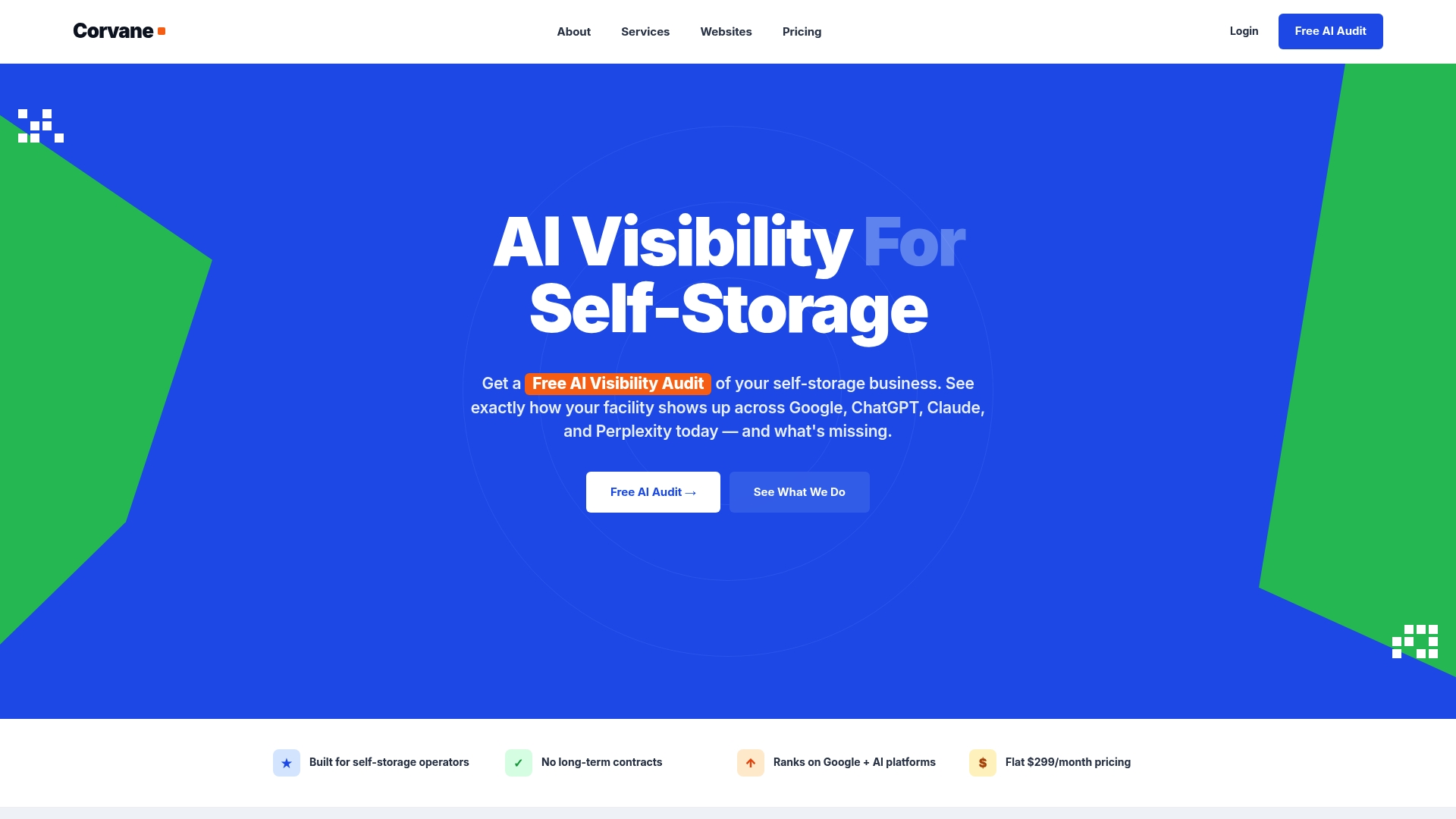
Corvanesystems is built specifically for self-storage operators who need to win in local search and AI-generated results. When a potential tenant asks ChatGPT or Perplexity for storage options near them, Corvanesystems structures your facility's digital presence so it surfaces in that answer. The service includes technical SEO, Google Business Profile optimization, AI visibility audits across ChatGPT, Claude, and Perplexity, and 30 keyword-optimized articles published monthly. One flat monthly rate, no contracts. See how it works and get your facility in front of the tenants already searching for you.
FAQ
What is a storage facility location factors checklist?
A storage facility location factors checklist is a structured scoring tool that evaluates prospective sites across trade-area demand metrics and physical site attributes. Operators use it to compare locations objectively and identify which sites will support fast lease-up and stable long-term occupancy.
What square footage per capita signals an underserved storage market?
Markets below 7 square feet of storage per capita are considered underserved and represent the strongest development opportunity. Markets above 10 square feet per capita carry saturation risk and require a detailed competitive analysis before proceeding.
How far does a self-storage primary trade area extend?
The primary trade area spans 3–5 miles in urban and suburban markets and extends to 8–10 miles in rural markets. This radius defines the population pool from which a facility draws the majority of its tenants.
Why does drive aisle width matter in site evaluation?
Drive aisles require a minimum of 26 feet to safely accommodate moving trucks. Sites that cannot meet this standard force operators to choose between unsafe traffic conditions and losing rentable square footage to wider aisles.
Can a low-visibility storage site still succeed?
A low-visibility site can reach stabilized occupancy, but it requires a higher and sustained digital marketing budget to compensate for the lack of drive-by exposure. That ongoing spend permanently compresses margins compared to a visible competitor spending less to attract the same tenant.