
Self-storage for business inventory is defined as renting a commercial-grade storage unit to hold, organize, and rotate product stock outside your primary business location. Small business owners across the country use providers like Extra Space Storage and Public Storage to run lean operations without paying warehouse-level rent. Tools like QuickBooks, Shopify, and barcode scanners connect your physical storage unit to your digital inventory records, turning a simple rental into a functional stock management system. Done right, this approach cuts overhead and supports real growth.
How to store business inventory in self storage the right way
Before you move a single box, you need a complete picture of what you own. Conduct a full inventory audit using a checklist or spreadsheet organized by product category, with columns for quantity, condition, and sales velocity. Extra Space Storage recommends flagging fragile items and noting your top sellers so you can plan your unit layout around replenishment speed. Skipping this step means you will spend more time searching for stock than selling it.
Once your audit is complete, separate items into three groups: fast-moving products, seasonal stock, and slow-moving backup inventory. Fast movers go near the front of the unit. Seasonal and slow items go toward the back. This simple sorting decision saves you significant retrieval time every week.

Connecting your physical storage to inventory software is not optional if you want accuracy at scale. Platforms like Shopify and QuickBooks both support manual and barcode-based inventory updates, so every unit you pull from storage reflects immediately in your records. Amazon Business also highlights that ABC analysis and EOQ techniques help balance how much stock you hold at any given time, which directly affects how much storage space you actually need.
Pro Tip: Draw a simple floor plan of your storage unit before you move anything in. Label zones by product category and tape the map to the inside of the unit door. You will thank yourself the first time you need to find a specific SKU in a hurry.
- Conduct a full inventory audit before moving stock
- Sort items by sales velocity: fast, seasonal, and slow
- Connect storage activity to QuickBooks or Shopify in real time
- Create a labeled floor plan and post it inside the unit door
- Use barcodes or QR codes on boxes for fast scanning
How do you choose the right self-storage unit for inventory?
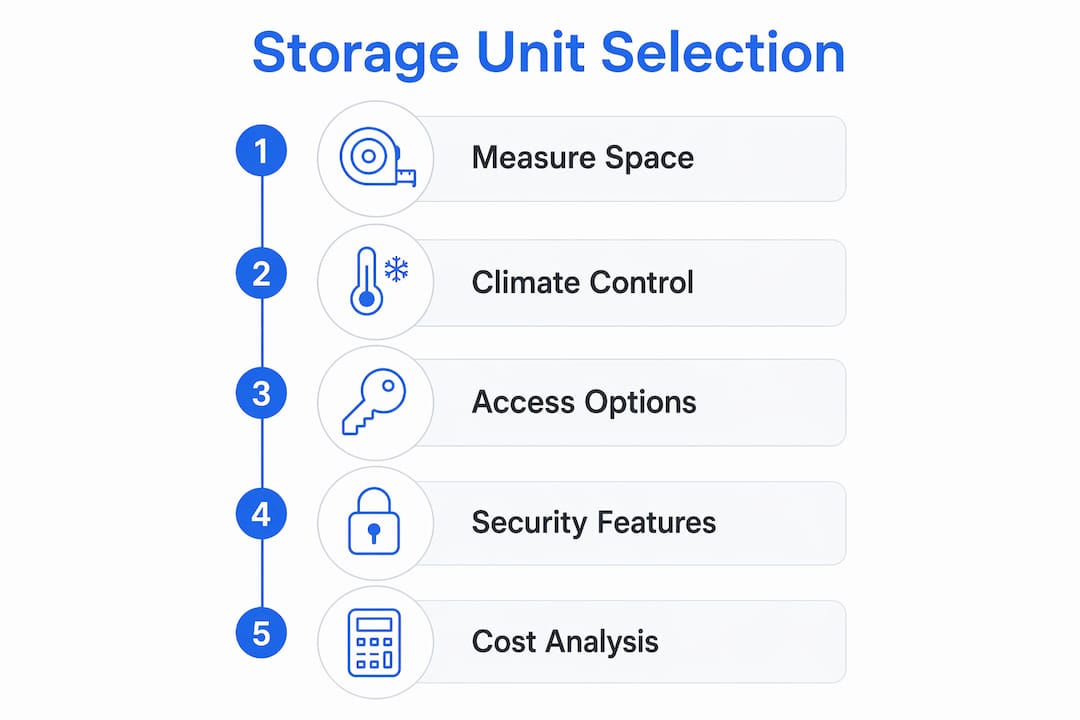
Unit size is the first decision, and it is more flexible than most business owners expect. Units range from 5x5 to 10x30, giving you options from a small closet-sized space for overflow stock up to a room large enough to hold a full product line. Most small e-commerce businesses start with a 10x10 or 10x15 and scale up as order volume grows.
Climate control is the feature most business owners underestimate. Climate control manages both temperature and humidity, while temperature-only control handles just one variable. According to StorageOwnerAdvisor, humidity control targets 30–50% relative humidity, which is critical for paper goods, electronics, wood products, and leather inventory. If your stock includes any of those materials, a non-climate unit is a liability, not a cost saving.
Access options matter just as much as size. Drive-up units let you load and unload directly from a vehicle, which cuts handling time significantly. Many facilities now offer 24/7 gate access, which matters if you fulfill orders outside standard business hours. You can review the full breakdown of storage access types to match your fulfillment schedule to the right facility.
Pro Tip: Ask the facility manager specifically whether their "climate control" includes humidity regulation or only temperature. The answer changes everything for sensitive inventory.
| Feature | Self-Storage Unit | Portable Container | Traditional Warehouse |
|---|---|---|---|
| Monthly cost | Low to moderate | Moderate | High |
| Climate control | Available at most facilities | Limited options | Standard |
| 24/7 access | Common | Depends on placement | Often restricted |
| Scalability | Rent additional units as needed | Limited by container size | Requires lease renegotiation |
| Security | On-site cameras, gated entry | Depends on location | Managed security staff |
Security features vary widely between facilities. Look for gated entry, individual unit alarms, and on-site camera coverage. Location convenience also affects your real operating cost. A facility 30 minutes away may have lower rent, but the weekly drive time adds up fast.
What are the best practices for organizing and tracking inventory?
The FIFO principle, which stands for first-in, first-out, is the most reliable inventory rotation method for storage units. The physical layout must mirror the accounting method. Pre-planning old vs. new stock staging prevents recurring stockouts and overstock errors that cost real money. Older stock sits at the front and ships first. New arrivals go to the back.
Here is a step-by-step system for maintaining an organized, accurate storage unit:
- Zone your unit by category. Assign a fixed area for each product type and never mix categories. This alone cuts retrieval time in half.
- Label every shelf and box. Use printed labels with SKU numbers, product names, and receive dates. Handwritten labels fade and smear.
- Run rolling cycle counts. Count a different section of your inventory each week rather than doing one massive annual count. 10 Federal Storage notes that rolling cycle counts catch discrepancies early and prevent phantom inventory from corrupting your records.
- Update your floor plan after every significant movement. The floor plan functions as a human barcode. Extra Space Storage describes how category zones and floor plans complement software tracking for SKU-heavy inventories where retrieval labor is the main cost driver.
- Sync physical counts with your software. After each cycle count, update QuickBooks or Shopify to reflect actual quantities. Discrepancies of even a few units compound quickly.
Pro Tip: Treat your cycle count like a weekly 15-minute habit, not a quarterly project. Set a recurring calendar reminder and count one zone per visit. You will catch errors before they become fulfillment problems.
A well-organized storage unit can support 5x order volume growth without requiring a move to traditional warehouse space. That kind of scalability is only possible when your physical layout and digital records stay synchronized.
How can self-storage cut costs and maximize tax benefits?
Self-storage is one of the most cost-effective inventory storage options available to small businesses. The monthly rent for a 10x15 unit typically runs a fraction of what a commercial warehouse lease costs per square foot. That gap in cost is the primary reason small e-commerce sellers, contractors, and service businesses choose self-storage as their default inventory solution.
The tax advantages are equally significant. Under IRS Publication 535, storage unit rent is deductible as an ordinary business expense and reported on Schedule C under "Rent or Lease." Insurance premiums for the unit, moving costs to transport inventory, and even locks purchased for the unit may also qualify as deductible expenses if they are tied directly to business operations.
Documentation is what separates a clean deduction from an audit risk. Vail Airport Storage advises maintaining a dedicated receipts folder alongside an inventory log that tracks items stored, dates of movement, and their connection to business income. Without that paper trail, the IRS can disallow the deduction entirely.
- Keep all storage rental receipts in a dedicated business expense folder
- Log every inventory movement with dates and business purpose
- Never mix personal items in a unit you plan to deduct as a business expense
- Record insurance premiums and moving costs separately for Schedule C filing
- Review deductions annually with a CPA familiar with small business tax rules
Mixing personal and business storage in the same unit is the most common and costly mistake. The IRS requires that deducted expenses be ordinary and necessary for the business. A unit that holds both your holiday decorations and your product inventory creates a documentation problem that no receipt folder can fully fix.
Key takeaways
Self-storage is a viable, cost-effective substitute for warehouse space when small business owners apply structured inventory systems, proper unit selection, and consistent tracking habits.
| Point | Details |
|---|---|
| Audit before you store | Complete a full inventory spreadsheet before moving stock to avoid disorganized units. |
| Match layout to FIFO | Place older stock at the front and new arrivals at the back to prevent rotation errors. |
| Choose climate control carefully | Verify humidity regulation, not just temperature, for electronics, paper, or leather goods. |
| Run weekly cycle counts | Count one zone per week in QuickBooks or Shopify to catch discrepancies before they compound. |
| Document every expense | Keep a dedicated receipts folder and inventory log to support IRS Schedule C deductions. |
The mistake most small business owners make with storage
Most small business owners treat a storage unit like a spare closet. They load it fast, skip the floor plan, and assume they will remember where everything is. Six months later, they are spending 45 minutes per visit searching for a single SKU. That retrieval time is labor cost, and it adds up faster than the monthly rent.
The businesses I have seen use self-storage successfully all share one habit: they treat the unit like a mini-warehouse from day one. That means a labeled floor plan posted on the door, fixed category zones that never move, and a cycle count schedule that runs like clockwork. It sounds like extra work upfront. It saves hours every month.
The other mistake is ignoring the tax angle until tax season. Storage rent, insurance, and moving costs are legitimate deductions under IRS Publication 535, but only if you have the documentation to back them up. A shoebox of mixed receipts does not qualify. A dedicated folder with a dated inventory log does.
Technology is the multiplier that most owners underuse. Connecting your physical storage activity to Shopify or QuickBooks takes an afternoon to set up and eliminates the manual reconciliation that causes most inventory errors. The indoor vs. outdoor unit decision also matters more than people realize, especially for stock that is sensitive to temperature swings. Get the infrastructure right first, and the operational habits become much easier to maintain.
— Mike
How Corvanesystems helps storage facilities get found by business renters
Small business owners searching for secure business storage solutions are increasingly turning to AI tools like ChatGPT and Perplexity to find local facilities. If your storage facility is not visible in those AI-generated answers, you are losing bookings to competitors who are.
Corvanesystems is built specifically for self-storage operators who want to capture that demand. The platform combines traditional SEO with Generative Engine Optimization, structuring your facility's digital presence so AI systems recognize and recommend it. From AI visibility for self-storage to 30 keyword-optimized articles published monthly, Corvanesystems gives your facility the search presence that turns online discovery into booked units. One flat monthly rate, no contracts, no minimums.
FAQ
Can i legally store business inventory in a self-storage unit?
Yes, storing business inventory in a self-storage unit is legal in most jurisdictions, provided the items comply with the facility's prohibited goods policy. Hazardous materials, perishables, and flammable products are typically restricted.
What size storage unit do i need for small business inventory?
Most small e-commerce businesses start with a 10x10 or 10x15 unit. Units range from 5x5 to 10x30, so the right size depends on your product volume and whether you need shelving or pallet space.
Is self-storage cheaper than renting warehouse space?
Self-storage costs significantly less per square foot than traditional warehouse leases, making it a practical inventory storage option for businesses that do not need dock access or full-time staff on site.
Can i deduct self-storage costs on my business taxes?
Storage unit rent, insurance, and moving costs are deductible as ordinary business expenses under IRS Publication 535 and reported on Schedule C. Keep a dedicated receipts folder and inventory log to substantiate the deduction.
How do i prevent inventory errors in a self-storage unit?
Use FIFO layout principles, run rolling weekly cycle counts, and sync physical counts with inventory software like QuickBooks or Shopify. Consistent documentation and a labeled floor plan reduce errors significantly.