
Most storage websites lose traffic for one of four reasons: a technical indexing failure, an analytics misconfiguration that makes a real drop look worse than it is, a Google Business Profile problem cutting local visibility, or a SERP shift where AI answers are absorbing clicks before users reach your site. Before you do anything else, open Google Search Console and check Coverage errors and Manual Actions. Then pull GA4 and confirm the property tag is firing on every page. Those two checks alone will tell you whether you have a real traffic problem or a measurement one.
Quick triage checklist (15 minutes):
- GSC Coverage report: look for a spike in "Excluded" or "Crawled, not indexed" pages
- GSC Manual Actions tab: a penalty here explains sudden, site-wide drops
- GA4 Admin panel: confirm the correct property is connected and no filters were recently changed
- Google Business Profile dashboard: check for suspensions, ownership conflicts, or unresolved flags
- Site speed: run one key page through PageSpeed Insights — 53% of mobile users abandon a site that takes more than 3 seconds to load, and a 1-second delay can cut conversions by roughly 7%
Key Takeaways
Storage websites most often lose traffic because of technical indexing failures, analytics misconfiguration, Google Business Profile problems, or AI-driven SERP changes absorbing clicks before users reach the site.
| Point | Details |
|---|---|
| Check GSC and GA4 first | Confirm the drop is real by comparing GSC clicks against GA4 sessions before making any site changes. |
| Speed kills conversions | 53% of mobile users abandon a site that loads in over 3 seconds; fix Core Web Vitals in the first 30 days. |
| GBP suspensions are silent | A suspended Google Business Profile can remove your local pack presence entirely — check the dashboard weekly. |
| AI answers reduce clicks | Forbes reports a 15–64% click decline from AI Overviews; restructure informational pages with local signals and schema to stay visible. |
| Corvanesystems covers all layers | Corvanesystems combines technical SEO, local GBP management, and GEO content in a flat-rate service built for storage operators. |
Table of Contents
- Why do storage sites lose traffic? Start with these diagnostic tests
- Technical SEO problems that quietly drain your rankings
- Content problems that shrink your organic footprint
- How Google Business Profile problems cut local visibility
- Is your traffic drop real, or is GA4 lying to you?
- Market and competitive forces unique to self-storage
- Why impressions stay flat while your clicks keep falling
- Your 30/60/90-day recovery roadmap
- What Corvane Systems consistently sees with storage clients
- Corvanesystems fixes what's actually causing your traffic loss
- Sources
Why do storage sites lose traffic? Start with these diagnostic tests
The first question is whether the drop is real or an artifact. A sudden fall in GA4 sessions that does not show up as a matching decline in GSC clicks almost always points to a tracking problem, not a search problem.
| Tool | What to check | Signal it gives |
|---|---|---|
| Google Search Console | Coverage report, Manual Actions, Performance | Indexing errors, penalties, impression vs. click gaps |
| GA4 | Property settings, filters, tag firing | Misconfiguration, filter changes, attribution shifts |
| PageSpeed Insights | Core Web Vitals scores | Speed and mobile rendering failures |
| Screaming Frog | Full site crawl | Broken links, redirect chains, noindex tags |
| Server logs | 5xx error spikes, crawler activity | Hosting failures, bot floods, crawl blocks |
| Tag Assistant | Tag firing on all pages | GA4 or conversion tag gaps |
If impressions in GSC are holding steady but clicks are falling, the problem is almost certainly a SERP feature or AI answer absorbing the query. If both impressions and clicks dropped together, the site has an indexing or penalty issue. Isolated page-level drops usually trace to content or redirect problems.
Technical SEO problems that quietly drain your rankings
Indexing failures are the most common technical cause of traffic loss on storage sites. An accidental noindex tag pushed during a redesign, a robots.txt rule blocking Googlebot from key service pages, or a canonical tag pointing to a non-preferred URL can remove pages from the index within days of a site update.
The most common technical culprits:
- Accidental
noindexon facility pages or city landing pages after a CMS update - robots.txt blocking
/units/,/reserve/, or other high-value paths - Missing or broken 301 redirects after a URL restructure or domain migration
- Redirect chains (A → B → C) that dilute link equity and slow crawl
- Outdated XML sitemap still referencing old URLs
- Heavy page builders or unoptimized image stacks failing Core Web Vitals
Outdated storage sites lacking schema, mobile-first design, and fast load times consistently lose both search visibility and conversions. Google's mobile-first indexing means a slow mobile experience is not just a UX problem — it directly affects how the page ranks.
Priority remediation order: fix any noindex or robots.txt block first (same-day impact), then audit redirects with Screaming Frog, then address Core Web Vitals using Lighthouse. Speed fixes typically take 1–2 weeks to reflect in rankings.
Pro Tip: Pull your raw server logs and filter for Googlebot requests returning 5xx errors. A hosting outage or misconfigured server that lasted even 48 hours can cause a crawl gap that takes weeks to recover from — and GA4 will not show you this directly.
Content problems that shrink your organic footprint
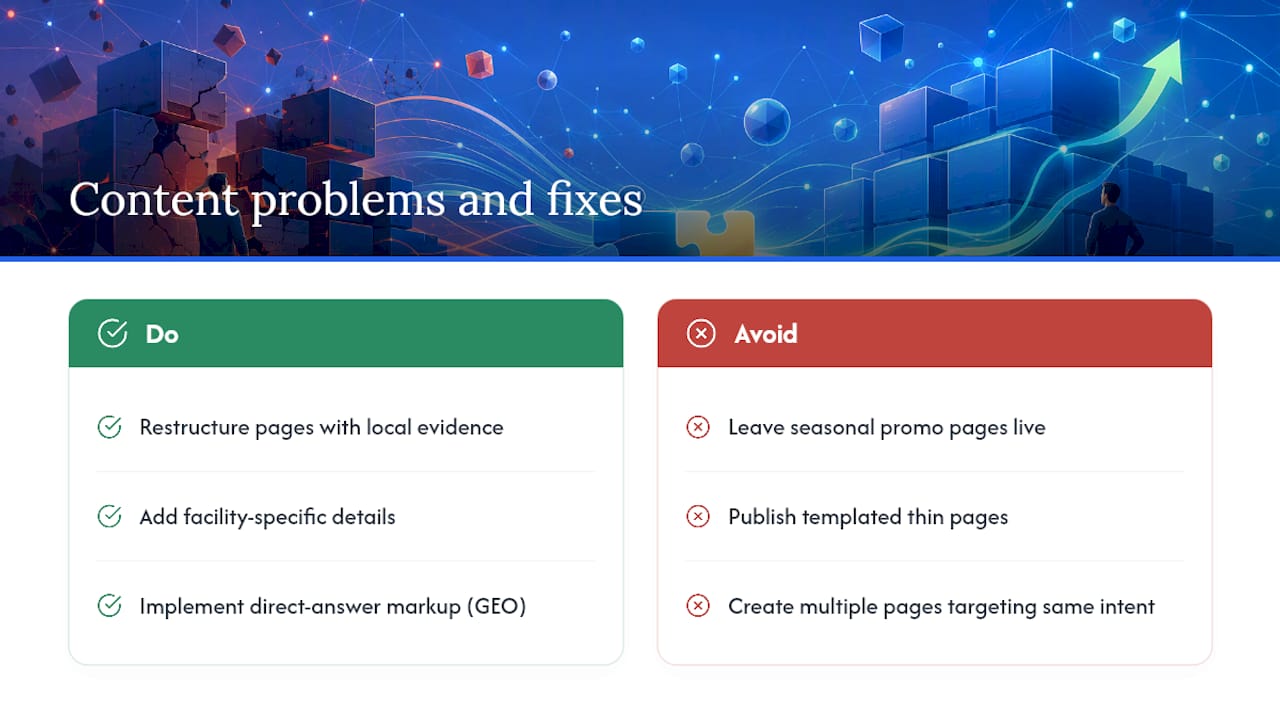
Thin pages are a chronic issue on storage sites built with templated CMS platforms. When every unit-size page shares the same boilerplate copy with only the dimensions swapped, Google treats them as near-duplicate content and devalues the set. The same happens with seasonal promotional pages left live after the offer expires.
Keyword cannibalization is the subtler version of this problem. If you have a "storage units in Austin" page, a "cheap storage Austin" page, and a "Austin self-storage" page all targeting the same local intent, they compete against each other. Google picks one to rank and suppresses the others, often choosing the weakest.
The bigger shift right now is what happens to informational content. Pages like "how to pack a storage unit" or "what size storage unit do I need" used to drive discovery traffic. AI Overviews and generative answers now consume that content directly, satisfying the query without a click. The fix is not to delete those pages — it is to restructure them with local evidence, facility-specific details, and direct-answer markup so AI systems attribute the answer to your facility and pass the user along. This is the core of GEO (Generative Engine Optimization). For a deeper look at making your content AI-visible for storage searches, the approach is more structural than most operators expect.
How Google Business Profile problems cut local visibility
A suspended or unverified GBP listing can drop a facility out of the local pack entirely, which for most storage operators means losing the highest-converting traffic channel on the page. Suspensions often happen silently after a competitor flags the listing, after a bulk edit, or after Google detects a NAP (name, address, phone) mismatch between the profile and the website.
Fast local audit steps:
- Log into the GBP dashboard and check for any yellow or red status flags
- Search your facility name and address in Google Maps — confirm the listing appears and the details match your website exactly
- Check citation consistency on Yelp, Apple Maps, Bing Places, and major data aggregators (Foursquare, Neustar Localeze)
- Look at your review velocity: a sudden drop in new reviews or a cluster of low-rated reviews can suppress local pack rankings
Local SEO for self-storage typically starts showing traction in 3–6 months. Larger effects take 6–12 months depending on competition and content quality. That timeline makes early detection critical — a GBP suspension left unresolved for two months is two months of compounding loss.
Is your traffic drop real, or is GA4 lying to you?
GA4 misconfiguration is responsible for a surprising share of "traffic drops" that turn out to be measurement errors. The most common: someone connected the wrong GA4 property to the site, a developer added a filter that excluded organic traffic, or a tag was removed during a site update and nobody noticed for weeks.
Cross-check protocol: compare GSC clicks against GA4 organic sessions for the same date range. If GSC shows stable clicks and GA4 shows a drop, the problem is in your analytics setup, not in search. Use Google Tag Assistant to confirm the GA4 tag fires on every page, including thank-you pages and reservation confirmations. Also check whether a recent spam-traffic cleanup or bot filter removal caused an apparent drop — removing junk sessions improves lead quality even though the session count falls. For a full walkthrough of conversion tracking on storage sites, the most common gaps are on booking confirmation pages.
Market and competitive forces unique to self-storage
Not every traffic drop is a website problem. Placer.ai documents that demand has shifted from move-driven to lifestyle-driven storage, with 12.6% of U.S. households using self-storage in 2023. That shift changes searcher intent: fewer people search "storage units near me" because they are moving and more search because of renovation, remote work, or downsizing. Landing pages built around moving-season messaging miss that audience entirely.
The supply side compounds the problem. A COVID-era overbuild has left many newer facilities below 50% occupancy, and national REITs are spending heavily on paid search to protect their market share. That ad spend pushes organic results down the page and raises the cost of paid clicks for independents.
Strategic responses for independent operators:
- Shift messaging from "moving storage" to utility-driven use cases (home renovation, business inventory, seasonal gear)
- Build hyperlocal landing pages for each neighborhood or suburb you serve, not just the city
- Track competitor ad activity with tools like Google Ads Transparency Center to understand where REIT spend is heaviest
- Lean into competing with national operators on trust signals: real photos, local reviews, and response time
Why impressions stay flat while your clicks keep falling
This is the AI search problem, and it is accelerating. Forbes reports that AI Overviews and generative answers can reduce organic clicks by 15–64% depending on search type, with roughly 60% of certain queries now producing no clicks at all. For storage operators, this hits informational queries hardest — "what size storage unit do I need," "how much does storage cost," "storage tips for small apartments."
The response is structural. Pages that want to survive in an AI-heavy SERP need:
- Direct-answer formatting in the first 100 words (question, then answer, then supporting detail)
- Local entity signals woven into the copy (city name, neighborhood, nearby landmarks)
- Schema markup for LocalBusiness, FAQPage, and where applicable, Product
- Named facility details that AI systems can attribute (address, hours, specific unit types)
Check whether your storage business is visible to AI platforms before assuming the problem is purely a ranking one. Many operators rank fine on traditional search but are invisible inside ChatGPT, Perplexity, and Google's AI Overviews.
Your 30/60/90-day recovery roadmap
| Phase | Priority actions | KPIs to watch | Typical cost range |
|---|---|---|---|
| Days 1–30 | Fix indexing errors (noindex, robots.txt, redirects); validate GA4 tags; resolve GBP suspensions; run PageSpeed audit | GSC coverage errors, GA4 session accuracy, GBP status | DIY: —; Agency audit: — |
| Days 31 to 60 | Rebuild thin/duplicate local pages; fix keyword cannibalization; improve Core Web Vitals; clean up citations | Organic sessions, local pack appearances, page speed scores | DIY: —; Agency remediation: — |
| Days 61 to 90 | Launch GEO-optimized content; add schema markup; build local citations and backlinks; monitor AI visibility | Clicks from AI-driven SERPs, online reservation rate, occupancy lift | DIY: ongoing; Agency retainer: — |
Local SEO traction typically starts in 3–6 months, so the 30-day phase is about stopping the bleeding, not seeing results. Escalate to an agency when the technical issues are beyond your CMS access, when GBP appeals are being rejected, or when you have run the diagnostic checks and still cannot identify the cause.
Pro Tip: Set up a weekly GSC performance snapshot exported to a Google Sheet. Tracking impressions, clicks, and average position week-over-week gives you an early-warning signal before a drop becomes a crisis.
What Corvane Systems consistently sees with storage clients
The most common pattern: a storage operator notices a traffic drop, assumes it is a Google algorithm update, and spends weeks on content changes that do not move the needle. The actual cause, in the majority of cases, is one of three things: a GA4 tag that stopped firing after a site update, a redirect that was never set up after a URL change, or a GBP listing that was quietly suspended months earlier.
The second pattern is more strategic. Operators in oversupplied Sunbelt markets are seeing genuine demand softness, not just a search problem. In those cases, the digital fix is necessary but not sufficient. Pricing strategy, unit-mix messaging, and local differentiation all need to move together. The local SEO tactics that work in a high-barrier Northeast market do not translate directly to a Phoenix suburb with 12 competing facilities within 3 miles.
The operators who recover fastest are the ones who triage methodically: confirm the drop is real, identify whether it is technical, local, or market-driven, and fix in priority order rather than doing everything at once.
Corvanesystems fixes what's actually causing your traffic loss
Most storage operators who come to Corvanesystems have already tried the obvious fixes. What they have not done is connect the technical, local, and AI visibility layers into a single coherent strategy.
Corvanesystems is built specifically for self-storage operators. The flat-rate monthly service covers technical and on-page SEO audits, GA4 and GSC cleanup, Google Business Profile management, and 30 AI-optimized articles per month structured so generative engines recognize and recommend your facility. There are no tiers, no long-term contracts, and no minimums — just a predictable monthly cost tied directly to search and AI visibility outcomes. For operators who need a stronger foundation, Corvanesystems also builds custom, conversion-focused storage websites with schema and local SEO built in from day one, following storage website development best practices.
If you are not sure whether your problem is technical, local, or market-driven, start with a diagnostic. Request an audit from Corvanesystems and get a clear picture of what is actually costing you traffic before spending another month guessing.