
Independent self-storage operators can compete with Public Storage by building premium, localized, service-driven facilities that large REITs structurally cannot replicate. Public Storage now controls roughly 14% of the U.S. self-storage supply following its 2026 acquisition of National Storage Affiliates, operating more than 4,500 facilities and nearly 330 million square feet. That scale creates real advantages in pricing power and national advertising. The good news is that scale also creates blind spots. Independents who understand where REITs fall short can build loyal tenant bases, command premium rents, and grow occupancy without ever entering a price war they cannot win.
How to compete with Public Storage without cutting prices
Price competition with a REIT is a structural trap. Large REITs sustain prolonged discounting using dynamic pricing models that independents cannot economically match. A REIT can absorb months of below-cost street rates across thousands of units while waiting for a smaller competitor to blink. An independent operator with 200 to 400 units cannot absorb that same pressure without damaging long-term revenue.
The math is straightforward. When a large REIT drops rates by $30 per unit across a market, it generates marketing data and fills vacancies at scale. When an independent matches that cut, it simply loses margin with no offsetting benefit. Price slashing is the primary threat to independents in cooling markets precisely because REITs can sustain discounting far longer.
The alternative is to stop treating price as the primary competitive variable. Boutique operators who focus on service, specialty storage, and community presence command significantly higher rents. Independent operators achieve premium pricing of $220–$480 per month for boutique services, compared to the $180–$380 monthly rates typical of chain operators. That spread represents real revenue that compounds over a full tenant lifecycle.
Pro Tip: If a large competitor drops rates in your market, resist the reflex to match them immediately. Instead, audit your current tenants' satisfaction and double down on service quality. Tenants who feel valued rarely leave for a $20 monthly discount.
- Never match a REIT's promotional rate dollar for dollar
- Audit your unit mix and identify which sizes carry the most pricing power
- Position your lowest-priced units as entry points, not your brand identity
- Communicate value clearly in every tenant touchpoint, from signage to email
What service specializations actually win tenants away from chain operators?
The most durable competitive advantage for an independent is a specialty that a large REIT cannot profitably offer at scale. Specialty climate-controlled storage for wine, art, and antiques commands monthly premiums of $480 to $980 per unit. Those tenants are also far stickier than standard renters because moving specialty items carries real risk and cost.
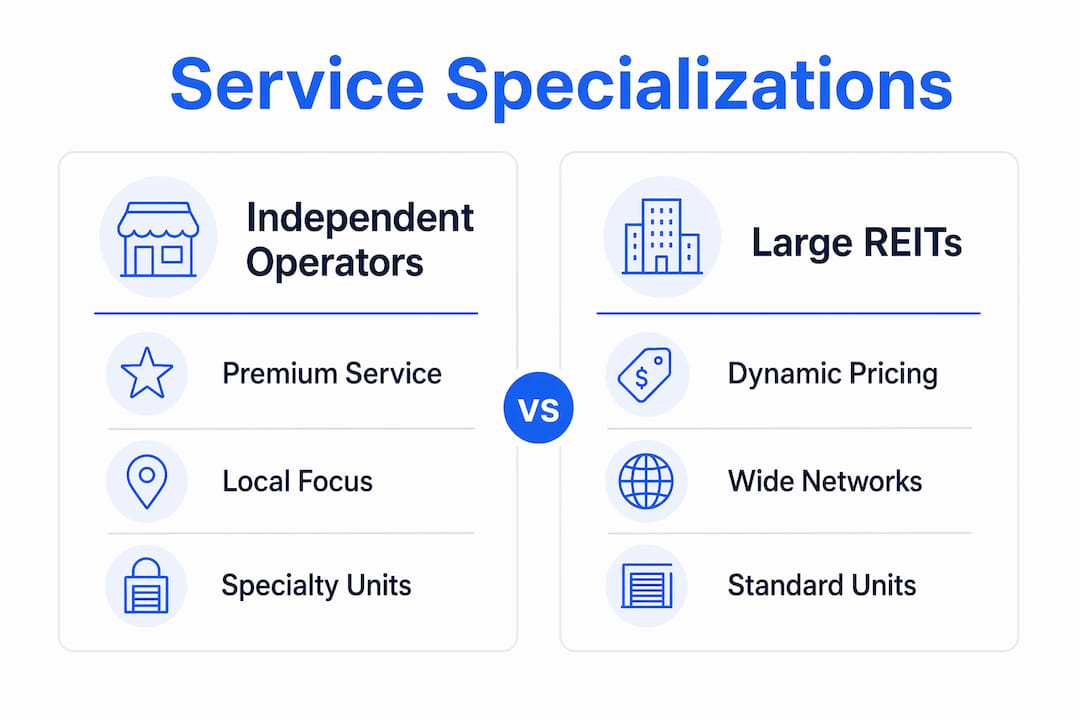
Wine storage is a particularly strong entry point. A dedicated wine vault with precise humidity control, vibration dampening, and 24-hour access attracts collectors, restaurant owners, and caterers who need reliable long-term storage. These tenants rarely price-shop because the cost of a damaged collection far exceeds any monthly savings. Art and antique storage follows the same logic, drawing interior designers, estate managers, and galleries who prioritize trust over price.
Commercial account programs are another high-value niche. Small businesses need storage for inventory, equipment, and documents. They rent larger units, pay consistently, and often expand their footprint over time. Offering dedicated loading dock access, extended hours, and a named account manager creates a service tier that generic chain operators simply do not provide.
- Climate-controlled units for wine, art, and antiques ($480–$980/month premium tier)
- Commercial accounts for small businesses with dedicated access and account management
- Valet storage and concierge pickup for urban or high-income markets
- Package receiving and forwarding for e-commerce sellers
- Secure document storage with shredding partnerships for professional offices
Pro Tip: Create an Instagram account focused on organization content. Before-and-after unit photos, packing tips, and storage hacks build an audience of local renters who already trust your brand before they ever need a unit.
Hyper-local marketing that emphasizes community involvement, superior cleanliness, and responsive management helps independents neutralize the national advertising advantage REITs hold. Sponsor a local youth sports team, partner with a moving company, or host a community shredding event. These touchpoints build brand recognition in your trade area at a fraction of what a national campaign costs.
How does local SEO help independent storage operators outrank large REITs?
Local SEO and frequent Google Business Profile updates are the most direct way to outperform national REITs in local search results and AI-powered search tools. A REIT's national profile cannot match a well-maintained local listing with fresh photos, weekly posts, and 50 recent five-star reviews from actual tenants in your zip code.

Your website is your most important digital asset. Independent operators' websites that provide faster, simpler rental processes than REIT sites convert more leads into tenants. Large corporate platforms often route renters through multiple screens, upsell prompts, and account creation walls. A clean, mobile-first site with a three-step online rental flow beats that experience every time.
Here is a practical digital presence checklist for independent operators:
- Claim and fully complete your Google Business Profile with photos, hours, and a direct booking link
- Publish at least two Google Business Profile posts per week featuring promotions, tips, or facility updates
- Build city-specific landing pages targeting "storage in [neighborhood]" and "storage near [landmark]" phrases
- Run hyper-local Google Ads campaigns targeting a 5-mile radius with messaging that highlights your specific advantages
- Add an AI chatbot to your website to answer common questions and capture leads outside business hours
- Collect reviews systematically by texting tenants a direct review link within 48 hours of move-in
Pro Tip: Ask your best tenants to mention specific unit types or neighborhoods in their reviews. "Great climate-controlled wine storage in Midtown" is far more valuable for local search than a generic five-star rating.
| Digital tactic | Primary benefit | Difficulty |
|---|---|---|
| Google Business Profile optimization | Appears in "storage near me" results | Low |
| City-specific landing pages | Captures neighborhood search traffic | Medium |
| Hyper-local PPC campaigns | Drives immediate rental inquiries | Medium |
| AI chatbot on website | Converts after-hours leads | Low |
| Review generation program | Builds trust and local search ranking | Low |
For operators who need a stronger digital foundation, Corvanesystems builds custom storage websites designed specifically to convert local renters.
How should you monitor competitor pricing and respond to REIT moves?
The competitive trade area for most storage facilities spans a 3–5 mile radius. Within that radius, you need to track unit sizes, climate control availability, facility age, and street rates for every meaningful competitor. Doing this manually with a spreadsheet is not sustainable.
Independent operators should use lean, flat-rate technology solutions instead of complex enterprise systems for competitive pricing updates and tenant analytics. Tools like Store Track and Radius+ pull competitor street rates automatically and alert you to pricing changes in real time. That intelligence lets you respond to a REIT rate drop with a targeted promotion rather than a blanket price cut.
Grouping local competitors into tiers produces more accurate pricing decisions than treating all nearby facilities equally. A primary competitor is a facility within 2 miles with similar unit mix and digital presence. A secondary competitor is farther out or less visible online. A tertiary competitor is a facility that rarely shows up in local search results. Your pricing and promotional response should scale with that tier structure.
- Track primary competitors weekly for rate changes and new promotions
- Review secondary competitors monthly for unit mix and occupancy signals
- Monitor tertiary competitors quarterly or when they announce expansions
- Adjust promotional pricing at the unit-type level, not across your entire facility
- Never drop your standard rate. Use move-in specials and first-month discounts instead
When a REIT opens a new facility in your trade area, resist the urge to panic-discount. Instead, audit your current tenant satisfaction, refresh your Google Business Profile, and launch a referral program. Tenants who already trust you are your best defense against a new competitor.
Key Takeaways
Independent operators who focus on premium services and local visibility consistently outperform those who compete on price against large REITs.
| Point | Details |
|---|---|
| Avoid price wars | REITs can sustain discounting far longer than independent operators can afford. |
| Specialize in premium niches | Specialty storage for wine, art, and commercial accounts commands $480–$980 per month. |
| Dominate local search | Frequent Google Business Profile updates and local landing pages outrank national REIT listings. |
| Use tiered competitor tracking | Group competitors into primary, secondary, and tertiary tiers to set accurate rates. |
| Invest in a fast website | A simple, mobile-first rental process converts more leads than complex corporate platforms. |
Why I think most independents are playing the wrong game entirely
After working with storage operators across dozens of markets, the pattern I see most often is this: an independent operator watches a REIT open nearby, panics, drops rates, and then spends the next 18 months wondering why revenue is flat. The rate cut did not win new tenants. It just trained existing tenants to expect lower prices.
The operators who actually grow occupancy after a REIT enters their market do the opposite. They raise their service standards, sharpen their local marketing, and lean into the things a 4,500-facility corporation simply cannot do. They know their tenants by name. They call when a payment is late instead of sending an automated notice. They stock moving supplies at the front desk and recommend local movers. These are not expensive tactics. They are just things that require a human being who cares.
The self-storage rental market is consolidating fast, and that trend will continue. But consolidation does not eliminate the independent. It actually creates a clearer lane for operators who are willing to be genuinely different. The boutique hotel did not disappear when Marriott expanded. It found its audience and served them exceptionally well. That is exactly the opportunity in front of independent storage operators right now.
The operators I worry about are the ones who see their only job as filling units at any price. The ones I am optimistic about are the ones asking how to build a brand their community actually trusts. That question leads somewhere worth going.
— Mike
How Corvanesystems helps independent storage operators get found
Independent operators who build great facilities still lose tenants if those facilities do not appear in local search results or AI-generated recommendations. That is the gap Corvanesystems closes.
Corvanesystems combines traditional local SEO with Generative Engine Optimization, structuring your facility's digital presence so it surfaces when renters search "storage near me" on Google or ask an AI assistant for recommendations. The service includes Google Business Profile management, city-targeted content, and monthly AI visibility audits across ChatGPT, Claude, Perplexity, and Google AI Overviews. For operators ready to turn online discovery into booked units, Corvanesystems delivers a flat-rate, purpose-built solution with no contracts and no tiers. You can also explore self-storage revenue strategies to pair visibility with a stronger pricing foundation.
FAQ
How can an independent storage facility compete with Public Storage?
Independent operators compete most effectively by specializing in premium services, building strong local SEO, and delivering a tenant experience that large REITs cannot replicate at scale. Price competition with a REIT is financially unsustainable for most independents.
What is the best pricing strategy for independent storage operators?
The best approach is to position around value rather than matching REIT street rates. Boutique and specialty storage commands $220–$480 per month, well above commodity chain pricing, and attracts tenants who prioritize quality over the lowest available rate.
How far should I track competitors for my storage facility?
The standard competitive trade area spans a 3–5 mile radius. Within that zone, track unit sizes, climate control options, and street rates weekly for primary competitors and monthly for secondary ones.
Does local SEO actually help storage facilities outrank large REITs?
Local SEO consistently helps independent facilities outrank national REITs in neighborhood-level searches. Regular Google Business Profile updates, tenant reviews, and city-specific landing pages signal local relevance that a national brand profile cannot easily replicate.
What specialty storage types generate the highest revenue for independents?
Climate-controlled storage for wine, art, and antiques generates the highest premiums, with monthly rates reaching $480–$980 per unit. Commercial account programs for small businesses also produce strong, consistent revenue with lower turnover than standard residential tenants.