
To show up in Google's AI Overviews, a storage facility needs a site Google can crawl and index, plain-text facts about units, prices and access, a complete Google Business Profile, and pages that answer the questions renters actually ask. Google documents no special markup or file for AI Overviews. The work is strong, consistent SEO applied to storage, and it has to be kept up month after month. That ongoing work is what we do at Corvane Systems, for a flat $299 per month.
This guide is for owners and operators. It covers what AI Overviews are, how Google picks sources, what to change on your site and profile, and how to see whether it is working.
TL;DR
- Google says there is no extra technical requirement for AI Overviews: a page must be indexed and eligible to show in Search with a snippet.
- Ranking well still matters. Pages in higher organic positions are cited more often in AI Overviews.
- Storage pages that state unit sizes, prices, climate control and access hours in plain text give AI systems something to quote.
- A complete, current Google Business Profile and consistent business details support both the Local Pack and AI answers.
- Track visibility monthly in Search Console and by checking real renter questions, so you see movement instead of guessing.
Table of Contents
- What AI Overviews are and why storage operators should care
- How Google decides which pages to use
- Step 1: Make every facility page crawlable and indexable
- Step 2: Put the facts in plain text
- Step 3: Answer renter questions in self-contained blocks
- Step 4: Keep your Google Business Profile complete and consistent
- Step 5: Decide what you allow Google to use
- Step 6: Measure what you can, every month
- What to skip
- The case for an integrated approach
- Our perspective
- Get started with Corvane
- FAQ
- Sources
What AI Overviews are and why storage operators should care
AI Overviews are AI-generated summaries that Google places above the regular results when its systems decide a generated answer will help. Google's own help page says they give key information with links to dig deeper, and that they can make mistakes.
For a storage business, the practical meaning is this. A renter who once scrolled ten blue links now often reads a summary first. If your facility is named or linked in that summary, you are in the shortlist before anyone clicks. If it is not, you compete for what is left below it.
The queries that matter most to you are questions like "how big a unit do I need for a two-bedroom apartment" or "is climate-controlled storage worth it." Those are the questions that start a rental decision. Local searches such as "storage near me" still lean on the map pack and your profile, which is why this work covers both.
How Google decides which pages to use
Google's documentation is direct on eligibility: to be used in AI features, a page must be indexed and eligible to appear in Search with a snippet. There are no added technical requirements, and Google adds that indexing and serving are never guaranteed.
Two mechanics are worth knowing:
- Grounding in the Search index. Google's optimization guide says AI Overviews draw on the Search index and use query fan-out, which means issuing several related sub-searches. A page can be pulled in because it answers a sub-question that does not match the renter's original wording.
- Organic position still helps. Search Engine Land's guide reports a study in which a link in position one had a 53% chance of appearing in an AI Overview, against 36.9% at position ten.
Put together: the pages that get cited are the pages that already rank and that answer specific sub-questions clearly. For a storage operator, that points at your location pages, your unit-size content and your local presence.
Step 1: Make every facility page crawlable and indexable
Nothing else works if Google cannot reach and index the page. Google's guidance asks you to allow crawling in robots.txt and in any CDN or hosting layer, and to make content findable through internal links.
What that looks like on a storage site:
- Check robots.txt and your host's firewall. Security settings and CDN bot rules sometimes block Googlebot without anyone noticing.
- Give each location its own URL. A single page listing six facilities is hard to rank for any one town. Each facility needs a page that can stand on its own.
- Link to every location page from your main navigation and from related unit-size pages, so crawlers find them quickly.
- Render key facts on the server. If unit sizes and prices only appear after a script loads, some crawlers never see them. We cover this in our piece on server-rendered facts for storage sites.
- Keep page speed and mobile layout solid. Google lists good page experience among its recommendations, and most storage searches happen on phones.
General technical guidance for crawl access, internal links and page experience is also laid out in AI visibility and SEO services material. In our service, full site audits, metadata work, indexing and ongoing health monitoring are part of the flat rate, so these checks are repeated every month, not done once.
Step 2: Put the facts in plain text
Google recommends keeping important content in text form, supported by quality images and video. For storage, that means the details a renter would otherwise have to call you for:
- Unit sizes with dimensions, and what typically fits in each
- Current prices or starting rates
- Climate control, drive-up access, interior units, indoor loading
- Gate hours and office hours
- Insurance, deposit and move-in requirements
- Address, directions and nearby landmarks
A photo of a price sheet or a PDF rate card is invisible to a model that reads text. A table on the page is not. Trade coverage in Modern Storage Media's Clarity Is Crucial piece advises self-storage operators to use tables and lists for structured details, add "last updated" dates and break content into self-contained FAQ blocks. Those habits make a page easy to quote and easy for a renter to trust.
Here is a worked example. Compare these two descriptions of the same unit.
Vague: "Spacious, secure units for all your storage needs at great prices."
Specific: "10x10 climate-controlled interior unit, ground floor, fits the contents of a one-bedroom apartment, gate access 6 a.m. to 10 p.m. daily."

Only the second contains anything a summary could use. The first could describe any facility in the country.
If you use structured data, Google asks that it match the visible text on the page. Markup that says something the page does not is a problem, not a boost.
Step 3: Answer renter questions in self-contained blocks
Because of query fan-out, a single page can be cited for a sub-question. So write sections that each answer one question completely, with the question as an H2 or H3 and a short, factual answer beneath it.
Good storage questions to cover on location and guide pages:
- What size unit do I need for a car, a two-bedroom home, a small business inventory?
- Is climate control necessary where I live, and what does it protect?
- Can I access my unit at night or on weekends?
- What do I need to bring on move-in day?
- What can't I store?
- How does month-to-month rental work?
Write for the renter first, in short sentences. State the answer in the first line, then the detail. Use specifics that belong to your facility and town: the nearest highway, the lake or campus that drives demand, the local weather that makes humidity control matter. A sentence that could sit on any storage site anywhere gives Google no reason to choose yours.
This is also where volume helps. Each unanswered question is a sub-search where you cannot be cited. Our service publishes 30 keyword-optimized articles a month, built around structured, conversational coverage so those questions get answered across your market. Our guide on optimizing a storage facility for AI Overviews goes deeper on page formats.
Step 4: Keep your Google Business Profile complete and consistent
Google's guidance specifically says to keep Business Profile information up to date. For storage, the profile is often the first thing a renter sees and a major input to local answers.
Check these items on every location:
- Business name, address and phone number exactly matching your website
- Correct categories, with self-storage facility as primary
- Hours, including gate access hours if they differ from office hours
- Services and attributes such as climate control and drive-up access
- Fresh, real photos of the entrance, hallways, unit interiors and signage
- A steady flow of reviews, with replies to each
Inconsistency is the quiet problem. If your website says one phone number, your profile another and a directory a third, a system trying to identify your business has to guess. Matching details everywhere makes your facility easy to recognize as a single, real place. Our local search work covers profile optimization, city-based keyword targeting and competitor tracking so your service area stays covered.
Step 5: Decide what you allow Google to use
Google now has a Search generative AI control in Search Console that lets a site owner include the site in AI Overviews and AI Mode, which is the default, exclude it, or inherit the setting from a parent property. Sites that are excluded get no traffic or impressions from those features.
For an operator who wants renters to find the facility, the answer is to keep the setting on include. Confirm it in Search Console for each property, especially if a web developer or previous agency changed settings during a redesign.
Step 6: Measure what you can, every month
AI visibility is harder to measure than rankings, so build a simple routine and stick to it.
Search Console. Google says sites that appear in AI features are counted in the overall Web search type in the Performance report. It also reports that clicks from results pages with AI Overviews tend to be higher quality, with visitors more likely to spend time on the site.
Know the counting quirks. Search Engine Land's measurement guide notes that an AI Overview impression is counted only when the citation is shown, all citation links share one position, and Search Console does not separate these impressions from standard Web impressions. So treat the figures as direction, not precise attribution.
Your own question set. Make a list of 15 to 20 questions a renter would ask in your town, and run them monthly in Google, ChatGPT and Perplexity. Record whether your facility is named, linked or absent, and who appears instead. The Modern Storage Media piece recommends this same practice of typing customer questions into AI tools to see which competitors get mentioned.
Business results. Track calls, direction requests, reservation form submissions and move-ins by source. Visibility only matters if it fills units.
A simple monthly scorecard looks like this:
| Metric | Where to find it | What it tells you |
|---|---|---|
| Indexed location pages | Search Console | Whether Google can see each facility |
| Impressions and clicks, Web | Search Console Performance | Overall search visibility trend |
| Named in AI answers | Your question set | Share of renter questions where you appear |
| Profile views, calls, directions | Business Profile | Local demand |
| Move-ins by source | Management software | Real occupancy impact |
Our AI visibility audit scores how a facility appears across ChatGPT, Claude, Perplexity, Google AI and llms.txt, then lays out a roadmap. Monthly reporting covers rankings, organic traffic and search visibility in one summary.
What to skip
Google's optimization guidance says no special AI markup or file is needed for AI Overviews. Do not spend a budget cycle chasing tricks. Spend it on the fundamentals above: pages that load, say specific things and match your profile. The advantage goes to the operator who does those things on every location and keeps doing them, because rankings and citations move as competitors publish.
The case for an integrated approach
To win AI Overview citations you need technical health, local profile work, a steady stream of specific content and measurement, all aimed at the same facilities. Run by separate vendors, those pieces drift apart. Run by one team that works only with self-storage, they reinforce one another: the audit finds the gap, the content fills it, the profile matches it and the report shows whether it moved.
Our perspective
Most operators we talk to ask whether AI search needs a new playbook. Our view: it needs the old playbook done thoroughly, plus a way to see how you show up inside ChatGPT, Claude, Perplexity and Google's AI answers.
That is why we built one system for storage only. Technical SEO, local positioning, 30 articles a month and an AI visibility audit share a single goal: when someone asks where to rent a unit, your facility is understood well enough to be named.
We keep it flat and simple on purpose. One monthly rate, no tiers, no contracts, no minimums, so you can judge us on results.
Mike
Get started with Corvane
The full Corvane system is $299 per month, with a one-time onboarding fee of $50. It includes technical and on-page SEO, local search work, 30 articles every month, AI visibility audits and monthly performance tracking, with no contracts. We also build custom websites for storage operators, and we offer a free AI Visibility Audit so you can see where your facility stands today.
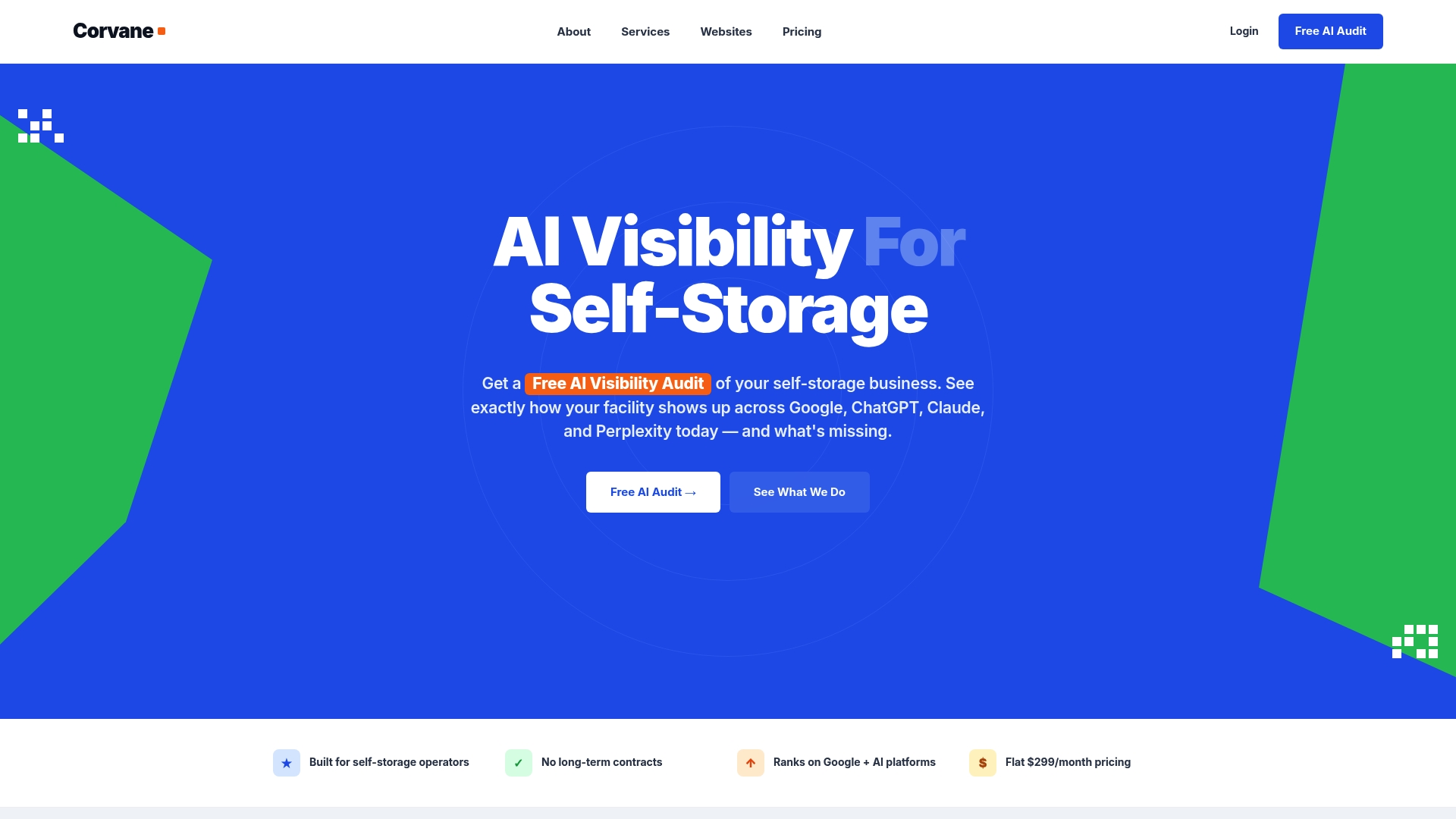
See the details on the Corvane Systems pricing section, or start with the audit through our main site.
FAQ
Do I need special markup or an llms.txt file to appear in AI Overviews?
No. Google's documentation says a page needs to be indexed and eligible to show in Search with a snippet, and it lists no extra markup requirement. Focus on crawlable pages, plain-text facts, a complete Business Profile and structured data that matches what the page shows.
Can I see exactly how often my facility appears in AI Overviews?
Not precisely. Search Console includes AI feature appearances in overall Web search data, and it does not separate them from standard impressions. Combine Search Console trends with a monthly check of real renter questions and your move-in sources.
Does ranking well in regular search still matter?
Yes. Search Engine Land reports that higher organic positions are cited more often in AI Overviews, and Google builds these answers from its Search index. Strong local and organic rankings are the base for AI visibility.
How long does it take to show up?
That depends on your market, your current site health and how quickly new pages get indexed. Google does not guarantee crawling, indexing or serving, so the dependable approach is steady monthly work, measured against a baseline you record at the start.
Sources
- Google Search Help: AI Overviews
- Google Search Central: AI features and your website
- Google Search Central: Guide to optimizing for generative AI features
- Search Console Help: Search generative AI control
- Search Engine Land: AI Overviews optimization guide
- Search Engine Land: Measuring visibility in a zero-click world
- Modern Storage Media: Clarity Is Crucial
- AI visibility and SEO services