
AI search visibility is how often, and how accurately, your facility shows up when someone asks ChatGPT, Claude, Perplexity or Google's AI features where to rent a unit. For a storage operator it comes down to three things: whether AI systems can read your site, whether they find consistent facts about you across the web, and whether you can show that any of it produces calls and rentals. This guide covers each, with the measurement method and the fixes that hold up.
TL;DR
- AI search visibility is a mix of being mentioned, being cited with a link, and being described correctly. All three can be checked by hand.
- Google says its AI features rely on the same foundational SEO practices as regular search, so strong SEO is the base layer, not something you replace.
- There is no stable "rank one" in AI answers. Track a fixed set of renter questions over time, plus AI referral visits and rentals.
- The fixes are mostly unglamorous: crawlable pages, accurate prices and availability, consistent listings, and useful local content.
- A one-time audit of what AI tools say about you today is the fastest way to find the gaps.
Table of Contents
- What AI search visibility means for a storage facility
- How AI search optimization relates to regular SEO
- What influences whether an AI tool names your facility
- How to measure AI search visibility
- What an AI visibility audit should check
- Practical steps to improve AI visibility
- Our perspective: treat AI visibility as a data-quality job
- Getting this done without a second job
- FAQ
- Sources
What AI search visibility means for a storage facility
Traditional SEO asks where your page ranks for "storage units near me." AI search visibility asks a different question: when a renter types "where can I rent a 10x10 climate-controlled unit in Tucson?" into an assistant, does your facility appear in the answer, is your site linked, and are the details right?
Those are separate outcomes. A facility can be named without a link, linked without being recommended, or described with an old price or the wrong gate hours. Each one needs its own check, which is why a good measurement plan counts mentions, citations and accuracy separately.
This matters because the answer box increasingly sits above the results. Pew Research Center analyzed 68,879 Google searches by U.S. adults and found that 18% produced an AI summary. On pages with a summary, users clicked a traditional result 8% of the time, against 15% on pages without one. They clicked a link inside the summary itself in only 1% of visits. A separate Pew survey reported that 65% of U.S. adults at least sometimes see AI summaries in search results, and 45% see them often or extremely often.
The takeaway for an operator: when a summary appears, fewer people click through to any site. Being the facility named inside the answer becomes worth more than being the fifth blue link under it.

Why storage is exposed to the shift
Storage renters search under time pressure and mostly on a phone. The Self Storage Association's demand study says online search methods now outpace drive-by discovery, and that smartphones account for 50% of consumer device use in the study. Demand for the search itself is also growing: StorageCafe's analysis of Google Ads keyword data reported an 8% rise in self-storage searches across the 150 largest U.S. cities in 2024.
Renters choose from a short list, and the decision is local and practical: size, price, distance, access hours, climate control. Those are exactly the questions an AI assistant is good at answering in one paragraph. If your facts are hard to find or inconsistent, a competitor's cleaner data gets summarized instead of yours.
How AI search optimization relates to regular SEO
Operators often ask whether they need a separate strategy. Mostly, no. Google's documentation says AI Overviews and AI Mode use the same foundational SEO practices as Google Search. A page has to be indexed and eligible to show a snippet, and there is no extra technical requirement or special optimization for eligibility.
That has a practical meaning. If your location pages are blocked, slow, duplicated or buried, no amount of "AI tuning" will rescue them. And if they are in good shape, you already have most of what Google's AI features need.
Where AI search goes beyond classic SEO is in the other assistants. Tools like ChatGPT, Claude and Perplexity pull from many sources and generate an answer. Google describes the general pattern in its explanation of retrieval-augmented generation: a system retrieves relevant information from external sources, combines it with the question, and writes a grounded answer, with links so users can verify it. So the quality and consistency of what exists about your facility, on your site and elsewhere, shapes what gets retrieved.

In short: SEO gets your pages found and indexed. AI visibility work makes sure the facts are clear, consistent and easy to quote. We cover the overlap in more detail in our guide to AI search optimization for a storage business.
What influences whether an AI tool names your facility
No one outside the AI companies knows the exact weighting, and anyone who claims a formula is guessing. The evidence points to a few consistent themes.
Your own site is not the only voice. A vendor study of 21,311 commercial-query brand mentions across ChatGPT, Claude and Perplexity attributed 85% to third-party domains and 13.2% to brand-owned domains. It is a vendor study and not specific to storage, so treat it as directional. Still, it fits what operators see: directories, local lists, review sites and community pages feed the answers.
Consistency beats volume. If your Google Business Profile says one thing, your website another, and an aggregator a third, an AI system has no clear answer to quote. Matching names, addresses, phone numbers, hours and unit pricing across every listing is cheap and pays off in both classic and AI search.
Google wants people-first content, not volume. Google's guidance on generative AI features says unique, useful, reliable, people-first content matters more than large quantities of commodity content. It also cautions against inauthentic mentions. Pages that repeat what every storage site says ("safe, secure, affordable") add nothing a model can use.
Citation behavior differs by system. Different assistants cite differently, and the same assistant can answer differently by wording, user and day. That is why a single screenshot proves nothing.
How to measure AI search visibility
Be skeptical of any tool that promises a precise "AI rank." Answers vary with each user and interaction, so a stable number-one position does not exist the way it does in a Google results page. What you can measure is a pattern, using a method that holds the conditions steady.
Build a fixed prompt set
Write 20 to 30 questions a renter would actually ask, covering different intents:
- Location: "storage units near [neighborhood]" or "self storage in [city] with drive-up access"
- Size and feature: "how big is a 10x20 storage unit" or "climate-controlled storage in [city]"
- Price: "cheapest storage unit in [city]" or "how much does a 5x10 cost in [city]"
- Situation: "where to store furniture during a move in [city]"
- Brand check: "is [your facility name] any good"
Run the same prompts on ChatGPT, Claude, Perplexity and Google, in a logged-out or consistent account state, from the same city. Keep wording identical each round.
Record the same fields every time
For each prompt and platform, log whether your facility was mentioned, whether your site or a third-party page about you was cited, where in the answer you appeared, which competitors were named, and the test date. Repeat monthly. From that sheet you can calculate:
| Metric | How to calculate | What it tells you |
|---|---|---|
| Mention rate | Prompts where you are named ÷ total prompts | Basic presence |
| Citation rate | Prompts where a page about you is linked ÷ total prompts | Whether you earn the click |
| Share of voice | Your mentions ÷ all facility mentions in the set | Standing against local competitors |
| Accuracy rate | Answers with correct price, hours, address ÷ answers mentioning you | Whether the facts hold |
| AI referrals | Visits from AI platforms in your analytics | Real traffic |
Mention and citation are different results, so keep them in separate columns. Being named without a link still builds awareness. Being linked sends a renter to your reservation flow.
Tie it to rentals
Prompt tracking shows presence. It does not show revenue. Segment AI referral traffic in your analytics, then follow those visits to reservations, move-ins and calls. The honest view is a trend line over several months: more mentions, more AI-sourced visits, more move-ins. Individual weekly swings are noise.
One caution from MIT Sloan Management Review: its interviews with 15 senior marketing and digital leaders found recurring blind spots in AI-visibility measurement, slow adaptation of SEO workflows, and an underestimate of how often AI amplifies wrong information. Measurement is only worth doing if you also act on what it reveals.
What an AI visibility audit should check
An AI visibility audit, also called an AI search audit, is a structured review of how both machines and renters see your facility. A useful one covers six areas.
- Crawlability and indexing. Can search engines reach and index every location and unit page? Google's guidance says a page must be indexed and snippet-eligible to appear in its AI features. Check robots rules, noindex tags, canonical tags and whether key facts load without relying on scripts. Our piece on server-rendered facts for self storage explains why this matters.
- Page experience. Mobile speed, readable layouts and a reservation path that works on a phone.
- Unit and price data. Are sizes, rates, promotions and availability shown as text on the page, current, and identical wherever else they appear?
- Local-business details. Name, address, phone, hours, gate versus office hours, and a Google Business Profile that matches the site.
- Non-commodity content. Does each facility page say something specific: the neighborhood, access details, what fits in each size, real photos? A storage size guide built to be cited is a good example of content a model can quote.
- What AI systems say today. Run your prompt set and read the answers. MIT Sloan Management Review describes an audit method of querying AI systems with real customer questions and tracing incorrect claims back to the source URLs so they can be fixed. Its argument is that AI visibility is both a discoverability problem and an accuracy problem, and that auditing the answers surfaces misinformation conventional analytics cannot.
Structured data deserves a note. Google says it is not required for generative AI search, though it can support rich-result eligibility. Its documentation explains that structured data gives explicit, standardized clues about a page's meaning. Treat it as part of a sound SEO base, not a magic switch, and make sure the markup matches what is visible on the page.
Practical steps to improve AI visibility
Here is the order we would work in for a single facility or a small portfolio.
1. Fix the foundation first
Make sure every facility page is indexed, loads quickly on mobile and states its core facts in plain text. Check Google Search Console for pages excluded from the index. This is the same groundwork Google says its AI features depend on, and it is where most storage sites quietly lose.
2. Publish facts, not slogans
Put current prices, unit sizes, availability, access hours, contact details, and a clear rental flow on the page. Add real photos. Write in plain English, the way a renter asks the question. A page that answers "Will my queen mattress and dresser fit in a 5x10?" gives an AI system something it can actually use. See our walkthrough on conversational content built from one facility page.
3. Make listings agree
Audit your Google Business Profile, Apple and Bing listings, directories, chamber of commerce and local lists. Names, addresses, phone numbers and hours should match your site exactly. Where you manage multiple sites, a consistent page template helps; our location page playbook lays out the elements.
4. Cover the questions renters ask
Build helpful pages around size guides, moving checklists, climate control, vehicle storage and local-specific topics. Quality matters more than count. Google's guidance on generative AI content says AI-generated material must be checked for accuracy, quality, relevance and trustworthiness before publication, including metadata, structured data and image alt text. Anyone publishing at volume needs an editor in the loop.
5. Optimize for Google's own AI features
Because Google's AI Overviews reuse standard SEO signals, local relevance, a complete Business Profile and clear page structure help here directly. Our guide on how to optimize a storage facility for AI Overviews goes deeper.
6. Correct what is wrong
When an assistant gives a wrong price or an old address, trace where it came from: an old directory entry, a cached page, a third-party article. Fix the source, not just your own site. Then retest next month.
7. Avoid shortcuts
Google specifically warns against AI-only hacks, scaled commodity content and inauthentic mentions. Fake reviews and planted directory posts do not survive, and they can damage the trust that actually earns recommendations.
Our perspective: treat AI visibility as a data-quality job
We work only with self-storage operators, and the pattern is consistent. The facilities that struggle in AI answers are rarely short on effort. They are short on clean, consistent facts. A rate on the site that differs from the listing, a unit page that renders blank without scripts, a Business Profile with the wrong hours: each is small, and together they give an AI system little reason to name you.
So we do not sell a trick. We treat AI visibility as classic SEO done thoroughly, plus structure that makes your facility easy to understand and quote, plus honest measurement. We also tell owners plainly that AI answers shift by user and day, so anyone promising a fixed AI ranking is overselling. The right goal is a rising trend in mentions, citations and move-ins, checked against the same prompts every month.
If you do one thing this week, run ten renter questions across the major assistants and read what comes back. You will learn more from that than from any report, ours included.
— Mike
Getting this done without a second job
Most owners know what needs doing and lack the hours. Corvane Systems is an SEO and AI search visibility service built only for self-storage operators. The full Corvane system is a flat $299 per month with no tiers, no contracts and no minimums, plus a one-time onboarding fee of $50. It covers technical and on-page SEO, local search work including Google Business Profile optimization and competitor tracking, 30 AI-optimized articles published monthly, AI visibility audits across ChatGPT, Claude, Perplexity and Google AI, and a monthly performance summary.
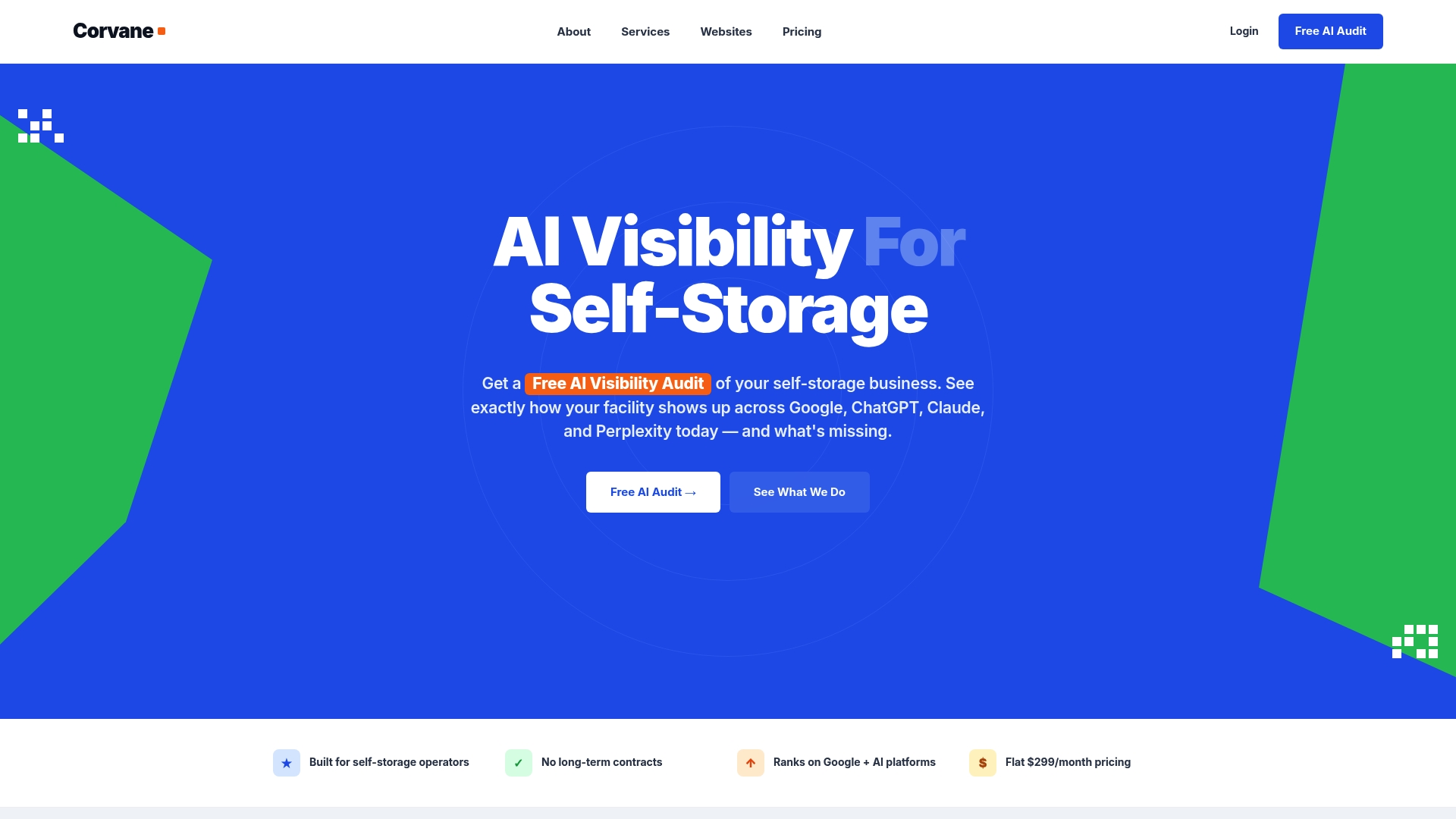
You can start with a free AI visibility audit to see how your facility appears today, and we also build custom storage websites for operators who need a stronger foundation. Details are on the Corvane Systems site. For a self-guided starting point, our operator guide to AI visibility and the checklist on whether your storage business is visible to AI walk through the basics.
FAQ
Is AI search visibility the same as SEO?
No, but they overlap heavily. Google says its AI features use the same foundational SEO practices as regular search, so indexing, quality content and clear local details come first. AI visibility adds attention to how other assistants read and quote your facts, and to accuracy across third-party sources.
Can I track my ranking in ChatGPT or Perplexity?
Not as a fixed position. Answers vary by user, wording, platform and time. Instead, run a consistent set of renter questions monthly, log mentions, citations and accuracy, and watch AI referral visits and rentals in your analytics.
What is the difference between an AI visibility audit and an SEO audit?
An SEO audit checks technical health, content and links. An AI visibility audit includes those checks, then tests what AI tools actually say about your facility with real customer questions and traces errors back to their source pages. It looks at accuracy as well as presence.
Do I need structured data to appear in AI answers?
Google says structured data is not required for generative AI search. It still helps Search understand a page and can support rich-result eligibility, so use it as part of a broader SEO effort and keep it matched to the visible content.
How long until I see results?
Expect a trend over months, not days. Technical and listing fixes can show up in indexing quickly, but mentions and referrals move gradually and fluctuate between tests. Judge progress on a three- to six-month view of the same prompt set.
Sources
- Pew Research Center: Do people click on links in Google AI summaries?
- Pew Research Center: How Americans feel about AI summaries in search results
- Self Storage Association: Self Storage Demand Study
- StorageCafe: Self-storage demand and trends
- Google Search Central: AI Features and Your Website
- Google Search Central: Guide to Optimizing for Generative AI Features
- Google Search Central: Guidance on Generative AI Content
- Google Search Central: How Structured Data Markup Works
- Google: Building Agents with Retrieval-Augmented Generation
- MIT Sloan Management Review: The New Rules of Brand Visibility in AI Search
- AirOps: Third-Party Sources Drive 85% of Brand Discovery