
The single highest-impact CRO move for self-storage websites is showing live unit availability and pricing above the fold, paired with a one-click reservation flow, and measuring every step in GA4. Get that right and you convert more browsers into booked units, cut manual follow-up calls, and finally know which marketing dollars actually fill space.
TL;DR:
- Showing live unit availability and price above the fold paired with a quick, one-click reservation flow significantly increases conversions without requiring a redesign.
- Landing pages should display pricing, availability, and key security or access features prominently above the fold to answer renters' common questions instantly.
- Implementing detailed event tracking in GA4, including reservation and payment events, enables accurate measurement of marketing effectiveness and integrates with offline conversion imports.
- Running small, targeted experiments while collecting user behavior data with tools like Microsoft Clarity helps validate improvements and identify friction points before scaling tests.
- Aligning paid advertising with actual site messaging and availability prevents mistrust, maximizes ad spend, and improves the quality of traffic, especially for specific unit and promo promises.
Table of Contents
- Quick CRO checklist for self-storage: what to fix this week
- Landing pages and persuasive messaging for storage conversions
- Analytics and conversion tracking: GA4, conversions, and reliable measurement
- Testing, user research, and validating improvements
- Aligning paid channels (PPC) with CRO to maximize booked units
- Technical fixes that reduce friction: speed, mobile, accessibility
- A 30/60/90 day CRO roadmap for a single-facility operator
- Corvane Systems perspective and operational proof points
- Common mistakes and realistic expectations
- Corvane Systems offer: free AI visibility audit and conversion-focused websites
- Authoritative measurement and CRO resources
- Sources
- FAQ
Quick CRO checklist for self-storage: what to fix this week
Most storage sites lose renters before they ever see a unit, because the site hides the one thing renters want: availability and price. Fix the checklist below in order of ease and payoff.
- Put live unit availability and pricing above the fold on every location and unit page.
- Cut down to one prominent call-to-action button and remove competing links near it.
- Simplify the reservation path so a renter can book from a phone in under 60 seconds.
- Set up GA4 events for reserve, call, payment, and move-in so every step is measurable.
- Add trust signals like security features, climate control, access hours, and reviews near the CTA.
None of these require a redesign. A facility running an older WordPress or Storable template can usually make the first three changes without touching a developer, and the last two are content and layout tweaks. The point is sequencing: fix visibility and friction before you spend more on traffic, because a leaky reservation flow just burns ad spend faster.
Landing pages and persuasive messaging for storage conversions
A storage landing page has one job: answer the renter's questions faster than the facility down the street. That means the size picker, the price, current availability, and the CTA all sit above the fold, with no scrolling required to start a reservation.
- State the price and any promotional rate directly next to the unit size, not on a separate pricing page.
- Address security, access hours, and climate control in a single line near the CTA, since these are the questions renters ask most before booking.
- Use short FAQ microcopy under the reservation form to handle objections like deposits, lock requirements, or month-to-month terms without sending renters to another page.
- Test a sticky mobile CTA bar against a static one to see which holds attention through the scroll.
Climate-controlled units are a common trust signal worth calling out explicitly when a facility offers them, since renters storing furniture or electronics actively filter for that feature. A short line like "climate-controlled with a comfortable temperature range year-round" does more work than a badge icon alone.
Pro Tip: Run one small experiment at a time, such as moving the price above versus below the unit photo, and give it real time before drawing conclusions.

For a deeper diagnostic on why a storage site might be underperforming despite decent traffic, a common-mistakes breakdown walks through the friction points operators overlook most often.
Analytics and conversion tracking: GA4, conversions, and reliable measurement
You cannot optimize what you cannot measure, and most storage sites measure almost nothing beyond pageviews. Start by instrumenting the events that actually map to revenue.
reserve_start: fires when a renter begins the reservation flow.reservation_complete: fires when the reservation form is submitted.call_click: fires when a renter taps a phone number.payment_complete: fires when the first payment clears.move_in_confirmed: fires when staff confirm the unit is occupied.
Once those events exist, Google Analytics lets you create conversions from key events and share them with Google Ads, which centralizes conversion management and reduces the discrepancies that show up when Ads and Analytics report different numbers for the same campaign.
Exporting GA4 to BigQuery is widely regarded as the single most valuable standard GA4 feature for unsampled analysis and long-term measurement, according to Oneiro Digital's GA4 guide. GA4's own interface applies sampling and retention limits on raw event data, so a facility trying to compare this quarter's move-ins against last year's without an export is working from incomplete numbers. BigQuery export runs once per day and keeps the full, unsampled event history available for cross-source analysis, which matters when you're trying to tie a move-in back to the specific ad or keyword that started the reservation weeks earlier.
Because move-ins often happen days after the online reservation, offline conversion import is the step that closes the loop. Google Ads can ingest confirmed move-ins so the algorithm optimizes toward actual rentals, not just form fills. A step-by-step GA4 mapping guide covers how to wire these events into a working funnel without a developer.
Testing, user research, and validating improvements
Not every fix needs a formal experiment. If a button is invisible or a form has ten fields, change it now, that's a heuristic fix, not a hypothesis to test. Save A/B testing for changes where the right answer genuinely isn't obvious, like price formatting or CTA wording.
- Before testing, ask whether the fix is an obvious usability problem; if so, ship it without a test.
- For single-facility traffic levels, expect experiments to run for weeks, not days, so pick tests with a real chance of a meaningful lift rather than cosmetic tweaks.
- Use Microsoft Clarity to watch session recordings and heatmaps before writing a single test hypothesis, since it shows where renters hesitate or abandon without any sampling limits.
- Good test candidates include CTA placement, showing price per month versus per week, occupancy urgency messaging, and the number of steps in the reservation form.
Clarity recordings tend to surface the same handful of friction points across facilities: renters rewatching the size guide, hovering over the price without clicking, or abandoning right when a form asks for a driver's license number too early.
Aligning paid channels (PPC) with CRO to maximize booked units
Traffic and conversion work only when they point at the same page and the same promise. If an ad promises a discounted 10x10 unit, the landing page needs that unit, that price, and that CTA, not a general facility homepage.
- Match ad groups and keywords to the specific landing page that matches renter intent, unit size or use case included.
- Confirm your GA4 conversions are linked to Google Ads and that attribution settings reflect how renters actually convert, often over several days.
- Retarget visitors who started a reservation but didn't finish, and use limited-availability messaging when a facility is genuinely close to full.
- Keep pricing and offers identical between the ad copy and the landing page, since a mismatch kills trust instantly.
A storage-specific ad guide has practical creative and landing page pairings worth reviewing before your next campaign refresh.
Technical fixes that reduce friction: speed, mobile, accessibility
Page speed and mobile flow quietly cap conversions long before anyone sees your messaging. A slow-loading unit page loses renters before the price even renders.
- Compress images, trim unnecessary JavaScript, and use hosting fast enough to load a unit page in a couple of seconds on mobile data.
- Streamline mobile forms with autofill support and one-click or saved-card payment options, since most storage searches happen on a phone.
- Avoid hiding availability or pricing behind JavaScript that search crawlers and AI systems can't read, or you lose both search visibility and conversions.
- Keep phone numbers tappable and visible in the header for renters who'd rather call than fill out a form.
Pro Tip: Test your own reservation flow on a phone with slow data, not office WiFi, since that's closer to how most renters actually experience it.
A 30/60/90 day CRO roadmap for a single-facility operator
You don't need a full quarter to see movement, but you do need a sequence. Trying everything at once makes it impossible to know what worked.
- Days 1 to 30: instrument the five core GA4 events, fix visible availability and pricing, and cut unnecessary fields from the booking form.
- Days 31 to 60: run two or three focused A/B tests on CTA placement or pricing display, while collecting Clarity heatmaps and recordings to generate the next round of hypotheses.
- Days 61 to 90: export GA4 to BigQuery for unsampled reporting, align PPC campaigns and attribution with your conversions, and scale whichever variants won.
Each phase builds on the last. Skipping straight to testing without instrumentation just produces results you can't trust.
Corvane Systems perspective and operational proof points
CRO fixes friction once a renter finds your site, but a growing share of storage searches now happen inside AI tools like ChatGPT, Claude, Perplexity, and Google's AI Overviews rather than a traditional search results page. Generative Engine Optimization structures a facility's content and data so those systems correctly understand and recommend it, which brings in the qualified traffic that CRO then converts.
- The service runs technical and on-page SEO audits tailored to storage sites, alongside local search positioning for "storage near me" queries.
- The content program publishes keyword-optimized articles regularly, formatted for both conversational AI search and traditional indexing.
- AI visibility audits score how a facility currently appears across various AI platforms, with a roadmap to close the gaps.
An operator with in-house marketing bandwidth can implement much of the CRO checklist above alone. A specialist becomes worth engaging once the question shifts from "is our reservation flow broken" to "why don't AI assistants ever mention us," since that requires structured content work most facility teams don't have time to build.
Common mistakes and realistic expectations
Chasing cosmetic redesigns without tracked conversions is the fastest way to waste ad spend, since you'll never know if the new button actually booked more units. More traffic doesn't mean more rentals if you're not measuring move-ins, not just form fills. Treat search visibility and conversion work as one system, not two separate projects.
— Mike
Corvane Systems offer: free AI visibility audit and conversion-focused websites
Getting found in search and getting renters to actually book both matter, and most storage operators only have the bandwidth to chase one. Corvane Systems handles both under one flat monthly rate, with no contracts and no tiers to navigate.
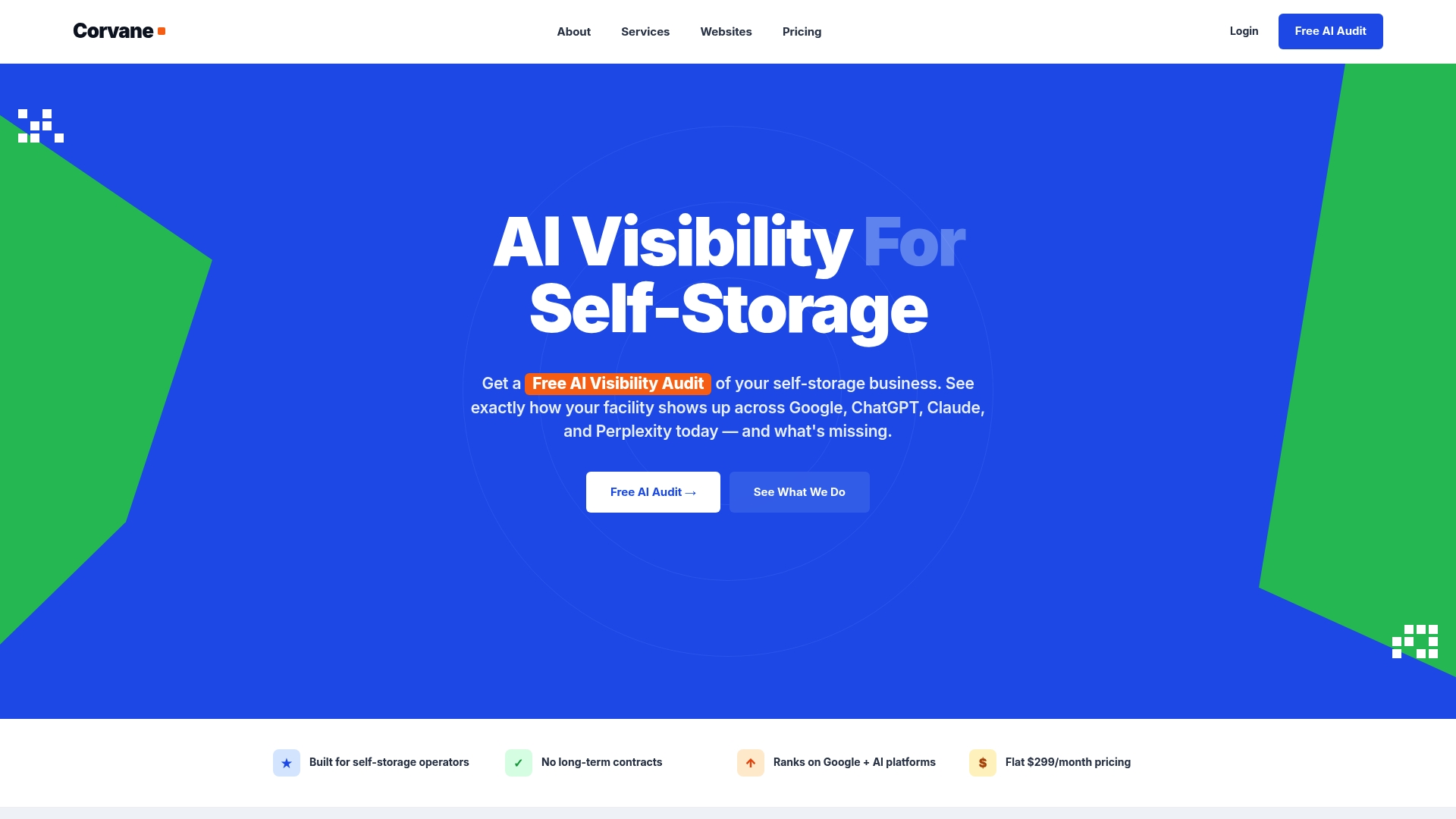
- A free AI visibility audit shows exactly how your facility currently appears across Google and AI assistants like ChatGPT and Perplexity.
- The full system combines technical SEO, local search positioning, and AI-optimized articles for a monthly fee plus a one-time onboarding payment.
- Custom, conversion-focused websites are available for operators whose current site is the actual bottleneck, not just the visibility.
If your reservation flow needs the fixes covered above but you'd rather have it done for you, start with the free audit at Corvane Systems and see where the gaps actually are before spending on ads.
Authoritative measurement and CRO resources
- Microsoft Clarity for heatmaps and session recordings.
- Google Analytics 4 guide for BigQuery export and unsampled reporting.
- Creating conversions in Analytics for GA4-to-Ads conversion sharing.
- Offline conversion tracking guide for importing move-ins into Ads.
Sources
- Microsoft Clarity
- Google Analytics 4: The Complete Ecommerce Guide (2026) | Oneiro Digital
- Creating and managing conversions - Analytics Help
FAQ
Who is the biggest self-storage company?
Public Storage is widely recognized as one of the largest self-storage operators, with a national network of facilities across many markets. Exact rankings shift depending on unit count versus revenue, so figures are best confirmed directly with each company.
Who has the cheapest self-storage?
There's no single cheapest provider, since pricing depends heavily on location, unit size, and season. Comparing live rates across a few nearby facilities, including any current promotions, is the only reliable way to find the lowest price in your area.
Can I just stop paying my storage unit?
No, stopping payment typically puts your rental agreement into default, which can lead to late fees, loss of access, and eventually a lien sale of the unit's contents under most facility contracts. Reviewing the specific lease terms with the facility is the safest way to understand what happens after a missed payment.
What cannot be stored in self-storage?
Most facilities prohibit hazardous, flammable, or perishable items, along with illegal goods and living things. Specific restrictions vary by facility, so checking the rental agreement or asking staff directly is the best way to confirm what's allowed before booking.