For most self-storage operators, the highest-return advertising approach combines three things: a Google Local Search or PPC ad targeting high-intent keywords within a tight geographic radius, a listing on local marketplaces like Craigslist with a clear price and unit size, and drive-by signage that captures the traffic already passing your facility.
The formula that ties them together is simple: [Headline with size or price] + [One trust signal] + [Price or price hint] + [Single CTA]. Example: "10×10 Units from a competitive monthly rate | Climate-Controlled | Gated Access | Reserve Online Today."
Three CTAs renters respond to most: "Reserve online now," "Call for same-day move-in," and "Use code MOVE25 for your first month." Start there before testing anything else.
The three ad types worth testing first:
- Google Local Search / geo-targeted PPC — captures renters actively searching "storage near me" or "storage units in [city]"
- Local marketplace listings (Craigslist, Facebook Marketplace, Nextdoor) — low cost, high local intent, easy to update with current availability
- Drive-by signage and direct mail — still highly effective because self-storage customers are intensely local and often decide based on what they see on their commute
Pro Tip: Before spending on paid ads, claim and fully complete your Google Business Profile. It costs nothing and often outperforms paid placements for "storage near me" searches in smaller markets.
Table of Contents
- Which ad channels should you use, and when?
- Three real campaigns worth stealing from
- Ad copy formulas and headline swipes you can use today
- How to present promotions without misleading renters
- How do you track whether your storage ads are working?
- What should you A/B test first?
- Five ready-to-run ad templates
- Key Takeaways
- What a storage marketer actually tests first
- Corvanesystems helps your facility get found before the ad click
- Useful sources
Which ad channels should you use, and when?
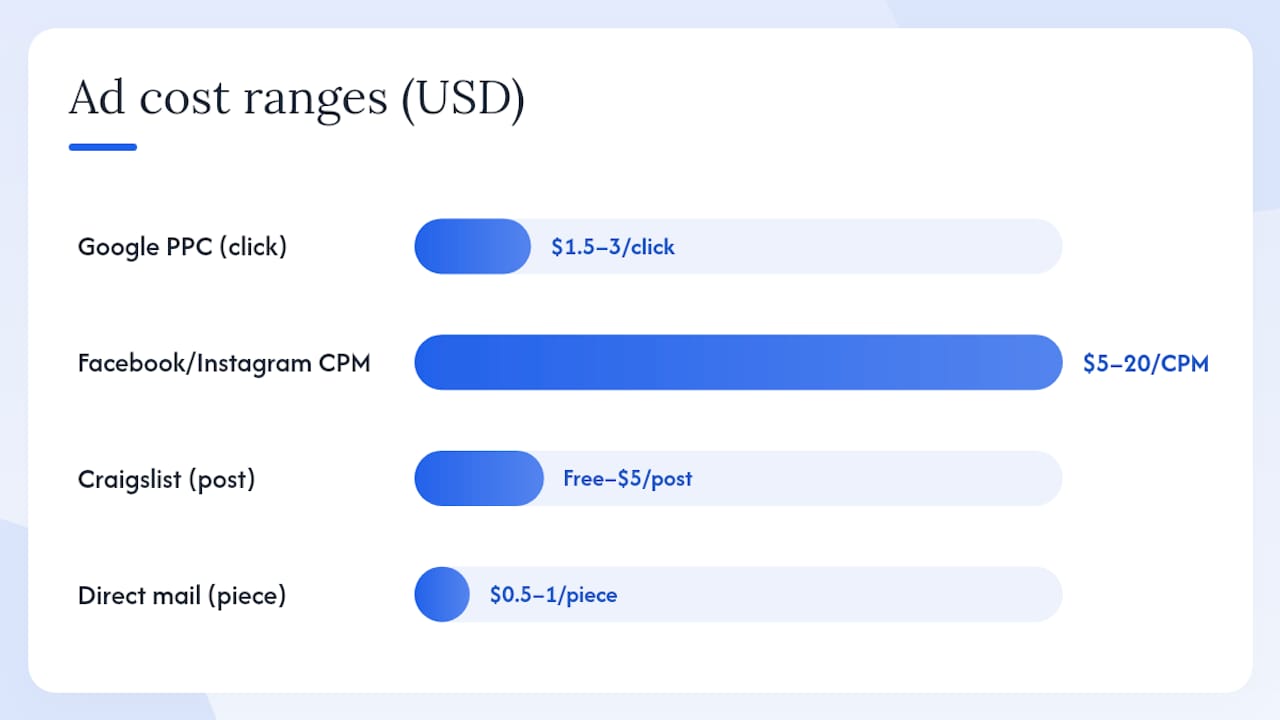
Not every channel fits every facility or budget. The table below maps the main options so you can build a mix that matches your situation.
| Channel | Best for | Typical cost range | Lead intent | Recommended CTA |
|---|---|---|---|---|
| Google Search / PPC | High-intent, last-minute renters | $1.50–$3 per click | Very high | Reserve online / Call now |
| Google Local / Maps | "Near me" searches, mobile users | Free–moderate (LSA) | Very high | Get directions / Call |
| Facebook/Instagram geo ads | Awareness, seasonal demand, movers | $5–$20 CPM | Medium | Learn more / Reserve |
| Craigslist / FB Marketplace | Budget-conscious renters, quick fills | Free–$5 per post | High | Call or text now |
| Direct mail (postcards) | New movers, neighborhood campaigns | $0.50–$1 per piece | Medium | Promo code redemption |
| Billboards / drive-by signage | Brand awareness, high-traffic corridors | Varies widely | Low–medium | Phone number / URL |
| Realtor / mover partnerships | Referral pipeline, planned moves | Low (relationship cost) | High | Referral code / call |
For a small operator running under 200 units, low-cost DIY tactics like yard signage, Google Maps optimization, and Craigslist postings often produce the strongest return per dollar spent. A mid-sized facility (200–500 units) can layer in Facebook geo-targeted ads and a modest Google PPC budget. Larger operators benefit from running all channels simultaneously with dedicated tracking per channel.
Seasonally, demand peaks in late spring through summer (May–August) when moves concentrate. Student storage spikes in August and January. Direct mail and social ads timed four to six weeks before these windows tend to outperform the same spend placed reactively.
The Self Storage Association's research data is a useful benchmark for demand cycles and renter behavior in your region.
Geo-fencing your PPC campaigns to a tight radius, typically three to five miles around your facility, keeps spend focused on renters who can realistically use your location. Matching ad copy to intent matters too: a "last-minute move this weekend?" headline outperforms a generic brand message for someone searching at 9 PM on a Friday.
Pro Tip: On Craigslist and Facebook Marketplace, refresh your listing every 48 hours. Listings drop in visibility quickly, and a free repost keeps you near the top of local search results on both platforms.
Three real campaigns worth stealing from
The most instructive storage campaigns share a pattern: they speak to a specific local problem, show some personality, and make the decision obvious for the renter. Here is what three well-known campaigns did and how you can replicate the mechanics.
Manhattan Mini Storage: hyper-local wit
Manhattan Mini Storage built a long-running outdoor campaign around New York City life, using billboard copy that referenced local anxieties ("Your closet is so small, it's practically a studio apartment"). The ads never mentioned price. They worked because they reflected the renter's exact situation back at them with humor, creating instant recognition. The lesson for a neighborhood facility: you do not need a big budget to be specific. A yard sign that reads "Moving out of the Riverside Apartments? We're 0.4 miles away" does the same thing at a fraction of the cost.
Old Spice and Progressive: borrowed creative lessons
Old Spice's "The Man Your Man Could Smell Like" and Progressive's Flo campaigns are not storage ads, but Storable's breakdown of memorable storage campaigns draws on the same principle both use: a single, consistent character or voice that makes a commodity product memorable. For storage, that translates to a consistent visual identity (same colors, same font, same tone across every ad) and a recurring offer mechanic the local market comes to recognize. One regional operator used a "We're the storage place your neighbor uses" tagline across all channels for a full year. Occupancy held steady through a period when nearby competitors were discounting heavily.
The Craigslist offer mechanic
Real classified ads demonstrate a third approach: lead with the discount, then justify it with specifics. A Washington D.C.-area listing used "HALF OFF YOUR FIRST 3 MONTHS" as the headline, then listed security features, cleanliness, and a free moving truck offer in the body. A Dallas-area listing led with the facility name and year, then listed unit sizes and pricing clearly. Both approaches work because they answer the renter's core questions immediately.
What to steal for your facility:
- Pick one local problem your renters face (small apartments, seasonal overflow, a nearby college move-out) and write every ad to that problem.
- Use a consistent offer mechanic (first month discount, free lock, free truck) across all channels so renters recognize it.
- On Craigslist and marketplace listings, lead with the discount in the headline, then list unit sizes and prices in the body.
Ad copy formulas and headline swipes you can use today
Good storage ad copy is short, specific, and answers the renter's question before they ask it. Here are formulas and swipes organized by channel and renter type.
Search ad headline formula: [Size] + [Price anchor] + [Key feature] + [CTA] "10×10 Units from $89 | Climate-Controlled | Reserve Today"
Social ad formula: [Problem] + [Solution] + [Offer] + [CTA] "Running out of space? Secure 10×10 units from $89/mo. First month 50% off. Reserve online."
Marketplace listing formula: [Discount hook] + [Unit sizes and prices] + [Security features] + [Contact CTA]
Five headline swipes:
- "Climate-Controlled Storage from $[X]/mo — [City] | Reserve Online"
- "Moving This Weekend? Same-Day Storage Available — Call Now"
- "5×5 to 10×30 Units | Gated, Monitored, Affordable | [City]"
- "First Month Free on Select Units — Limited Availability"
- "Student Storage Near [University] — Short-Term Leases Welcome"
Six body copy swipes by renter type:
- Student: "Short-term leases, flexible move-out dates, and a location two miles from campus. Units from $49/mo."
- Mover: "We're three blocks from the highway. Drive-up access, 24/7 entry, and same-day move-in available."
- Car storage: "Covered and enclosed vehicle storage from $[X]/mo. Gated, monitored, and insured."
- Business inventory: "Secure commercial storage with 24/7 access and loading dock. Monthly billing, no long-term commitment."
- Climate control: "Temperature-regulated units for furniture, electronics, and documents. From $[X]/mo, no humidity surprises."
- General discount: "First month half price on all available units this month. Gated access, video surveillance, online reservations."
Image brief checklist:
- Photograph the gate closed and lit (security signal)
- Shoot a clean unit interior with the door open (size reference)
- Include a close-up of the lock and latch (safety signal)
- For social ads, overlay unit size and price directly on the image
- Avoid stock photos; real facility images outperform them in local ads
Two 15-second video script ideas:
- Open on the gate opening, cut to a clean unit interior, voiceover: "Need space? We've got 5×5 to 10×30 units in [City], starting at $[X] a month. Reserve online today." Close on the facility sign with phone number.
- Open on a person loading boxes into a drive-up unit, voiceover: "Same-day move-in, 24/7 access, and your first month at half price. [Facility name] in [City]." Close on the website URL.
How to present promotions without misleading renters
Offer mechanics drive rentals, but poorly disclosed promotions create chargebacks, angry tenants, and FTC scrutiny. The Federal Trade Commission's truth-in-advertising rules require that material conditions of an offer be clear and conspicuous, meaning buried fine print does not satisfy the requirement.
Dos:
- State the exact discount and what it applies to: "50% off your first month on 10×10 and larger units"
- Include the expiry date or availability limit: "Offer valid through [date] or while units last"
- Disclose required add-ons upfront: "Requires a $15/mo protection plan and facility-provided lock ($20)"
- Use a promo code in every ad so you can track redemptions: "Use code MOVE25 at checkout"
Don'ts:
- Don't advertise a "first month free" if the renter must also pay a mandatory admin fee that effectively cancels the discount
- Don't use "from $X/mo" if that price requires a 12-month commitment and most renters will pay a higher month-to-month rate
- Don't omit the protection plan or lock requirement from the ad if those are mandatory
Real classified ads show how operators handle this well. The Washington D.C. listing mentioned earlier disclosed the free moving truck and included insurance directly in the ad body, not in a footnote. That transparency is what keeps the renter from feeling misled on move-in day.
A short disclosure line that works in most ads: "Offer valid for new tenants on select unit sizes. Requires protection plan. See facility for full terms."
Pricing transparency also converts better. Consistent listings with clear unit sizes, features, and monthly rates improve both local search visibility and the rate at which searchers become tenants. Renters who see a price in the ad and confirm it on the booking page convert at a higher rate than those who have to call to find out. For more on pricing strategy, the storage pricing guide covers how to set and present rates without undercutting your own margins.
How do you track whether your storage ads are working?
Tracking is where most small operators fall short. They run an ad, watch occupancy, and draw a rough conclusion. That works until you have two or three channels running simultaneously and no idea which one drove the rental.
Step-by-step tracking setup before you launch:
- Set up a unique landing page per channel — (or at minimum per campaign). A page at yourdomain.com/google-storage-deal vs. yourdomain.com/craigslist-deal lets you see which source converts to a reservation.
Key metrics to watch:
| Metric | What it tells you | Low-cost tool |
|---|---|---|
| Cost per lead | How much each channel costs to generate an inquiry | UTM + Google Analytics |
| Conversion rate to lease | % of leads who sign | Booking software + promo codes |
| Cost per rental | Total ad spend ÷ new rentals | Spreadsheet |
| Occupancy lift | Change in % occupied before/after campaign | Facility management software |
| Phone call volume | Calls generated per channel | CallRail or Google Call Extensions |
For seasonality benchmarks and demand patterns, the Self Storage Association's research data gives you a baseline to compare your occupancy trends against industry norms. If your occupancy drops in February while the industry holds steady, your ad spend may need to shift, not your pricing.
For a deeper look at why leads sometimes don't convert after the click, the storage website lead guide covers the landing page and booking flow issues that kill ad ROI.
What should you A/B test first?
Most operators test too many things at once and end up with data that proves nothing. Run one test at a time, let it collect enough data to mean something, then move to the next.
Priority test order:
- Headline — test a price-led headline ("Units from $89/mo") against a problem-led headline ("Running Out of Space? We're 0.4 Miles Away"). Run for four weeks minimum.
- Price presentation — exact price ("$89/mo") vs. price hint ("from $89/mo") vs. no price (call for pricing). Exact price almost always wins on conversion rate.
- CTA copy — "Reserve Online" vs. "Check Availability" vs. "Call Now." The right answer depends on your booking flow and whether your online reservation system is frictionless.
- Lead form length — a two-field form (name + phone) vs. a five-field form. Shorter forms convert more leads; longer forms pre-qualify them better.
A simple 4–6 week cadence:
- Week 1–2: Launch both variants with equal budget. Do not touch them.
- Week 3–4: Check results. A winner needs at least 30 conversions per variant to be meaningful. If neither has hit that threshold, extend the test.
- Week 5–6: Pause the loser, scale the winner, and set up the next test.
For practical significance: a 20% or greater difference in conversion rate between variants is worth acting on. A 5% difference with low volume is noise.
Pro Tip: Test offers using promo codes rather than separate landing pages when you're running on a tight budget. Assign one code to each variant, track redemptions manually, and you get clean attribution without building two pages.
Five ready-to-run ad templates
Each template below includes a headline, one-line body, CTA, image brief, and a sample promo code. Copy, adapt the price and location, and post.
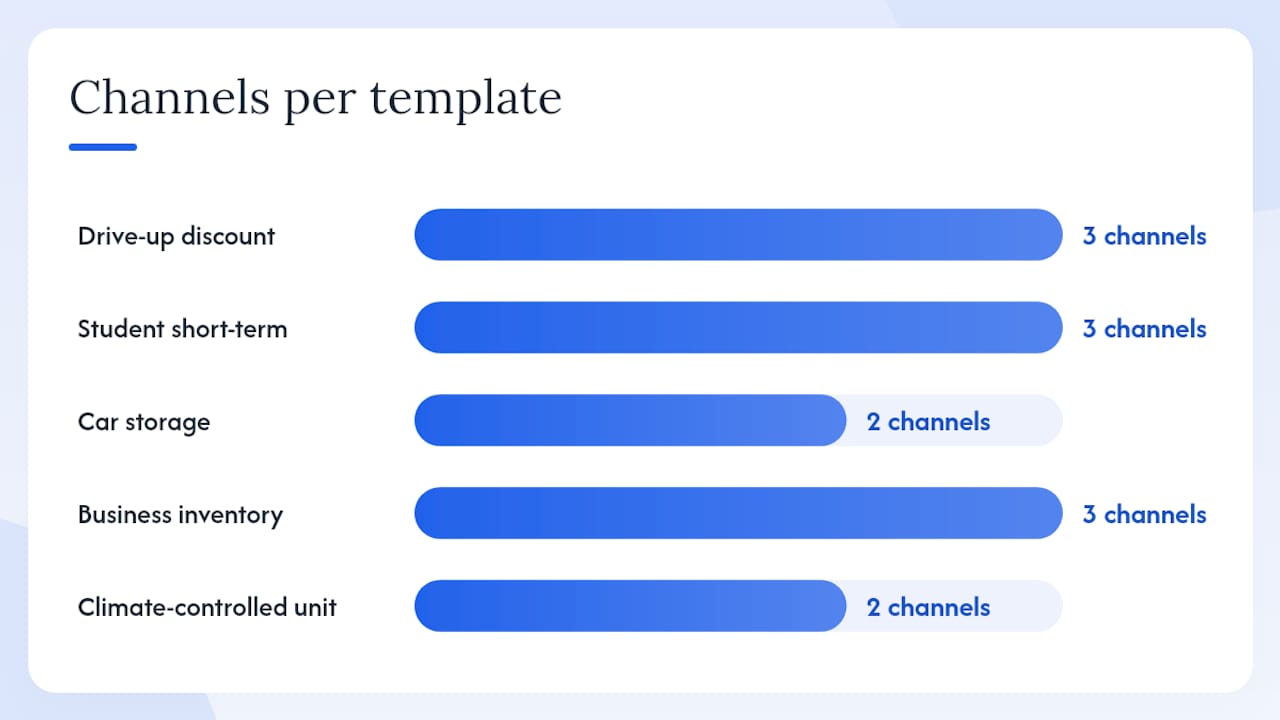
1. Drive-up discount (Google Search / Craigslist)
- Headline: "Drive-Up Storage from $[X]/mo | [City] | First Month 50% Off"
- Body: Gated, drive-up units with 24/7 access. No long-term commitment.
- CTA: Reserve online or call [number]
- Image: Drive-up unit row, gate visible, unit door open
- Promo code: DRIVEUP50
- Best on: Google Search, Craigslist, Facebook Marketplace
2. Student short-term (Facebook/Instagram, Nextdoor)
- Headline: "Student Storage Near [University] — From $[X]/mo, Short-Term OK"
- Body: Flexible leases, easy move-out, and a location you can reach without a car.
- CTA: Check availability online
- Image: Clean 5×5 unit with boxes stacked neatly, well-lit
- Promo code: STUDENT25
- Best on: Facebook geo-targeted to campus zip codes, Nextdoor
3. Car storage (Google Search, direct mail)
- Headline: "Covered Car Storage in [City] | From $[X]/mo | Gated & Monitored"
- Body: Enclosed and covered vehicle storage with 24/7 camera surveillance and keypad entry.
- CTA: Call for availability
- Image: Vehicle inside a covered unit, gate in background
- Promo code: CARSAFE10
- Best on: Google Search ("car storage near me"), direct mail to neighborhoods with limited parking
4. Business inventory (LinkedIn, Google Search, direct mail)
- Headline: "Commercial Storage in [City] | 24/7 Access | No Long-Term Lease"
- Body: Secure units for inventory, equipment, and documents. Loading dock available.
- CTA: Reserve your unit online
- Image: Clean unit with shelving, business boxes labeled, loading area visible
- Promo code: BIZ1FREE
- Best on: Google Search, direct mail to local business districts
5. Climate-controlled unit (Google Search, Facebook)
- Headline: "Climate-Controlled Storage from $[X]/mo | [City] | No Humidity"
- Body: Temperature-regulated units for furniture, wine, electronics, and documents. Reserve online in minutes.
- CTA: Reserve online today
- Image: Interior of a climate-controlled unit, temperature display visible on wall
- Promo code: CLIMATE15
- Best on: Google Search ("climate controlled storage [city]"), Facebook geo-targeted to higher-income zip codes
To customize any template: replace [City] with your actual city or neighborhood, replace [X] with your real rate, and verify the promo code is active in your booking system before the ad goes live. Marketplace listings benefit from refreshing these templates every two weeks with updated availability and pricing.
Key Takeaways
The highest-return storage unit ads combine local high-intent search, transparent pricing, and a single clear CTA — operators who track by channel and test one variable at a time consistently outperform those who run broad, untracked campaigns.
| Point | Details |
|---|---|
| Lead with price and size | Ads that show a real rate and unit size convert faster than vague "call for pricing" copy. |
| Match channel to intent | Google Search captures last-minute renters; Facebook and direct mail build awareness for planned moves. |
| Disclose offer terms clearly | State discount scope, expiry, and required add-ons in every ad to avoid chargebacks and FTC issues. |
| Track every channel separately | UTM tags, promo codes, and call tracking let you cut what doesn't work and scale what does. |
| Corvanesystems for organic lift | Corvanesystems builds the SEO and AI visibility that reduces your cost per rental over time alongside paid ads. |
One-week launch checklist:
- Choose your offer (first month discount, free lock, or bundle)
- Pick your first two channels (Google Local + Craigslist recommended for most operators)
- Set up UTM tags and assign a unique promo code per channel
- Launch ads and set a calendar reminder to review results in 14 days
- After 30 days, cut the underperforming channel and reinvest in the winner
For a broader occupancy strategy that complements your ad campaigns, the guide to filling empty storage units covers channel mix, pricing, and follow-up systems in depth.
What a storage marketer actually tests first
Most operators I talk to want to know the "best" channel before they've run a single tracked campaign. That instinct is understandable but backwards. The channel matters less than the offer clarity and the tracking setup. I've seen a well-structured Craigslist listing outperform a $1,500/month Google PPC campaign for a 150-unit facility in a mid-size market, simply because the Craigslist ad had a real price, a real photo, and a promo code that the operator actually tracked.
What I test first, every time: local search visibility, then price presentation in the ad copy, then the CTA. In that order. Local search visibility because if your Google Business Profile is incomplete or your facility doesn't appear in the map pack, paid ads are doing the work that organic should be doing for free. Price presentation because the single biggest conversion lever in storage ads is whether the renter sees a number before they click. And CTA last because it matters less than the first two, but it's the easiest to test.
One thing most operators underestimate: renters in smaller markets often decide based on what they see driving by, then confirm online. That means your signage and your Google Business Profile need to tell the same story. A renter who sees "First Month Free" on your sign and then lands on a website with no mention of that offer will call to confirm, or more often, won't call at all.
The shift toward AI-assisted search is changing this further. When someone asks ChatGPT or Perplexity "best storage near [city]," your facility needs to be structured and described in a way those systems can understand and recommend. That's where Corvanesystems's AI visibility work fills a gap that traditional ad spend can't.
Corvanesystems helps your facility get found before the ad click
Paid ads fill units while they're running. Organic and AI search visibility fills units while you sleep. Corvanesystems is built specifically for self-storage operators who want to reduce their cost per rental over time by becoming the facility that surfaces first, whether a renter searches on Google, asks an AI assistant, or checks a local directory.
The service includes technical SEO, Google Business Profile optimization, 30 keyword-focused articles published monthly, and AI visibility audits across ChatGPT, Claude, Perplexity, and Google's AI Overviews. One flat monthly rate, no contracts, no minimums.
For operators who also need a better website to convert the traffic their ads are already sending, Corvanesystems builds custom, conversion-focused storage sites.
If you're spending on ads and not seeing the occupancy lift you expected, the issue is often the digital foundation those ads are pointing to. See what Corvanesystems includes and get a clear picture of where your facility stands in search and AI results today.
Useful sources
- How To Advertise A Storage Unit For Rent - Innago | Innago
- Self Storage Advertising and Marketing Ideas | Unit Trac
- Self-Storage Ad Inspiration: 3 Brilliant Campaigns | Storable
- selfstorage.org
- Armor Self Storage 2026! - parking & storage - parking storage rent - craigslist
- HALF OFF YOUR FIRST 3 MONTHS! 🚨 Safe, Spotless & Secure Storage - parking & storage - parking storage rent - craigslist