
Most single-site self-storage operators in the United States should budget a few hundred to several thousand dollars per month for SEO, depending on how aggressively they want to grow. Multi-location operators and facilities in hot lease-up markets often invest several thousand dollars or more monthly. Rankings typically start moving in 3 to 6 months, with move-ins climbing meaningfully by month 6 to 12.
TL;DR:
- Smaller storage operators typically budget between a few hundred and 1,500 dollars per month for basic SEO services, focusing on Google Business Profile management and technical cleanup.
- Larger and multi-location operators should expect to spend several thousand dollars monthly, with costs rising to over ten thousand dollars for extensive content, local strategies, and custom engineering.
- The most significant cost factor is location count, with competing markets and site complexity directly influencing pricing, especially for busy, high-competition areas.
- Early SEO results usually appear within 3 to 6 months, with meaningful move-in growth often happening between 6 and 12 months, depending on market conditions.
- Transparent proposals should include specific deliverables like location pages, content volume, technical work, and reporting, with clear scope differences explaining potential cost variations.
Table of Contents
- How Much Does SEO Cost for Self Storage Facilities?
- What Drives the Price Difference Between SEO Quotes?
- What Deliverables Should You Get at Each Price Point?
- Which Pricing Model Should You Choose?
- When Will You See Results, and How Do You Measure ROI?
- How Do You Evaluate a Storage SEO Provider?
- What Does a Flat-Rate Storage SEO Package Actually Include?
- What I'd Actually Spend If I Ran a Storage Facility
- Get a Clear Picture of Your Facility's Search Visibility
- Sources
- FAQ
How Much Does SEO Cost for Self Storage Facilities?
Storage SEO pricing breaks into three practical bands, and where you land depends on facility count, market competition, and how fast you need occupancy to climb.
Starter budgets run several hundred to around one thousand five hundred dollars a month. This tier covers Google Business Profile management, a modest content cadence, and basic technical cleanup for a single site. It fits owners who already have decent occupancy and want steady, unspectacular improvement rather than a lease-up sprint.
Mid-market budgets land between a range of a few thousand dollars per month. This is where most stabilized single-site operators and small two-to-three-facility groups actually spend. It buys consistent local dominance work, regular content production, and ongoing technical fixes rather than a one-time cleanup. Operator-reported budgets in this range are common across the industry, and total marketing spend for single-site operators frequently lands in a similar band once you count ads, SEO, and agency fees together.
Aggressive and enterprise budgets hit several thousand to over ten thousand dollars per month. This tier is built for multi-location operators managing 5, 10, or 50 facilities, where each location needs its own optimized page, its own GBP listing, and its own local competitive strategy. Custom engineering work and higher-frequency content publishing live here too.
By the numbers: Storage operators typically allocate a mid-range percentage of revenue to marketing overall, with the higher end reserved for active lease-up periods. SEO usually represents a third to half of that total marketing line.
One-time project costs sit outside the monthly retainer. A custom website build for a storage facility typically runs several thousand to tens of thousands of dollars depending on design complexity, unit-availability integration, and whether it needs a full booking flow. Site migrations, large-scale technical overhauls, or schema rebuilds get quoted separately, often as flat project fees.
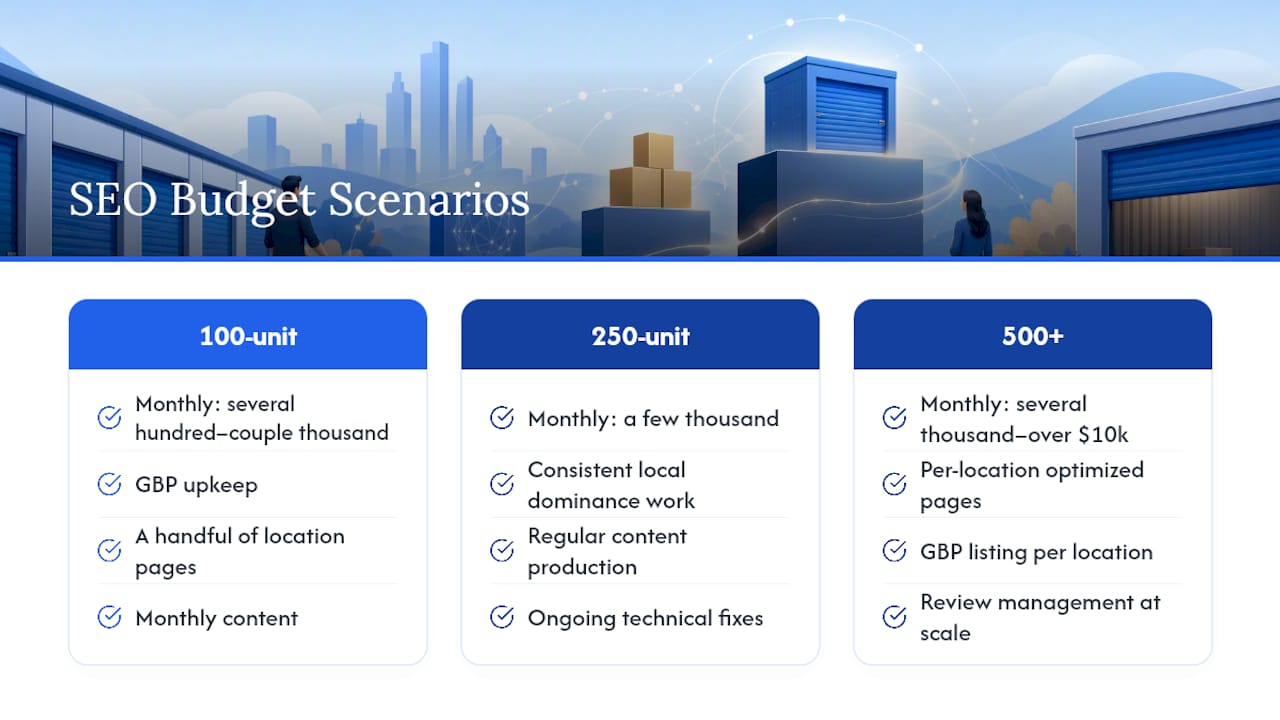
Picture three scenarios. A 100-unit single facility in a mid-sized metro likely needs several hundred to a couple thousand dollars a month: enough for GBP upkeep, a handful of location-specific pages, and monthly content. A 250-unit facility competing against three or four established operators probably needs a few thousand dollars a month to hold and grow market share. A 500-plus unit portfolio spanning multiple cities usually requires several thousand to over ten thousand dollars a month once you account for per-location page builds, review management at scale, and content volume across every market.
What Drives the Price Difference Between SEO Quotes?
Two vendors quoting wildly different numbers for the same facility usually aren't being dishonest. They're pricing different variables.
Location count is the biggest lever. Per-location work doesn't scale linearly.
Local competition matters just as much. A facility competing against three national brands in a dense metro needs far more content and technical work than one in a market with two mom-and-pop competitors and no major chains nearby.
Other cost drivers include:
- Site platform and technical debt — an outdated CMS with slow load times and broken schema costs more to fix upfront than a clean, modern site.
- Content volume — AI-optimized article programs (the kind built for both Google and tools like ChatGPT and Perplexity) cost more than a bare-minimum blog cadence.
- Integrations — connecting live unit availability, reservation systems, or third-party booking APIs adds engineering time that a pure content-and-links package doesn't need.
- Vendor specialization — a generalist agency has to build storage-specific frameworks from scratch; a storage-focused vendor already has unit-size page templates and GBP playbooks ready to deploy.
Pro Tip: Ask any vendor whether their quote assumes a single template rolled out across locations or fully custom work per site. That single question explains most of the price gap between competing proposals.
What Deliverables Should You Get at Each Price Point?
Price and scope should move together. If two proposals are $1,000 apart but promise identical deliverables, something doesn't add up. Here's what belongs in a legitimate scope of work, roughly in order of what you'd expect at increasing budget levels:
- Google Business Profile management — listing accuracy, category selection, photo uploads, weekly posts, and review response. Google's own partner guidance treats consistent GBP upkeep as foundational to local visibility, and it's usually the fastest win in any storage SEO plan.
- Location and unit-size pages — dedicated pages covering unit dimensions, pricing tiers, "what fits in a 10x10" guidance, and LocalBusiness schema markup for each facility.
- Technical health work — Core Web Vitals fixes, canonical tag cleanup, crawl and indexing checks, and current XML sitemaps.
- Content production — a defined article cadence, increasingly built around AI-optimized formatting so language models can parse and recommend the facility, plus entity-focused pages covering things like climate control or vehicle storage.
- Reporting — move-in attribution, call tracking, direction requests, and occupancy trend data tied back to organic traffic.
- Add-ons — custom website builds, live availability feeds, and reservation or booking system integration, usually quoted as separate projects.
A detailed local tactics breakdown shows how these deliverables typically stack for a single-site operator working with a limited monthly budget.
Which Pricing Model Should You Choose?
Vendors charge in four main ways, and each carries different risk.
Flat-rate subscriptions are predictable. You know the bill every month. The catch: always get the exact deliverable list in writing, because "flat rate" sometimes means a shrinking scope once the contract is signed.
Tiered retainers and per-location pricing show up with multi-site rollouts. Vendors usually discount per-location cost as location count rises, but confirm whether that discount kicks in at 3 locations or 10.
One-time project fees cover audits, migrations, and onboarding. These should have a clearly defined start and end date, not an open-ended hourly clock.
Watch for these common contract pitfalls:
- Automatic renewals that lock you in past a 30 or 60-day cancellation window.
- Vague deliverable language like "ongoing optimization" with no defined output.
- KPIs measured only in rankings, never in calls, leads, or move-ins.
- Onboarding fees that aren't disclosed until the proposal stage.
Start negotiations with a 90-day pilot tied to specific deliverable milestones rather than a 12-month commitment. It protects you and gives the vendor a fair runway to show results.
When Will You See Results, and How Do You Measure ROI?
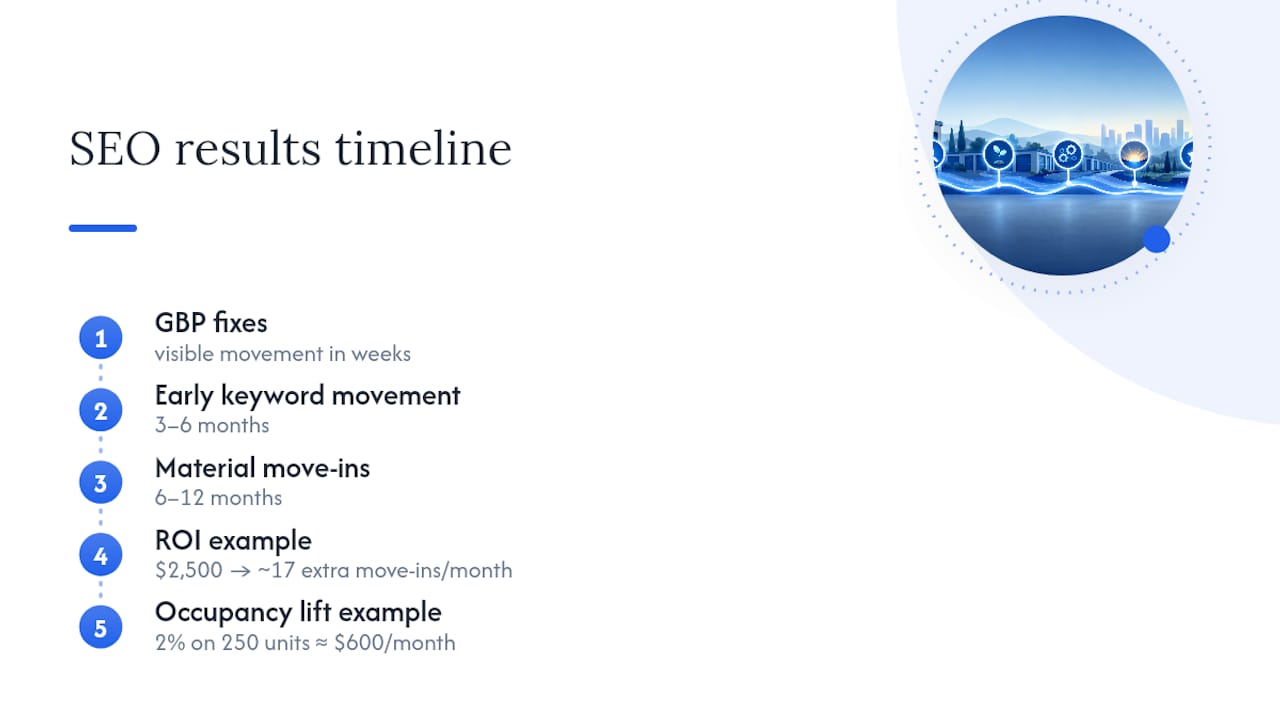
Google Business Profile fixes can produce visible movement in weeks. Full organic ranking and traffic gains take longer. Expect early keyword movement in the 3 to 6 month range and material move-in volume by month 6 to 12, which matches typical SEO timelines across most local service industries.
Cost math worth running: if your current cost-per-move-in from paid ads sits at $150 and organic search brings that down to $60 once rankings mature, a $2,500 monthly SEO investment pays for itself once organic drives roughly 17 extra move-ins a month.
Paid search often dominates short-term spend because it produces immediate leads, while SEO compounds slower but lowers your cost-per-move-in over time. Track ROI using call tracking numbers on your GBP listing and website, tagged reservation forms, and Google Signals data tied to actual lease agreements. A 2-point occupancy increase on a 250-unit facility charging $120 average monthly rent adds roughly $600 a month in new revenue, which is the kind of math that should anchor your SEO budget decision, not guesswork.
During active lease-up, layer paid search on top of your organic investment rather than choosing one or the other. Ads buy immediate move-ins while SEO builds the asset that lowers acquisition cost for years after the campaign ends.
How Do You Evaluate a Storage SEO Provider?
Comparing proposals gets easier once you standardize what you're asking every vendor.
- Ask about industry specialization. Has this vendor worked specifically with storage operators, or is storage their first vertical experiment this quarter?
- Request a sample scope of work. A real proposal names specific deliverables (how many location pages, how many articles per month, which schema types) rather than vague phrases like "comprehensive optimization."
- Ask how they attribute move-ins. If a vendor can't explain how they'll connect organic traffic to actual rentals, their reporting will be useless six months in.
- Request sample reporting. A redacted or anonymized client report tells you more than any sales deck.
- Propose a 60 to 90 day pilot with agreed KPIs before signing anything longer.
Red flags to walk away from: any guarantee of a specific ranking position, mention of "link schemes" or other black-hat tactics, or a proposal with no line-item deliverables at all. Normalize competing quotes by dividing total monthly cost by number of locations covered, then compare that per-location number alongside the actual deliverable list.
Pro Tip: You can verify a vendor's track record without asking them to name other storage clients directly. Ask instead for anonymized before-and-after data, like a percentage increase in organic leads over a defined period.
What Does a Flat-Rate Storage SEO Package Actually Include?
Corvane Systems runs on a single flat monthly rate built specifically for self-storage operators, which sidesteps a lot of the guesswork covered above. A typical month includes:
- Technical and on-page audits tuned to storage sites, covering indexing, metadata, and site health.
- Google Business Profile upkeep, "storage near me" keyword targeting, and competitor tracking for your service area.
- Roughly 30 AI-optimized articles published monthly, structured so they surface correctly in tools like ChatGPT, Claude, and Perplexity in addition to Google.
- An AI visibility audit scoring how the facility currently appears across major AI platforms, plus a roadmap to improve it.
- Straightforward monthly reporting on rankings, traffic, and visibility.
Custom website builds and integrations like live availability feeds get quoted as separate projects. A discovery call typically starts with a walkthrough of current visibility across both search engines and AI tools before any scope is proposed.
What I'd Actually Spend If I Ran a Storage Facility
If you're single-site and stabilized, mid-thousand-dollar range per month is the realistic floor for work that moves occupancy rather than just checking boxes. If you're in active lease-up on a new facility, push toward several thousand dollars and run paid search alongside it. Multi-location operators should budget per location, not per portfolio, because that's how the actual work scales.
Your first 90 days should focus on three things: fixing Google Business Profile completely, building out unit-size and pricing pages for every location, and cleaning up whatever technical debt is slowing indexing. Content production matters, but it compounds slower than those three fixes.
Pro Tip: If your budget forces a choice, prioritize GBP accuracy and unit-size pages over content volume. Those two levers produce measurable movement fastest, and they're what most rushed vendor proposals skip first.
— Mike
Get a Clear Picture of Your Facility's Search Visibility
Corvane Systems is the alternative to piecing together a generalist agency, a freelance SEO consultant, and a separate web developer for your storage facility. Instead of stacking three invoices and three sets of excuses, you get one flat monthly rate covering technical SEO, local search positioning, AI-optimized content, and AI visibility tracking across ChatGPT, Claude, Perplexity, and Google's AI Overviews, all built specifically for storage operators rather than adapted from a generic local-business template.
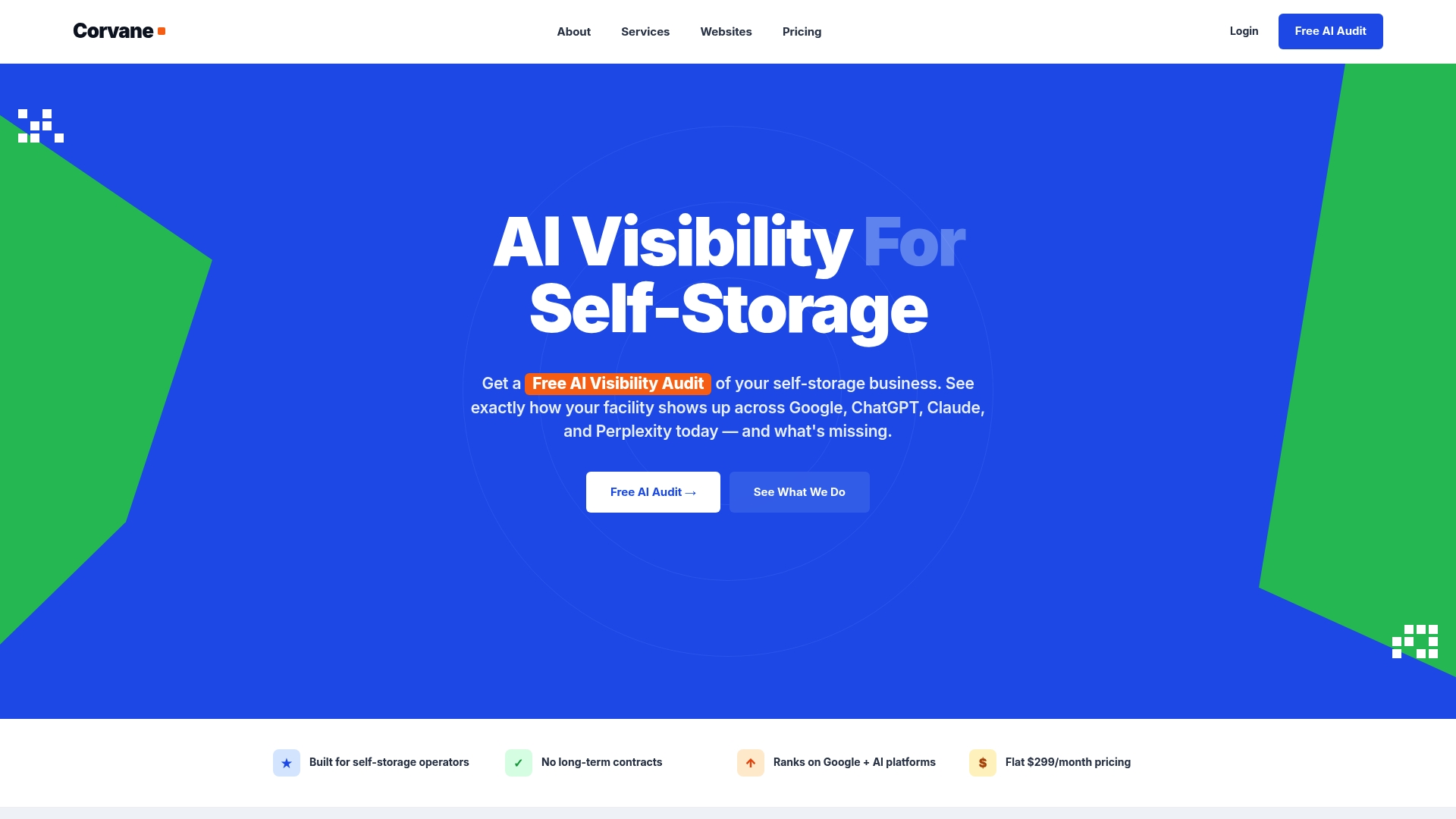
Pricing runs at a flat monthly fee of $299, with a one-time $50 onboarding fee and no long-term contract locking you in. If you're not sure where your facility currently stands, request the free AI visibility audit through Corvanesystems to see exactly how your listings and content perform across search engines and AI platforms before committing a dollar to a monthly plan. Operators managing multiple locations can also ask about custom website builds during that same conversation, since scope and pricing get defined once someone actually looks at your current site and market.
Sources
- United States self storage market - Mordor Intelligence
- Self Storage Marketing Cost: What Operators Pay — M6 Marketing
- Google Partners — Agency profile (Google)
FAQ
How Much Does Local SEO Cost in the U.S.?
Local SEO for a small business typically runs $500 to $4,000 a month depending on market competition and scope, with self-storage facilities usually falling in the $1,500 to $4,000 range once they need steady content and technical maintenance.
What Is the Average Cost of Self-Storage in the U.S.?
Self-storage unit rental rates vary widely by market and unit size, and this article focuses on SEO marketing costs for operators rather than rental pricing for renters.
How Much Does SEO Typically Cost?
Across industries, SEO retainers commonly range widely depending on business size and competition, and self-storage falls within that variation with most single-site operators budgeting from a few hundred to several thousand dollars per month.
Is SEO Still Worth It in 2026?
Yes. SEO lowers cost-per-move-in over time compared to relying solely on paid ads, and it compounds as content and local authority build, making it one of the most durable channels for occupancy growth.
What Does Corvane Systems Charge for Storage SEO?
Corvane Systems charges a flat monthly fee for its full SEO and AI visibility service, plus a one-time onboarding fee, with no long-term contract required.