Four moves matter more than everything else combined: claim and completely fill out your Google Business Profile under the Self-Storage Facility category, build unique landing pages for each location and unit size with live pricing, run a steady review-generation process instead of sporadic asks, and add SelfStorage structured data so search engines (and AI tools) understand your facility as a distinct entity. Get those four right before touching anything else on this list.
TL;DR:
- Claim and fully optimize your Google Business Profile, including photos, hours, services, and regular activity, as it directly influences rankings.
- Build unique location pages with live pricing, local directions, and real photos for each facility, focusing on high-intent, unit-size specific searches.
- Develop a structured data strategy using SelfStorage schema, verify site health, and connect live availability to enhance search engine understanding and AI recognition.
- Consistently generate and respond to reviews, spreading requests over time without discounts, because review metrics significantly impact local ranking and occupancy.
- Maintain cohesive, conversational content and data across all platforms to improve AI tool recommendations and visibility in AI-driven search results.
Table of Contents
- What Is Entity SEO for Self Storage?
- Google Business Profile & Map-Pack Playbook
- Which Location Pages Actually Convert Renters?
- How Do You Find the Right Keywords for a Storage Site?
- Do Reviews Really Move the Needle on Rankings?
- Structured Data and Technical SEO for Storage Sites
- What Content Actually Attracts Storage Renters?
- Citations, Local Backlinks, and NAP Consistency
- How Do You Prove SEO Is Actually Filling Units?
- Scaling SEO Across Multiple Storage Locations
- Making Your Facility Visible Inside AI Search Results
- An Operator's Honest Take on What Actually Moves Occupancy
- A Faster Path to Local and AI Visibility
- Sources
- FAQ
What Is Entity SEO for Self Storage?
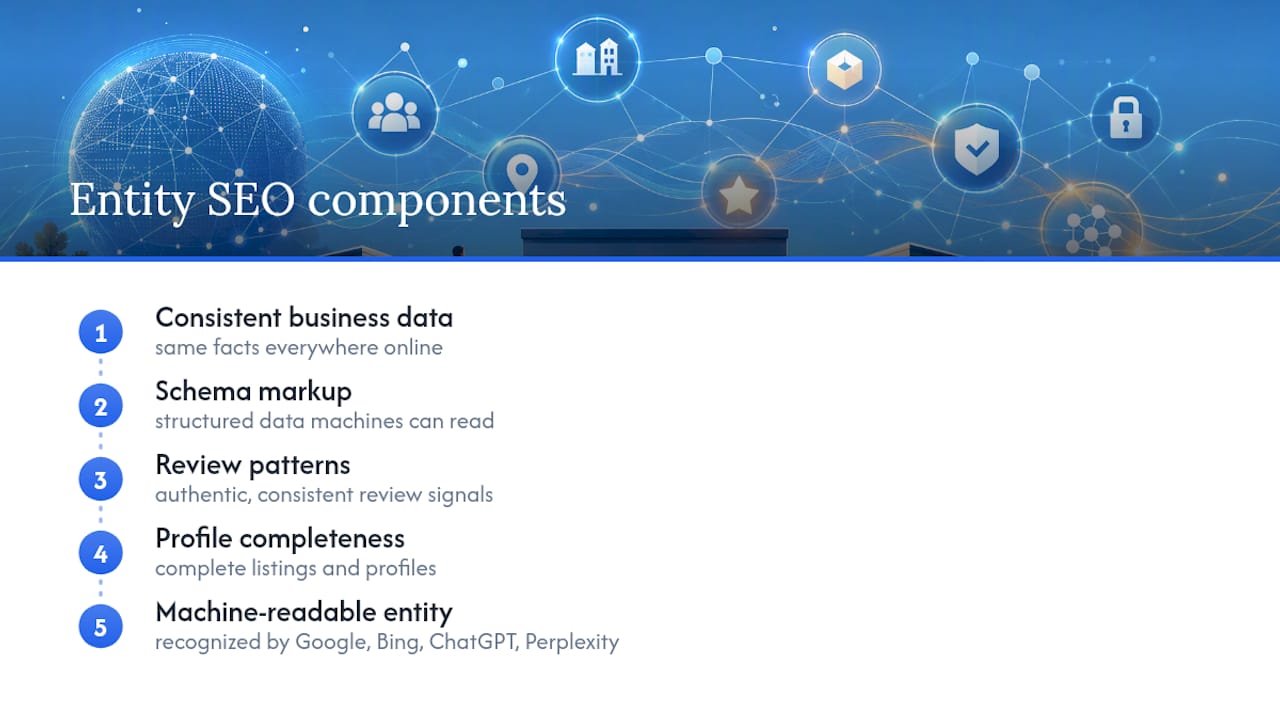
Entity SEO for self storage means structuring your facility's online presence so Google, Bing, and AI systems like ChatGPT and Perplexity recognize it as a specific, verifiable business entity, not just a webpage with keywords on it. That distinction matters because entity signals (consistent business data, schema markup, review patterns, and profile completeness) now carry more ranking weight than raw keyword density. Traditional local SEO for storage still applies: proximity, citations, on-page optimization. But entity SEO layers on a machine-readability requirement. Your facility needs to say the same thing about itself everywhere it appears online, in a format both search engines and language models can parse without guessing.
Google Business Profile & Map-Pack Playbook
Your Google Business Profile is the single highest-leverage asset you control. Map Pack ranking comes down to proximity, profile completeness and activity, and review signals, and none of those three can be purchased or gamed with backlinks.
Start with verification, then build out every field:
- Claim your listing and verify ownership through Google's postcard, phone, or video verification flow.
- Set the primary category to "Self-Storage Facility" and add secondary categories like "Moving Supply Store" if you sell boxes and locks.
- Fill in hours (both office and access hours, listed separately), services, attributes (climate control, drive-up access, 24-hour gate), and a complete address.
- Upload at least 10 current photos: exterior signage, unit interiors by size, hallways, and your office.
- Add unit sizes as service listings with descriptions.
Keep the profile active weekly: post a photo every few days, answer every question in the Q&A section within 48 hours, and update seasonal offers as Google Posts. Watch calls, direction requests, and website clicks in your GBP insights weekly. Those three numbers move before rankings do.
Pro Tip: A dormant GBP with perfect fields still loses to a mediocre one that posts weekly. Activity is a ranking signal on its own.
For a deeper walkthrough of the 30-day version of this exact sequence, see our 30-day storage map pack plan.
Which Location Pages Actually Convert Renters?
A single "Our Facilities" page listing five locations in one paragraph will not rank for anything competitive. Self-storage SEO depends on hyperlocal signals and unit-size specific pages, because renters search within a few miles of home and type queries like "10x10 storage unit near me" or "climate controlled storage [city]."
Each location page needs:
- A unique description written for that address, not a copy-pasted template with the city name swapped out.
- Live unit inventory and pricing, pulled from your management software wherever possible.
- Driving directions referencing actual local landmarks, not just a map embed.
- Real photos taken at that facility, not stock images.
- A short FAQ answering the questions your front desk actually gets asked.
Separate unit-size pages (5x5, 10x10, 10x20, RV and boat storage) matter because those are high-intent, near-purchase searches. Interlink them from the main location page so Google understands the hierarchy instead of treating them as competing pages.
Pro Tip: Build a one-page photo SOP for staff: which angles, which units, what time of day. A 20-minute shoot once a month keeps every location page fresh without hiring a photographer.

How Do You Find the Right Keywords for a Storage Site?
Renters search in fairly predictable clusters, and mapping them correctly is most of the battle:
- Near-me and location terms: "storage units near me," "storage in [neighborhood]." These map to your homepage and location pages.
- Size-specific terms: "5x10 storage unit," "10x30 storage unit price." These map to unit-size landing pages.
- Feature terms: "climate controlled storage," "RV storage with power," "drive-up storage units." Map these to feature-focused sections within location pages.
- Price and moving-related terms: "cheap storage units," "storage unit costs," "storage near me for moving." These convert well when paired with live pricing.
Pull actual query data from Search Console, cross-reference with a modest keyword tool, and check what's already in your unit inventory. Prioritize using intent multiplied by volume multiplied by conversion likelihood. A low-volume "climate controlled 10x15 unit [city]" search often converts better than a high-volume generic term, so don't let raw search volume alone dictate your publishing order.
Do Reviews Really Move the Needle on Rankings?
Yes, and the effect is bigger than most operators assume. Facilities with numerous positive reviews and a high rating tend to fill units faster, because review count, rating, and recency all factor into Map Pack clicks and, downstream, actual conversions.
Build this into your move-in process rather than treating it as an afterthought:
- Trigger a review request automatically 3 to 5 days after move-in, when the experience is still fresh.
- Use a drip cadence, a handful of requests spread steadily over time, rather than a bulk blast to your entire tenant list at once.
- Reply to every review, positive or negative, within 48 hours using a template that references the specific facility and issue.
- Pull your best reviews into GBP posts and onto location pages to lift click-through from search results.
Drip-based requests consistently outperform bulk asks because steady, natural-looking review velocity reads as authentic to Google's systems.
Pro Tip: Never offer a discount in exchange for a review. It violates Google's policies and it's easy to spot in review language patterns.
Structured Data and Technical SEO for Storage Sites
Search engines and AI tools both need machine-readable facts about your facility, not just prose. SelfStorage schema, a LocalBusiness subtype, clarifies hours, coordinates, unit types, and amenities in a format crawlers parse instantly instead of inferring from text. For the mechanics of implementation and validation, this guide to LocalBusiness schema walks through the markup itself.
Technical priorities, roughly in order:
- List gate hours separately from office hours in both schema and on-page copy.
- Verify your site in Google Search Console and submit an updated XML sitemap.
- Fix crawl errors and broken internal links before chasing new content.
- Confirm mobile page speed, since most storage searches happen on phones in the parking lot or car.
- Connect live availability and pricing from platforms like SiteLink or storEDGE and use Offer or Product markup on unit listings where your platform supports it.
| Element | Where It Lives | Why It Matters |
|---|---|---|
| SelfStorage schema | Location page code | Clarifies entity type, hours, amenities |
| Gate hours vs. office hours | Schema + visible copy | Prevents renter confusion and bounce |
| Offer/Product markup | Unit-size pages | Signals live pricing to search engines |
| Mobile speed | Site-wide | Most storage searches happen on mobile |
What Content Actually Attracts Storage Renters?
A blog stacked with generic "storage tips" posts wastes effort. A focused content program built around unit-size guides, packing checklists, and seasonal content gives smaller operators the page volume to compete with national REIT sites in local search.
Prioritize in this order:
- Unit-size guides ("What fits in a 10x10 storage unit") that link directly to the matching landing page.
- Packing and moving checklists tied to your service area.
- Feature comparisons: climate control versus standard, drive-up versus interior.
- Small-business storage guides for local contractors, e-commerce sellers, and seasonal retailers.
- Seasonal promotions timed to your slowest months.
Publish before your peak season, generally March through May for most markets, and maintain a consistent publishing schedule through summer rather than concentrating all content in one month. Repurpose each post into a GBP post or a location-page FAQ entry instead of letting it sit orphaned on the blog.
Citations, Local Backlinks, and NAP Consistency
Your name, address, and phone number need to match character-for-character across every directory. Audit these first:
- Google Business Profile, Apple Maps, Bing Places, Yelp, and the Better Business Bureau.
- State self-storage association (SSA) directories, which carry industry-specific trust.
- Any old listings from a previous address or ownership that need correcting or merging.
For backlinks, chase realistic wins: sponsor a local youth sports team, partner with moving companies for cross-referrals, pursue local press mentions when you expand or renovate, and get listed in curated "best storage in [city]" roundups that meet Google's standard for genuine, editorially earned links. Run a full citation audit once a year, and treat outreach as an ongoing trickle rather than a one-time sprint. For the audit mechanics, this guide to building local citations covers the process step by step.
How Do You Prove SEO Is Actually Filling Units?
Traffic and rankings mean nothing if you can't tie them to leases. Verify your site in Search Console and define a specific "rental start" event in your analytics so search activity connects to actual move-ins instead of stopping at a form submission.
- Set up GA4 to track "rental start" as a distinct conversion event, separate from generic contact-form fills.
- Pull query-level data from Search Console monthly to see which terms are driving impressions versus clicks.
- Integrate with your property-management platform, SiteLink or storEDGE, so live pricing displays on-site and move-in events feed back into your dashboards.
- Track impressions, clicks, GBP calls and direction requests, rental-start events, and your cost per acquisition over time.
Pro Tip: If you can't tell which keyword led to last month's move-ins, you're managing SEO by feel. Fix the tracking before you spend more on content.
Scaling SEO Across Multiple Storage Locations
Multi-location operators face a real risk: templated pages that read as duplicate content to Google. The fix is knowing exactly what must stay unique per location and what can safely follow a template.
- Keep photos, local directions and landmarks, live inventory and pricing, and customer reviews unique to each address, never shared or reused.
- Template the layout, metadata patterns, and schema structure, since structural consistency doesn't hurt rankings the way duplicated prose does.
- Build a content brief and photography SOP that every location manager follows, so quality doesn't depend on which manager is more marketing-savvy.
- Automate review-request workflows per location rather than running one shared campaign.
- Publish new locations in phases, verifying each page's uniqueness before moving to the next, instead of launching twenty templated pages at once.
Managing GBP at scale needs a central operations playbook, one person or team responsible for consistency, even when individual managers post updates locally. Our multi-location SEO playbook covers the governance side in more depth.
Making Your Facility Visible Inside AI Search Results
AI visibility builds directly on core SEO fundamentals: clean content, consistent citations, and structured data all improve your odds of being recommended by ChatGPT, Claude, or Perplexity, not just ranked by Google.
- Keep your schema, GBP data, and on-site copy saying the exact same thing about hours, pricing, and amenities. AI tools cross-reference these sources, and contradictions get you dropped from consideration.
- Write conversational FAQ content that mirrors how people actually phrase questions to AI assistants, not just short-tail keyword phrases.
- Run a periodic check of what ChatGPT, Claude, and Perplexity say about your facility when asked about storage in your area, and note where the answer is wrong or missing entirely.
- Prioritize fixes that improve machine-readable signals first: schema gaps, inconsistent NAP data, and thin location pages.
Pro Tip: Ask an AI assistant "best storage facility near [your address]" and see what comes back. If your facility doesn't appear, that's your fix list.
Corvane Systems runs this exact audit and roadmap process for operators who'd rather not chase it manually. Our guide on AI search optimization for storage businesses and our AI visibility checklist both break this down further.
An Operator's Honest Take on What Actually Moves Occupancy
Most operators overinvest in page-speed tweaks and underinvest in GBP and reviews, when the reverse pays off faster. In the first 30 days: claim and verify GBP, refresh one location page fully, start a consistent review request process, and verify Search Console. In the next 90: publish unit-size pages, add SelfStorage schema, connect live availability, and set up rental-start tracking in GA4. Skip the sequence and you'll spend months polishing things that don't move a single move-in.
— Mike
A Faster Path to Local and AI Visibility
Everything above is doable in-house, but it takes consistent weekly execution across GBP, content, reviews, and technical fixes, work most facility managers don't have spare hours for. A specialized service is available to run this playbook for self-storage operators, including technical and on-page audits, Google Business Profile management, competitor tracking, and AI-optimized articles published monthly, all under one flat monthly rate with no tiers or contracts.
This service differs from piecing this together yourself by including an AI visibility layer: a scored audit showing how your facility currently appears across ChatGPT, Claude, Perplexity, and Google's AI Overviews, paired with a roadmap to fix the gaps. If you want to see where your facility currently stands, request an AI visibility audit from Corvane Systems and get a clear picture of what's fixable in the next 30 days.
Sources
- Local SEO for Self-Storage: How to Win the Google Map Pack
- Self-Storage SEO Company | Storage Facility Marketing | 1Digital®
FAQ
What Is Entity SEO for Self Storage?
It's the practice of structuring your facility's data (schema, GBP fields, on-site content) so search engines and AI tools recognize it as one consistent, verifiable business entity rather than a collection of disconnected pages.
How Long Does It Take to Rank in the Map Pack?
Most operators see measurable movement in calls and direction requests within 30 days of completing GBP fields and starting a review drip, though full ranking gains often take 90 days or more.
Do I Need Separate Pages for Each Unit Size?
Yes. High-intent searches like "10x10 storage unit near me" convert better on a dedicated page with live pricing than on a general facility page, and separate pages let you target size-specific keywords without cannibalizing each other.
What Schema Should a Storage Facility Use?
Use SelfStorage schema, a LocalBusiness subtype, to declare hours, coordinates, unit types, and amenities, and list gate hours separately from office hours to avoid confusing both renters and crawlers.
Can AI Tools Like ChatGPT Actually Recommend My Facility?
Yes, when your schema, GBP data, and site content are consistent and conversationally written. Services like Corvane Systems' AI visibility audits specifically measure and improve this kind of machine-readable presence.