Prioritize unit-size guides, item-specific how-tos, life-event pages, and neighborhood pages before anything else. These four clusters carry the highest commercial intent, which means they turn into phone calls and reservations faster than generic organizing tips. The rest of this guide gives you a ready-to-publish list, a starter calendar, and the SEO and Generative Engine Optimization (GEO) moves that get these posts noticed by both Google and AI assistants.
TL;DR:
- Focusing on unit-size calculators, neighborhood pages, and item-specific guides generates higher conversion and local visibility than generic storage tips.
- Publishing seasonal content 4 to 6 weeks before peak demand and evergreen posts anytime ensures steady traffic and leads.
- Pairing optimized blog posts with Google Business Profile updates enhances local rankings and AI citations, directly impacting bookings.
- Single-location operators often need 20 to 40 posts, while competitive markets may require up to 60 to effectively compete against national chains.
- Outsourcing content and SEO services can help facilities with limited time or expertise build a strong online presence and improve occupancy.
Table of Contents
- Blog Ideas for Self Storage That Are Ready to Publish
- Why These Blog Topics Convert Better Than Generic Tips
- SEO and GEO Practices Every Storage Blog Post Needs
- When to Publish and How to Measure What's Working
- Ready-to-Use Templates and a 4-Post Starter Calendar
- What I'd Tell an Owner Sitting on a Blank Blog
- Let Corvane Systems Handle the Blog While You Handle the Move-Ins
- Sources
- FAQ
Blog Ideas for Self Storage That Are Ready to Publish
Most facility blogs waste months on generic "storage tips" posts that rank for nothing and convert nobody. The topics below are ranked by how directly they connect to a booking decision, not by how easy they are to write.
1. "What Size Storage Unit Do I Need?" Calculator Post Pair a simple size-estimation tool with room-by-room examples (studio apartment, three-bedroom house, single office). This is the single highest-converting format because it answers the exact question a renter has thirty seconds before they call. Aim for 1,200 to 1,500 words, include a size comparison chart, and add FAQ schema for common size questions.
2. How to Store [Specific Item] the Right Way Write individual posts for mattresses, appliances, seasonal tires, musical instruments, and business inventory. Item-specific how-tos are evergreen assets that keep pulling in high-intent visitors long after publication, according to SoftScotch's blog planning guide. Target 800 to 1,000 words with at least three photos showing proper stacking or wrapping technique.

3. Moving Checklist for [Your City] Residents A life-event page built around relocation timing, local moving companies, and storage as a bridge solution. Keep it local, keep it practical, and link straight to your unit-size page.
4. Downsizing Guide: What to Keep, Store, or Sell This targets retirees and empty-nesters, a segment that rents mid-term and pays consistently. Format as a checklist with a decision-tree graphic.
5. Storage Units Near [Neighborhood Name]: What to Know Before You Rent Build one of these for every neighborhood within a 10-minute drive. These pages are what let a single-location facility outrank national chains locally when the page is paired with an active Google Business Profile.
6. Climate-Controlled vs. Standard Units: Which Do You Need? A comparison post that resolves a real hesitation point. Link this directly into your climate-controlled unit guide if you have one already published.
7. Business Storage: Inventory, Documents, and Equipment Solutions Targets a commercial renter who books longer terms and rarely churns. Include a short section on tax record retention rules to add practical weight.
8. Divorce, Death, and Downsizing: Storage During Life Transitions Sensitive but high-converting. Renters in this situation need trust signals more than sales language, so keep the tone informational and calm.
9. Seasonal Storage: Holiday Decorations, Sports Gear, and Off-Season Vehicles Publish this in late summer or early fall to catch seasonal search volume before it peaks.
10. Military and PCS Move Storage Guide If you're near a base, this is a near-guaranteed traffic source with almost no competition from national chains.
11. Student Storage for Summer Break Publish in April and May, timed to dorm move-out. Format it as a short checklist with a pricing callout.
12. What Documents Do I Need to Rent a Storage Unit? Removes friction for first-time renters. Pair this with your pre-rental questions guide for a natural internal link.
13. RV and Boat Storage: What to Look for in a Facility Item-specific and specialty storage combined. High intent, low competition in most markets.
14. How Much Does a Storage Unit Cost in [Your City]? Address pricing directly instead of letting renters guess and bounce. Reference your own pricing strategy content for internal linking structure.
Seasonal posts (moving, students, holiday decor) should publish 4 to 6 weeks ahead of demand. Evergreen posts (item-specific how-tos, size guides) can go live anytime and just need periodic refreshing.
Why These Blog Topics Convert Better Than Generic Tips
A renter searching "how to pack a storage unit" is browsing. A renter searching "10x10 storage unit size" or "storage near [neighborhood]" is deciding. The gap between those two intents is the entire reason some facility blogs generate calls and others generate nothing.
Unit-size and neighborhood pages sit closest to the booking decision because they answer the last question before checkout, not the first question of curiosity. A size calculator, for instance, removes the friction of a renter guessing wrong and calling to ask "will my couch fit?" That single interaction, resolved on the page instead of over the phone, is often the difference between a bounce and a reservation.
Facility blogs built around customer-first, locally relevant content function less like marketing and more like a lead-generation engine that runs while you sleep, according to Kinnovis's analysis of top-performing storage blogs. The mechanics are simple:
- Item-specific posts capture long-tail search traffic with almost no competition from national chains.
- Life-event pages build trust before the renter ever picks up the phone.
- Neighborhood pages win the local map pack, where most rental decisions actually get made.
Statistic Callout: A small set of well-optimized pages, specifically unit-size calculators, neighborhood pages, and life-event guides, can outperform national chain competitors locally when paired with a strong Google Business Profile presence.
SEO and GEO Practices Every Storage Blog Post Needs
Publishing the right topic is half the job. The other half is structuring it so Google, the map pack, and AI assistants like ChatGPT and Perplexity can actually find and cite it.
- Use one clear H1 with your target keyword, then break the post into H2 sections that mirror real search questions ("What size unit do I need for a studio apartment?").
- Add FAQ schema markup to every post with three or more question-style headings. This is the single easiest technical win most operators skip.
- Write a meta title and description template for each cluster type (size guides, item-specific, neighborhood) so every new post follows a consistent, scannable pattern.
- Sync every published post with a Google Business Profile update and fresh photos. This amplifies the local ranking signal instead of letting the post sit isolated on your blog.
- Structure answers as explicit question-and-answer pairs with specific numbers and local details. This is what actually earns citations in AI-generated answers, according to Instant Press's unit-fill content playbook.
- Internally link every blog post to your booking page or unit-size finder tool. A post with no path to conversion is just a blog for its own sake.
- Confirm mobile page speed and canonical tags are clean before you scale publishing volume. A fast site with thin content will still lose to a slower site with the right structure, but don't make your readers wait either.
Pro Tip: Include a specific number in every FAQ answer, not a vague range. "A 10x10 unit fits the contents of a two-bedroom apartment" earns more AI citations than "a medium unit fits a lot of stuff."
When to Publish and How to Measure What's Working
Publishing order matters almost as much as topic selection. A small facility with limited time should start with two unit-size pages, three item-specific how-tos, one life-event page, and one neighborhood page. That seven-post foundation covers the highest-intent searches first and gives you a fast path to measurable local gains.
- Weeks 1 to 2: Publish your primary unit-size calculator post and one neighborhood page for your busiest service area.
- Weeks 3 to 4: Add two item-specific how-tos (pick items your current tenants store most).
- Month 2: Publish your first life-event page and a second neighborhood page.
- Month 3 onward: Settle into a cadence of two to four posts per month, prioritizing whichever cluster is underperforming in Google Search Console.
Single-location operators generally need somewhere between 20 and 40 posts to fully cover their primary topic clusters. Facilities in competitive metro markets often need closer to 60 to compete against both national chains in Google and in AI-generated answers.
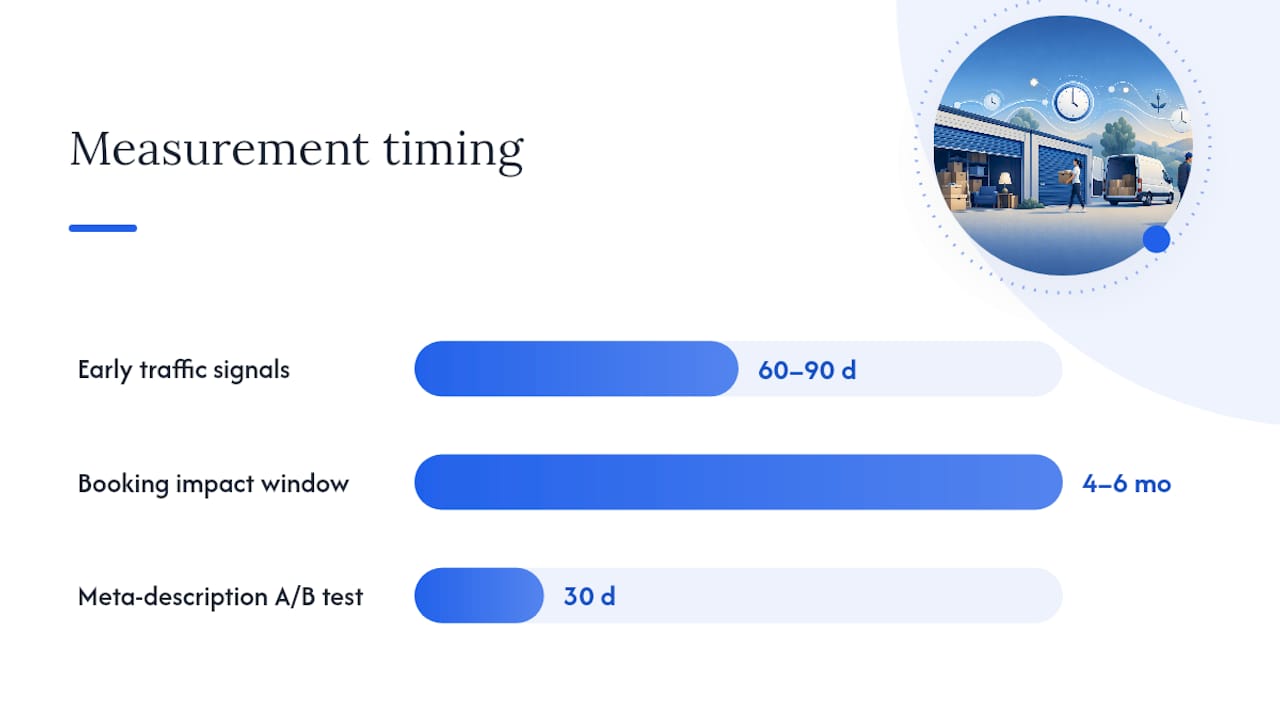
Track four numbers monthly: organic traffic to blog pages, map-pack impression share, phone or reservation conversions attributed to blog referral traffic, and keyword position movement on your priority terms. Expect early traffic signals within 60 to 90 days and measurable booking impact within four to six months of consistent publishing. Run a simple A/B test by publishing two versions of your size-guide meta description and tracking click-through rate over 30 days before committing to one format across all posts.
Ready-to-Use Templates and a 4-Post Starter Calendar
Copy these headline and meta description templates directly. Each one is built around a topic cluster proven to convert.
- "What Size Storage Unit Do You Need? A Room-by-Room Guide"
- "How to Store [Item] Without Damage: A Step-by-Step Guide"
- "Moving to [City]? Here's Your Complete Storage Checklist"
- "Storage Units Near [Neighborhood]: Prices, Sizes, and What to Know"
- "Climate-Controlled Storage: Is It Worth the Extra Cost?"
- "Downsizing at Retirement: What to Keep, Store, and Let Go"
| Week | Post Topic | Format | Repurposing Action |
|---|---|---|---|
| 1 | Unit-size calculator guide | Interactive tool + guide | Google Business Profile post + email blast |
| 2 | Neighborhood page (busiest area) | Local landing page | Social carousel with local landmarks |
| 3 | Item-specific how-to (top request) | Checklist with photos | Printable PDF for front-desk handout |
| 4 | Life-event page (moving or downsizing) | Long-form guide | Short video summary for social |
Run every post through a quick checklist before publishing: does it match real search intent, does it link to your booking page, does it carry FAQ schema, and did you schedule a matching Google Business Profile post? One long article can multiply into social posts, an email, a printable handout, and a short video, extending its reach well past the original publish date according to SoftScotch's repurposing guidance.
Pro Tip: Turn your best-performing blog post into a Google Business Profile update within the same week it publishes. The overlap in timing tends to lift both the post's traffic and the profile's local visibility at once.
What I'd Tell an Owner Sitting on a Blank Blog
Most operators overthink topic selection and underthink sequencing. The mistake isn't picking a bad topic, it's publishing a moving checklist before you've published a unit-size guide, or writing ten item-specific posts before you've built a single neighborhood page for your busiest zip code. Sequence beats volume every time I've seen it tested.
If you have an internal marketing person with two or three hours a week, the starter calendar above is genuinely enough to see movement in 60 to 90 days. If you're running a single-location facility with no dedicated content person, or you're watching a competitor's Google Business Profile outrank you in a market where you should be winning, that's the point to bring in a specialist rather than let the blog sit half-finished for another quarter.
— Mike
Let Corvane Systems Handle the Blog While You Handle the Move-Ins
An alternative to hiring a marketing employee or juggling multiple freelancers for self-storage content is a service charging a flat monthly rate covering technical SEO, local search positioning, and a set number of AI-optimized articles monthly, built around relevant topic clusters.
If you're stretched thin on time, experiencing low occupancy, or watching your Google Business Profile lag behind competitors in the map pack, such services aim to close that gap. Such services may include ongoing AI visibility audits across platforms like ChatGPT, Claude, Perplexity, and Google's AI Overviews, so you can understand how your facility appears beyond traditional search rankings. For facilities that need a stronger site foundation before content can convert, a custom-built site from a partner like Dot Xero can round out the technical side.
Check out the Corvane Systems landing page to see current pricing and get a sense of what a flat-rate content and SEO plan would look like for your facility.
Sources
- Content Marketing for Self-Storage (Unit-Fill Playbook) | Instant Press
- Blog Ideas for Storage Facilities | SoftScotch
- The Best Self-Storage Blogs and What Makes Them Truly Awesome | Kinnovis
FAQ
What Blog Topics Should a Storage Facility Publish First?
Start with a unit-size calculator guide, one neighborhood page for your busiest service area, and two or three item-specific how-tos before moving into life-event content.
How Many Blog Posts Does a Storage Facility Need?
Single-location facilities typically need 20 to 40 posts to cover their core topic clusters, while operators in competitive metro markets often need closer to 60 to compete in both Google and AI results.
Do Storage Blog Posts Actually Help With Bookings?
Yes. Posts built around unit-size decisions, local neighborhoods, and life events sit closer to the booking decision than generic tips content, and syncing them with Google Business Profile updates amplifies local ranking signals.
How Often Should a Storage Facility Publish New Blog Content?
Two to four posts per month is a sustainable cadence for a small team, with seasonal topics published four to six weeks ahead of expected demand.
Should I Write Blog Content Myself or Hire a Specialist?
If you have a few hours a week and can follow a structured calendar, DIY works fine to start; once you're stretched too thin to publish consistently or you're losing local visibility to competitors, a service like Corvanesystems can take over content and SEO on a flat monthly rate.