
The fastest way to improve storage map pack ranking is completing every field on your Google Business Profile, then compounding that with steady reviews and a location page that matches what your listing already says. Claim and verify your profile first, fix any name, address, or phone mismatches across the web, then follow the 30-day checklist below. Do that, and most facilities see measurable movement within a couple of months.
TL;DR:
- Claiming and verifying your Google Business Profile is essential to prevent hijacking, and filling out all fields with accurate, consistent information boosts ranking.
- Regularly requesting reviews seven to ten days after move-in and responding within 48 hours improves your visibility and credibility in local searches.
- Maintaining NAP consistency across all directories and updating the location page with structured data and fresh photos ensures your listing stays relevant and authoritative.
- Conduct geo-grid searches across your service area monthly to track visibility scores, identify weak zones, and gain a realistic picture of your market coverage.
- Automated tools for rank tracking, citation management, review requesting, and reporting can streamline ongoing optimization, especially for operators managing multiple facilities.
Table of Contents
- What Actually Determines Storage Map Pack Ranking?
- Claiming and Optimizing Your Google Business Profile
- How Do You Get Storage Renters to Leave Reviews?
- Why NAP Consistency Still Breaks Storage Rankings
- Building a Location Page That Backs Up Your Listing
- Structured Data and Photos: The Machine-Readable Layer
- How Do You Measure Map Pack Ranking Across a Service Area?
- The 30-Day Storage Map Pack Ranking Playbook
- Which Tools Are Worth Paying for at a Single Facility?
- What Storage Operators Consistently Get Wrong on GBP
- A Managed Alternative for Operators Who Don't Have the Time
- Sources
What Actually Determines Storage Map Pack Ranking?
Google ranks the local map pack using three inputs: relevance, distance, and prominence. That framework comes straight from BrightLocal's breakdown of the Local Pack, and it applies to storage facilities the same way it applies to plumbers or pizza shops, just with a twist on distance.
Relevance is how well your profile and website match the search. A renter typing "climate controlled storage near me" needs to see that phrase, or something close to it, reflected in your categories, services, and page copy.
Distance carries outsized weight for storage specifically. Renters don't drive across town to save $10 a month on a unit; they pick the closest facility that meets their needs. Search a keyword from three different points in your service area and you'll often see three different sets of competitors in the map pack, sometimes with your facility missing entirely from one.
Prominence covers everything that signals authority: review count, review rating, citation consistency, and general web visibility. It's the factor most operators neglect because it takes ongoing work rather than a one-time fix.
The mistake most owners make is checking their rank once, from their office computer, and calling it done. That single search only tells you how you rank from one point for one phrase. A renter searching from the neighborhood two miles east sees an entirely different map pack. That's why serious local storage ranking work requires a grid check, not a glance.
- Relevance: category accuracy, service keywords, matching website copy
- Distance: physical proximity to the searcher, which varies by query location
- Prominence: reviews, citations, backlinks, and overall web authority
- Query phrasing: "storage units" vs "self storage" vs "climate controlled storage" can each pull different competitors
Claiming and Optimizing Your Google Business Profile
Nothing else on this list matters if your profile isn't verified and locked down. Facilities get profiles hijacked or duplicated more often than owners realize, usually because nobody claimed it first or access was left with a former employee.
- Claim and verify ownership through Google Business Profile, using a business email tied to your domain, not a personal Gmail account.
- Lock down access by adding only current staff as managers and removing anyone who has left the company.
- Pick the right primary category. "Self Storage Facility" is the correct primary category for most operators; add secondary categories like "Moving Supply Store" only if you genuinely sell boxes and packing materials on-site.
- Fill every field completely: exact address, local phone number, website URL, service area radius, access hours (which often differ from office hours), attributes (drive-up access, climate control, 24-hour access), and the products/services section listing unit sizes.
- Upload photos strategically, covering exterior signage, gate and access points, hallway conditions, and at least one photo per unit size category. Aim for 15 to 20 photos at launch and add two or three new ones monthly.
- Post updates regularly, at minimum twice a month, covering promotions, seasonal reminders (moving season, holiday storage), or facility improvements.
Incomplete profiles are exactly the kind storage-specific local SEO research flags as the most common reason a facility underperforms in its own backyard.
Pro Tip: Set a recurring calendar reminder to check your GBP "Updates" tab monthly. Google sometimes auto-suggests edits based on user-submitted photos or Q&A, and if you don't review them, incorrect information can sit live for months.
How Do You Get Storage Renters to Leave Reviews?
Review count and review recency both feed prominence, and prominence is the one lever you can pull every single week without touching a line of code. Timing the ask matters more than the wording.
The best moment to request a review is seven to ten days after move-in, once the renter has actually used the unit and access system, not the day they sign the lease. A second good window is right after a positive staff interaction, like helping someone troubleshoot a gate code or swap to a bigger unit.
Send the request by text message first; SMS response rates for review requests consistently beat email for local service businesses. Follow up once by email three days later if there's no response, then stop. Repeated nagging drives complaints, not stars.
- Text within ten days of move-in with a direct link to your Google review page
- Follow up once by email if there's no response after three days
- Ask staff to mention reviews verbally during positive in-person interactions
- Never offer discounts or incentives in exchange for reviews (this violates Google's policies)
Respond to every review within 48 hours. For five-star reviews, thank the renter by name and mention something specific from their comment. For one-star reviews, respond calmly, acknowledge the issue, and move the conversation offline with a phone number or email. Google and renters both notice when an owner engages professionally with criticism.
Watch your review velocity, not just your total count. A facility with 200 reviews but nothing new in eight months looks less active to Google's prominence signal than a competitor steadily adding three or four reviews a month. If you see a dip, it usually traces back to a staffing change that broke the ask-for-review habit. For deeper templates and cadence guidance, see this storage facility review playbook.
Pro Tip: Keep a simple spreadsheet logging review dates alongside staff schedules. When velocity drops, you'll usually find the gap lines up with someone leaving or a new hire who wasn't trained on the ask.
Why NAP Consistency Still Breaks Storage Rankings
NAP stands for name, address, and phone number, and inconsistency across the web is one of the quietest ways a facility loses map pack ranking storage visibility without the owner ever noticing. If your Google listing says "123 Main St Suite B" and your Yelp listing says "123 Main Street," Google can't always confirm they're the same entity, which weakens the prominence signal you've otherwise earned.
Priority listings to check, in order:
- Google Business Profile (the anchor record everything else should match)
- Bing Places for Business
- Apple Maps / Apple Business Connect
- Yelp, Facebook, and Nextdoor
- Industry-specific directories like SpareFoot or Storage.com
- Data aggregators like Data Axle and Foursquare, which feed dozens of smaller directories
Run a manual audit quarterly: search your facility name plus city, open every listing that surfaces, and log the exact name, address, and phone format on each. Fix mismatches directly on the platform, and for aggregator-fed listings, correct the source record rather than chasing each individual site. A citation building checklist built for storage operators can shortcut this process considerably.
Building a Location Page That Backs Up Your Listing
Your Google Business Profile makes a claim. Your website has to back it up, or Google treats the mismatch as a relevance problem. Every physical facility needs exactly one canonical page, never a shared "locations" page trying to represent multiple addresses at once.
- Mark up the address using structured data so the page and the GBP entry are unmistakably describing the same business.
- List access hours prominently, separate from office hours, since this is the detail storage renters search for most and get wrong most often when they rely on generic hours widgets.
- Break out unit types and sizes with dimensions and typical use cases (a 5x10 for a studio apartment, a 10x20 for a garage clear-out), not just a price list.
- Add clear calls to action above the fold: a phone number, a reserve-online button, and a link to check current availability.
- Write service-area copy naming the neighborhoods and ZIP codes you actually serve, using the language locals use, not generic filler about "convenient storage solutions."
- Optimize for mobile first. Most map-pack traffic clicks through on a phone, often while standing in a parking lot deciding where to drive next.
- Link internally from your homepage and blog content back to the location page, and make sure any citation you build points to that same URL, not your homepage.
Structured FAQ and pricing sections on the page also give Google more text to match against long-tail searches like "storage units near me under $100." For a deeper build-out specific to storage sites, this self-storage SEO guide walks through the on-page details.
Structured Data and Photos: The Machine-Readable Layer
Schema markup tells Google exactly what your business is instead of leaving it to guess from surrounding text. For a single facility, the ProfessionalService schema type covers the necessary ground, and LocalBusiness works as a close alternative depending on your site builder.
Properties worth prioritizing:
name,address, andtelephonematching your GBP exactlyopeningHoursSpecificationreflecting access hours, not office hoursgeocoordinates pinned to the physical facilitypriceRangeor specificoffersfor unit types where your site displays pricing
Once markup is live, run it through Validator and Google's rich results test before publishing. Skipping validation is how a single misplaced comma quietly breaks an entire markup block for months.
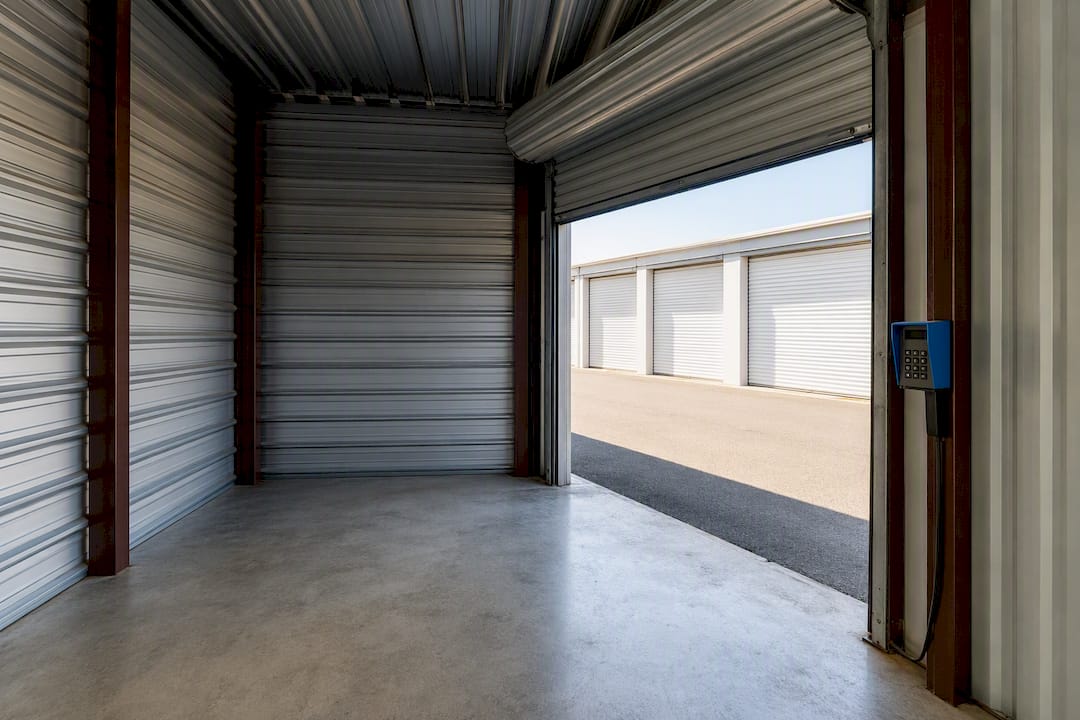
Photos deserve the same attention as code. Your GBP cover image should show the facility entrance or signage, not a stock photo of boxes. Add unit interiors, gate access points, and clear signage shots, and write descriptive alt text on every website image ("10x10 drive-up storage unit interior with roll-up door") rather than leaving the filename as the description.
How Do You Measure Map Pack Ranking Across a Service Area?
A single search from your office tells you almost nothing useful. Map pack position shifts by query and by location, which is exactly why Maps Agent's explainer on map pack ranking recommends treating any one-point check as a snapshot rather than a verdict.
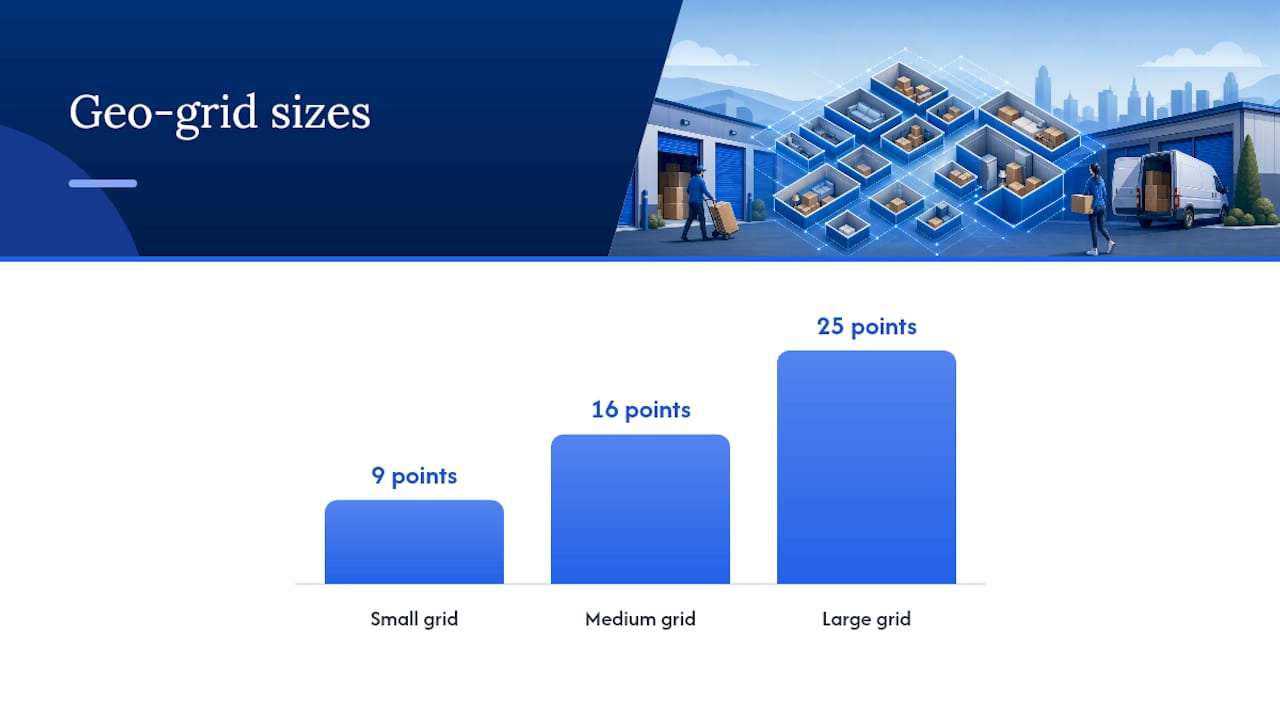
A geo-grid check runs the same search term from a grid of points spread across your service area, typically 9, 16, or 25 points depending on how large that area is. The output rolls up into a visibility score, a single number representing what percentage of that grid shows your facility in the top three map pack results.
Track these KPIs alongside the visibility score:
- Map pack impressions, pulled from GBP insights
- Clicks to call and clicks for directions, both tracked in GBP insights
- Website clicks originating from the profile
- Review count and average rating trend over rolling 30 and 90 day windows
Check your geo-grid monthly at minimum. A visibility score that drops more than 15 to 20 points between checks should trigger a deeper audit: a competitor may have added a location, your GBP may have an unnoticed edit, or a citation mismatch may have surfaced. Georanktracker's map pack tracker and similar tools automate this grid process so you're not manually searching from a dozen browser tabs.
Statistic to watch: because rank position varies by exact search location, the only trustworthy way to know your real market coverage is a grid average, not any single search result.
The 30-Day Storage Map Pack Ranking Playbook
This sequence is built to compound. Each week's work makes the next week's task more effective, so resist the urge to skip ahead to reviews before the profile itself is clean.
Week 1: Fix the foundation.
- Claim and verify your Google Business Profile if you haven't already, and remove any former staff with manager access.
- Correct your primary category and fill every empty field: hours, service area, attributes, and unit types.
- Upload 10 to 15 priority photos covering signage, access points, and at least one unit per size category.
- Search your business name plus city and fix any glaring name, address, or phone mismatch you spot on the first page of results.
Week 2: Turn on reviews and start the citation audit. 5. Set up a text-message review request triggered seven to ten days after every move-in. 6. Train front-desk staff on responding within 48 hours to any new review, with a simple script for both positive and negative feedback. 7. Audit your top ten citation sources (Google, Bing, Yelp, Facebook, plus two storage-specific directories) and log every mismatch you find. 8. Correct the citations you can fix directly; flag aggregator-fed ones for correction at the source.
Week 3: Strengthen the website. 9. Publish or update your facility's location page with correct schema markup, access hours, and unit-size breakdowns. 10. Confirm the page loads cleanly on mobile and that the phone number and reserve button are visible without scrolling. 11. Run your schema through validator.schema.org and fix any flagged errors. 12. Add two or three fresh photos to the GBP and post one update covering a seasonal promotion or facility note.
Week 4: Measure and set the ongoing rhythm. 13. Run a geo-grid check across your service area and note your visibility score as the baseline. 14. Identify the weakest zones on the grid and investigate whether a competitor, a citation gap, or a review shortfall explains it. 15. Set a recurring monthly reminder to repeat the geo-grid check, review the GBP insights dashboard, and post at least two GBP updates.
Pro Tip: Do Week 1's tasks even if you think your profile is "already fine." Roughly half the facilities we've reviewed had at least one stale manager account or an outdated service-area radius nobody had touched since the listing was first created.
Which Tools Are Worth Paying for at a Single Facility?
You need four tool categories, and for a single-location operator, most of them have a usable free tier before you need to spend anything.
- Map pack rank trackers with geo-grid capability, like Georanktracker, report your visibility score across a grid rather than one search point, and they flag which specific zones are weak.
- Citation management tools scan directories for NAP mismatches and, in paid tiers, push corrections automatically rather than requiring you to update each listing by hand.
- Review automation platforms handle the timing logic for review requests (SMS after move-in, email follow-up) so nobody on staff has to remember to send them manually.
- GBP reporting comes built into your profile's Insights tab for free and covers impressions, calls, and direction requests without any additional purchase.
For a single facility, start with free GBP Insights and a basic geo-grid tracker before paying for a full citation-management suite. Multi-location operators get a much stronger return from paid citation tools, since manual audits don't scale past two or three sites. A third-party primer on Google Business Profile optimization is worth a read if you want more detail on the fundamentals before comparing paid platforms.
What Storage Operators Consistently Get Wrong on GBP
Three mistakes show up across nearly every facility profile we've reviewed, and none of them require a developer to fix.
The first is category selection. Owners default to "Storage Facility" as a generic catch-all instead of confirming "Self Storage Facility" is set as primary, and some accidentally leave a moving company or truck rental category as primary from an old setup. The second is NAP drift. A facility moves offices internally, updates its GBP, and forgets that Yelp, Facebook, and three regional directories still show the old suite number. The third is photo neglect. A profile launched with ten photos in 2022 and never touched again looks stale to both renters and to Google's freshness signals, even if the facility itself is well maintained.
If you do nothing else this week, spend twenty minutes checking your primary category and uploading five current photos. That single-day fix has moved the needle for facilities we've worked with faster than almost anything else on this list, mostly because it's the thing owners assume is already correct and never double-check.
— Mike
A Managed Alternative for Operators Who Don't Have the Time
DIY works when someone on staff can commit a few hours weekly to reviews, citations, and profile upkeep. For operators running multiple locations, or a single facility with no spare staff hours, that time rarely materializes, and the checklist above quietly stalls after Week 1.
Corvanesystems built its service specifically around this gap. The flat-rate plan covers technical and on-page SEO, Google Business Profile management, citation and NAP cleanup, review-system setup, and monthly performance reporting, plus AI visibility audits that check how your facility shows up in ChatGPT, Claude, Perplexity, and Google's AI Overviews. There's one flat monthly rate, no tiers, and no long-term contract locking you in. Operators managing two or more facilities, or anyone who simply doesn't have a spare ten hours a month for profile maintenance, tend to see the fastest return from handing this off. If you want a clear read on where your facility currently stands, request an assessment from Corvanesystems and see exactly which fixes would move your visibility score first.