
ChatGPT is now a practical operations tool for self-storage facility operators, not just a writing assistant. With OpenAI's persistent File Library launched in March 2026, paid subscribers can store documents, PDFs, and spreadsheets across multiple sessions, turning ChatGPT into something closer to a working-document hub. For storage operators, that shift matters. You can now keep lease templates, pricing sheets, and customer FAQ documents accessible in one AI-powered workspace, ready to pull into any conversation without re-uploading.
Here is what Storage ChatGPT delivers for your facility:
- Persistent document access across sessions via the File Library with generous storage capacity for individual and enterprise accounts
- AI-driven customer interaction for answering inquiries, qualifying leads, and drafting booking confirmations
- Data privacy controls including the ability to disable model training and use Temporary Chat for sensitive conversations
- Multi-format file support covering PDFs, spreadsheets, presentations, and images
- Admin controls on Business and Enterprise plans for retention policies and compliance management
The term "Storage ChatGPT" is an informal phrase operators use to describe ChatGPT's document and chat management capabilities applied to storage business workflows. The recognized industry framing is AI-assisted document management and customer engagement, and that is exactly what this guide covers.
Table of Contents
- Top use cases for ChatGPT in self-storage operations
- Data privacy and handling for storage businesses using ChatGPT
- Best practices for implementing ChatGPT in your self-storage facility
- How to measure ROI from ChatGPT in your storage business
- Challenges and limitations of using ChatGPT in self-storage operations
- What successful ChatGPT use looks like in storage operations
- Why AI adoption in self-storage requires more than a ChatGPT subscription
- Key Takeaways
- The real opportunity most storage operators are missing
Top use cases for ChatGPT in self-storage operations
1. Generating localized marketing content
ChatGPT writes city-specific unit descriptions, Google Business Profile posts, and seasonal promotions faster than any copywriter on retainer. Feed it your facility's address, unit sizes, and amenities, and it produces geo-targeted copy in minutes. Pair that with a storage website built for AI search and the content actually gets indexed.

2. Answering customer inquiries automatically
Operators use ChatGPT to draft templated responses for the most common questions: unit availability, access hours, climate control options, and pricing. With the right prompt setup, responses stay accurate and on-brand without requiring staff time for every inbound message.
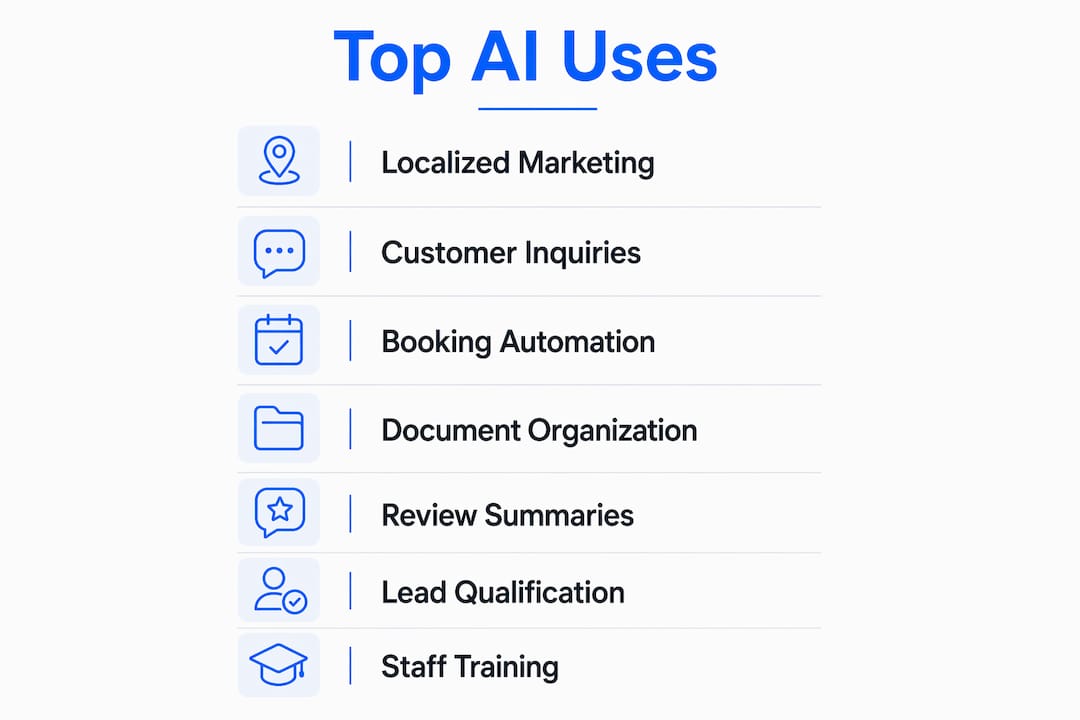
3. Automating booking confirmations and follow-ups
ChatGPT drafts confirmation emails, move-in instructions, and payment reminders. The output needs a human review pass, but the drafting time drops from 15 minutes to under two. That adds up across hundreds of monthly transactions.
4. Organizing internal documents in the File Library
Lease agreements, employee handbooks, rate cards, and vendor contacts can all live in ChatGPT's File Library. Individual users can store up to 10GB of documents in the File Library, while enterprise accounts have a 100GB limit.
5. Summarizing customer reviews and feedback
Paste a batch of Google reviews into ChatGPT and ask it to identify recurring complaints or praise. It surfaces patterns in seconds, which would otherwise take an hour of manual reading. That kind of analysis directly informs service improvements and marketing messaging.
6. Qualifying leads and handling FAQs
ChatGPT can power a basic FAQ bot on your website or help your team pre-qualify leads by generating screening questions. Operators who want to convert more web traffic into qualified storage leads find that AI-assisted lead handling cuts response lag significantly.
7. Supporting staff training
New hires can use ChatGPT to run through scenario-based training prompts: how to handle a late payment call, how to explain climate control pricing, or how to walk a customer through the rental agreement. It is not a replacement for hands-on training, but it is a useful supplement.
Data privacy and handling for storage businesses using ChatGPT
Privacy is where operators need to read the fine print, not just the marketing copy.
Business and Enterprise customers' data is excluded from model training by default. That is a meaningful protection for commercial users who upload sensitive documents like lease agreements or customer records. Free and Plus accounts do not carry the same default protection, so the plan tier matters.
The File Library introduces a new consideration: files you upload persist in your account indefinitely until you manually delete them. Once deleted, OpenAI retains the data on its servers for a limited period before permanent removal. For operators subject to state-level data retention rules or self-storage lien law compliance, that 30-day window needs to factor into your data governance policy.
Two privacy tools every operator should know:
- Temporary Chat: Conversations in this mode do not appear in chat history, create no memories, and are not used for model training. Use it for any conversation involving tenant personal information.
- Disable "Improve the model for everyone": Found under Settings > Data Controls, this toggle stops new conversations from contributing to model training on non-enterprise plans.
ChatGPT's AI memory and File Library features are both optional and can be disabled entirely. The platform also carries SOC 2 Type 2 compliance and supports GDPR frameworks, which matters if your facility operates across state lines or handles international customers.
Treat ChatGPT as a convenience layer above your core document systems, not a replacement for them. Regulated records belong in your property management software or a purpose-built document management system.
Best practices for implementing ChatGPT in your self-storage facility
Getting value from ChatGPT in a storage operation comes down to setup and discipline, not just access.
Integrate carefully with your property management software. ChatGPT does not connect natively to most storage management platforms. Use it as a drafting and analysis layer, then transfer outputs into your actual system of record. Copy-paste workflows are fine; unsupervised automation into live tenant records is not.
Use enterprise admin controls if you are on a Business or Enterprise plan. Workspace owners can set retention policies and control whether ChatGPT automatically references Library files when responding. For a multi-location operator, those controls keep data governance consistent across staff accounts.
Build custom prompts for your facility. Generic prompts produce generic output. Write prompts that include your facility name, unit types, local market, and tone of voice. Save those prompts in a document in your File Library so any team member can use them consistently.
Know the mobile limitation. The mobile apps for iOS and Android support recent file access and search but do not yet offer full File Library functionality. If your managers work primarily from phones, plan for that gap.
The File Library is single-user. ChatGPT's Library does not support team collaboration or shared document editing. Files are tied to individual accounts. A shared team document repository still needs a dedicated tool like Google Drive or SharePoint.
Pro Tip: Set a monthly calendar reminder to audit your File Library. Delete documents that are no longer active, and note the 30-day server retention window when timing compliance-sensitive deletions.
How to measure ROI from ChatGPT in your storage business
ROI from ChatGPT in a storage operation is not abstract. It shows up in specific, trackable places.
Start with time saved on content creation. If ChatGPT cuts your monthly marketing copy time from eight hours to two, that is six hours redirected to operations or sales. Multiply that by your effective hourly rate and you have a concrete dollar figure to compare against your subscription cost.
Track lead response time before and after implementing AI-drafted reply templates. Faster responses correlate with higher conversion rates in self-storage, where a prospect who does not hear back within an hour often books elsewhere. Measure your average response time and your close rate on web inquiries over a 90-day window.
For content-driven traffic, monitor organic search rankings and Google Business Profile views monthly. If you are publishing AI-assisted, keyword-targeted content consistently, you should see measurable movement in local search visibility within three to six months. Corvanesystems tracks exactly these metrics for storage operators through monthly reporting that covers keyword rankings, organic traffic, and AI visibility across platforms like ChatGPT and Perplexity.
Challenges and limitations of using ChatGPT in self-storage operations
ChatGPT is genuinely useful, but operators who go in with unrealistic expectations hit friction fast.
The biggest operational gap is the lack of real-time data access. ChatGPT cannot check your actual unit availability, pull live pricing from your management software, or process a payment. It works on what you give it, not on live system data. Any workflow that requires real-time facility information still needs a human or a purpose-built integration.
Accuracy is another real constraint. ChatGPT can confidently produce incorrect information, particularly on local regulations, lien law timelines, or state-specific self-storage statutes. Never use AI output for legal or compliance decisions without verification from a qualified source.
The single-user File Library structure limits team utility. A facility with multiple managers cannot share a single Library, which means document consistency across staff requires a separate system. ChatGPT is not an enterprise AI storage infrastructure tool. High-performance platforms like IBM Storage Scale exist for organizations managing massive unstructured data at scale. ChatGPT's Library serves a different purpose: personal productivity and document organization for individual users.
Finally, mobile functionality remains limited. Full Library access requires the web interface at chatgpt.com, which is a real constraint for operators who manage facilities from the field.
What successful ChatGPT use looks like in storage operations
The operators getting the most from ChatGPT are not using it as a magic solution. They are using it as a disciplined drafting and analysis tool within a clear workflow.
A common pattern: a facility manager uses ChatGPT to draft the month's Google Business Profile posts, review response templates, and a local competitor analysis summary. That content gets reviewed, lightly edited, and published. The whole process takes 90 minutes instead of a full afternoon.
Another effective use is review analysis. Operators paste their last 30 Google reviews into ChatGPT and ask it to identify the top three complaints and the top three compliments. The output informs both operational decisions and marketing copy, with zero spreadsheet work required.
Operators who have connected their AI content strategy to their broader digital presence report that consistent, AI-assisted publishing builds the kind of topical authority that gets a facility recommended by AI tools when someone searches "storage near me." That is the compounding benefit most operators are not yet capturing.
Why AI adoption in self-storage requires more than a ChatGPT subscription
The self-storage industry is in the middle of a real shift in how customers find and choose facilities. Search is moving from blue links to AI-generated answers, and most operators are not yet visible in that layer.
ChatGPT's File Library and AI capabilities are genuinely useful for internal productivity and content drafting. But they do not, on their own, make your facility visible to the AI tools your future tenants are using to make decisions. That requires structured digital presence work: the right schema markup, consistent local citations, AI-optimized content published at volume, and an understanding of how language models index and recommend local businesses.
Corvanesystems was built specifically for this gap. We combine traditional SEO with Generative Engine Optimization, publishing 30 keyword-targeted articles monthly, auditing your facility's visibility across ChatGPT, Claude, Perplexity, and Google AI, and tracking the rankings that actually drive bookings. One flat monthly rate, no contracts.
If your facility is not surfacing when someone asks an AI assistant where to rent a unit, Corvanesystems is the place to start fixing that.
Key Takeaways
ChatGPT's persistent File Library and privacy controls make it a practical productivity tool for storage operators, but AI visibility across search and recommendation platforms requires a dedicated content and SEO strategy.
| Point | Details |
|---|---|
| File Library storage limits | Individual users have a 10GB storage limit, and Business/Enterprise accounts have a 100GB storage limit. |
| Data privacy default | Business and Enterprise users' data is excluded from model training by default. |
| Deleted file retention | Files deleted from the Library are retained on OpenAI's servers for up to 30 days before permanent removal. |
| Mobile limitation | Full File Library functionality is web-only; mobile apps support only recent file access and search. |
| AI visibility gap | ChatGPT productivity tools do not make your facility visible to AI recommendation engines without a structured content and SEO strategy. |
The real opportunity most storage operators are missing
The conversation around ChatGPT in self-storage tends to focus on what the tool can do inside your workflow. That is useful, but it is the smaller half of the opportunity.
The larger shift is happening outside your facility's walls, in the AI tools your prospective tenants are using right now to decide where to rent. When someone asks ChatGPT or Perplexity "best storage near downtown Austin," the facilities that surface are not the ones with the most square footage. They are the ones whose digital presence is structured in a way that AI systems can read, understand, and recommend.
Most operators are not there yet. The ones who move first on AI-optimized content and local search structure will hold a durable advantage, because AI recommendation patterns, once established, are slow to shift. The window to build that position is open now, and it will not stay open indefinitely.