
A 10x10 storage unit measures exactly 10 feet wide by 10 feet deep, giving renters 100 square feet of floor space. Most facilities pair that footprint with an 8-foot ceiling, yielding roughly 800 cubic feet of usable volume, though some properties offer 9- or 10-foot ceilings that add meaningful capacity. For operators, this is your highest-demand medium unit. It sits at the sweet spot between "too small for a real move" and "too expensive for a single-room cleanout," which means it fills fast and turns over regularly.
- Floor area: 100 sq ft (10 ft × 10 ft)
- Standard volume: ~800 cu ft at an 8-ft ceiling
- Common comparison: roughly half a one-car garage or a small bedroom
- Operator priority: publish ceiling height, door type, and access details on every unit page so AI systems and search engines can extract and surface those facts
Table of Contents
- What fits in a 10x10 storage unit?
- How door type and aisle planning affect usability
- How to price a 10x10 unit and read demand signals
- Organization tips that help renters visualize the space
- SEO and AI visibility tactics for marketing your 10x10 units
- A ready-to-publish 10x10 unit page template
- Key Takeaways
- Why AI-ready unit pages convert better in 2026
- Corvanesystems helps operators fill 10x10 units faster
- Useful sources and further reading
What fits in a 10x10 storage unit?
The 10–15 ft moving-truck rule is the most useful shorthand: if a renter's belongings fill a truck that size, a 10x10 unit is almost always the right call. That covers the contents of a one- to two-bedroom apartment, including a king mattress set, sofa, dresser, lamps, small appliances, and a stack of boxes.
For business renters, the unit handles seasonal inventory, trade-show equipment, filing cabinets, and shelving units without issue.
Realistic box counts matter. Marketing copy sometimes claims 140+ boxes, but that figure assumes a perfect Tetris stack with no room to walk. Once you factor in a usable central aisle, the realistic range is 50–100 boxes. Publish the aisle-inclusive number. Renters who show up expecting 140 boxes and can't close the door become bad reviews.
| Reference point | Approximate equivalent |
|---|---|
| Moving truck size | 10–15 ft truck |
| Household rooms | 1–2 bedrooms |
| Garage comparison | Half of a one-car garage |
| Realistic box count (with aisle) | 50–100 boxes |
| Vehicle fit | Motorcycle or jet ski only — no full-size cars |
Pro Tip: Use the moving-truck comparison in your unit-page headline and Google Business Profile description. "Fits a 10–15 ft moving truck" is a phrase renters already understand, and it reduces sizing questions before they call.
How door type and aisle planning affect usability
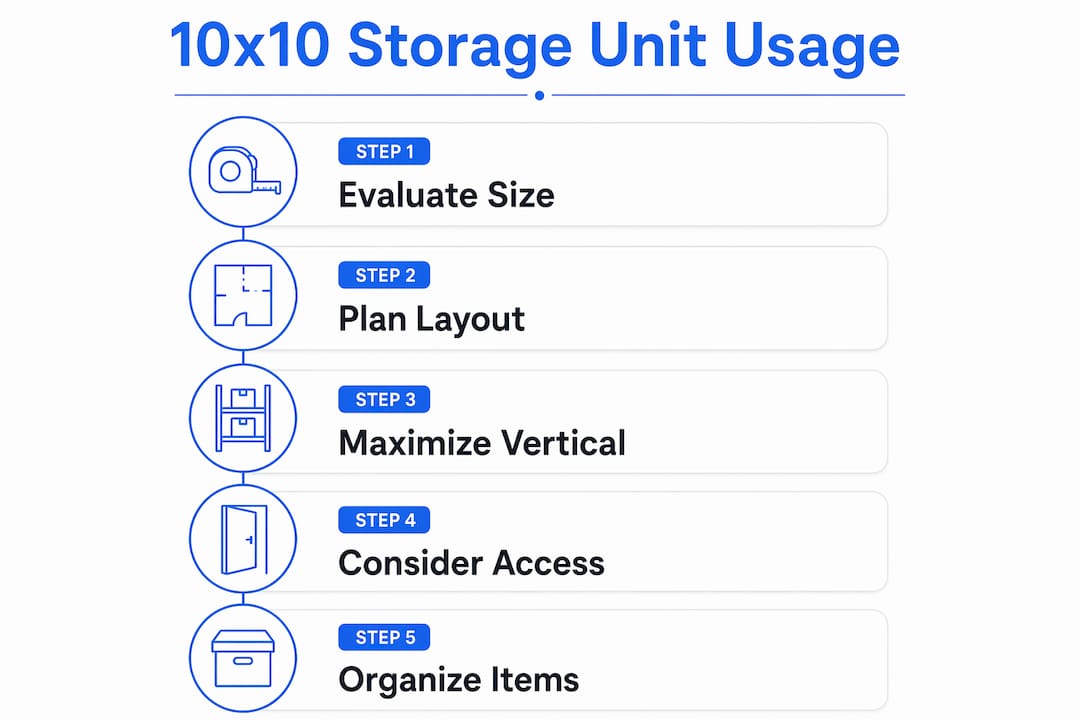
The aisle factor is the single most overlooked detail in unit-page copy. A 10x10 unit with no central aisle is effectively a wall of boxes the renter can never access after move-in. Operators who explain aisle planning upfront convert better and generate fewer complaints.
Door and building type change the picture significantly. Roll-up doors on ground-level, drive-up units let renters back a truck directly to the opening, which makes loading faster and reduces the need for wide internal clearance. Indoor multi-story units typically sit behind wide hallways with elevator access, which changes how renters stage a move-in. Neither is better, but the difference matters to the renter deciding between two facilities.
A short layout checklist to add to your unit pages:
- State door type (roll-up vs. swing) and opening width
- Note whether drive-up access is available
- Specify indoor vs. outdoor/ground-level location
- Recommend leaving a 2-ft central aisle for repeat access
- Flag that small recreational vehicles like motorcycles or jet skis may fit, but full-size cars do not
How to price a 10x10 unit and read demand signals
Pricing for 10x10 units varies widely by market, amenity set, and time of year. There is no universal rate, but there are clear levers operators can pull.
- Local market rate: Check competitor pricing monthly. A $10 gap in either direction affects conversion more than any other single variable.
- Seasonality: Demand spikes in late spring and summer as people move, renovate, or transition between leases. Raise rates slightly heading into peak season; use short-term promos to stabilize occupancy in slower months.
- Amenity premium: Climate-controlled units and drive-up access both justify higher rates. If you offer either, price it separately and say so explicitly on the unit page.
- Availability signal: When occupancy on 10x10 units exceeds 85%, test a rate increase. When it drops below 70%, run a first-month promotion before cutting the base rate.
- Google Business Profile: Update your GBP description when you run a promotion. AI systems and local search both pull from that field, and a stale description costs you clicks.
For a deeper look at yield strategy, the 2026 pricing guide covers dynamic rate-setting in detail.
Organization tips that help renters visualize the space
Staging photos and written guidance do real conversion work. A renter who can picture their furniture in the unit is more likely to book without calling. Show a central aisle in every photo. A stacked mattress against the back wall, labeled boxes on one side, and a clear path from the door to the rear is all it takes.

Vertical space is underused. With an 8-foot ceiling, a standard shelving unit leaves 2–3 feet of clearance above the top shelf. Publish your actual ceiling height on the listing. A facility with 10-foot ceilings offers significantly more cubic capacity than one with 8-foot ceilings, and renters who need vertical stacking will choose you for it.
Advise renters to store frequently accessed items near the door and seasonal or rarely touched items deep inside. That single tip, added to your unit page, reduces the "I can't find anything" calls that eat staff time. For more on practical layouts, the organization systems guide has seven proven examples operators can share directly with renters.
SEO and AI visibility tactics for marketing your 10x10 units
Operators who build AI-ready unit pages with live availability and local use cases gain a measurable discovery edge. The page structure below is what AI systems and search engines actually extract.
| On-page element | Why it helps | Priority |
|---|---|---|
| H1 with unit size + location | Matches search queries and AI prompts | High |
| BLUF paragraph (100 sq ft, ceiling height, door type) | AI citation anchor; answers the question immediately | High |
| "What fits" bullet list | Featured-snippet target; reduces pre-booking questions | High |
| Pricing snapshot with amenity notes | Feeds local pack and AI price comparisons | Medium |
| Availability status (live or updated weekly) | AI systems favor current, accurate data | High |
| Schema markup (Offer/Product) | Structured data improves AI extraction accuracy | Medium |
| CTA with phone + reservation link | Conversion; reduces friction at decision point | High |
Pro Tip: Add a dateModified field to your schema and update it whenever availability or pricing changes. AI crawlers weight recency, and a page last modified six months ago loses ground to a competitor who updated theirs last week.
- Audit your current 10x10 page against the table above.
- Add ceiling height, door type, and aisle guidance if missing.
- Implement basic JSON-LD schema (see the template section below).
- Update availability status at least weekly.
- Refresh your Google Business Profile description each time you run a promotion.
For a full technical walkthrough, the AI search optimization guide covers schema, crawlability, and GEO tactics specific to storage sites.
A ready-to-publish 10x10 unit page template
Drop these copy blocks into your CMS and replace the bracketed fields with your facility's specifics.
BLUF paragraph: Our 10x10 storage units measure 10 ft × 10 ft (100 sq ft) with [X]-ft ceilings and [roll-up / swing] door access. That's enough room for a one- to two-bedroom apartment's worth of furniture, appliances, and boxes — roughly what fills a 10–15 ft moving truck.
What fits (bullet list):
- King or queen mattress set
- Sofa and living room furniture
- Dresser, lamps, and shelving units
- Major appliances (washer, dryer, refrigerator)
- A realistic number of boxes with a central aisle for access
- Motorcycle or jet ski (no full-size vehicles)
Access and aisle note: [Drive-up / indoor hallway] access. We recommend leaving a 2-ft central aisle so you can reach items at the back without unloading the front.
Meta title example:
10x10 Storage Units in [City, State] | [Facility Name]
Meta description example:
Rent a 10x10 storage unit in [City] — 100 sq ft, [X]-ft ceilings, [climate control / drive-up access]. Reserve online today.
JSON-LD snippet (adapt with your facility's values):
{
  "@context": "https://schema.org",
  "@type": "Product",
  "name": "10x10 Storage Unit",
  "description": "100 sq ft self-storage unit, 10 ft × 10 ft floor, [X]-ft ceiling, [door type] access.",
  "offers": {
    "@type": "Offer",
    "priceCurrency": "USD",
    "price": "[monthly rate]",
    "availability": "https://schema.org/InStock",
    "url": "[unit page URL]"
  }
}
Key Takeaways
A 10x10 storage unit's 100 sq ft footprint makes it the highest-demand medium unit in most facilities, and operators who publish precise specs, aisle guidance, and AI-ready schema consistently outperform those who don't.
| Point | Details |
|---|---|
| Publish exact specs | List ceiling height, door type, and access type on every unit page to reduce pre-booking questions. |
| Use realistic box counts | Advertise a realistic box count, not inflated theoretical maximums, to set accurate expectations. |
| Price dynamically | Monitor local competitors monthly and adjust rates around seasonal demand spikes and occupancy thresholds. |
| Structure pages for AI | Add JSON-LD schema, a BLUF paragraph, and a weekly-updated availability status so AI systems can extract and surface your units. |
| Corvanesystems | Corvanesystems builds and optimizes AI-ready unit pages for storage operators, combining technical SEO with GEO to increase 10x10 occupancy. |
Why AI-ready unit pages convert better in 2026
Most facility operators underestimate how much a structured, specific unit page does for them. A page that states "100 sq ft, 8-ft ceiling, roll-up door, drive-up access" in the first two sentences is not just clearer for human readers. It is the exact format that ChatGPT, Perplexity, and Google's AI Overviews pull from when someone asks "what size storage unit do I need for a one-bedroom apartment?" Generic pages that bury specs in a paragraph three screens down simply don't get cited.
The operators I see winning in competitive markets treat their unit pages the way a product listing manager treats an e-commerce page: precise specs up front, a realistic "what fits" list, a clear price signal, and a CTA that doesn't make the renter think. That combination works in organic search, in AI-generated answers, and in the moment a renter is standing in a parking lot comparing two facilities on their phone. The AI visibility guide has a diagnostic checklist if you want to score your current pages before making changes.
Corvanesystems helps operators fill 10x10 units faster
Most storage operators have good units and weak pages. Corvanesystems fixes the second problem. We publish 30 keyword-optimized, AI-structured articles per month for your facility, run technical SEO audits, optimize your Google Business Profile, and score your visibility across ChatGPT, Claude, Perplexity, and Google's AI Overviews — all at a flat monthly rate with no contracts.
If your 10x10 unit pages are missing ceiling heights, schema markup, or a clear "what fits" list, those gaps are costing you bookings right now. A free AI visibility audit from Corvanesystems shows exactly where you stand and what to fix first. Schedule yours today.
Useful sources and further reading
Primary sources used in this article:
- CubeSmart — 10x10 Storage Unit Size Guide
- Public Storage — 10x10 Unit Guide
- Extra Space Storage — 10x10 Unit Size Guide
- 10 Federal Storage — How Big Is a 10x10 Storage Unit?
- StorageUnitGuide.org — 10x10 Storage Unit Guide
- U-Haul — 10x10 Storage Unit Information
- Stoots Storage Solutions — Facility consultation and metal storage structures
Corvanesystems resources for operators:
- Storage Unit Organization Systems: 7 Proven Examples
- How Storage Facilities Set Prices: 2026 Strategy Guide
- AI Visibility for Self Storage: 2026 Operator Guide
- How to Fill Empty Storage Units: 2026 Guide