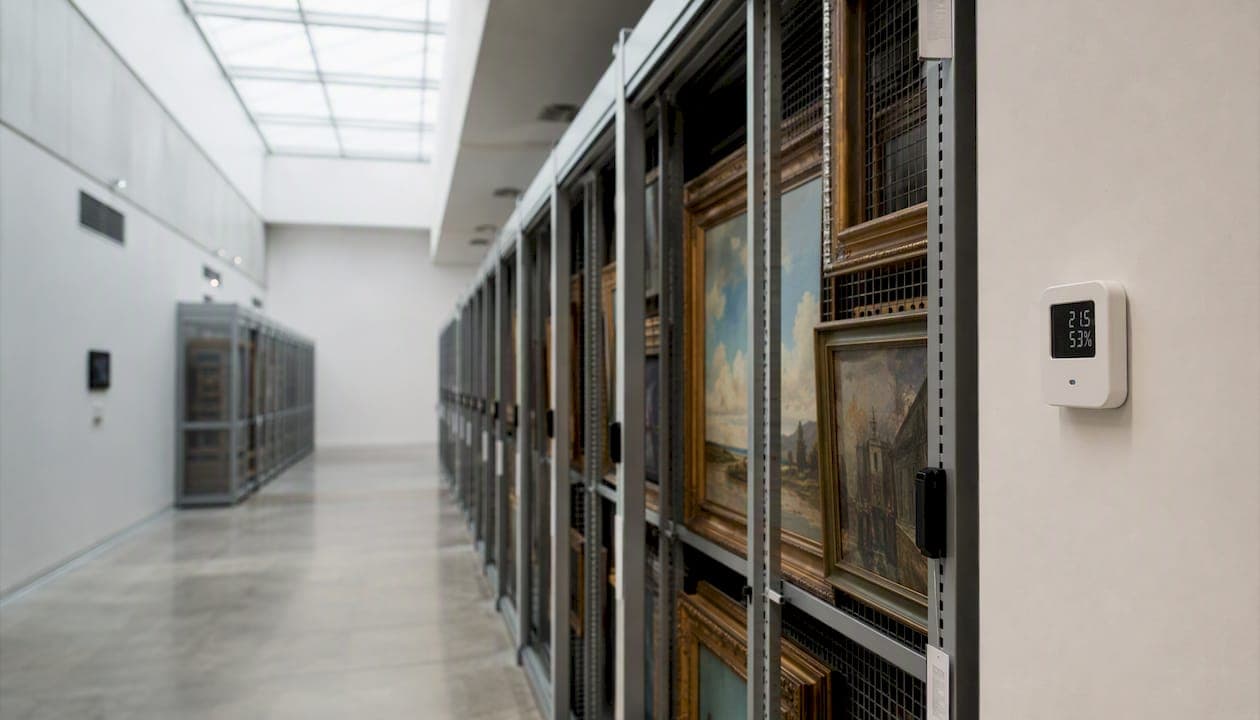
An art storage facility offering, in the self-storage context, is a dedicated set of climate-and-humidity-controlled units combined with enhanced security, documented chain-of-custody handling, and services marketed specifically to collectors, galleries, and institutions. The industry term you'll encounter in institutional circles is "off-site collections storage," defined and governed by the Suggested Practices for Commercial Off Site Museum Storage Companies (commonly called the ICEFAT guidelines). The American Alliance of Museums (AAM) and ISO 11799 set complementary benchmarks for environmental and documentation standards.
For most self-storage operators, adding this offering is viable if you can commit to three non-negotiables: stable climate control, documented security, and trained staff. Skip any one of them and you're not offering art storage; you're offering a regular unit with a premium price tag.
- Climate-controlled units holding 65–70°F and 45–55% relative humidity (RH)
- Electronic access control with logged entry, CCTV with off-site retention, and verified alarm response
- Intake condition reports, property passes, and chain-of-custody documentation on every move
- Staff trained specifically on handling and security for stored works of art
- A Facility Report documenting your compliance with suggested practices
Pro Tip: Before spending a dollar on upgrades, walk your facility with an insurance broker who writes fine-art riders. Their checklist will tell you exactly which gaps to close first and may save you from over-investing in features your target clients don't require.
Table of Contents
- What environmental controls and security features does art storage require?
- What unit types and handling practices work for art storage?
- How should you handle intake, documentation, and staff responsibilities?
- What does it cost to set up, and how do you price art-grade units?
- How do collectors and galleries find your art storage offering?
- Launch checklist and templates you can use this week
- Key Takeaways
- The part most operators underestimate
- Corvanesystems helps your art storage offering get found
- Useful sources
What environmental controls and security features does art storage require?
Temperature and RH stability matter more than the exact set point. Most mixed-media collections tolerate 65–70°F with RH held at 45–55%, but the critical factor is limiting daily swings to no more than ±2°F and ±5% RH. Sudden fluctuations crack paint, warp panels, and delaminate photographs faster than a slightly elevated average ever would.
Your HVAC system needs redundancy: a backup unit or at minimum a monitored failover alert so a compressor failure at 2 AM doesn't go undetected until Monday morning. Add MERV-13 or better filtration to control particulates, and keep air circulation gentle enough to avoid vibration near racked works.
The sensor stack that insurers now expect includes temperature/RH sensors with encrypted, tamper-evident telemetry, door contacts, light sensors (UV exposure is a silent killer for pigments), and vibration monitors near racking. Logs should be exportable and retained for several months to support any insurance claim.
| Control Layer | Minimum Spec | Recommended Upgrade |
|---|---|---|
| Temperature | 65–70°F, ±2°F daily swing | Redundant HVAC with failover alert |
| Relative humidity | 45–55%, ±5% daily swing | Dedicated dehumidifier + backup |
| Air filtration | MERV-13 | MERV-13 with activated carbon |
| Sensors | Temp/RH + door contacts | Full IoT stack: light, vibration, tamper-evident |
| Log retention | 6 months | several months, exportable off-site |
On the security side, professional fine-art storage combines 24/7 video surveillance, biometric or credentialed access control, and inert-gas fire suppression. You don't need all of that on day one, but you do need: badge or PIN access with a timestamped log, CCTV covering all entry points with footage retained off-site for at least 30 days, a monitored alarm with verified response, and background checks for every staff member with access.
Operationally, the ICEFAT guidelines call for a supervisory role that is distinct from your security officers, and they specify additional specialized training hours for staff whose primary responsibility is protecting works of art. Document that training. Collectors and institutional clients will ask.
Pro Tip: Run a background check on every employee with art-area access, not just new hires. Insurers writing fine-art endorsements often require documented, recurring screening as a policy condition.
What unit types and handling practices work for art storage?
Dedicated interior climate-controlled rooms are the strongest option. A standard 10×10 or 10×20 interior unit with its own HVAC zone, sealed walls, and no exterior exposure gives you the most stable environment. If you're retrofitting standard units, prioritize interior-facing ones and seal any gaps around doors and conduit penetrations.
Racking matters as much as the room. Picture racks with padded vertical slots keep canvases off the floor and allow air circulation between works. Palletized shelving with non-slip matting handles sculptures and crated pieces. Every anchor point should be non-vibratory; rubber isolators under shelving feet cost almost nothing and prevent transmitted vibration from HVAC equipment.
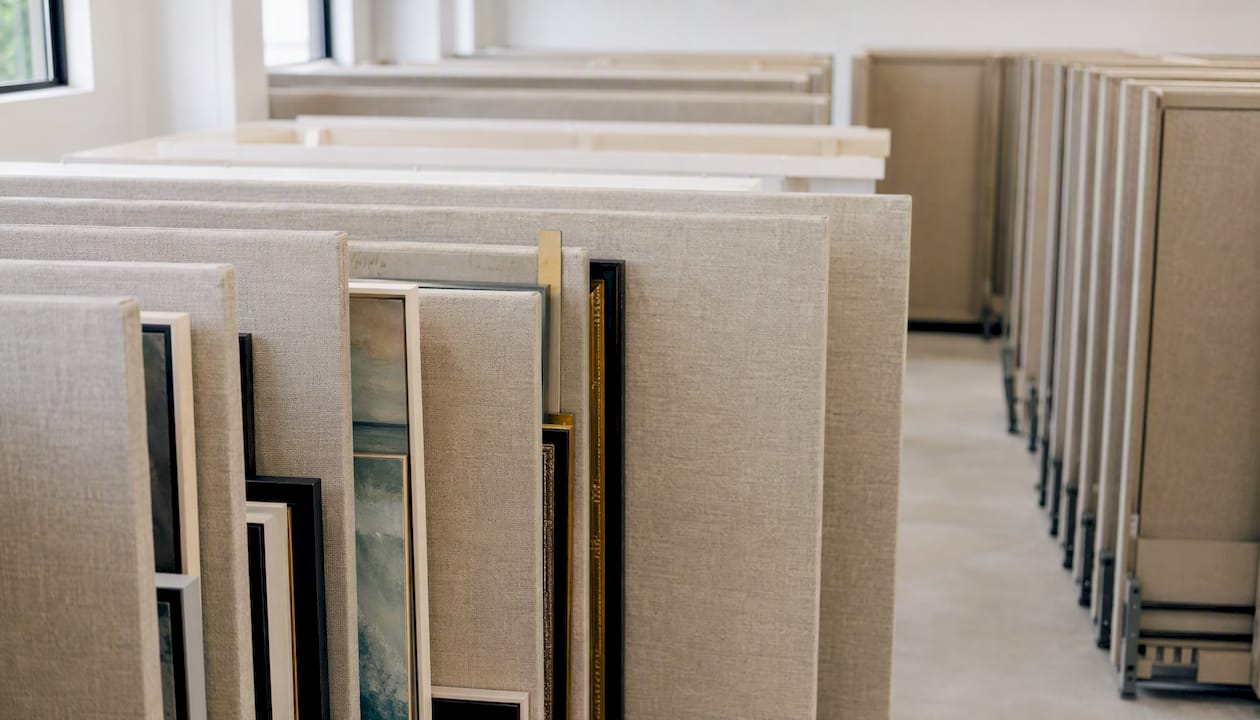
For handling, two-person moves are the rule for anything larger than 24×36 inches or heavier than 30 pounds. Padded carts with adjustable upright supports prevent edge damage during transport within the facility. For inbound or outbound moves involving transport, vibration-damping crates or foam-lined cases protect works from road shock.
Packing materials must be archival: acid-free interleaving tissue, polyethylene foam, and moisture-barrier wrapping. Avoid standard bubble wrap directly against painted surfaces; the texture can transfer under pressure. Tamper-evident seals on crates and boxes create a visible chain-of-custody record that clients and insurers both appreciate.
Pro Tip: Keep a standard transfer kit at your intake desk: a printed condition report template, a roll of tamper-evident tape, a set of numbered evidence bags for small accessories, and a phone mount for hands-free photo documentation. It takes five minutes to assemble and signals professionalism to every client who watches you use it.
How should you handle intake, documentation, and staff responsibilities?
Every inbound move should be appointment-only. Walk-in drops create documentation gaps and rush condition assessments. At intake, complete a condition report covering high-resolution photos of the front, edges, reverse, and any existing labels or markings. Timestamp and geotag every image. For high-value items, require dual signatures on the transfer receipt.
The ICEFAT guidelines are specific about property passes: copies must be retained for no less than one year. All parcels are subject to inspection on arrival, and personal artwork not being stored under contract is not permitted in the building. That last rule protects you from liability and keeps your chain of custody clean.
Your Facility Report is the document that ties everything together. Structure it as a one-page compliance summary with attachments: your current sensor logs, staff training records, insurance endorsements, and a copy of your intake policy. Galleries and institutional clients will request it before signing a contract. Insurers will want it before writing a fine-art rider.
- Confirm appointment and collect client contact and insurance information
- Inspect parcel on arrival; photograph all sides before unsealing
- Complete condition report with dual signatures for items valued above your threshold
- Issue property pass; retain a copy on file for minimum one year
- Assign unit location and log in inventory system with item ID
- Conduct quarterly audits; reconcile inventory against property passes
Pro Tip: Use an offline-capable mobile app for condition reports so documentation doesn't stall in low-connectivity loading docks. Apps that geotag and timestamp automatically create immutable records that hold up in insurance disputes.
What does it cost to set up, and how do you price art-grade units?
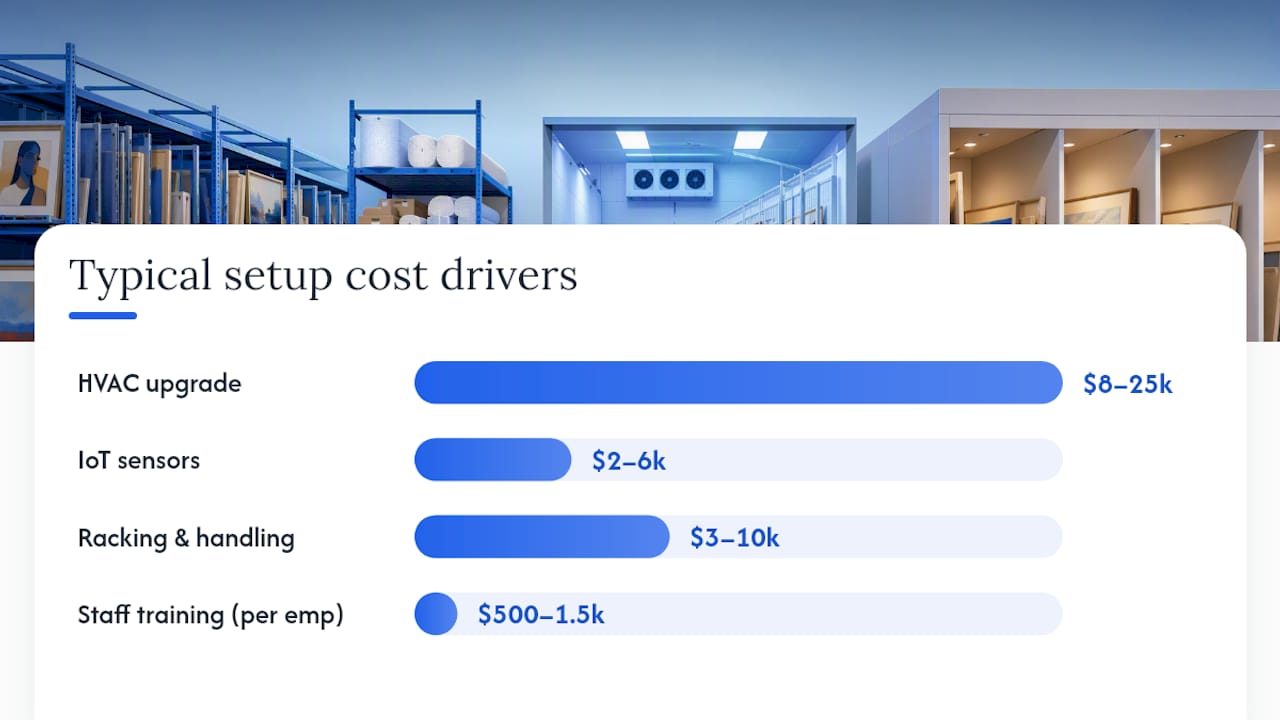
Setup costs vary by your starting point. A facility with existing climate-controlled interior units and a monitored alarm system needs considerably less capital than one starting from scratch.
Common cost drivers:
- HVAC upgrade or dedicated zone: $8,000–$25,000 depending on square footage
- IoT sensor hardware and monitoring subscription: $2,000–$6,000 upfront plus monthly fees
- Racking and handling equipment: $3,000–$10,000
- Staff training (32 hours per person): $500–$1,500 per employee
- Insurance endorsement for fine art: varies by coverage limit; budget for an increased premium
A minimal viable offering (climate + sensors + documentation workflow) can be operational in 4–6 weeks. A full buildout with dedicated racking, biometric access, and a trained team typically runs 3–4 months.
Pricing models that work:
- Premium unit rate: a significant premium above standard climate-controlled pricing
- Per-move handling fee: charged per inbound or outbound transfer
- Monthly storage tiers: base rate plus insured-value surcharge for high-value collections
- Concierge services: packing, transport coordination, and condition-report preparation billed separately
The self-storage guidance from StoragePost confirms that climate control, security, and space planning are the three features collectors prioritize. Price accordingly: clients paying for art storage are paying for certainty, not square footage.
How do collectors and galleries find your art storage offering?
Search and AI discovery are where most operators leave money on the table. A collector searching "climate-controlled art storage [city]" or asking an AI assistant for secure storage near a gallery district needs to find your facility, not a generic self-storage listing.
- Build a dedicated service page for art storage with the phrase "climate-controlled art storage" in the H1, meta title, and first paragraph
- Add an FAQ section answering "what temperature is art storage kept at" and "do you provide condition reports"
- Optimize your Google Business Profile with "art storage" as a service category and appointment-only access noted in your description
- Publish timestamped climate log summaries as proof content; AI systems cite specific, verifiable claims
- Reach out to local galleries, conservators, and art brokers with your Facility Report and a one-page capability summary
For AI visibility specifically, structured content that leads with direct answers gets cited by ChatGPT, Perplexity, and Google's AI Overviews at a much higher rate than generic marketing copy. Your condition report workflow, your temperature specs, and your ICEFAT compliance are exactly the kind of specific, verifiable claims that AI systems surface.
Track: inquiries from galleries and collectors, conversion rate from inquiry to signed contract, and average monthly revenue per stored item. Those three numbers tell you whether the offering is worth scaling.
Pro Tip: Ask every new art-storage client how they found you. If "AI search" or "ChatGPT" starts appearing in those answers, you'll know your structured content is working. If it never does, your pages need more specific, answer-first content.
Launch checklist and templates you can use this week
Phase 1: Policy and infrastructure (Week 1–2)
- Draft intake policy: appointment-only, dual-signature threshold, inspection protocol
- Deploy IoT sensors in target units; confirm telemetry is logging and exportable
- Create Facility Report template with sections for environment, security, training, and insurance
Phase 2: Staff and documentation (Week 3–4)
- Complete 32-hour art-security training for all staff with art-area access
- Build condition report template: client name, item description, dimensions, medium, existing damage notes, photo set (front/edges/reverse/labels), transfer date, dual signatures
- Print property pass pads; set up one-year retention file
Phase 3: Pilot and marketing (Days 30–90)
- Onboard 1–3 pilot clients (gallery contacts or trusted collectors) at a negotiated rate
- Reconcile insurance coverage with broker; add fine-art endorsement
- Publish art-storage service page and update Google Business Profile
- Request a Corvanesystems AI visibility audit to confirm your facility surfaces in AI-assisted searches
Transfer receipt checklist (minimum fields):
- Client name and contact
- Item ID and description
- Declared value
- Condition at transfer (reference condition report number)
- Tamper-evident seal number
- Inbound/outbound date and time
- Staff name and signature
- Client signature
Key Takeaways
An art storage offering succeeds when climate control, security documentation, and trained staff operate together as a system, not as isolated upgrades.
| Point | Details |
|---|---|
| Climate is the foundation | Hold 65–70°F and 45–55% RH with daily swings no greater than ±2°F and ±5% RH. |
| Documentation wins contracts | Property passes retained for one year minimum and a current Facility Report are what galleries and insurers ask for first. |
| Training is non-negotiable | ICEFAT guidance calls for art-specific security training for staff members; document and file certificates. |
| Pricing reflects certainty | Premium unit rates of a significant premium above standard climate-controlled pricing are justified by the documentation and security stack you provide. |
| Corvanesystems accelerates discovery | Structured SEO and AI visibility content helps your art-storage offering surface when collectors and galleries search or ask AI tools for secure storage. |
The part most operators underestimate
The operators who struggle with art storage usually don't fail on the climate control. They fail on the paper trail. A collector whose insurer denies a claim because the condition report was incomplete, or a gallery that walks away because you couldn't produce a Facility Report, represents a much more expensive problem than an HVAC upgrade.
The other thing worth saying plainly: the marketing gap is real. You can build a genuinely excellent art-storage offering and still have it invisible to the collectors and galleries who need it, because your facility's digital presence was built for self-storage renters, not institutional clients. Those two audiences search differently, ask AI tools differently, and respond to completely different trust signals.
The operators who get this right treat the documentation and the marketing as equally important as the hardware. The Facility Report isn't just for compliance; it's your best sales document. The condition report workflow isn't just for claims; it's what a gallery director shows their board when they justify choosing you over a competitor.
Start with the pilot. Three clients, full documentation, honest feedback. You'll learn more in 90 days than any guide can tell you.
Corvanesystems helps your art storage offering get found
Most self-storage facilities that add art-grade units see the same problem: the offering exists, but collectors and galleries can't find it. Generic storage listings don't surface for "climate-controlled art storage" searches, and they're invisible to AI tools like ChatGPT and Perplexity, which now drive a meaningful share of high-intent storage inquiries.
Corvanesystems is built specifically for self-storage operators who need search and AI visibility that matches the quality of their offering. For art storage, that means structured service pages that answer the exact questions collectors ask, Google Business Profile optimization for appointment-only specialty services, and AI-optimized content that gets your facility cited when someone asks an AI assistant for secure art storage in your city. One flat monthly rate, no contracts, no minimums.
If you're ready to make your art-storage offering visible to the clients it was built for, get your AI visibility audit and see exactly where your facility stands today.
Useful sources
-
Suggested Practices for Commercial Off Site Museum Storage Companies — The ICEFAT guidelines document. Consult this for property-pass requirements, record retention minimums, security supervision structure, and the 32-hour staff training standard. The authoritative reference for any operator pitching to institutional clients.
-
Art Storage Security & Insurance Lessons — Practical operator guidance on IoT sensor selection, tamper-evident log requirements, transfer kit contents, and insurer expectations. Use this when specifying your sensor stack and documentation workflow.
-
The 5 Essential Criteria for Proper Fine Art Storage (Fortius) — Covers surveillance, biometric access, inert-gas suppression, timestamped traceability, and conservator-level staffing. Useful as an aspirational benchmark and for understanding what institutional clients may have seen before approaching you.
-
How to Choose a Secure Facility for Fine Art Storage (Fortius) — Explains what specialized insurers and institutional customers require as proof documents, specifically timestamped climate reports and access logs.
-
Storing Art in a Self-Storage Unit (StoragePost) — Self-storage-focused guidance on climate control, security, and space planning for different art media. A useful reference for operators explaining their offering to first-time collector clients.