
Month-to-month storage is a self-storage rental agreement that renews every calendar month automatically, with no long-term lease required. You pay for one month at a time and can leave, stay, or switch units at the end of any period without penalties. This structure makes it the go-to choice for people navigating moves, home renovations, seasonal decluttering, or any situation where storage needs are uncertain. Providers like Elk Country Storage Co., Extra Space Storage, and Public Storage all offer this format, and understanding how it works will help you avoid surprise charges and choose the right unit from day one.
How does month-to-month storage work?
Month-to-month storage, also called a rolling lease or flexible self-storage agreement, operates on a simple cycle. You sign a rental agreement, pay for the first month, and the lease automatically renews each month until you decide to leave. There is no fixed end date built into the contract.

Lease terms and renewal
The lease renews on a calendar month basis. Most facilities bill rent on the first of each month, regardless of when you moved in. If you move in mid-month, many providers will prorate your first payment so you only pay for the days you actually use. After that, you are billed for full months.
Notice requirements
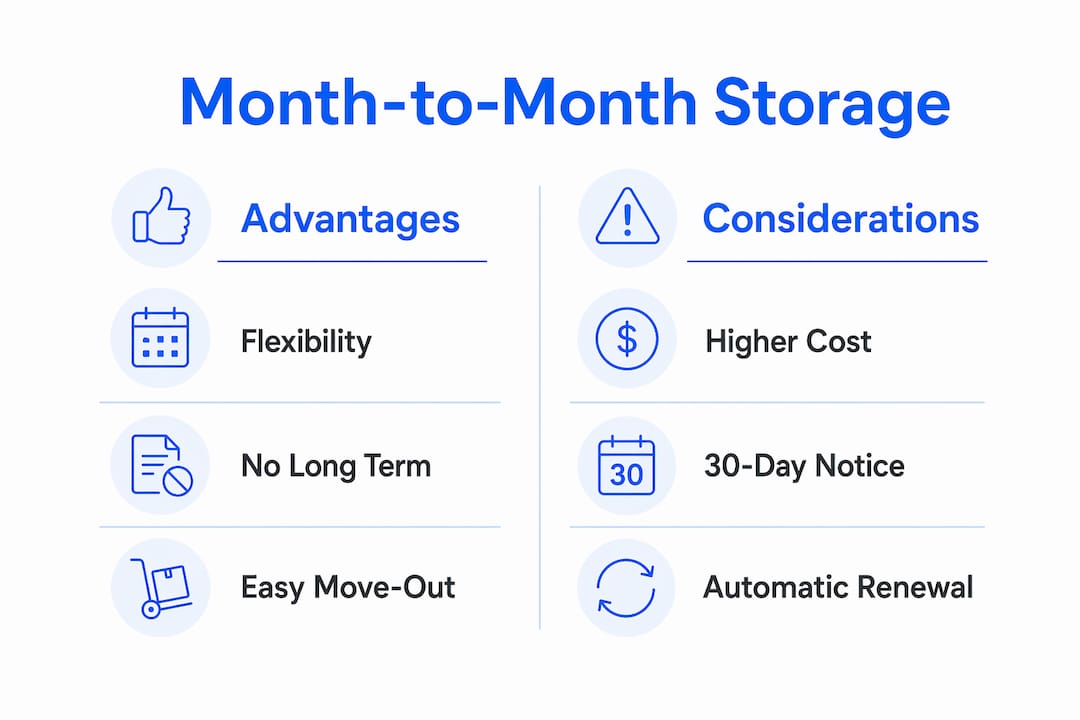
Giving 30-day written notice before moving out is the standard requirement at most facilities. That means if you plan to leave on June 30, you need to submit written notice by June 1 at the latest. Missing that window often means paying for an additional month you did not intend to use. Some facilities require notice immediately after move-in if you already know your timeline, so read the contract carefully on day one.
Deposits and upfront costs
Some facilities require no deposit for month-to-month rentals, which lowers the barrier to getting started. In those cases, you pay only the first month's rent at signing. Other providers may charge a small administrative fee or require a refundable deposit. Always confirm this before signing.
Pro Tip: Ask the facility manager whether your billing date resets to the first of the month or stays tied to your move-in date. That one detail affects how you calculate your notice deadline and your final bill.
Automatic renewals and rate changes
Month-to-month agreements renew automatically, which is convenient but also means rate increases can take effect with relatively short notice. Facilities typically notify you in writing before raising rates, but the threshold varies by state and provider. Set a calendar reminder to review your storage bill every few months so a rate hike does not catch you off guard.
What are the costs of month-to-month storage?
Pricing for month-to-month storage depends on unit size, unit type, and location. A small 5x5 unit in a rural area might run $40–$60 per month, while a climate-controlled 10x20 unit in a major metro can exceed $300 per month. These are not fixed industry benchmarks. They reflect the reality that drive-up access, climate control, city location, and unit size all push prices in different directions.
Common pricing factors
- Unit size: Larger units cost more. A 10x10 typically costs two to three times a 5x5.
- Unit type: Climate-controlled units carry a premium over standard drive-up units, often 25–50% more per month.
- Location: Urban facilities in high-demand markets charge significantly more than suburban or rural equivalents.
- Availability: When a facility runs low on a specific unit size, prices for that size tend to rise.
- Promotional rates: Some providers offer a discounted or free first month to attract new renters, then revert to standard pricing.
Month-to-month vs. long-term lease pricing
Month-to-month rates run higher monthly than long-term lease rates at the same facility. A facility might offer a 10x10 unit at $120 per month on a rolling lease but drop that to $95 per month on a six-month or annual commitment. That $25 monthly difference adds up to $300 over a year.
However, total expected cost over your storage period is the smarter number to track. If you only need storage for two or three months, paying the higher monthly rate with no early termination fee beats locking into a six-month lease and paying a penalty to exit early. The math favors month-to-month for short or uncertain timelines.
Additional fees to watch
- Late payment fees if rent is not received by the due date
- Lock purchase requirements at some facilities
- Access fees for after-hours or gate entry at certain locations
- Rate increase notices, which can arrive with as little as 30 days' warning
Month-to-month vs. long-term storage leases: key differences
The core tradeoff between these two lease types is flexibility versus price. Month-to-month storage costs more per month but commits you to nothing. Long-term leases cost less per month but lock you in for a set period, often six or twelve months, with penalties for early exit.
| Feature | Month-to-Month | Long-Term Lease |
|---|---|---|
| Commitment length | One month at a time | 6–12 months typical |
| Monthly cost | Higher | Lower |
| Early exit penalty | None | Often 1–2 months' rent |
| Flexibility to resize | High | Low |
| Best for | Moves, renovations, short-term needs | Stable, predictable storage needs |
| Deposit requirement | Often none | Sometimes required |
When month-to-month makes more sense
Month-to-month storage works best when your timeline is uncertain. Common scenarios include waiting for a new home to close, storing furniture during a renovation, managing seasonal inventory for a small business, or holding items during a cross-country move. In each case, the ability to adjust unit size or end the rental without breaking a contract is worth the higher monthly rate.
When a long-term lease wins
If you know you need storage for at least a year and your needs will not change, a long-term lease saves real money. A business storing archive files or equipment on a permanent basis benefits from the lower monthly rate and the predictability of a fixed contract. The risk is that life changes and you end up paying penalties to exit early.
Pro Tip: If you are unsure whether you need storage for two months or six, start month-to-month. You can always ask the facility about switching to a longer-term rate once your timeline becomes clear. Most operators will work with you.
Practical tips for using month-to-month storage effectively
Getting the most out of a flexible storage rental comes down to planning and attention to contract details. These steps will help you avoid the most common and costly mistakes.
-
Read the notice clause before signing. Know exactly how many days' notice you need to give and in what format. Written notice via email or certified mail is the standard, but some facilities require a specific form.
-
Mark your billing and notice dates on a calendar. Tracking renewal and notice deadlines prevents you from accidentally rolling into an extra month you did not plan to pay for.
-
Plan your move-out date to align with your billing cycle. Moving out on schedule with proper notice avoids paying for an additional month unnecessarily. If your billing resets on the first, aim to be fully out before that date.
-
Reassess your unit size every few months. If you have cleared out half your unit, downsizing to a smaller space saves money. Most facilities allow you to transfer to a different unit size without breaking your agreement.
-
Ask about rate increase policies upfront. Find out how much notice the facility gives before raising rates and whether there is a cap on annual increases. This is especially relevant if you expect to stay longer than three months.
-
Compare total cost, not just monthly rate. Before choosing between a short-term storage facility and a long-term lease, estimate how many months you will realistically need. Multiply the monthly rate by that number and factor in any fees. That total is your real cost.
-
Confirm access hours and security features. Knowing whether the facility offers 24-hour access, video surveillance, or individual unit alarms helps you choose a location that fits your actual usage pattern. You can explore storage access options to understand what different facilities typically offer.
Key takeaways
Month-to-month storage is the most flexible self-storage option available, but it costs more per month than long-term leases and requires careful attention to notice deadlines and billing cycles.
| Point | Details |
|---|---|
| Core definition | Month-to-month storage renews automatically each month with no long-term commitment required. |
| Notice requirements | Most facilities require 30-day written notice before move-out to avoid extra charges. |
| Cost tradeoff | Monthly rates run higher than long-term leases, but total cost is lower for short or uncertain timelines. |
| Flexibility benefit | Renters can resize units or end the rental without penalties, making it ideal for moves and renovations. |
| Key risk | Automatic renewals and rate increases can add unexpected costs if you do not track your billing cycle. |
The fine print is where month-to-month storage gets complicated
I have reviewed a lot of storage contracts over the years, and the flexibility of month-to-month agreements is real. But it is also the part most renters take for granted until something goes wrong.
The most common mistake I see is people assuming "month-to-month" means they can walk away any time with zero consequences. That is not accurate. The 30-day notice requirement is a hard deadline at most facilities. Miss it by one day and you owe another full month's rent. That is not a technicality. It is written clearly in the lease, and facilities enforce it.
The second misunderstanding is around rate increases. Month-to-month agreements give the facility the right to adjust pricing with relatively short notice. I have seen renters sign up at a promotional rate, forget to check their bill for six months, and discover they have been paying 20% more than they expected. Reading the contract once is not enough. You need to check your bill regularly.
That said, I genuinely believe month-to-month storage is the right call for most people who are not certain about their timeline. The ability to store items during a move or renovation without committing to a year-long lease is worth the premium. The key is treating the agreement like a real contract, not a casual arrangement. Know your notice date. Know your billing date. Set reminders. Do those three things and month-to-month storage works exactly as advertised.
— Mike
How Corvanesystems helps storage facilities get found
If you operate a self-storage facility, the renters searching for flexible storage options need to find you before they find anyone else. Corvanesystems is an SEO and AI visibility agency built specifically for storage operators. We publish 30 keyword-optimized articles per month for your facility, optimize your Google Business Profile, and structure your digital presence so AI tools like ChatGPT, Perplexity, and Google's AI Overviews recommend your location by name. When someone asks an AI assistant "where can I find month-to-month storage near me," your facility should be the answer. Visit Corvane Systems to see how we make that happen.
FAQ
What is month-to-month storage?
Month-to-month storage is a self-storage rental that automatically renews each month with no long-term lease required. Renters pay one month at a time and can leave or change units at the end of any billing period.
How much notice do i need to give before moving out?
Most facilities require 30-day written notice before your intended move-out date. Missing this deadline typically results in being charged for an additional full month of rent.
Is month-to-month storage more expensive than a long-term lease?
Yes, monthly rates for rolling leases are generally higher than long-term lease rates at the same facility. However, the total cost is often lower for short or uncertain storage timelines because there are no early termination fees.
Can i change my unit size on a month-to-month agreement?
Most facilities allow renters to transfer to a larger or smaller unit without breaking their agreement. This flexibility is one of the primary benefits of month-to-month rental storage compared to fixed-term contracts.
What fees should i watch for with month-to-month storage?
Watch for late payment fees, administrative fees at move-in, lock purchase requirements, and rate increase notices. Some facilities also charge for after-hours access. Always ask about these before signing.