
Storage customer lifetime value is the total revenue (or profit) an average tenant generates from move-in to move-out. The simplest version is a formula you can build in a spreadsheet this afternoon: (average monthly rent + average monthly ancillary revenue) × average tenancy length in months. Run it against annualized inputs and you get a portfolio-level number instead of a single-unit estimate.
CLV matters because it puts a ceiling on what you should ever pay to acquire a tenant. If a unit generates $2,400 over its lifetime, spending $600 to acquire it is defensible. Spending $2,000 is not, no matter how good the lead looked on paper. Every dollar you put toward marketing, discounting, or retention should be measured against that number.
- Definition: net revenue or profit expected from an average tenant relationship
- Simple formula: (rent + ancillaries) × tenancy months
- Why it matters: sets your CAC ceiling and connects retention directly to profitability
According to the standard CLV framework, the concept ranges from a crude back-of-envelope heuristic to full predictive modeling. Most storage operators only need the simple version to make better decisions.
Key Takeaways
Storage CLV works because it turns tenancy length and ancillary revenue into a single number that caps what you should ever pay to acquire a tenant.
| Point | Details |
|---|---|
| Use the simple formula first | Multiply monthly rent plus ancillaries by average tenancy in months before building anything complex. |
| Switch to margin-based CLV for CAC | Subtract cost to serve from revenue before setting your acquisition budget ceiling. |
| Split CLV by cohort | Compare move-in month, unit size, and channel to find where marketing dollars perform best. |
| Run sensitivity checks quarterly | Vary tenancy and margin by 10 to 20% to catch a model that's too fragile to trust. |
| Get a CLV-informed marketing audit | Corvane Systems ties CLV and cohort data to acquisition strategy through flat-rate SEO and AI visibility services. |
Table of Contents
- How to Calculate Storage Customer Lifetime Value
- What Data You Need to Calculate CLV Accurately
- Using CLV to Set Acquisition Budgets and Priorities
- Strategies to Increase Storage Customer Lifetime Value
- Common CLV Modeling Mistakes to Avoid
- Frequently Asked Questions
- Sources
How to Calculate Storage Customer Lifetime Value
There are three ways to model CLV, and which one you use depends on how clean your data is. Start simple, then layer in complexity only when the extra precision changes a real decision.
- Simple revenue-based CLV. Take average purchase value times purchase frequency, then multiply by customer lifespan. For storage, that becomes (monthly rent + average monthly ancillaries) × average tenancy in months. This is the formula Shopify recommends adapting for subscription-style businesses, and storage rent is functionally a subscription.
- Margin-based CLV. Swap revenue for gross margin. Salesforce frames this as (Average Revenue Per Customer × Customer Lifespan) minus Total Costs to Serve. For storage, subtract direct servicing costs (staff time, insurance claims, unit turnover cleaning) from revenue before multiplying by tenancy months. This is the number that should actually drive your CAC ceiling, not raw revenue.
- Discounted CLV. If your average tenancy runs multiple years, future dollars are worth less than today's dollars. Apply a discount rate to weight near-term revenue more heavily than revenue five years out. This matters more for large climate-controlled facilities with long average holds than for drive-up facilities with faster turnover.
Here's a worked example using typical inputs. Say average monthly rent is $135, average ancillary revenue (insurance, locks, boxes) is $12 per month, and average tenancy runs 14 months.
- Monthly revenue per tenant: $135 + $12 = $147
- Simple CLV: $147 × 14 = $2,058
- If direct cost to serve is roughly $18/month (staff allocation, insurance overhead, minor maintenance), margin-based CLV becomes ($147 − $18) × 14 = $1,806
Plug your own numbers into those same three cells: average rent, average ancillary revenue, and average tenancy months. If the output looks wildly higher or lower than your gut sense of tenant value, check whether you're including commercial accounts or long-term storage units that skew the average.
What Data You Need to Calculate CLV Accurately
Your property management system, payment processor, and accounting records already hold everything required. You just need to pull it in the right shape.
- PMS records: unit rent history, lease start and end dates, unit size and type
- Payment gateway data: actual collected revenue versus quoted rent (late fees, discounts, and delinquencies distort the picture if ignored)
- Ancillary sales logs: insurance, locks, moving supplies, truck rental commissions
- Accounting records: direct cost to serve, by facility if you operate more than one
- Marketing spend records: cost per lead and cost per move-in, broken out by channel
To calculate average tenancy length, divide total tenant-months across all closed leases by the number of closed leases. Use a rolling 12 to 24 month window so seasonal move-out spikes don't distort the average, and pull commercial or business-storage accounts into a separate cohort. Their much longer holds and different rent structures will inflate a blended number in ways that mislead your residential-tenant strategy.
Pro Tip: Run your CLV calculation quarterly, not annually. Storage tenancy patterns shift with local economic conditions, and a number that's a year stale will send you chasing the wrong acquisition channels.
Using CLV to Set Acquisition Budgets and Priorities
Once you have a margin-based CLV number, it becomes your operating ceiling for customer acquisition cost. A common rule of thumb is to keep CAC well below net CLV, leaving enough margin to absorb bad leads, vacancy periods between tenants, and marketing spend on tenants who never convert at all.
Break CLV out by cohort instead of treating your whole facility as one number:
- By move-in month — tenants who sign in peak season (May through August in most markets) often show different retention patterns than off-season sign-ups.
- By unit size — larger units frequently carry longer average tenancies because moving a 10x20 unit's contents is a bigger project than a 5x5.
- By acquisition channel — leads from local search and Google Business Profile often convert into longer-tenured tenants than leads from aggressive discount-driven paid ads, because they're searching with intent rather than chasing a promo.
Cohort-level CLV changes real decisions. If your paid-search cohort shows a CLV of $1,400 but your organic-search cohort shows $2,100, that tells you exactly where to shift budget before you renew a media contract. It also tells you how aggressive you can afford to be with move-in specials for each channel; a channel with strong lifetime value can absorb a bigger first-month discount without hurting margin.
- Rising CLV trend across cohorts signals it's time to invest in facility upgrades or expand ancillary offerings.
- Falling CLV trend, especially paired with rising CAC, is an early warning to tighten targeting before occupancy problems show up on the P&L.
- Use CLV by unit size to decide where added capacity actually pays off during expansion planning.
Strategies to Increase Storage Customer Lifetime Value
CLV moves through three levers: more revenue per tenant, longer tenancy, and lower cost to serve. Rank your experiments by which lever has the most room to move.
- Ancillary revenue upsells. Bundle insurance and lock sales into the move-in flow rather than offering them as an afterthought. Test conversion rate on bundled versus a la carte pricing over a 60 day window.
- Size-up campaigns. Reach out to tenants approaching capacity in their current unit and offer a size upgrade before they consider a competitor. Measure incremental monthly rent captured per outreach sent.
- Tenancy extension outreach. Contact tenants at month 3 and month 9 with a simple check-in, since personalized communication measurably extends tenancy in self-storage specifically. Track move-out rate for contacted versus uncontacted cohorts.
- Price optimization by unit type. Test small rent increases on your best-retaining unit sizes first, where demand is least price-sensitive, and watch churn over the following 90 days.
- Cost-to-serve reduction. Audit insurance claims, turnover cleaning costs, and staff hours per unit. Small reductions here flow straight into margin-based CLV without touching revenue at all.
Seasonality complicates all of this. A tenant who signs in November during a slow leasing season often behaves differently than a June sign-up chasing a moving deadline. Track uplift experiments against the same calendar window a year prior, not against last month, or you'll credit a tactic for gains that were really just seasonal demand.
Pro Tip: Run size-up and price-optimization tests on your top-performing unit category first. A 5% lift on your best-retaining unit type moves more absolute dollars than a 15% lift on your weakest one.
Common CLV Modeling Mistakes to Avoid
The biggest mistake is assuming last year's tenancy and pricing patterns will repeat without checking. Local competition, rate changes, and economic conditions shift retention in ways a static model misses.
- Using a single blended average instead of splitting cohorts by unit size, channel, or move-in season
- Ignoring discount rate entirely when tenancy horizons run multiple years
- Confusing revenue with profit by skipping the cost-to-serve subtraction
- Treating a small-sample cohort (under roughly 30 tenants) as statistically reliable
Run a quick sensitivity check before trusting any number: vary tenancy length by plus or minus 10 to 20% and margin by plus or minus 5 to 10%, then see how much CLV swings.
- Vary tenancy length and re-run the formula
- Vary margin percentage and re-run the formula
- Compare swings against your CAC ceiling to see how much cushion you actually have
Simple historical models work well when pricing and demand are stable. Predictive CLV, built on machine learning against event-level data, earns its complexity only once you have enough tenant history and the team to maintain it.
A specialist's view on CLV and storage marketing
CLV only means something if you can trace it back to the lead source that produced it. Storage happens to be one of the best businesses for this kind of math: long tenancies, predictable per-unit revenue, and clean cohort lines by move-in month. At Corvane Systems, we build acquisition strategy around exactly that connection between search visibility and tenant lifetime value.
Get Help Turning CLV Into a Growth Plan
Corvane Systems is the flat-rate alternative to hiring a traditional marketing agency to figure out which leads are actually worth keeping. Instead of guessing which channel produces your longest-tenured tenants, we pull the cohort data, run the CLV math against your acquisition spend, and tell you exactly where to shift budget.
Our services cover the full loop: local search positioning to bring in qualified leads, AI visibility audits so your facility shows up when someone asks ChatGPT or Perplexity where to rent a unit, and monthly performance tracking that ties directly back to occupancy and retention. No tiers, no contracts, one flat monthly rate. If you want a facility-specific look at where your acquisition spend stacks up against tenant lifetime value, visit Corvane Systems and get started with an AI visibility audit.
Frequently Asked Questions
What is storage customer lifetime value?
Storage customer lifetime value is the total revenue or profit an average tenant generates over their entire stay, calculated by multiplying average monthly rent plus ancillary revenue by average tenancy length in months.
How do you calculate CLV for a self-storage facility?
Use (average monthly rent + average monthly ancillary revenue) × average tenancy in months for a simple estimate. For a more accurate net figure, subtract direct cost to serve before multiplying, which gives you margin-based CLV suitable for setting acquisition budgets.
Why does customer lifetime value matter for storage operators?
CLV sets the ceiling for how much you can spend acquiring a tenant while staying profitable. It also connects retention efforts directly to revenue, since longer tenancy is the single biggest lever in the formula.
How does seasonality affect storage CLV calculations?
Tenants who move in during peak season (typically late spring through summer) often show different retention patterns than off-season sign-ups. Compare cohorts against the same calendar window from prior years rather than month-over-month to avoid crediting seasonal swings to unrelated tactics.
What's the difference between simple CLV and predictive CLV?
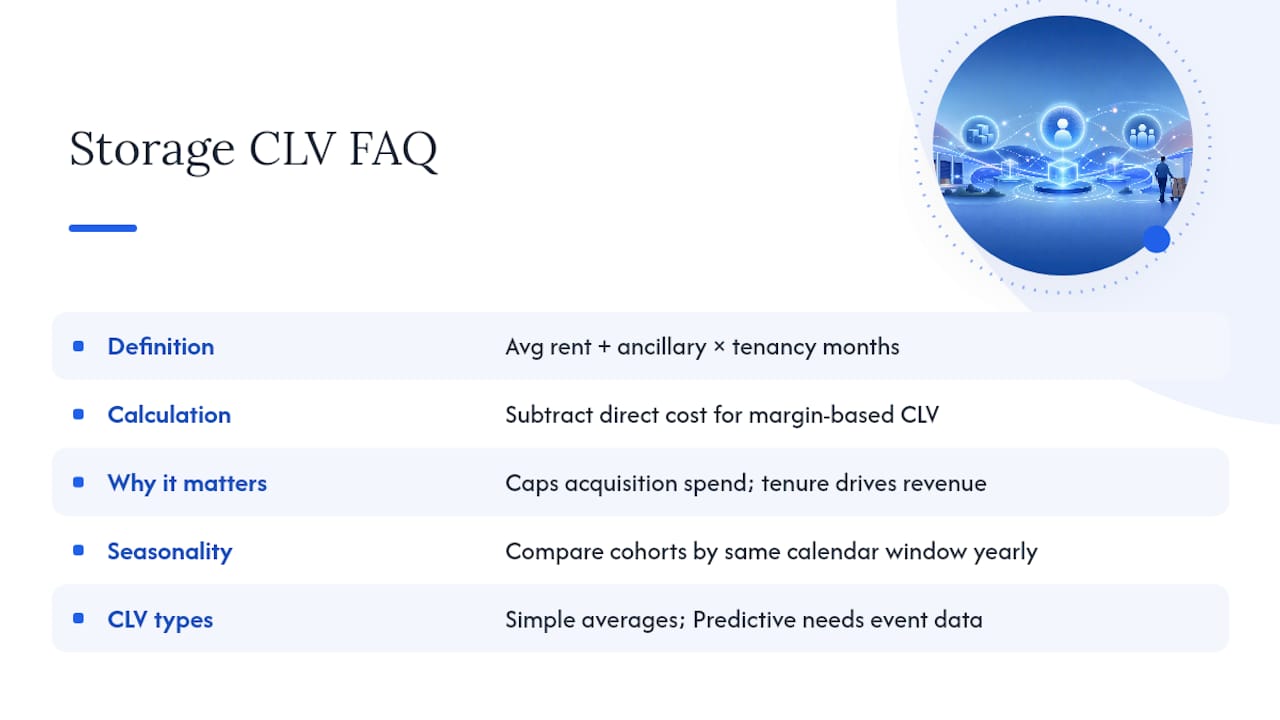
Simple CLV uses historical averages and works well when pricing and demand are stable. Predictive CLV applies machine learning to event-level data and is worth the added complexity only once you have enough tenant history and the analytics capability to maintain it.
Sources
- What Is Customer Lifetime Value (CLV) and How to Calculate? | Salesforce
- What Is Customer Lifetime Value? How to Calculate? | Shopify
- 8 Self Storage Customer Retention Strategies for Operators | Inside EXR