
The highest-value backlink sources for a U.S. self-storage facility are local citations, partner pages, sponsorship pages, editorial and local press links, and resource content pages. Start today by claiming and verifying your Google Business Profile, then audit your top five citation listings for NAP consistency.
Here's how to prioritize your effort:
Immediate wins (this week):
- Claim and verify Google Business Profile, Yelp, Better Business Bureau (BBB), SpareFoot, and YellowPages
- Correct any name, address, or phone number inconsistencies across those listings
- Check for duplicate listings and merge or suppress them
High-value outreach (weeks 2–6):
- Contact moving companies, real estate brokers, and apartment complexes about referral-exchange links
- Join your local Chamber of Commerce for a directory listing
- Identify one community sponsorship opportunity with a published sponsor page
Scalable content plays (months 2–3):
- Publish a neighborhood moving guide or seasonal packing checklist
- Pitch that resource to local blogs, chambers, and partner websites
- Monitor new referring domains monthly using Semrush or BrightLocal
A single relevant local business page link outperforms dozens of low-quality, unrelated links for a storage facility's local rankings. The rest of this guide unpacks every source type, how to acquire each one, and what to realistically expect.
Table of Contents
- What types of storage facility backlink sources should you claim first?
- How do local partnerships produce backlinks for storage facilities?
- Can sponsorships actually earn you quality backlinks?
- What content formats earn the most backlinks for storage facilities?
- How do you get local press and guest post links for your facility?
- How do SpareFoot, Yelp, and review platforms fit into your backlink strategy?
- How do you keep your backlink profile clean and avoid penalties?
- What does a realistic outreach process and timeline look like?
- How should a storage facility prioritize its backlink strategy?
- Key Takeaways
- Why local relevance beats link volume for storage
- Corvanesystems handles your backlink strategy so you can run your facility
- Useful sources
What types of storage facility backlink sources should you claim first?
Directories and local citations are the foundation of any storage facility's backlink profile. They're low effort, they send consistent local signals to Google, and they're the first thing to fix before any outreach campaign makes sense.
The reason they matter so much for storage specifically comes down to how customers search. Most people looking for a unit type "storage near me" or "storage in [city name]." Google's local algorithm weighs citation consistency heavily when deciding which facilities to surface in the map pack. If your NAP (name, address, phone number) differs across listings, those signals conflict and your rankings suffer.
Data aggregators like Data Axle, Foursquare, and Neustar Localeze push your listing information to hundreds of downstream directories automatically. Getting your data right on those three platforms multiplies your reach without extra manual work.
Verification checklist for every directory listing:
- Claim ownership of the listing (look for "Is this your business?" prompts)
- Verify via phone, postcard, or email as the platform requires
- Standardize NAP exactly: same abbreviations, same suite format, same phone number
- Confirm your website URL points to the correct page (homepage or location page)
- Select the most accurate business categories available
- Upload at least five photos (exterior, interior, unit types, access gate)
- Set accurate hours including holiday exceptions
Must-have listings to claim:
- Google Business Profile — the single most important listing; controls your map pack appearance
- Yelp — consumer-facing reviews and a dofollow link to your site
- Better Business Bureau (BBB) — trust signal and a high-authority referring domain
- SpareFoot — storage-specific aggregator that drives direct leads alongside the backlink
- YellowPages — broad reach and strong domain authority
Duplicate listings are one of the most common citation problems for storage facilities. If Google finds two GBP listings for the same address, it may suppress both. Use BrightLocal or Yext to scan for duplicates before you start building new citations — fixing existing problems first gives you a clean baseline.
Pro Tip: When you claim your BBB listing, request accreditation if you qualify. Accredited businesses get a higher-authority link placement and a trust badge you can display on your website, which reinforces credibility for both visitors and search engines.
How do local partnerships produce backlinks for storage facilities?
Strategic partnerships with moving companies, real estate brokers, apartment complexes, and home renovation specialists generate some of the most relevant backlinks a storage facility can earn. These links carry local intent signals that generic directory links simply cannot replicate, and they often send actual referral traffic alongside the SEO value.

Think about the customer journey. Someone signing a lease at an apartment complex needs storage. A homeowner mid-renovation needs a place for furniture. A family using a moving company needs temporary space. Each of those businesses is already talking to your ideal customer. A link from their website to yours is not just an SEO asset — it's a warm referral channel.
Partner types worth prioritizing:
- Moving companies (highest intent match — customers actively need storage)
- Real estate brokers and property managers (relocation triggers storage demand)
- Apartment complexes (tenants with limited space are recurring customers)
- Home renovation contractors (project-based storage needs)
- RV and boat dealers (specialty storage referrals)
- Landscaping and seasonal businesses (equipment storage)
The key difference between a partner link and a directory link is relevance and intent. A link from a moving company's "trusted local partners" page tells Google that a business serving the same customer base endorses your facility. That contextual signal carries more weight than a listing on a general business directory.
How to make the ask work:
- Identify 10–15 local businesses in the partner categories above using Google Maps and Yelp
- Find the owner or office manager's contact information (LinkedIn, the business website's contact page)
- Send a personalized email referencing their specific business and location
- Offer something concrete in return — a reciprocal link, a co-branded moving checklist, or an exclusive discount code for their customers
- Follow up once, seven days later, if you don't hear back
A simple outreach offer that works: "We refer customers who need moving help to local movers all the time. We'd love to add [Business Name] to our recommended partners page and include a link to your site. In return, we'd appreciate a mention on your resources page for customers who need storage during a move. Happy to send over our logo and a short description."
That framing is low-pressure, mutually beneficial, and gives the partner a clear reason to say yes. You can adapt the same structure for realtors and apartment managers by swapping the specific use case. For more on how referral channels between apartment managers and storage operators work in practice, see leasing more units with digital tools.
Can sponsorships actually earn you quality backlinks?
Yes, and they're one of the most underused link sources in the storage industry. Chambers of commerce and community organizations frequently publish member and sponsor directories with links to local businesses, and those pages tend to carry real domain authority because they're maintained by established local institutions.

The link placement varies by sponsorship type. Youth sports leagues typically publish a sponsor page on their team or league website. School programs may list sponsors in a newsletter archive or on a dedicated page. Community festivals often maintain a year-round event site with a partners section. Emergency response charities and food banks frequently acknowledge donors with a link on their "supporters" page.
Budget-tiered sponsorship ideas:
- No cost: Donate a storage unit for a local nonprofit's supply storage needs; they list you as an in-kind sponsor
- Low cost ($50–$250): Sponsor a youth sports team jersey; team websites and league directories list sponsors
- Mid budget ($250–$1,000): Title sponsor a community 5K or festival booth; event sites publish sponsor pages that persist after the event
- Higher budget ($1,000+): Sponsor a school program or emergency preparedness initiative; these often generate press coverage and multiple links
When you negotiate a sponsorship, ask explicitly about digital attribution. Most organizations are happy to include a link if you ask — they just don't always do it automatically. Request the specific URL you want linked (your homepage or a relevant location page), and confirm the page where your name will appear before you finalize the agreement.
The best time to follow up on a sponsorship link is within 48 hours of the event or announcement going live. Organizations update their sponsor pages quickly after an event and then rarely revisit them. If your link isn't there in that window, a polite email with your URL and preferred anchor text usually resolves it fast.
Pro Tip: Keep a simple spreadsheet of every sponsorship: organization name, contact email, agreed link placement URL, date of event, and date you followed up. This makes link reclamation straightforward and gives you a record if a link disappears after a site redesign.
What content formats earn the most backlinks for storage facilities?
Resource pages and practical guides are the content types that consistently attract links from local partners, blogs, and chambers. The reason is utility: a moving company's website is happy to link to a free "Apartment Move-Out Checklist" because it helps their customers, not because they owe you a favor.
Content ideas that work specifically for storage:
- Neighborhood moving guides (e.g., "Moving to [City Neighborhood]: What to Know About Storage")
- Seasonal packing checklists (winter gear, holiday decorations, summer sports equipment)
- College move-in/move-out guides targeting students near your facility
- Senior moving resources (downsizing guides, estate storage tips)
- Business storage guides (document storage, inventory overflow, equipment storage)
- RV and boat storage resources (seasonal prep, what to store, how to winterize)
For a resource page to earn links, it needs to be genuinely useful and easy to reference. A single-page PDF checklist with your logo and website URL at the bottom is ideal: partners can share it with their customers, and every download carries your brand. A web page version with a downloadable asset gives you both a linkable URL and a shareable file.
Distribution checklist:
- Email your existing partner contacts first — they already know you and are most likely to share
- Send to your local Chamber of Commerce with a note that members might find it useful
- Pitch to local blogs and neighborhood news sites (Patch.com, NextDoor community pages)
- Share in local Facebook groups and community forums where residents ask moving questions
- Follow up with anyone who hasn't responded after 10 days
Metrics to track for content-driven backlink acquisition:
- New referring domains pointing to the resource page (check monthly in Semrush or Ahrefs)
- Referral traffic sessions from partner sites (Google Analytics)
- Conversion rate from referral traffic (form submissions, phone calls, unit reservations)
- Number of outreach emails sent vs. links placed (your placement rate benchmark)
The goal isn't to write a viral blog post. It's to create something specific enough that a local business would rather link to it than build their own version. That's a much lower bar than most facility owners think. For more on content that converts referral traffic into booked units, see filling empty storage units.
How do you get local press and guest post links for your facility?
Local press releases earn backlinks primarily when targeted at local media and community boards that will actually publish them with a functioning link. National wire distribution rarely produces lasting backlink value for a local business. The outlets worth your time are hyperlocal: city newspapers, neighborhood blogs, Patch.com, local TV station websites, and community newsletters.
Editorial links from these sources carry more weight than most other link types because they're earned, not bought or traded. A local news site linking to your facility as part of a story about community development or seasonal storage tips is a genuine endorsement in Google's eyes.
Story angles local outlets regularly cover:
- New facility openings or major renovations
- Community sponsorships and charitable donations
- Seasonal storage tips (spring cleaning, back-to-school, holiday prep)
- Security or technology upgrades (new surveillance systems, smart access)
- Human-interest angles (helping a local nonprofit store supplies, supporting disaster relief)
Pitch template elements:
- Subject line: Keep it specific and local. "New Climate-Controlled Storage Opens in [Neighborhood]" beats "Press Release: [Facility Name]."
- Opening sentence: State the news hook in one sentence. Who, what, where, when.
- Body (2–3 short paragraphs): Why it matters to local residents, any community angle, a quote from the owner.
- Contact info and website URL: Make it easy for the editor to link directly.
- Follow-up: Send one follow-up email five days after the initial pitch if you haven't heard back. Don't call unless the outlet specifically invites it.
Patch.com is worth a dedicated effort. It covers hyperlocal news in thousands of U.S. communities and allows business owners to submit announcements directly. A well-written post about a community sponsorship or facility opening often gets published with a link intact — and Patch pages tend to rank well for local searches.
Pro Tip: Time your press pitches to seasonal hooks. A "spring cleaning storage tips" pitch sent in late February has a much higher open rate than the same pitch in July. Editors are actively looking for seasonal content to fill their editorial calendar, and your facility becomes the local expert source.
How do SpareFoot, Yelp, and review platforms fit into your backlink strategy?
Aggregator and review platforms serve a dual purpose: they generate direct leads and they provide referring domain links that reinforce your local authority. SpareFoot is the most storage-specific of these platforms and deserves priority attention because it targets customers who are already in the decision phase of their search.
A fully optimized SpareFoot listing includes unit types, sizes, pricing, photos, access hours, and amenities. Incomplete listings rank lower within the platform and send weaker signals to external search engines. The same principle applies to Yelp and YellowPages: a sparse profile with no photos and no reviews is a missed opportunity on multiple levels.
Platform optimization checklist:
- Claim your profile on SpareFoot, Yelp, and YellowPages
- Select the most specific business categories available (not just "storage" — add "climate-controlled storage," "vehicle storage," etc.)
- Add unit types, sizes, and pricing where the platform allows
- Upload at least eight photos (exterior, interior, unit sizes, security features)
- Set up a review request process: email customers after move-in with a direct link to your Yelp or Google review page
- Respond to every review, positive and negative, within 48 hours
Reputation management basics:
- For negative reviews, acknowledge the issue, offer to resolve it offline, and provide a contact method. Never argue publicly.
- For positive reviews, a brief, specific thank-you (mentioning the unit type or location) reads more genuine than a generic response.
- Satisfied customers who leave detailed reviews are also potential testimonial sources for your website. With their permission, a quote on your site adds social proof that can itself attract links from local press or partner pages.
Review platform links are typically nofollow, but that doesn't make them worthless. Forum and blog comment links are usually nofollow too, yet they still drive referral traffic and contribute to a natural-looking link profile. Treat review platform links as visibility tools and lead generators first, SEO signals second.
How do you keep your backlink profile clean and avoid penalties?
Link quality matters more than quantity for storage facilities. A small number of industry-relevant backlinks can tip search rankings in favor of one facility over another, while a large volume of low-quality links from unrelated directories can trigger a manual penalty or algorithmic suppression.
Dofollow vs. nofollow basics:
A dofollow link passes "link equity" to your site and directly influences rankings. A nofollow link tells Google not to pass equity, but it still drives referral traffic and contributes to a natural link profile. Most editorial and partner links are dofollow. Most review platform and forum links are nofollow. Both have a role; neither should be your only source.
Red flags to avoid:
- Paid link networks or "link packages" sold by SEO vendors promising hundreds of links quickly
- Sudden unnatural spikes in referring domains (Google's algorithms flag these)
- Low-quality general directories with no editorial standards or obvious spam signals
- Links from sites with no topical relationship to storage or your local area
Link reclamation and audit checklist:
- Run a backlink audit in Semrush, Ahrefs, or BrightLocal to identify your current referring domains
- Flag any links from spammy or irrelevant sites and disavow them via Google Search Console if necessary
- Search for unlinked mentions of your facility name using Google Alerts or Semrush's brand monitoring
- Contact sites that mention your facility without a link and request one
- Use the broken-link replacement method: find websites that linked to closed or rebranded competitors and pitch your facility as the current local alternative
NAP consistency is the citation equivalent of a clean backlink profile. If your facility's name appears as "ABC Storage" on Google, "ABC Self Storage LLC" on Yelp, and "A.B.C. Storage" on YellowPages, those conflicting signals reduce the local authority each citation passes. Tools like Yext or Whitespark can scan and correct these inconsistencies at scale.
Pro Tip: Set up a Google Alert for your facility name and address. When a new mention appears without a link, you have a warm outreach opportunity — the site already knows you exist and found you worth mentioning.
| Source Type | Effort | Link Type | Local Relevance | Authority | How to Acquire | Risk |
|---|---|---|---|---|---|---|
| Local citations (GBP, Yelp, BBB) | Low | Nofollow/Dofollow | High | Medium–High | Claim and verify | Low |
| Partner pages (movers, realtors) | Medium | Dofollow | Very High | Medium | Direct outreach, referral exchange | Low |
| Editorial/local press | High | Dofollow | High | High | Pitch story angles, press releases | Very Low |
| Sponsorship pages | Low–Medium | Dofollow | High | Medium | Sponsor event, request attribution | Low |
| Review sites (SpareFoot, Yelp) | Low | Nofollow | High | Medium–High | Claim and optimize profile | Low |
| Content/resource pages | Medium | Dofollow | Medium–High | Varies | Publish and distribute | Low |
| Paid link networks | Low | Dofollow | Low | Low | Purchase | High |
What does a realistic outreach process and timeline look like?
Most facility owners underestimate how straightforward backlink outreach actually is when you break it into repeatable steps. The process isn't complicated; it just requires consistency.
Step-by-step outreach process:
- Discovery: Use Google Maps, Yelp, and LinkedIn to build a list of 20–30 outreach targets (partners, local blogs, chambers, event organizers)
- Prioritize: Sort by relevance and likelihood to respond (existing relationships first, then warm contacts, then cold)
- Personalize: Reference the specific business, their location, and a concrete mutual benefit in every email
- Send: Use a simple email tool (Gmail, Mailchimp, or a CRM) to track opens and replies
- Follow up: Send one follow-up email 7 days after the initial send if no response
- Confirm placement: Once a link is agreed, verify it's live and pointing to the correct URL
- Track: Log the referring domain, link type, and placement date in a spreadsheet or your SEO tool
- Maintain: Check in with partners quarterly; relationships that stay warm produce more links over time
Email templates:
Partner link request: Subject: "Quick partnership idea for [Their Business Name]" Body: "Hi [Name], I run [Facility Name] in [City]. We refer customers who need moving help to local companies regularly, and I'd love to add [Their Business Name] to our recommended partners page. In return, I'd appreciate a mention on your resources page for customers who need storage. Happy to send our logo and a short description. Does that work for you?"
Sponsorship ask: Subject: "[Facility Name] would love to support [Event/Organization]" Body: "Hi [Name], we're a local storage facility in [City] and we'd like to sponsor [Event/Organization]. We'd love to be listed on your sponsors page with a link to our website. Could you let me know the sponsorship levels available and what digital recognition is included?"
Guest post/press pitch: Subject: "Story idea: [Seasonal Hook] + local storage tips for [City]" Body: "Hi [Name], I'm the owner of [Facility Name] in [City]. I have a short piece on [topic] that might be useful for your readers heading into [season]. Happy to write it as a guest post or provide quotes for a story. Here's a link to our site: [URL]."
Timeline and effort by source type:
| Source Type | Time to Placement | Person-Hours per Link |
|---|---|---|
| Local citations (GBP, Yelp, BBB, SpareFoot) | 1–3 days | 1 hour |
| Data aggregators (Data Axle, Foursquare, Localeze) | 2–6 weeks | 1–2 hours |
| Partner pages (movers, realtors, apartments) | 1–4 weeks | 1–3 hours |
| Chamber of Commerce | 1–2 weeks | 1 hour |
| Sponsorship pages | 1–8 weeks | 2–4 hours |
| Editorial/local press | 2–8 weeks | 3–6 hours |
| Resource/content pages | 4–6 weeks | 5–10 hours (content creation + outreach) |
KPIs to monitor monthly:
- New referring domains (track in Semrush or Ahrefs)
- Referral traffic sessions from backlink sources (Google Analytics)
- Citation consistency score (BrightLocal's Local Search Audit)
- Conversion rate from referral traffic (goal completions in Analytics)
- Map pack ranking position for "storage near me" and "[city] storage" queries
How should a storage facility prioritize its backlink strategy?
High-quality local backlinks show search engines a facility's connection to its service area, which is the core ranking signal for "storage near me" queries. For a single-site operator, the highest ROI combination is Google Business Profile optimization plus three to five strong local partner links. That combination outperforms a broad campaign chasing dozens of generic directory listings.
Sample 30/60/90-day plan:
Days 1–30 (Foundation):
- Claim and fully optimize GBP, Yelp, BBB, SpareFoot, and YellowPages
- Submit to Data Axle, Foursquare, and Neustar Localeze
- Run a citation audit with BrightLocal; fix NAP inconsistencies
- Identify and contact five local moving companies and three real estate offices about referral exchanges
- Join the local Chamber of Commerce
Days 31–60 (Outreach):
- Secure at least three partner page links (movers, realtors, or apartment complexes)
- Identify one community sponsorship opportunity and negotiate digital attribution
- Publish a neighborhood moving guide or seasonal checklist on your website
- Pitch that resource to 10 local blogs, chambers, and partner contacts
- Run a competitor backlink audit in Semrush to find directories and partners you've missed
Days 61–90 (Press and Content):
- Send two local press pitches (Patch.com plus one local newspaper or TV station website)
- Follow up on all outstanding outreach from days 31–60
- Use the broken-link replacement method: search for closed competitors and contact their referring domains
- Review KPIs: new referring domains, referral traffic, map pack position
- Plan next quarter's content and outreach calendar
GEO optimization tips that amplify backlink value:
Backlinks work harder when your site's content reinforces the same local signals. Add neighborhood-specific pages for each area you serve, include local schema markup (LocalBusiness schema with your NAP, hours, and service area), and create service-radius content that names the specific cities and zip codes you cover. When an AI assistant or Google's AI Overviews tries to answer "storage near me" for a user in your area, that combination of local backlinks and structured local content is what gets your facility recommended. For a deeper look at how AI search visibility works for storage operators, see AI search optimization for your storage business.
Pro Tip: Before you start any outreach, check your competitors' backlink profiles in Semrush or Ahrefs. Sort their referring domains by authority and look for local directories, partner pages, and community organizations you haven't claimed yet. This shortcut often surfaces 10–15 quick wins in under an hour.
Key Takeaways
Local, relevant backlinks from citations, partner pages, sponsorships, and editorial sources consistently outperform high-volume generic link campaigns for U.S. self-storage facilities.
| Point | Details |
|---|---|
| Citations come first | Claim GBP, Yelp, BBB, SpareFoot, and YellowPages before any outreach; fix NAP inconsistencies across all listings. |
| Partner links carry the most local intent | Moving companies, realtors, and apartment complexes link to you in context — those signals matter more than directory volume. |
| Sponsorships earn links with low risk | Community event and nonprofit sponsor pages produce dofollow links with no penalty exposure when negotiated directly. |
| Content earns links at scale | A neighborhood moving guide or seasonal checklist gives partners a reason to link without you having to ask repeatedly. |
| Corvanesystems accelerates the process | Corvanesystems handles citation audits, partner outreach support, and AI-optimized content for storage operators on a flat monthly rate. |
Why local relevance beats link volume for storage
The conventional wisdom in SEO is that more backlinks equal better rankings. For most industries, that's directionally true. For self-storage, it's actively misleading.
Storage is one of the most hyper-local businesses that exists. Your customers are almost always within a few miles of your facility. They're not searching nationally; they're searching by neighborhood. That means a link from a local moving company's website, a community center's sponsor page, or a neighborhood blog carries more ranking weight than a link from a high-authority national site with no geographic connection to your market.
The operators who get this wrong spend months chasing guest posts on general business blogs or paying for link packages that produce dozens of referring domains with zero local relevance. Their rankings don't move because Google's local algorithm is specifically looking for signals that connect a business to a place. A link from a Knoxville apartment complex to a Knoxville storage facility is exactly that kind of signal. A link from a generic "small business tips" blog is not.
What actually moves the needle for a single-site operator is a clean citation foundation, three to five strong local partner links, and one or two editorial mentions from local press or community organizations. That's a realistic 90-day goal, and it's the foundation Corvanesystems builds from when working with storage clients. The next step after that is making sure your site's content and structure reinforce those local signals, which is where getting your storage facility found online becomes the parallel priority.
Corvanesystems handles your backlink strategy so you can run your facility
Most storage operators know they need backlinks. Few have the time to run citation audits, manage partner outreach, and publish local content consistently every month. That's the gap Corvanesystems fills.
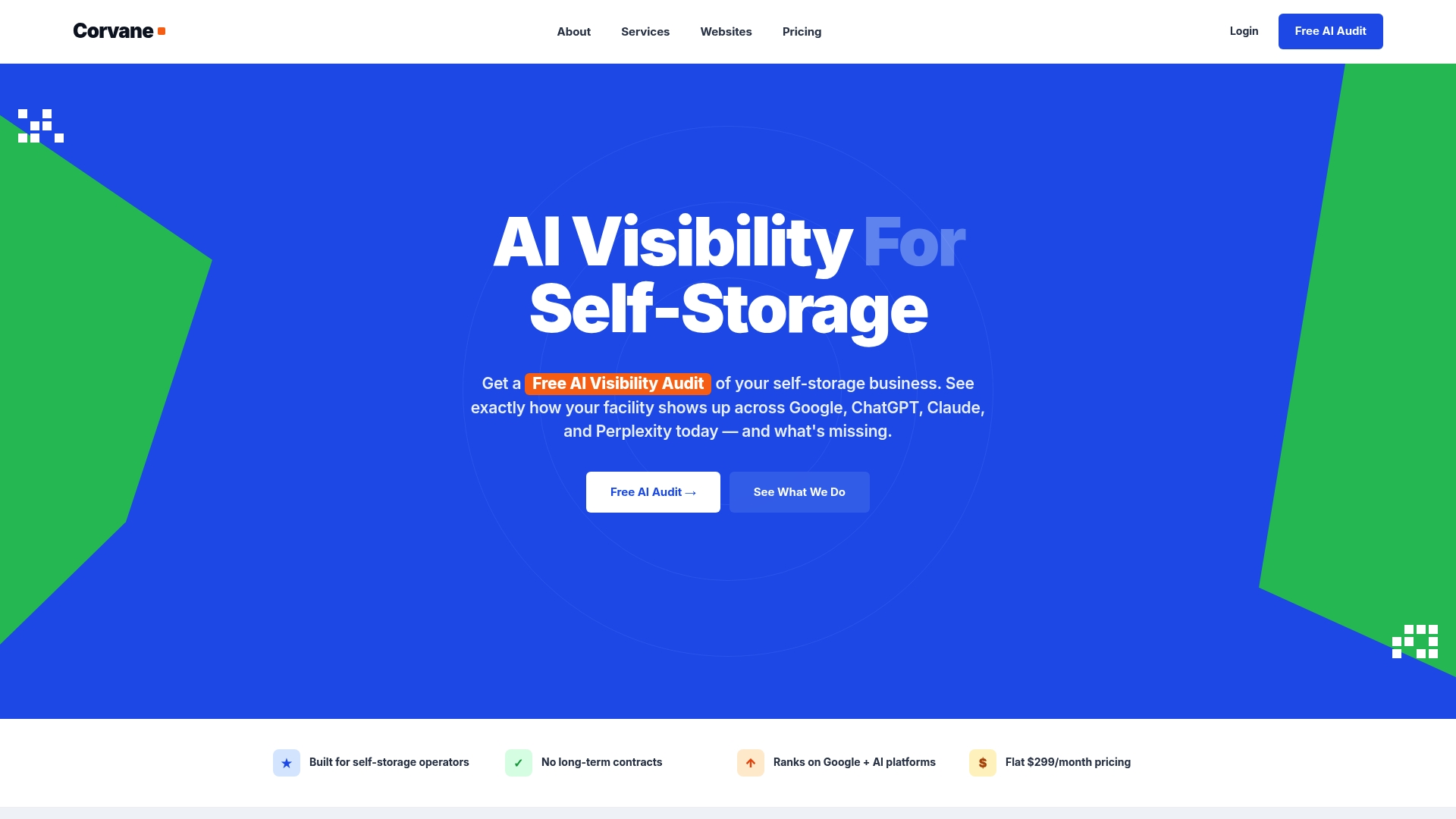
Corvanesystems is a flat-rate SEO and AI visibility service built exclusively for self-storage operators. For one predictable monthly fee, you get citation management, Google Business Profile optimization, 30 keyword-focused articles published monthly, and AI visibility audits across ChatGPT, Claude, Perplexity, and Google's AI Overviews. No contracts, no tiers, no surprise invoices. A backlink audit from Corvanesystems covers your current citation health, a prioritized backlink opportunity map, and a 90-day action plan specific to your facility and market. If you want to know exactly where your facility stands and what to fix first, request your audit at corvanesystems.com.
Useful sources
These are the primary references used to build this guide. Each one is worth bookmarking for deeper research or for backing claims in your own outreach templates.
- Grasping the Use of Link-Building as a Self-Storage Marketing Strategy — Inside Self-Storage's breakdown of why local relevance outweighs link volume, with specific tactics for storage operators.
- Boosting Self Storage SEO With Backlinks — StoragePug's practical guide covering citation directories, the Moving Man method, and competitor backlink analysis.
- Top 4 Link-Building Strategies for Self Storage — Covers data aggregators, Chamber of Commerce links, community sponsorships, and recommended audit tools including BrightLocal and Yext.
- Local SEO for Self Storage Facilities — Explains how local backlink signals connect a facility to its service area and why that matters for map pack rankings.
- How to Get Backlinks for Your Storage Facility from Your Local Community — Community-focused tactics including sponsorships, local partnerships, and press outreach with practical examples.
- Local SEO Las Vegas: Win More Customers in 2026 — Useful reference for understanding how community signals and targeted local backlink tactics translate into customer acquisition across competitive local markets.