
The fastest way to get bookings from a storage blog is to publish topic-focused posts in six proven buckets: how-to and maintenance, local and community, niche verticals, operations and security, promotions and events, and SEO/AI visibility content. You don't need a content calendar full of filler. You need three posts you can write this week.
Start here: a packing guide for a specific item type (furniture, seasonal gear, electronics), a neighborhood moving guide for your top feeder zip code, and a "what's included" security walkthrough with a booking CTA at the bottom. Each takes a few hours to draft and answers a question your next tenant is already typing into Google or ChatGPT.
- How-to/maintenance
- Local/community
- Niche verticals (business, students, RV/boat, art)
- Operations/security/trust
- Promotions/events
- SEO/GEO/AI visibility
Pro Tip: Publish one post per bucket in your first month. A customer-first, education-over-promotion approach converts better than pure sales copy, and it takes about 30 days to see the first movement in organic traffic.
Key Takeaways
A storage blog earns bookings by pairing practical, locally specific posts with the structural signals that get read by both search engines and AI assistants.
| Point | Details |
|---|---|
| Start with three posts | Publish a packing guide, a neighborhood moving guide, and a security walkthrough this month. |
| Match format to goal | Use how-to and checklist formats for SEO, local guides for GMB visibility, FAQ for AI citations. |
| Build a persona list | Tag your last 100 rentals by reason and unit size to find your top two or three renter personas. |
| Track four KPIs only | Watch organic sessions, booking conversions, GMB calls, and assisted conversions monthly. |
| Repurpose every post | Turn each article into social posts, a GMB update, and an email within the first week. |
Table of Contents
- Storage Blog Topics for How-To and Maintenance Content
- Local and Community Content That Wins "Near Me" Searches
- Niche Vertical Posts That Capture Higher-Value Bookings
- Operations and Security Posts That Remove Booking Hesitation
- Formats, Headlines, and a Simple Publishing Calendar
- The SEO, GEO, and AI Visibility Checklist Every Post Needs
- Turning One Post Into Five Pieces of Content
- Measuring Whether Your Storage Blog Actually Works
- 50 Grab-and-Go Storage Blog Post Titles
- Understanding Who Actually Reads a Storage Blog
- Finding the Gaps Your Competitors' Blogs Leave Open
- Generating Storage Blog Ideas Without Running Dry
- Sources
Storage Blog Topics for How-To and Maintenance Content
Renters search for reassurance before they search for a unit. Give it to them.
- "How to Pack Antiques for Climate-Controlled Storage" — answers the fear of damage, ends with a CTA to your climate-controlled unit page.
- "The Room-by-Room Checklist for What to Store vs. Toss" — built around a room-by-room clutter audit, which recommends regularly running the exercise to catch clutter that hides in plain sight.
- "Protecting Wood Furniture During Long-Term Storage" — link to your furniture protection checklist.
- "How to Fold and Box Clothes So They Don't Mildew" — links naturally to a clothing storage guide.
Add photos of your actual units, a downloadable checklist, and one internal link per post. That combination does double duty: it helps the reader and signals topical depth to search engines.
Local and Community Content That Wins "Near Me" Searches
Google and AI assistants both lean hard on locality signals when someone searches "storage near me" or asks an assistant where to rent nearby.
-
Neighborhood moving guides ("Moving to Maple Heights: What to Know Before You Pack")
-
Seasonal move checklists tied to your metro's peak moving months
-
"Best Local Movers in [City]" roundups that mention real, named businesses
-
Partner spotlights featuring realtors, moving companies, or college housing offices
These posts feed your Google Business Profile indirectly. Fresh local content gives you fresh anchor text for GBP posts and gives AI tools more local entities to associate with your facility, since pairing local guides with partner spotlights tends to earn more community backlinks.
Pro Tip: Email three local movers or realtors with a simple offer: "Feature you in our neighborhood guide, and you link back from your resources page." That single outreach template usually lands one or two placements per quarter.
Niche Vertical Posts That Capture Higher-Value Bookings
Not every renter is moving apartments. Some are running a business or storing a $40,000 sailboat, and they'll pay more for the right unit.
- Business inventory storage — "How Small Businesses Use Self-Storage to Cut Overhead," tied to your business inventory guide
- Student storage — timed for May and August move-out/move-in windows
- RV and boat storage — publish in early spring, ahead of boating season
- Art and collectibles storage — link to your art storage facility page
Each niche has its own keyword hook ("student storage near [college]," "boat storage before summer") and its own urgency window. Time the publish date, not just the topic.
Operations and Security Posts That Remove Booking Hesitation
Most people who abandon a storage booking do it over one unspoken question: is my stuff actually safe here?
- A security walkthrough post with real photos of gates, lighting, and cameras
- "What Storage Insurance Actually Covers" (link to your security guide)
- A move-in day checklist that doubles as a trust-builder
- General safety best practices explained in plain language
Include CCTV specs, gate-access details, and any certifications you hold. Link every one of these posts to your booking page and your security page. Specificity beats vague reassurance every time.
Formats, Headlines, and a Simple Publishing Calendar
Match the format to the goal. How-to posts and checklists win SEO. Local guides and case studies win local visibility and backlinks. FAQ-style posts win AI citations and featured snippets.
Headline formulas that consistently work: "How to [Task] Without [Common Mistake]," "[Number] Things to Know Before [Action]," and "Checklist for [Situation]." Keep titles under 60 characters and write a meta description that states the answer, not a teaser.
- Days 1-30: Publish 4 posts, one per bucket (how-to, local, security, niche). Roughly 3-4 hours each.
- Days 31-60: Publish 4 more, plus repurpose your best-performing post into a GMB update and email.
- Days 61-90: Publish 4 more, review analytics, and double down on whichever bucket drove the most bookings.
The SEO, GEO, and AI Visibility Checklist Every Post Needs
Traffic doesn't come from publishing alone. It comes from structure. This is the checklist Corvanesystems applies to every storage blog post we write for clients.
- Open with a direct answer in the first two sentences, not a setup paragraph.
- Use one clear H1 and logical H2/H3 breaks, not decorative subheads.
- Add FAQ schema where the post genuinely answers common questions, since concise answers paired with structured markup improve the odds of featured snippet and AI citation.
- Keep your name, address, and phone number identical across the post's author box, your Google Business Profile, and your footer.
- Update your Google Business Profile the same week you publish a related post.
- Add a 2-3 sentence TL;DR near the top so both skimming readers and AI crawlers get the gist fast.
Pro Tip: AI assistants tend to lift the first clear, factual paragraph of a page. If that paragraph is vague, you lose the citation to a competitor who wrote a sharper opening.
Turning One Post Into Five Pieces of Content
A single blog post is a starting point, not a finish line.
- Slice it into 4-5 social posts (a stat, a tip, a photo, a quote from the post).
- Post a shortened version to your Google Business Profile the same day.
- Send a two-paragraph email to your list linking back to the full post.
- Run a small paid boost ($20-50) behind the post for 5-7 days if it targets a high-intent local keyword.
- Watch organic shares in week one before deciding whether to extend the paid boost.
Organic promotion works best in the first 48 hours; paid support works best once you see early engagement worth amplifying.
Measuring Whether Your Storage Blog Actually Works
Track four numbers, not forty. Organic sessions to blog pages, conversions or booking form starts from blog traffic, calls and direction requests from Google Business Profile, and assisted conversions where a blog post touched the visitor before they booked.
Your minimum tracking stack: Google Analytics 4, Google Search Console, and a booking form that tags its traffic source. That's it. Anything more elaborate is optional until you're publishing weekly.
Set a simple rule: if a post gets zero organic traffic after 90 days, update its title and opening paragraph. If it still stalls after another 60 days, retire it or fold its content into a stronger post. Running a content audit twice a year, the same cadence recommended for physical clutter, keeps your blog from accumulating dead pages the way a garage accumulates boxes nobody opens.
50 Grab-and-Go Storage Blog Post Titles
How-to and maintenance (short, low effort):
- How to Pack Dishes So Nothing Breaks
- The Right Way to Store a Mattress
- How to Store Power Tools Without Rust
- Packing Electronics for Long-Term Storage
- How to Store Holiday Decorations Efficiently
- Storing Books Without Warping or Mold
- The Best Boxes for Fragile Items
- How to Store a Bicycle in a Small Unit
Local and community (medium effort): 9. Moving to [Your City]: A Newcomer's Guide 10. Best Neighborhoods Near [Your Facility] 11. Seasonal Moving Checklist for [Your Region] 12. Local Movers We Recommend and Why 13. [Your City]'s Best-Kept Storage Secrets
Niche verticals (medium to long): 14. Storage Solutions for Small Business Owners 15. A Student's Guide to Summer Storage 16. Storing an RV Through the Off-Season 17. What to Know Before Storing a Boat 18. How Contractors Use Storage Units for Equipment 19. Storing Artwork and Collectibles Safely
Operations and security (medium effort): 20. Inside Our Facility's Security System 21. What Storage Insurance Actually Covers 22. Your Move-In Day Checklist 23. Gate Access Codes: How They Work 24. What Happens If You Miss a Payment
Promotions and events (short effort): 25. Our Spring Cleaning Discount, Explained 26. Refer a Friend and Save on Your Unit 27. Why Fall Is the Cheapest Time to Rent Storage
SEO/AI visibility (long effort): 28. Self-Storage FAQ: Everything Renters Ask Us 29. What Size Unit Do I Actually Need?
Pick three from this list, one per bucket, and commit to publishing them in the next 30 days.
Understanding Who Actually Reads a Storage Blog
Storage renters aren't one audience. A downsizing retiree, a college student, and a small-business owner searching for inventory storage all want completely different answers, even when they land on the same site.
Break your readers into three or four working personas before you write a single post. A useful starting set: the life-transition renter (moving, downsizing, divorce, inheritance cleanup), the seasonal renter (students, RV or boat owners), the business renter (contractors, e-commerce sellers, retailers), and the long-term hoarder-adjacent renter who's simply out of space at home.
Each persona searches differently. The life-transition renter types emotional, uncertain queries like "what do I do with my mom's furniture." The business renter searches functionally: "climate-controlled storage for retail inventory." Write different headlines and different CTAs for each.

You don't need formal market research to build these personas. Pull your last 100 rental agreements and tag each by stated reason for renting, unit size, and lease length. Patterns show up fast. If 30% of your tenants are students, a persona-driven content plan probably needs two or three student-specific posts, not zero.
One detail most operators miss: the emotional weight behind someone's belongings shapes how they read your content. A decluttering-psychology framing that acknowledges the stress of parting with items, rather than treating storage as a purely logistical decision, tends to read as more relatable and convert better than dry, feature-first copy.
Finding the Gaps Your Competitors' Blogs Leave Open
Most self-storage blogs cluster around the same three or four topics: packing tips, seasonal promotions, and generic "why choose us" posts. That clustering is your opening.
Pull up the blogs of your five closest local competitors and list every post title. You'll usually find heavy overlap on basic packing content and almost nothing on local neighborhood guides, niche verticals, or security specifics. That gap is where you win both traffic and AI citations, because thin, generic operator blogs rarely go deep enough to become the source an AI assistant pulls from.
Check three things per competitor: publishing frequency (are they active or dormant?), depth (do posts answer the question fully or stop at 300 words?), and local specificity (do they mention actual neighborhoods, or just generic city names?). A competitor publishing once a quarter with shallow 400-word posts is not a real content competitor. You can out-publish and out-depth them within 90 days.
The bigger opportunity usually sits in business-vertical and security content, since most facilities default to consumer moving topics and skip the higher-intent searches from business owners and cautious first-time renters. Those searchers convert at a higher rate because they're closer to a decision, not further from one.
Generating Storage Blog Ideas Without Running Dry
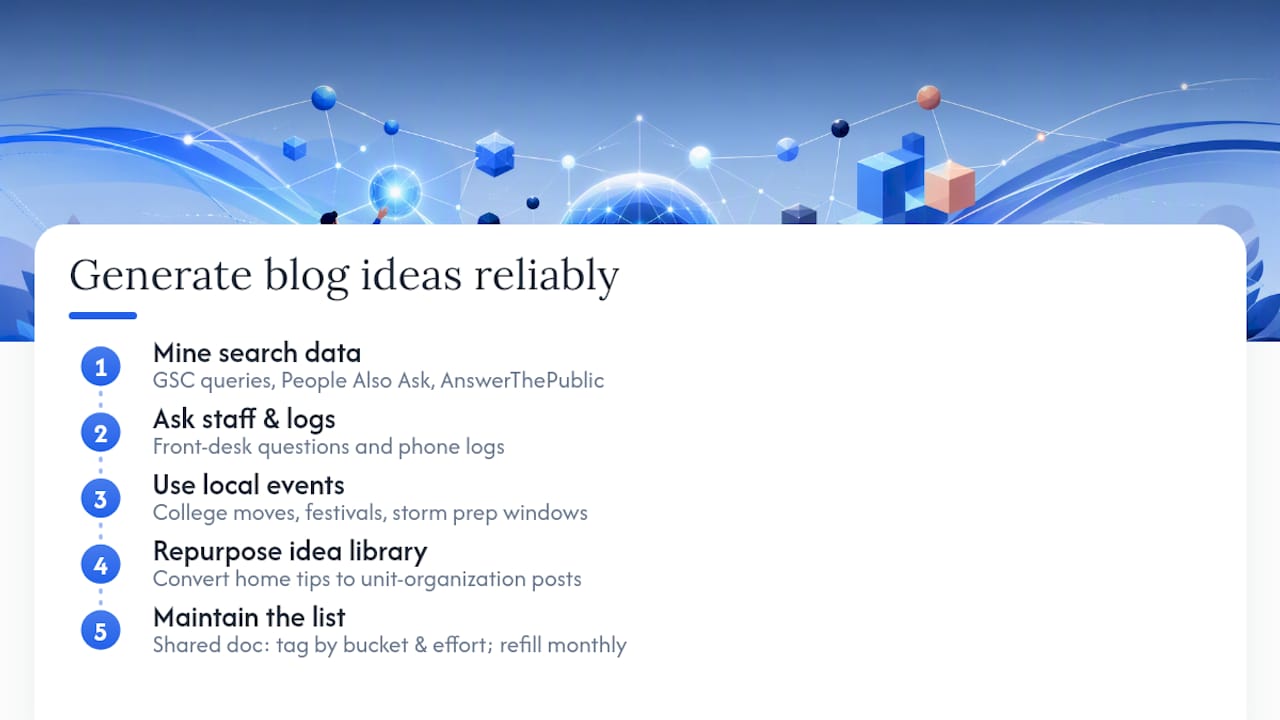
Content ideation for a storage blog gets easier once you stop brainstorming from scratch and start mining existing sources.
Google Search Console is the fastest starting point. Look at the queries already sending impressions to your site but with low click-through rates. Those are topics people search for that you haven't answered well yet. Google's "People Also Ask" boxes on your target keywords are a second free source. Answer.the.public and AlsoAsked pull related questions at scale if you want a batch to work through.
Your own front-desk staff and phone logs are an underused source. The questions renters ask before booking (about insurance, access hours, unit sizes) map almost directly to blog post titles. If your team gets the same question five times a month, that's a post, not a training issue.
Seasonal and local event calendars also generate reliable ideas: college move-in dates, local festival schedules, hurricane or winter-storm prep windows if your region has them. A broad library of practical storage and organization ideas, covering everything from garage shelving to small-space hacks, adapts easily into unit-organization content once you swap the home context for a storage-unit context.
Keep a running list in a shared document, tag each idea by bucket and estimated effort, and refill it monthly from these four sources rather than starting cold every time you sit down to write.
Why Corvane Systems Builds Storage Content This Way
I've watched storage operators pour effort into blogs that read well but never convert, usually because they skip the BLUF opening and bury the answer three paragraphs down. The fix we use with clients is boring but effective: answer the question first, add FAQ schema, then build the supporting detail underneath.
Explore more tactics on Corvane Systems' resource pages for storage-specific SEO guidance.
— Mike
Sources
Further reading: room-by-room clutter audits, 49 home storage ideas, the foolproof decluttering method, and what makes self-storage blogs work. For execution, see Corvane Systems' guides on organization systems and filling empty units.
- Where Does All Your Stuff Actually Go? A Room-by-Room Clutter Audit
- 49 Storage Ideas for Your Entire Home
- The Best Self-Storage Blogs and What Makes Them Truly Awesome