
What is generative engine optimization and why does it matter for storage businesses?
Generative Engine Optimization (GEO) is the process of structuring your storage facility's content and digital signals so AI platforms like ChatGPT, Google Gemini, and Perplexity recognize, understand, and cite your business in their generated answers. When a potential tenant asks an AI assistant "where can I rent a climate-controlled unit near me," GEO determines whether your facility gets named or gets skipped entirely.
For self-storage operators, this shift is direct and immediate. Renters increasingly turn to AI tools to shortlist facilities before they ever visit a website. If your facility isn't structured for AI comprehension, you're invisible at the exact moment a prospect is deciding.
GEO services for storage businesses typically address four core areas:
- Structured data and Schema markup so AI models can parse your facility's name, location, unit types, and pricing accurately
- Topical authority built through deep, question-answering content that AI systems trust as a reliable source
- AI citation strategies including digital PR and authoritative mentions that signal credibility to large language models
- Technical indexing controls like llms.txt configuration that determine whether AI bots can crawl your site at all
GEO doesn't replace your existing marketing. It layers on top of it, making everything you've already built more legible to the AI systems that now shape how customers find storage.
How GEO differs from traditional SEO for storage operators
Traditional SEO targets Google's blue-link rankings. You optimize for keywords, earn backlinks, and hope your facility appears on page one. GEO works differently: the goal is to earn inclusion in AI-generated summaries and conversational answers, where there are no "positions" and no page two.
The practical differences matter for how you plan and budget:
- Keyword targeting vs. semantic coverage. SEO rewards exact-match keyword density. GEO rewards content that fully answers a topic, because AI models synthesize information rather than match strings.
- Backlinks vs. citations. Both matter, but GEO also weights mentions in authoritative publications, forum answers, and structured knowledge sources that AI models pull from.
- Schema markup becomes decisive. Basic on-page SEO can succeed without Schema. For AI comprehension, Schema and semantic markup are often what determines whether a model correctly identifies your facility's services or ignores your site.
- Crawlability for AI bots. Your robots.txt may block AI crawlers without you realizing it. GEO requires auditing which bots can access your site and configuring llms.txt to explicitly permit AI indexing.
- Measurement is different. SEO tracks keyword rankings. GEO tracks how often and how accurately your facility appears in AI-generated responses across platforms.
The key point for storage operators: GEO doesn't make SEO obsolete. AI platforms still rely on foundational SEO signals like local reviews, backlinks, and Google Business Profile data to assess trustworthiness. GEO is the layer that translates those signals into AI-readable authority.
How GEO changes marketing and customer acquisition in self-storage
The customer research process for storage rentals has changed. Prospects used to Google "storage units near me," scan a map pack, and call two or three facilities. Now a growing share of that research happens inside AI chat interfaces, where the AI delivers a synthesized recommendation rather than a list of links.
Brands not cited in AI answers become effectively invisible in that part of the funnel. A facility with strong traditional SEO but no GEO presence can rank on page one of Google and still be absent from every AI-generated recommendation a prospect receives. That's a real gap, and it's widening as AI search adoption grows.
For storage operators, GEO-driven visibility produces several concrete benefits:
- Local brand exposure at the decision moment. When an AI names your facility in response to "best storage near downtown Austin," that mention carries implicit endorsement weight that a blue link doesn't.
- Qualified lead quality. Prospects arriving from AI recommendations have typically already received a summary of your facility's features. They're further along in their decision than a cold organic visitor.
- Competitive differentiation. Most storage operators haven't invested in GEO yet. Being one of the first in your market to earn consistent AI citations creates a visibility advantage that compounds over time.
- Improved digital footprint. The content and structured data work required for GEO also strengthens your overall online presence, reinforcing your local SEO signals simultaneously.
The operators who treat GEO as a future concern rather than a current one are ceding ground to competitors who are already building AI visibility. Getting your storage facility on ChatGPT and similar platforms isn't a 2027 project.
How to implement GEO strategies in your self-storage marketing
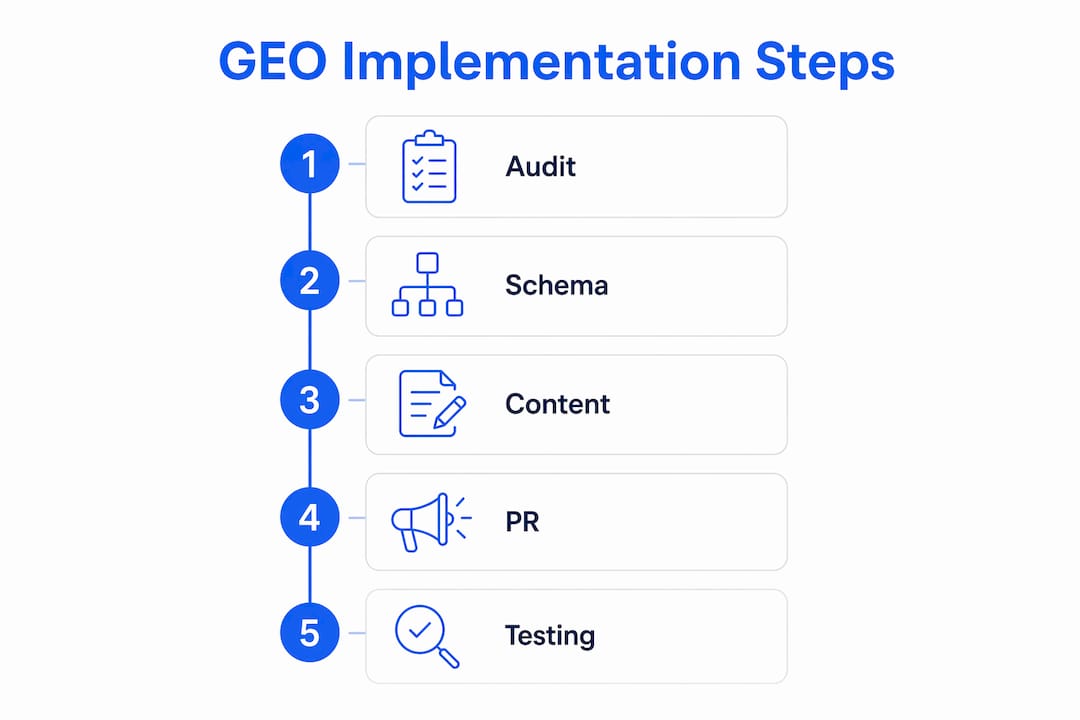
Implementation breaks into four practical areas. Each one builds on the last, so the order matters.

Technical foundation first. Audit whether AI bots can actually crawl your site. Check your robots.txt for unintentional blocks on major AI crawlers, and add an llms.txt file that explicitly permits access. Run a full AI visibility audit to establish a baseline: query ChatGPT, Perplexity, and Google's AI Overviews with prompts your customers would actually use, and document whether your facility appears, what it says, and whether the information is accurate.
Schema and structured data. Implement LocalBusiness, FAQPage, and StorageUnit Schema markup across your site. This gives AI models a structured, machine-readable summary of your facility's location, unit types, pricing, and hours. Without it, AI systems have to infer your business details from unstructured text, and they often get it wrong.
Topical content for AI authority. Storage operators who succeed in GEO publish content that answers the full range of questions renters ask, not just keyword-targeted landing pages. Think "how do I choose the right unit size," "what's included in climate-controlled storage," and "how does month-to-month storage work." AI models favor sources that demonstrate depth across a topic, not just breadth of keywords.
Digital PR and citation building. AI systems weight mentions in authoritative third-party sources. Getting your facility cited in local news, industry publications, and high-authority directories builds the citation profile that AI models use to assess credibility.
Pro Tip: Pro Tip: Test AI platforms with real customer queries every month. Prompt ChatGPT, Perplexity, and Google Gemini with questions like "best climate-controlled storage in [your city]" and track whether your facility appears, what it says, and whether the details are accurate. Continuous prompt testing is how you catch AI hallucinations about your business before they cost you bookings.
What GEO services typically cost for storage businesses
GEO pricing isn't standardized the way basic SEO packages often are. The added complexity of AI visibility audits, structured data implementation, and digital PR means costs vary meaningfully based on scope.
Common pricing structures you'll encounter:
- Flat-rate monthly retainers that bundle GEO with existing SEO work. These typically cover technical audits, content production, Schema implementation, and monthly AI visibility reporting in a single predictable fee.
- GEO as an SEO add-on. Some agencies offer GEO services as a supplement to an existing SEO retainer, priced separately. This works well if your SEO foundation is already solid and you're adding AI optimization on top.
- Tiered packages based on facility count, keyword targets, and content volume. A single-location operator needs a different scope than a multi-site portfolio.
What drives cost up: the number of AI platforms being monitored, the volume of content produced monthly, the depth of Schema implementation, and whether digital PR is included. What drives cost down: having a clean, well-structured site already, so the technical audit phase is shorter.
For storage operators evaluating GEO services, the key question isn't just monthly price. It's what deliverables are included and how AI visibility is measured. A service that doesn't track how your facility appears across ChatGPT, Perplexity, and Google AI Overviews isn't doing GEO. It's doing SEO with a new label.
Corvanesystems' specialized GEO services for self-storage operators
Corvanesystems is built specifically for self-storage facility operators, combining traditional SEO with GEO to close the gap between where storage businesses rank on Google and where they appear inside AI-generated answers. Most storage operators have invested in local SEO. Very few have structured their digital presence for AI comprehension. That's the gap Corvanesystems addresses.
The service offering covers every layer of AI visibility:
- Technical and on-page SEO including full site audits, metadata optimization, and indexing health monitoring tuned for storage sites
- Local search positioning with Google Business Profile optimization, city-based keyword targeting, and competitor tracking
- AI-optimized content with 30 keyword-targeted articles published monthly, formatted for conversational search so language models recognize and recommend your facility
- AI visibility audits that score how your facility currently appears across ChatGPT, Claude, Perplexity, Google AI, and llms.txt, with a clear roadmap for improvement
- Performance tracking with monthly reporting on keyword rankings, organic traffic, and AI search visibility
Pricing is a single flat monthly rate with no tiers, no contracts, and no minimums. For operators who need a stronger digital foundation, Corvanesystems also builds custom, conversion-focused websites designed from the ground up for AI search.
Pro Tip: GEO is not a one-time setup. AI models update their training data, competitors build citations, and your facility's information can drift from accurate to outdated inside AI responses without warning. Corvanesystems monitors AI visibility continuously and adjusts structured data and content as platforms evolve, so your facility stays accurately represented across every major AI system.
What GEO success looks like in practice for storage businesses
GEO implementations in the storage industry follow a recognizable pattern. A facility starts invisible in AI-generated answers despite solid Google rankings. After a technical audit reveals blocked AI crawlers and missing Schema, the operator implements LocalBusiness and FAQPage markup, adds an llms.txt file, and publishes a content series covering unit sizing, climate control, and move-in logistics. Within a few months, the facility begins appearing in Perplexity responses for local storage queries and earns inclusion in Google AI Overviews for competitive city-level searches.
The occupancy impact follows from visibility. Prospects who find a facility through an AI recommendation arrive with more context and convert at a higher rate than cold organic visitors, because the AI has already summarized the facility's features and positioned it as a credible option.
A useful reference point from outside the U.S. market: Hong Kong-based storage brand SC Storage, working with an SEO and GEO agency, secured the top Google ranking for two competitive keywords and saw a 40% increase in sales conversions driven by organic search traffic. That result came from traditional SEO, and it illustrates the conversion potential when a storage brand dominates search visibility. GEO extends that same principle into AI-generated answers, where the next wave of storage decisions is increasingly being made.
Which tools and platforms matter most for GEO in storage marketing
The GEO toolkit for storage operators spans technical, content, and monitoring categories. No single tool does everything, but the combination is manageable.
For AI visibility monitoring: Query ChatGPT (OpenAI), Perplexity, Google Gemini, and Microsoft Copilot manually with your target prompts monthly. Some agencies use proprietary AI visibility dashboards that automate this tracking and produce a "brand visibility score" across platforms.
For Schema implementation: Google's Rich Results Test and Schema.org's validator confirm whether your structured data is correctly formatted before it goes live. LocalBusiness, FAQPage, and StorageUnit schemas are the priority types for storage facilities.
For content production: AI-optimized content requires more than keyword targeting. Tools like Surfer SEO and Clearscope help identify the topical gaps your content needs to fill to build authority that AI models recognize. The content itself still needs human judgment to answer questions the way a knowledgeable storage operator would.
For technical auditing: Screaming Frog and Google Search Console identify crawlability issues, broken Schema, and indexing gaps. Pair these with a manual check of your robots.txt and llms.txt configuration to confirm AI bots have proper access.
For citation and digital PR: HARO (Help a Reporter Out), now operating as Connectively, connects storage operators with journalists seeking expert sources. Earned media mentions in local news and industry publications build the citation profile AI models use to assess authority.
The platforms being optimized for are ChatGPT, Google AI Overviews, Perplexity, and Google Gemini. These four currently account for the majority of AI-driven search interactions where storage decisions get made.
How to measure whether your GEO campaigns are working
GEO measurement requires a different dashboard than traditional SEO. Keyword rankings and organic traffic still matter, but they don't tell you whether your facility is appearing in AI-generated answers.
The core KPIs for storage GEO campaigns:
- AI citation frequency: How often does your facility appear when target queries are run across ChatGPT, Perplexity, Gemini, and Google AI Overviews? Track this monthly with a consistent set of prompts.
- Citation accuracy: When your facility is named, is the information correct? Wrong hours, outdated pricing, or missing unit types in AI responses actively harm conversion.
- AI referral traffic: Google Search Console and your analytics platform can identify traffic arriving from AI-generated results. This is a direct measure of GEO-driven visits.
- Branded search volume: As AI visibility grows, branded searches for your facility name typically increase. This is a secondary signal that AI mentions are driving awareness.
- Organic traffic and local rankings: These traditional SEO metrics remain relevant because AI platforms still weight foundational SEO signals. A drop in organic performance often precedes a drop in AI visibility.
The 2026 operator guide from Corvanesystems covers how to set up this measurement framework in detail. The short version: if you're not tracking AI citation frequency alongside traditional metrics, you're flying blind on half your search visibility.
Common challenges storage operators face with GEO and how to fix them
AI bots blocked by default configurations. Many storage websites were built with robots.txt settings that block non-Google crawlers. AI platforms like Perplexity and GPTBot get blocked silently. Fix: audit your robots.txt and explicitly allow the crawlers you want accessing your site.
Inaccurate facility information in AI responses. AI models sometimes pull outdated or incorrect details about your facility from old directory listings or cached content. Fix: update all third-party directory listings, claim your Google Business Profile, and implement Schema markup that gives AI models a current, authoritative source for your facility's details.
Thin content that AI models don't trust. A storage website with five pages and a contact form gives AI systems almost nothing to synthesize. Fix: build topical depth with content that answers the full range of questions renters ask, from unit sizing to lease terms to access hours.
No baseline measurement. Many operators don't know how they currently appear in AI responses, so they can't tell whether their GEO work is having any effect. Fix: run a structured AI visibility audit before starting any GEO work to establish a clear baseline.
Treating GEO as a one-time project. AI models update continuously, competitors build citations, and your facility's AI representation drifts without active maintenance. Fix: build monthly prompt testing and Schema review into your marketing calendar, or work with an agency that handles ongoing monitoring as part of the service.
Legal and ethical considerations for AI-driven GEO services
GEO raises a set of practical legal and ethical questions that storage operators should understand before committing to a service.
Accuracy of AI-generated information. When an AI model cites your facility with incorrect details, that misinformation can mislead prospects and create liability exposure. GEO work that includes ongoing monitoring and correction of AI-generated content about your business is a form of reputation management with real legal stakes.
Data privacy in AI tools. If your GEO agency uses AI tools to process customer data or facility information, confirm that data handling complies with applicable privacy regulations. For U.S. operators, this includes state-level privacy laws like the California Consumer Privacy Act (CCPA) where relevant.
Transparency in AI-generated content. Content produced with AI assistance and published on your site should accurately represent your facility. Publishing AI-generated content that contains fabricated claims about your services, pricing, or amenities creates both legal and reputational risk.
Ethical citation building. Some GEO tactics involve publishing content on third-party platforms to build AI citations. This is legitimate when the content is accurate and genuinely useful. Tactics that involve fabricated reviews, fake press releases, or manufactured citations violate platform terms of service and can result in penalties that harm rather than help AI visibility.
Vendor accountability. When hiring a GEO agency, get clear written commitments about what they will and won't do to build citations. Agencies that promise rapid AI visibility through unspecified "citation networks" are often using tactics that create short-term gains and long-term risk.
The ethical baseline is straightforward: GEO should make your facility easier for AI systems to find and accurately represent, not manipulate AI outputs with false information.
Key Takeaways
GEO services for storage businesses work by structuring your facility's content and digital signals so AI platforms like ChatGPT, Perplexity, and Google Gemini accurately cite your business when renters ask for storage recommendations.
| Point | Details |
|---|---|
| GEO is not SEO | GEO targets AI-generated answers, not blue-link rankings; both strategies must run together. |
| Schema markup is foundational | LocalBusiness and FAQPage Schema give AI models accurate, structured data about your facility. |
| Monthly prompt testing is required | Query ChatGPT, Perplexity, and Gemini monthly to catch inaccurate AI citations before they cost bookings. |
| AI referral traffic is measurable | Track AI-driven visits in Google Search Console alongside citation frequency across major platforms. |
| Accuracy carries legal weight | Incorrect AI-generated details about your facility can mislead prospects and create liability exposure. |