
Organize your site around a small set of renter-job pillar pages and linked cluster posts that point straight to booking pages. A topic cluster pairs one authoritative pillar page with several supporting posts, all linked together around a single theme. Build clusters this way and you give both search engines and AI assistants clearer signals, while giving prospective renters a direct path from a blog post to a reserved unit.
TL;DR:
- Score renter jobs by booking intent, local search demand, and content gaps, then build one pillar with four to eight distinct supporting posts.
- Every cluster post links to its pillar early, while the pillar directs readers to a relevant unit size or facility booking page.
- AI visibility needs no special markup; use readable, fast pages with unique facility facts, including unit dimensions, gate hours, and nearby landmarks.
- Track pillar traffic monthly, attribute bookings to individual posts, and assess rankings and AI mentions when trackable as results stabilize at varying speeds.
Table of Contents
- What are topic clusters for self storage marketers?
- Why clusters matter for SEO, conversion, and AI visibility
- How do you map renter jobs to pillar topics?
- How do you build clusters on your site?
- What content ideas fill a self-storage cluster calendar?
- How do you measure whether topic clusters are working?
- How should clusters be optimized for AI Overviews and voice search?
- How do topic clusters support your local SEO strategy?
- What operators who succeed with clusters do differently
- How Corvane helps you scale topic clusters without doing it all yourself
- FAQ
- Sources
What are topic clusters for self storage marketers?
A pillar page is a broad, authoritative page on one renter theme, say "downsizing to a smaller home." A cluster post is a narrower piece that supports that theme, like "how to choose a unit size when downsizing" or "a room-by-room downsizing checklist." Every cluster post links back to the pillar, and the pillar links out to each cluster post, creating a web of related content that search engines read as topical depth rather than a scattered pile of unrelated blog entries.
This linking pattern beats ad hoc blogging because it concentrates relevance. A single post about "moving boxes" competing against thousands of similar posts rarely ranks. A pillar on "moving and storage during a home move" surrounded by linked cluster posts, each answering a specific piece of that job, signals to Google and to AI systems that your site covers the topic thoroughly.
Formats that work well for storage sites include:
- Unit-size guides matched to specific life events (downsizing, dorm move-outs, inventory storage).
- Step-by-step moving and packing checklists tied to a season or scenario.
- Comparison posts (climate-controlled versus standard units, drive-up versus indoor access).
- FAQ-style posts answering the exact questions renters type into search bars.
Why clusters matter for SEO, conversion, and AI visibility
Topical authority is not a vague SEO buzzword. When a cluster covers a renter job from multiple angles, every linked page reinforces the others, and search engines treat the group as more credible evidence of expertise than any single page could provide on its own. Internal links also distribute ranking signals from your strongest pages to newer ones, helping fresh content rank faster.
This matters more than ever because the renter population has shifted. Residential customers now make up the vast majority of the self-storage market, a change that has pushed the industry to focus marketing on jobs like downsizing, home renovation, and life transitions rather than primarily on business storage, according to Section 5: Customer Traits.
Residential renters now represent the dominant share of self-storage demand, according to Section 5: Customer Traits, which means pillar topics built around household life events will reach a larger share of in-market searchers than business-focused content alone.
Clusters also shorten the path from content to conversion. A cluster post about packing seasonal decor should link directly to a page for small units, not to a generic contact form. That direct link, placed where the renter is already thinking about their specific situation, turns a blog visit into a booking inquiry instead of a dead end.
How do you map renter jobs to pillar topics?
Picking pillar topics by guesswork wastes months of content production. A renter-job approach starts with the specific situations that drive people to rent storage, then works backward to content.
- List the renter jobs worth testing: downsizing, military PCS moves, seasonal storage (holiday decor, sports equipment), business inventory overflow, and college move-ins or move-outs.
- Score each job on conversion intent: does a person searching this topic usually need a unit within weeks, or are they just researching?
- Check search volume and local relevance: a job with decent volume but no local competition targeting it is a stronger opportunity than a crowded generic term.
- Identify the content gap: search your target terms and see whether existing results actually answer the renter's question or just mention storage in passing.
- Build the pillar page around the highest-scoring job, then brainstorm four to eight cluster ideas that cover distinct angles of that same job.
- Assign each cluster post a target booking page, whether that is a specific unit size, a facility location, or a promotion page.
A simple worksheet pattern keeps this organized: renter job, pillar topic, cluster ideas, target booking page, in that order, filled out as a single row per job before any writing begins.
Pro Tip: Start with the renter job that already drives phone calls or walk-ins at your facility: your front desk knows which situations convert before any keyword tool does.
How do you build clusters on your site?
Technical structure matters as much as the writing. Keep pillar pages at a logical, shallow URL, such as a /blog/downsizing-storage-guide or a dedicated resource section, and place related cluster posts in the same folder or tagged under a consistent category so the relationship is visible in the URL structure and in your site's navigation.
Internal linking needs a few firm rules to stay useful instead of decorative:
- Every cluster post links to its pillar page at least once, placed within the first few paragraphs where it reads naturally.
- Use descriptive anchor text tied to the renter job, such as "unit size for downsizing" rather than "click here."
- Limit links per post to the ones that genuinely help the reader.
- Link pillar pages to relevant booking or unit-size pages directly, not just to other blog content.
On-page structure should carry its own signals. Use a clear H1 per page, logical H2 sections that mirror how a renter would ask the question, and an FAQ block that answers the specific sub-questions search engines already surface for that topic. Include a clear call to action tied to a unit size or facility location rather than a generic "contact us" link. Our guide to local SEO tactics for facility operators covers how these on-page choices also support local search visibility, and our breakdown of entity SEO for self-storage explains how structured, specific facility details help both pillar and cluster pages get recognized as authoritative.
What content ideas fill a self-storage cluster calendar?
Concrete topics beat vague ones. Organized by renter job, useful cluster ideas include:
- Downsizing: choosing the right unit size, a room-by-room decluttering checklist, what to do with furniture you are not ready to sell.
- Moving: a month-by-month moving timeline, how to pack a storage unit for easy access, climate control for sensitive items during a move.
- Military PCS: short-term storage options during deployment, what to store versus what to ship, insurance considerations for military families.
- Seasonal storage: packing holiday decor safely, storing patio furniture for winter, protecting sports equipment between seasons.
- Business inventory: choosing a unit size for e-commerce overflow, organizing a storage unit as inventory space, access hours that work for small businesses.
- College students: what to store during summer break, splitting storage costs with roommates, packing a dorm room efficiently.
A sample content calendar might open with the pillar page and supporting cluster posts, add more cluster posts while linking each back to the pillar, and later test different CTAs on the pillar page, comparing a unit-size quote form against a direct booking link to see which converts better. Useful formats beyond text include short video unit tours, a unit-size calculator embedded on the pillar page, and downloadable checklists that capture an email address in exchange.
How do you measure whether topic clusters are working?
Track a small set of KPIs rather than everything your analytics tool offers:
- Organic sessions to the pillar page, watched monthly to confirm the cluster is gaining visibility.
- Internal referral conversions, meaning how many bookings or quote requests originate from a cluster post click-through.
- Ranking breadth, or how many distinct keywords within the cluster appear in the first few pages of search results.
- AI visibility signals, such as whether your facility gets mentioned when someone asks an AI assistant about storage options in your area, where that is trackable.
The time it takes for new pages to be indexed, ranking movement to become visible, and traffic and conversions to stabilize varies, so judge a cluster over time. Residential renter demand continues to dominate the industry, according to Section 5: Customer Traits, so KPIs tied to household-focused pillars deserve particular attention.
Simple A/B tests help refine conversion once traffic arrives: try a unit-size quote form against a direct "check availability" button, or test a CTA placed mid-article against one placed only at the end. Attribute bookings correctly by tagging the specific cluster post a lead came from, not just "organic search" as a blanket source, so you know which content actually drives occupancy.
How should clusters be optimized for AI Overviews and voice search?
AI visibility is not a separate discipline from SEO. Google's own guidance indicates there is no special "AI schema" or machine-readable file required for a page to appear in AI Overviews; inclusion depends on the same fundamentals that have always mattered, including high-quality content, fast page speed, mobile optimization, and making important content available as clean, readable text, according to Digitalwomble. Google Search Central adds that the content most likely to be surfaced is non-commodity material offering unique expert or experiential insight rather than generic how-to posts that repeat what dozens of other sites already say, according to Developers.
Practitioner guidance for self-storage content stresses shifting away from generic blog-post lists toward a renter-job model where each piece links directly to an actionable, facility-specific solution, such as booking a particular unit size for a named scenario. Searchenginejournal
In practice, that means writing cluster pages with plain, readable HTML rather than burying key facts in images or scripts, adding unique facility-level details (actual unit dimensions, actual gate hours, actual neighborhood landmarks), and keeping pages fast and mobile-friendly since that remains a baseline requirement rather than optional polish.
Clusters are well suited to supplying the kind of specific, "groundable" facts that language models look for: a named city, a named unit size, a named facility feature, each paired with a clear pointer to a booking page. Our piece on conversational content for self-storage and our guide to AI search optimization for storage businesses go deeper into writing cluster copy that AI assistants can parse and recommend.
Pro Tip: Name your actual facility, city, and unit sizes in cluster content instead of writing generically about "a storage unit": specificity is what makes a page quotable by an AI assistant.

How do topic clusters support your local SEO strategy?
Topic clusters and local SEO work best as one system rather than two separate efforts. A pillar page on "downsizing storage solutions" gains local weight when its cluster posts reference specific neighborhoods, nearby landmarks, or city-specific move patterns, and when the pillar links directly to a location page for each facility you operate.
Local pack rankings rest on relevance, distance, and prominence, with prominence built through reviews, web authority, and consistent Google Business Profile activity, according to Redefineyourmarketing. Relevance is the entry requirement, and topic clusters are one of the clearest ways to demonstrate it: a site with ten pages mentioning "storage" in passing looks far less relevant than a site with a structured cluster proving deep coverage of local renter needs.
Practically, this means every cluster post should name the city or neighborhood it serves where natural, link to the relevant local landing page, and avoid duplicating the same city reference across unrelated topics. Pillar pages that serve multiple locations should link out to each location-specific page rather than trying to cover every city in one generic document. Our local SEO tactics guide for facility operators covers the mechanics of building those location pages so they reinforce, rather than compete with, your topic clusters. For operators with CMS or site-speed questions that affect how well clusters perform locally, the technical build guidance in Tatem Web's local SEO playbook offers useful detail on performance optimization that applies well beyond its original industry.

What operators who succeed with clusters do differently
The operators who get real occupancy gains from content do one thing consistently: they tie every cluster post to a renter job and a specific conversion action, never publishing a post just to have "more content" on the site. The ones who struggle tend to topic-dump, covering generic moving tips with no facility-specific detail and no clear next step for the reader.
Depth and specificity beat volume every time. A handful of well-mapped clusters tied to real renter jobs at your actual facility will outperform scattered posts that could belong to any storage company in the country.
— Mike
How Corvane helps you scale topic clusters without doing it all yourself
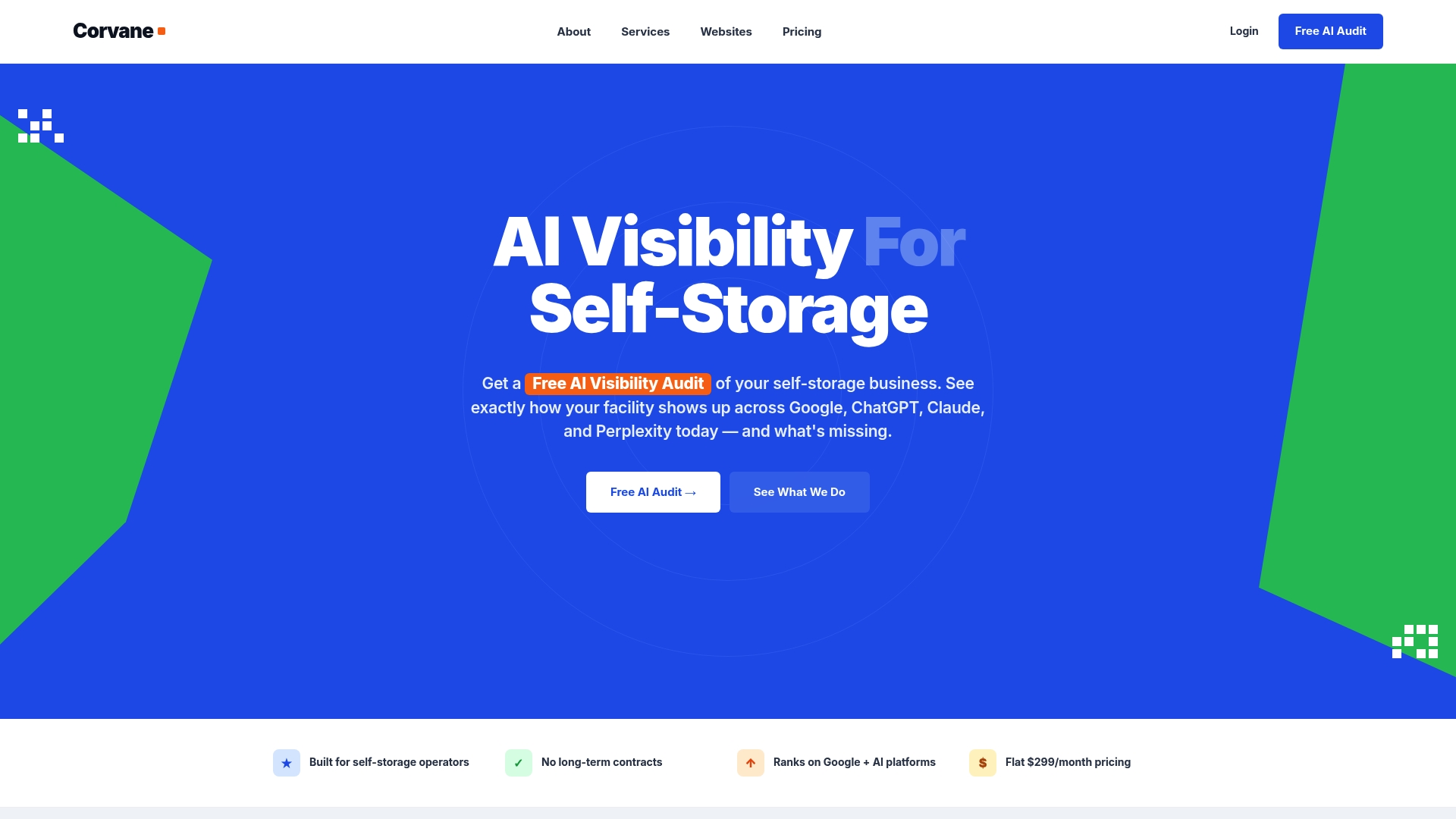
Building a full cluster program, auditing it for AI visibility, and keeping it updated every month is a lot to run alongside operating a facility. We built our flat-rate service specifically for self-storage operators who need this done without hiring an in-house content team.
Our system includes:
- Keyword-optimized articles published regularly, structured around renter jobs and formatted for both search engines and AI assistants.
- AI visibility audits scoring how your facility currently appears across ChatGPT, Claude, Perplexity, and Google's AI Overviews, with a roadmap to improve it.
- Local search positioning, including Google Business Profile optimization and "storage near me" targeting that works alongside your clusters.
If you want a clear picture of where your facility stands today, start with our Free AI Visibility Audit. For the full build-out, the Corvane system runs at $299 per month with a one-time $50 onboarding fee, no contracts or tiers involved.
FAQ
What is the best way to organize a storage unit?
Group items by category and frequency of use, placing things you need often near the front and rarely used items toward the back. Use shelving to keep boxes off the floor and leave a center aisle for access, and label every box clearly on multiple sides.
What is a content cluster?
A content cluster is a group of related pages built around one central topic, usually a broad pillar page supported by several narrower posts that each link back to it. This structure helps search engines and AI tools understand the full depth of a site's coverage on that subject rather than treating each page as an isolated piece of content.
Can you sleep in a storage unit during the day?
No, living or sleeping in a storage unit is against the terms of virtually every storage facility lease and typically violates local building and safety codes. Units lack ventilation, plumbing, and emergency exits suited for human occupancy, so check your specific facility's rental agreement for its occupancy policy before assuming any exception applies.
Can you use a self-storage unit as a workshop?
Most standard storage leases prohibit using a unit as a workshop because of fire risk, ventilation requirements, and local zoning or safety codes, though some facilities offer specific business-use or workspace units designed for that purpose. Check your facility's rental agreement and ask directly whether a workshop-friendly unit type is available before planning to use a standard unit this way.